

In This Article
Even if the number on the scale stays within the normal range, if only your lower belly sticks out and the pants you used to wear no longer fit, it may be worth considering an imbalance in body composition. That’s because obesity calculations based only on body weight may not adequately distinguish differences in body fat distribution and visceral fat. In this article, we summarize the criteria used to assess obesity, the indicators you should review alongside BMI when checking for “skinny fat,” and practical management principles.
1. How do you calculate BMI, and what are its limitations?
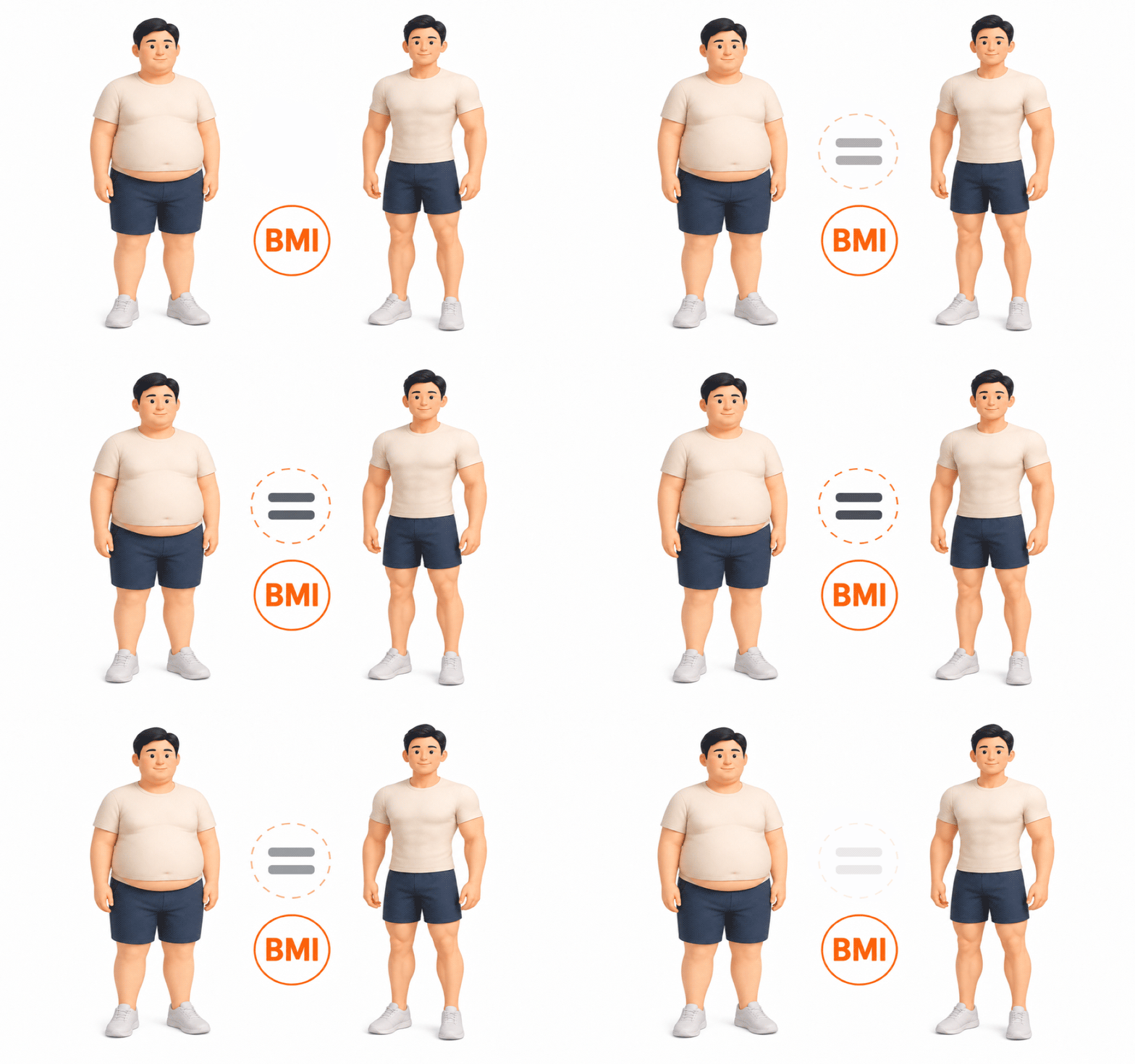
BMI (Body Mass Index), used for obesity calculation, is the value obtained by dividing weight (kg) by height (m) squared, and it has the limitation of not distinguishing between body fat and muscle mass. The formula is “BMI = weight (kg) / height (m)²,” and it is useful for quickly screening people at risk for metabolic disease.
However, BMI alone may not sufficiently reflect the degree of visceral fat accumulation in the abdomen. Even at the same BMI, metabolic risk can vary depending on muscle mass, body fat percentage, and where fat is stored. Someone who exercises frequently and has more muscle, and someone with lower muscle mass but a higher body fat percentage, can end up with the same BMI. Therefore, rather than looking only at weight, it is better to assess your current status by checking waist circumference and body composition together.
2. What are the obesity assessment criteria for Koreans?
In Korea, the diagnostic criterion for obesity in adults is BMI ≥ 25.0 kg/m², and the BMI 23.0–24.9 kg/m² range is classified as pre-obesity. Because Koreans may experience increased metabolic disease risk—such as elevated blood sugar and blood pressure—at relatively lower BMIs than Western populations, Korean criteria are used for evaluation.
Research by the National Health Insurance Service also found a tendency for obesity-related diseases to increase around BMI 23 and 25. Even if your weight is normal, if your waist circumference keeps increasing or metabolic markers such as blood pressure or blood sugar change on health screenings, it is necessary to review lifestyle habits along with abdominal fat status. It is difficult to conclude that abdominal fat and metabolic risk are low simply because BMI is normal.
3. Why is “skinny fat” metabolically risky?
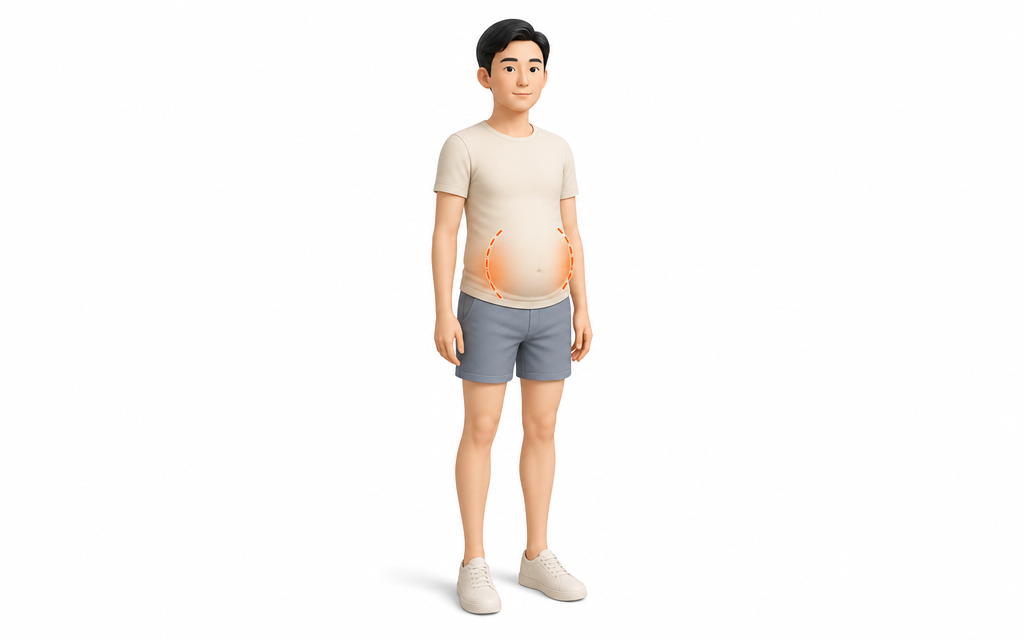
Even if you appear to have a normal body weight, “skinny fat” (normal-weight obesity) with a protruding belly may involve both visceral fat accumulation and low muscle mass, so metabolic risk should be considered. Unlike subcutaneous fat, visceral fat is associated with the release of inflammation-related substances and may influence insulin resistance, metabolic syndrome, and increased cardiovascular disease risk.
Studies suggest that even at a normal weight, a higher body fat percentage may worsen metabolic risk factors. If skinny fat is suspected, rather than checking weight alone, it can be helpful to review body composition and waist circumference together—and, if needed, consider blood tests to check metabolic markers such as fasting glucose and triglycerides. In particular, if your weight hasn’t changed much but your waist circumference has increased and muscle mass has decreased, confirming the body composition change itself can be useful.
4. How is abdominal obesity measured?
In Korea, the diagnostic criteria for abdominal obesity in adults are a waist circumference of ≥ 90 cm for men and ≥ 85 cm for women, and this is a risk assessment indicator checked separately from body weight. If your weight is similar but your waist circumference exceeds the cutoff or continues to increase, it is important to also consider the possibility of visceral fat accumulation.
For accurate measurement, measure horizontally at the midpoint between the lowest rib and the iliac crest (top of the pelvic bone) after exhaling comfortably. Measuring the same spot at least twice and recording the average can help reduce measurement error. It is also important to ensure the tape measure does not press too hard into the skin or tilt diagonally.
5. How can visceral abdominal fat be managed?

Managing skinny fat and visceral abdominal fat is fundamentally about lifestyle changes that avoid extreme food restriction and combine aerobic exercise, strength training, and dietary adjustments. Excessively reducing food intake can lead to muscle loss and a lower basal metabolic rate, which may be unfavorable for long-term weight management.
Because anti-obesity medications should be used according to indications, it is best to avoid using them for purely cosmetic purposes when BMI is normal. It is important to consistently combine at least 150 minutes of aerobic exercise per week with resistance training, and to maintain muscle mass by consuming quality protein. Rather than focusing only on weight loss, tracking how your waist circumference and body composition change can help you set the right management direction.
6. Frequently Asked Questions (FAQ)
Q. If my BMI is normal but my waist circumference increases, should I go to the hospital?
Even if your weight is normal, if your waist circumference continues to increase, it is necessary to check visceral fat and metabolic risk together. If it is ≥ 90 cm for men or ≥ 85 cm for women, you can discuss tests such as blood pressure, fasting glucose, and a lipid panel.
Q. Where exactly should I measure my waist circumference?
After exhaling comfortably, measure horizontally at the midpoint between the lowest rib and the iliac crest. Measure the same spot at least twice and record the average.
Q. What tests can confirm “skinny fat”?
A body composition analyzer (BIA) can check muscle mass and body fat percentage. If needed, risk can be assessed through tests such as an abdominal CT scan or metabolic evaluations including fasting glucose and triglycerides.
Q. I’m normal weight—can I still be prescribed diet pills?
Using anti-obesity medications for purely cosmetic purposes at a normal weight is not recommended. Medication decisions should be made after a clinician reviews indications and overall health status.
This health content has been reviewed by medical professionals, compiled from authoritative domestic and international sources, and is regularly updated in accordance with the latest clinical guidelines.
Sources
- Korean Society for the Study of Obesity (KSSO), Obesity Treatment Guidelines, 8th Edition (BMI classification and diagnostic criteria)
- Korea Disease Control and Prevention Agency (KDCA) National Health Information Portal, guidance on obesity and abdominal obesity (waist circumference) criteria
- Romero-Corral et al., study on the association between body fat percentage and metabolic syndrome in adults with a normal BMI
※ The copyright for all content on this blog belongs to medihi. Unauthorized copying, distribution, or derivative use is strictly prohibited, and violations may result in legal action without prior notice.