

For cataract surgery, choosing an intraocular lens that fits your daily lifestyle matters more than focusing only on the total cost. Reimbursement through private indemnity insurance can also vary widely depending on your policy generation and terms, so it’s important to clearly separate medical necessity from insurance eligibility when you review your situation.
“Multifocal lenses are expensive—how much can I get reimbursed with my insurance?”

Cataract surgery costs can feel very different depending on lens selection and the mix of non-covered (non-reimbursable) tests and materials. Whether private indemnity insurance reimburses you also depends on when you enrolled, your policy terms, how items are classified as covered vs. non-covered, and how out-of-pocket cost-sharing is structured—so it’s difficult to make assumptions in advance.
In real clinical practice, ophthalmologists build a surgical plan by comprehensively assessing the patient’s eye condition and the specific ways cataracts interfere with daily life—before discussing cost. During cost counseling, one common misconception to correct is the idea that an advertised price equals the final out-of-pocket total. In reality, cataract surgery costs are determined by adding lens costs and any non-covered tests/materials to the baseline surgical fee.
1. Why cataract surgery costs vary by clinic
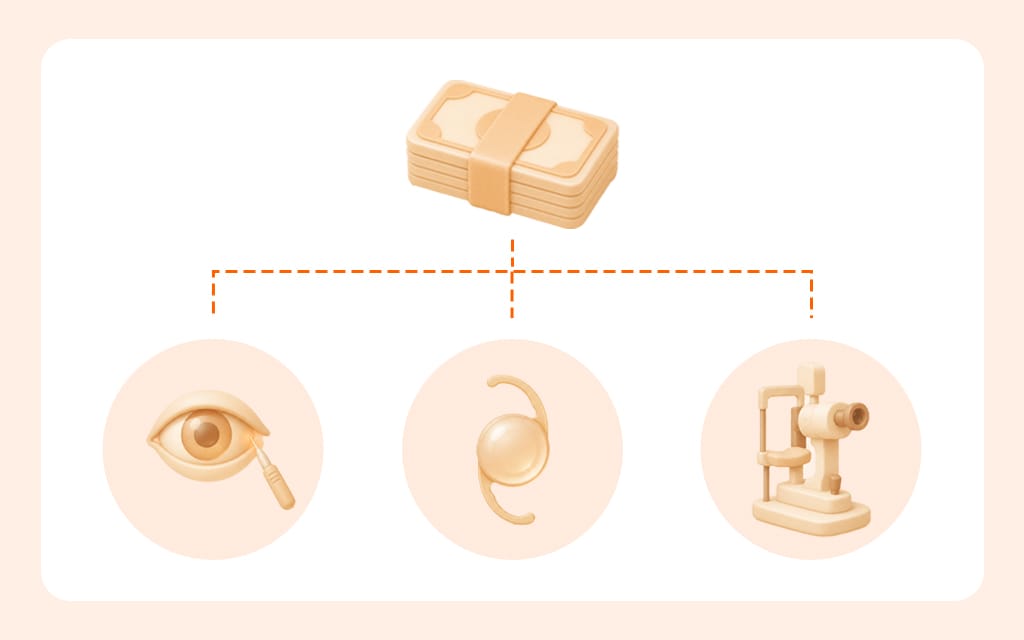
Cataract surgery costs can be broadly divided into three pillars. Understanding this structure helps explain why prices differ between clinics.
First is the surgical procedure fee itself. Cataract surgery in Korea is influenced by the DRG (Diagnosis-Related Group) bundled payment system. As a result, the baseline surgical fee covered by the National Health Insurance tends to be calculated similarly according to the type/level of medical institution.
Second is the intraocular lens (IOL) cost. Monofocal lenses are often explained primarily within the covered-benefit framework. In contrast, multifocal or EDOF (extended depth of focus) lenses are typically classified as non-covered items, and their prices can vary substantially by medical institution.
Third is the cost of tests and materials. The required preoperative measurements and detailed exams can differ depending on the patient’s eye condition, and additional surgical materials may also vary. If non-covered items are included here, the total cost gap can widen further.
Ultimately, cataract surgery costs vary by clinic because they are structured like a shopping cart: a baseline “standard product” (covered/DRG) plus options (lens) and additional components (tests/materials).
2. Why you should separate line items on a surgical estimate

If you only look at the total checkout amount, it’s hard to understand what drives price differences. The same applies to surgical estimates: meaningful comparison requires reviewing the line items, not just the total.
Start by checking whether the surgical fee falls under the DRG bundled payment scope. Next, identify whether the selected lens is monofocal, multifocal, or EDOF, and confirm whether it is listed as a non-covered item. Finally, request a detailed breakdown of which tests and materials are included as non-covered items.
When you separate the items this way, you can clearly see whether the cost difference comes from the lens option you chose or from differences in the test/material package.
✅Pre-surgery estimate checklist
- Is the surgical fee included under the National Health Insurance DRG bundled payment scope?
- Have you distinguished whether the lens is monofocal vs. multifocal/EDOF?
- Have you confirmed the detailed price of the lens listed as non-covered?
- Have you received an itemized breakdown of non-covered tests/materials?
- Are you comparing by line items rather than only the total?
3. Monofocal vs. multifocal: Is “lifestyle” more important than the price difference?

A monofocal IOL is a standard lens designed to provide a clear focus at either distance or near. It often offers high clarity, but you may still need reading glasses for close-up tasks like reading or using a smartphone.
A multifocal IOL can help you see at multiple distances and reduce dependence on glasses. However, because it splits focus into multiple points, it may be associated with dysphotopsia such as glare, light streaking, or halos—especially in dim environments.
Recently, enhanced monofocal lenses that preserve the strengths of monofocal designs while partially improving intermediate vision have also emerged as a practical alternative. For this reason, rather than choosing an IOL based only on price, it’s generally better to choose based on your lifestyle—such as how often you drive at night and how much near work you do.
[Cataract IOL Comparison by Type: Pros/Cons and Lifestyle-Based Customization]
| Option | Advantages | Things to Check | Suitable Lifestyle |
|---|---|---|---|
| Monofocal | Accustomed to high visual clarity | May require glasses for near work | Frequent night driving |
| Enhanced Monofocal | Intermediate distance vision can be complemented | Variations may exist across products/studies | Frequent computer monitor work |
| Multifocal | High likelihood of reduced dependence on glasses for near vision | Potential for glare and halos (dysphotopsia) | Frequent near reading or detailed work |
| EDOF (Extended Depth of Focus) | Designed to extend the focal range | Perceived near vision may vary individually | Seeking balance between intermediate distance and daily activities |
4. How much can you get reimbursed through private indemnity insurance—and why enrollment timing, policy terms, and covered vs. non-covered classification matter

Private indemnity insurance reviews claims and pays benefits based on the medical expenses you actually paid, according to the policy terms. That’s why it’s not possible to make a blanket statement like, “If you choose a multifocal lens, you’ll get reimbursed X amount.”
The most important factors are when you enrolled (policy generation) and whether items are classified as covered vs. non-covered. For monofocal surgery fees covered by National Health Insurance, reimbursement processing tends to be relatively straightforward. However, for items with a large non-covered portion—such as multifocal or EDOF lenses—coverage may be excluded or strict limits may apply depending on your insurance generation and any riders/special clauses.
To reduce the risk of disputes around claims, it helps to clearly separate the surgical fee, lens cost, and tests/materials on the estimate, and to confirm in advance how each non-covered item will be reviewed under your policy terms. Private indemnity insurance is not an unconditional coupon that covers the entire bill; eligibility can differ by line item.
✅ What to confirm during counseling before filing a claim
- Can I receive itemized receipts and detailed statements by category?
- Is the lens cost I selected classified as a non-covered item?
- Under my policy terms, what medical records are required for claim review?
- When covered and non-covered items are mixed, how is my out-of-pocket share calculated?
5. Does separating “medical necessity” from “claim eligibility” make decisions easier?

When cost is a concern, it becomes very difficult to decide if the questions “Do I really need surgery?” and “Will my insurance reimburse me?” get mixed together. In ophthalmology clinics, we recommend separating these two issues clearly.
First, evaluate medical necessity. If blurred vision makes reading or driving difficult and daily-life impairment is clear, the priority is assessing whether surgery is indicated. At this stage, a slit-lamp exam is used to check the degree of lens opacity, and a fundus exam is performed to assess the retina and optic nerve as well.
Once the treatment direction is clear, then it’s appropriate to discuss costs and claim documentation. Recently, the importance of detailed clinical records that support the medical necessity of ophthalmic surgery has increased. The most reasonable approach is to prioritize your symptoms and eye condition, and treat insurance as a variable in the settlement process that follows.
6. Frequently Asked Questions (FAQ)
Q. If I choose a monofocal lens, what total cost range should I expect?
Cataract surgery using a monofocal IOL is influenced by the DRG bundled payment system, so the basic structure is relatively straightforward. The baseline surgical fee paid by the patient tends to remain relatively consistent depending on the type/level of medical institution. However, non-covered items—such as certain detailed pre- and post-operative tests or additional materials—may still exist, so the final total can vary depending on each clinic’s specific item mix.
Q. If I choose a multifocal lens, how might non-covered items be handled by private indemnity insurance?
Private indemnity insurance reviews claims based on when you enrolled (policy generation) and the terms of your individual riders/clauses. Because multifocal and EDOF lenses often involve a large non-covered portion, it’s difficult to predict reimbursement in advance. Non-covered items may be fully excluded from coverage or subject to special limits, so you should be sure to compare each line item against your own policy terms.
Q. How can I tell which generation my private indemnity insurance policy is?
You can usually identify it by checking the enrollment year and product name in your insurer’s mobile app or website under “contract/policy information,” or by reviewing your physical policy certificate. The clearest approach is to contact the insurer’s customer service and ask directly whether your plan includes any riders related to reimbursement for non-covered IOLs.
Q. I drive a lot at night—what lens might cause fewer issues?
If you frequently drive at night, a monofocal lens or an enhanced monofocal lens that improves intermediate vision may be a suitable alternative, as these may have relatively less concern about glare or halos. Multifocal lenses can reduce dependence on reading glasses, but you should consider the possibility of halos under night lighting and reduced contrast sensitivity.

Cataract surgery costs are difficult to explain as a single price tag. To build a stable decision-making baseline, you should methodically separate and review: the baseline surgical fee under DRG, the lens cost that may differ depending on covered vs. non-covered classification, and the tests/materials that may also include non-covered items.
Private indemnity insurance is also reviewed on a case-by-case basis depending on generation-specific terms and out-of-pocket structures. Rather than broadly expecting reimbursement, it is safer to approach it by breaking the bill into line items. In an environment where costs are explained transparently, we hope you will discuss your eye condition and lifestyle priorities with your clinician and make a decision you won’t regret.
Sources
- Lee, Junmo; Kim, Hyomyung. Comparison of optical aberrations and contrast sensitivity between monofocal and multifocal intraocular lenses. *Journal of the Korean Ophthalmological Society*, 43(6): 982–989, 2002.
- Lim, Sang-eun; Choi, Cheol-young. Outcomes of exchange from diffractive multifocal intraocular lenses to monofocal intraocular lenses. *Journal of the Korean Ophthalmological Society*, 64(8): 675–683, 2023.
- Lee et al., An epidemic of cataract surgery in Korea: the effects of private health insurance on the NHIS, *Epidemiology and Health*, 46: e2024011, 2024.
※ The copyright for all content on this blog belongs to medihi. Unauthorized copying, distribution, or derivative use is strictly prohibited, and violations may result in legal action without prior notice.
Recommended reads
 medihi