

In This Article
A decline in vision due to glare and halos while driving at night may be more than simple age-related presbyopia—it can be a signal of complex pathological changes inside the eye. In particular, for professional drivers in their 50s–60s, reduced night vision can have many causes, including cataracts, dry eye, and optic nerve disorders, making a thorough differential diagnosis essential. In this article, we objectively summarize the differences in visual function required for night driving and the medical decision-making criteria needed to keep driving safely.
1. Why lights look fine in the daytime but “spread” at night
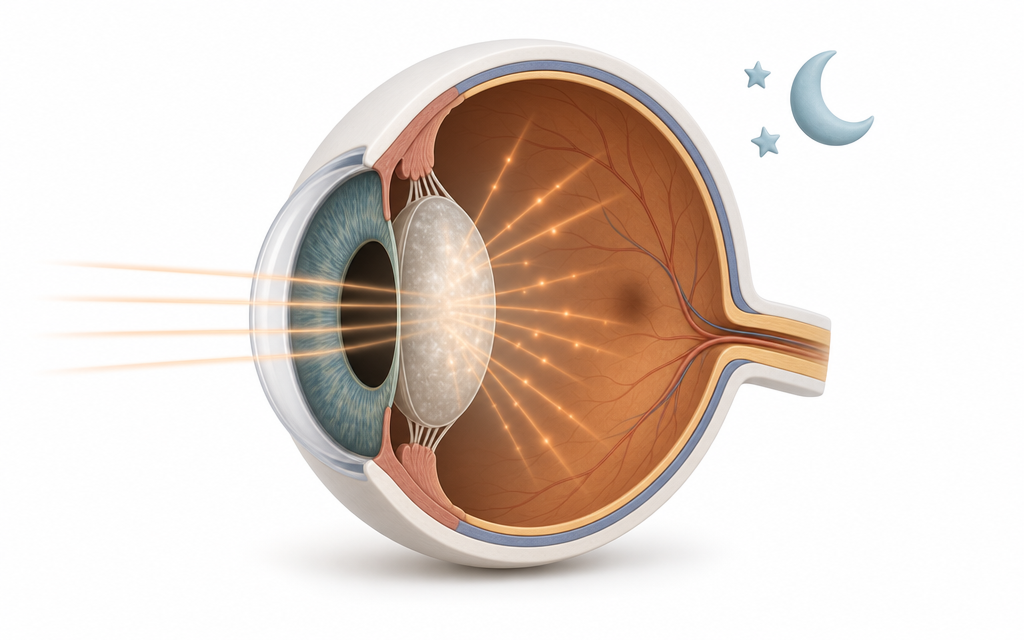
If lights look especially smeared or haloed at night, the first things to consider are increased light scatter due to pupil dilation and reduced contrast sensitivity. On dark roads, the pupil dilates to capture more light. At that time, light passing through a cloudy lens or an irregular corneal surface can scatter in multiple directions.
As a result, vision that seems clear during the day may look as if a hazy veil has been placed over it at night. If contrast sensitivity—the ability to distinguish outlines—also declines, you may notice lane markings on wet pavement or pedestrians in dark clothing later than you should. In addition, with aging, the mucin layer of the tear film can become unstable and the conjunctiva may loosen, worsening dry eye and causing blurred vision and a foreign-body sensation.
2. Are headlight halos an early sign of cataracts?
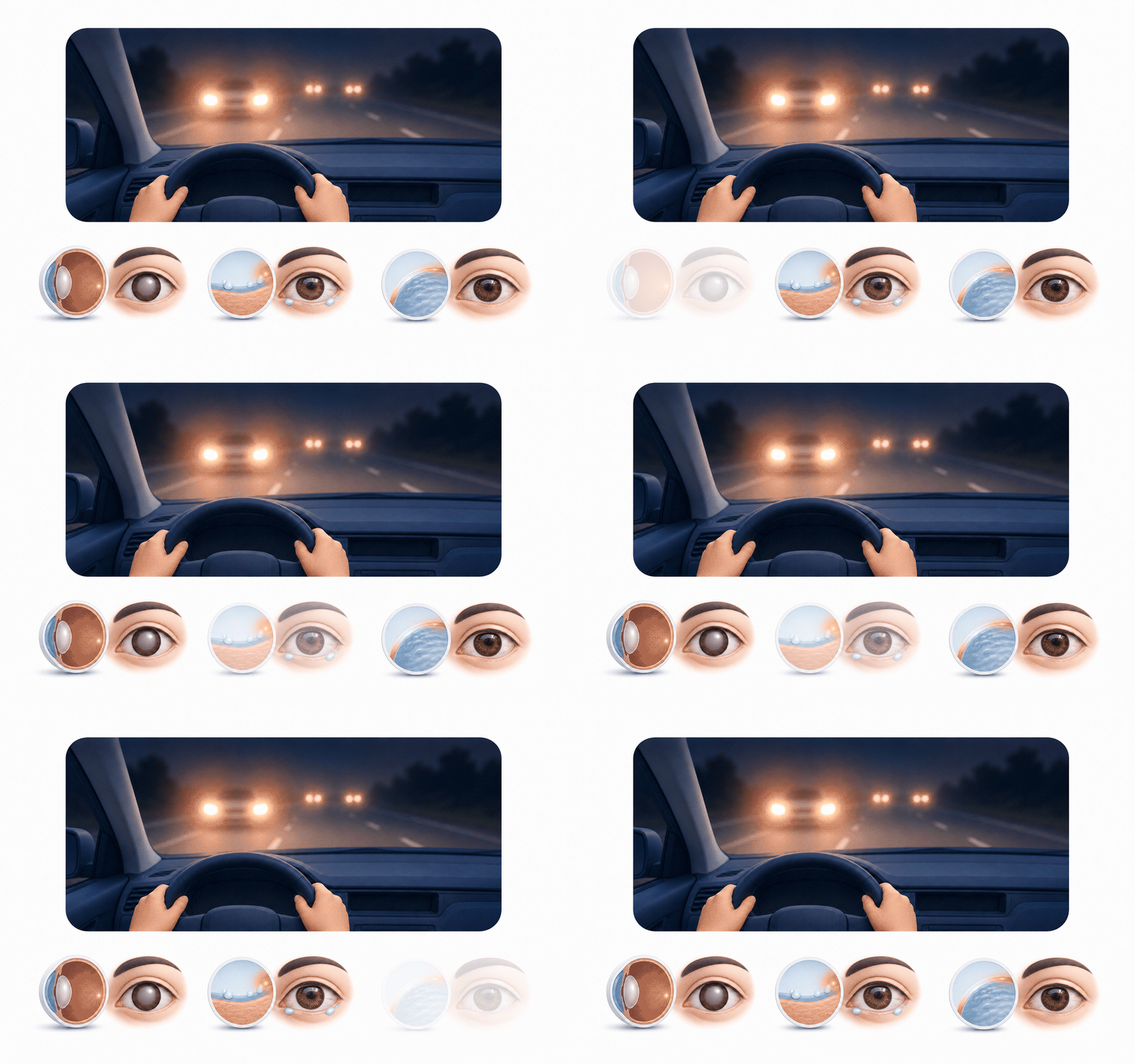
Headlight halos can be an early sign of cataracts, but they can also occur due to other causes such as dry eye or an irregular corneal surface. When age-related nuclear sclerosis occurs—where the central nucleus of the lens hardens and turns yellow—the refractive index becomes mismatched, making afterimages around lights appear darker and more pronounced.
During this process, a temporary myopic shift may occur, where near text becomes easier to read even without reading glasses. This does not mean the eye’s function has improved; it is a sign that the lens properties have changed. Because this discomfort often progresses slowly over several months, many people do not recognize it as cataract-related.
| Major Ocular Symptoms | Suspected Ocular Changes |
|---|---|
| Nighttime headlight glare and light smearing | Lens opacity, increased optical light scattering, and corneal abnormalities |
| Temporary improvement in near vision (myopic shift) | Pathological refractive changes due to progression of nuclear sclerosis |
3. If your chart vision is 1.0, is night driving still safe?
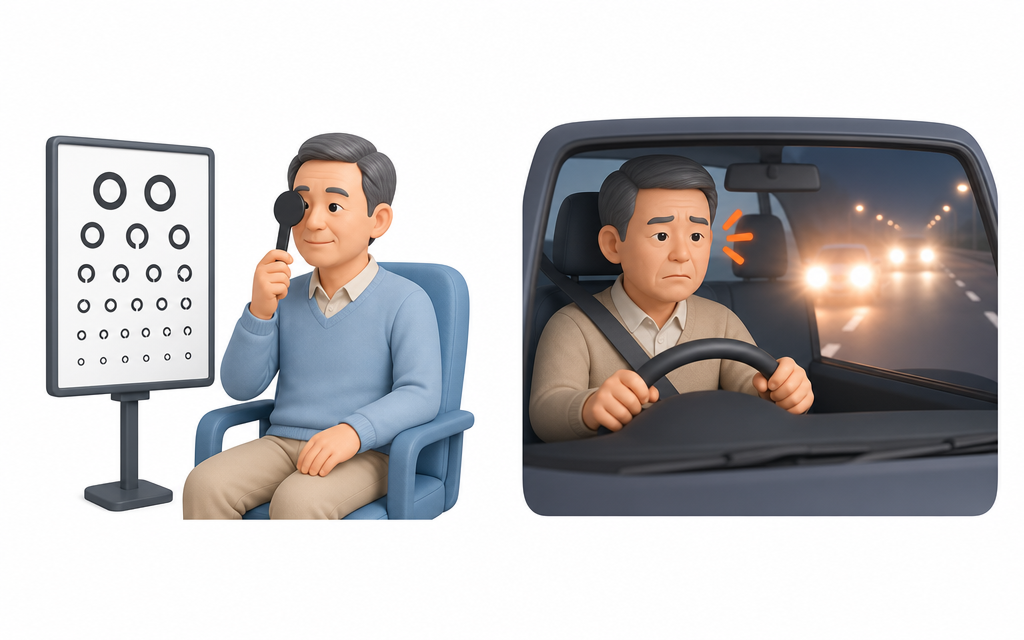
Standard eye chart testing is performed under moderate lighting with a bright chart background, which is different from real-world night driving conditions. Therefore, even if your visual acuity is 1.0, it does not necessarily mean glare or reduced night vision is “safe” during night driving.
In cataract patients whose hyperopia progresses with presbyopia, contrast sensitivity at night can drop markedly even when the chart test reads 1.0. Rather than relying only on the number, it is important to assess your own night-driving condition and identify risk factors.
✅Self-check criteria before night driving
- Around oncoming headlights, you see distinct starburst-like afterimages or a wide halo overlapping the light.
- Lights stretch into long streaks, and lane boundaries on the road at night look extremely faint.
- When entering a tunnel at night or driving in fog, your reaction time to recognize road signs becomes slower.
4. If night vision is getting worse, what eye exams are needed?
To accurately differentiate the cause of night-vision discomfort, you need comprehensive diagnostic testing that carefully evaluates the entire eye—not just a glasses prescription check. Simply changing your prescription makes it difficult to identify, at the root, light scatter from lens opacity or refractive problems caused by corneal surface irregularities.
During an ophthalmology visit, clinicians perform a structured evaluation that includes the corneal surface, the presence of lens opacity, and any abnormalities of the retina and optic nerve.
✅Step-by-step items in a detailed workup
- Slit-lamp exam: After dilating the pupil with eye drops, the clinician directly observes the location of lens opacity and the degree of nuclear sclerosis, and evaluates progression using standardized criteria such as LOCS III.
- Fundus and optic nerve exam: Determines whether decreased vision is due to retinal disease or macular abnormalities.
- Cornea and tear film assessment: Checks whether light scatter is accompanied by surface problems such as dry eye.
5. For professional drivers, when is surgery considered—and how should an IOL be chosen?
For professional drivers who spend a large portion of their time driving at night, the timing of cataract surgery is determined less by the eye chart number and more by how much visual function has declined in the actual work environment. In early stages, conservative monitoring is often prioritized, along with updating glasses prescriptions and treating dry eye.
However, once reduced contrast sensitivity and glare begin to seriously threaten driving safety, surgical correction should be discussed. When choosing an intraocular lens (IOL), it is generally advisable to prioritize options with a lower likelihood of optical side effects and that are favorable for securing night vision—such as monofocal IOLs or non-diffractive extended depth of focus (EDOF) lenses—through careful consultation. Premium monofocal lenses with designs that reinforce the central refractive zone may also be considered.
6. Frequently Asked Questions (FAQ)
Q. If headlights look unusually haloed, does that automatically mean cataracts?
It can be a sign of cataracts, but severe dry eye or refractive errors such as astigmatism can also cause similar glare and halos. That is why it is essential to identify the exact cause using detailed diagnostic equipment.
Q. If I can read smartphone text well without reading glasses, does that mean my eyes improved?
It may be a temporary myopic shift in which refractive power changes and near vision becomes clearer for a while. This is not a sign that the eyes have become healthier; it is more likely a pathological change during cataract progression.
Q. Can cataract eye drops make the eye clear again?
Patient guidance from the Korea Disease Control and Prevention Agency explains that early-stage eye drops may slow progression. However, a drug treatment that removes existing cataracts or stops progression has not been established.
Q. What type of IOL is suitable for truck drivers?
Multifocal lenses carry a risk of glare/halos, so if night driving is a major part of your work, it is better to avoid them. Monofocal or EDOF lenses, which tend to provide more stable vision, are appropriate.
This health content has been reviewed by medical professionals, compiled from authoritative domestic and international sources, and is regularly updated in accordance with the latest clinical guidelines.
Sources
- Korea Disease Control and Prevention Agency (KDCA) National Health Information Portal, “Cataract Diagnosis and Management Guidelines,” 2024.
- Journal of the Korean Ophthalmological Society, Clinical study on satisfaction after multifocal IOL exchange and dysphotopsia-related outcomes, 2023.
- Vingopoulos, F., et al., "Contrast Sensitivity and Night Driving in Cataract Patients," Journal of Ophthalmology, 2022.
※ The copyright for all content on this blog belongs to medihi. Unauthorized copying, distribution, or derivative use is strictly prohibited, and violations may result in legal action without prior notice.