

Successful vision recovery after cataract surgery depends largely on thorough hygiene at home and correct use of prescribed eye drops. This post summarizes essential rules—from handwashing to “one drop without touching,” keeping a 5-minute interval between drops, and what to do in common situations.
“Putting in several different eye drops multiple times a day, on time, is more complicated than you might think.”

Recovery after cataract surgery continues at home. Among all aftercare steps, the most important is using your eye drops correctly. Right after surgery, the dosing schedule can feel unfamiliar and inconvenient. But if you set clear rules and repeat them consistently, you can support a safer, steadier recovery for your eyes.
In the clinic, a key measure of recovery is whether you are instilling drops correctly at home without contamination and following the prescribed schedule and duration faithfully. After a precise surgical procedure, careful preventive care at home helps the eye settle smoothly and reduces avoidable risks.
1. Why are there multiple types of eye drops after cataract surgery?

After surgery, you typically won’t use just one eye drop alone. Instead, you’ll often be prescribed multiple medications together—such as antibiotic drops to help prevent infection and anti-inflammatory drops to support healing. For successful cataract post-op care, the basics start with using each drop regularly for its intended purpose.
Antibiotic drops help prevent serious complications such as endophthalmitis, which can occur if harmful bacteria enter the surgical site. Steroid and non-steroidal anti-inflammatory (NSAID) drops help calm the subtle inflammatory response inside the eye after surgery. They may also help reduce the risk of early cystoid macular edema (CME) in some patients.
Avoid stopping your drops early just because your eye feels temporarily more comfortable. Until the internal tissues of the eye fully stabilize, continuing the drops for the prescribed duration is important. Because the type and duration of drops can vary depending on your health status and coexisting conditions, it is best to follow your clinic’s individualized instructions closely.
2. From handwashing to no contact: 6 steps for correct eye drop instillation

For safe cataract post-op care, the top priority before instilling drops is keeping your hands clean. Right after surgery, the eye can react sensitively even to tiny amounts of irritants or bacterial contamination. Before touching your drops, wash your hands thoroughly with soap under running water.
The small pocket formed when you gently pull down the lower eyelid (the conjunctival sac) can hold only a limited volume of liquid. That is why the correct standard is to instill exactly “one drop” at a time. Even if you put in multiple drops in a row, most will overflow and run out, and the effective concentration that actually remains and reaches the eye does not meaningfully increase.
The most important caution is to avoid injuring the cornea with the pointed tip of the bottle. Keep the bottle tip at a safe distance so it does not touch your eyelashes or skin, and aim for the conjunctival sac created by pulling down the lower eyelid. This helps prevent corneal injury and reduces the risk of contaminating the bottle.
✅ Checklist: 6 steps for correct eye drop instillation
1. Handwashing: Wash your hands thoroughly with soap under running water.
2. Confirm the medication: Check the name of the drop and whether it needs to be shaken.
3. Get into position: Tilt your head back comfortably or lie down.
4. Create a pocket: Use your index finger to gently pull down the lower eyelid.
5. Instill one drop: Let only one drop fall in, without the bottle tip touching the eye.
6. Close gently: Do not rub; gently close your eye to help absorption.
3. What if you forget to use your eye drops?
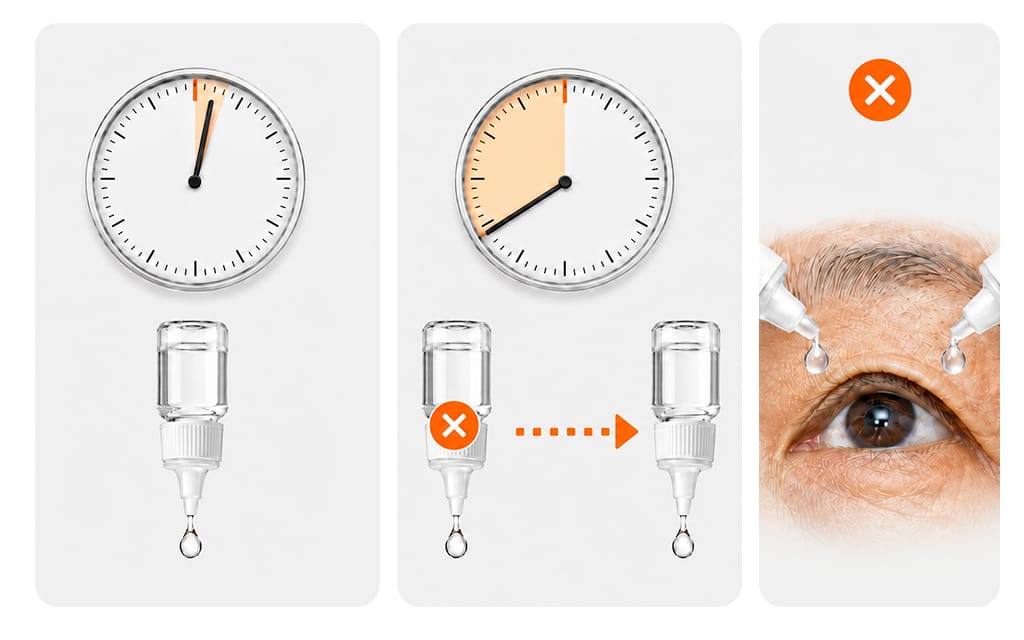
Even with a well-organized routine, it’s easy to occasionally forget a dose, and that can create confusion about what to do next. The first thing to check is how much time remains until the next scheduled dose.
If you realize you missed a dose and it is still close to your usual dosing time, instill one drop as soon as you remember. However, if it is already almost time for the next dose, skip the late dose and return to your original schedule—instilling only one drop at the next time. Trying to “make up” for a missed dose by putting in two drops at once is best avoided, as excessive dosing may cause unnecessary irritation or localized discomfort.
To help you stay consistent, setting smartphone alarms or using a calendar-style checklist can be genuinely helpful. Linking drops to daily routines can reduce missed doses significantly. For example, if a drop is prescribed four times a day, you might align three doses with meals and use the remaining dose before bedtime to simplify the pattern. If an older patient finds self-management difficult, it may be safer to get caregiver support or discuss schedule simplification options with the treating physician.
✅ Safe rules for missed eye drop doses
- If there is plenty of time: Instill 1 drop as soon as you remember.
- If the next dose is near: Skip the late dose and instill 1 drop at the next scheduled time.
- Do not: Instill 2 drops in a row to compensate for a missed dose.
4. Why is a “5-minute interval” important when using multiple drops?

When you have two or more prescribed eye drops, keeping a consistent interval between medications is important. If you instill the second drop immediately after the first, the active ingredient from the first drop can be washed out by the liquid from the second.
To allow the first drop to remain on the eye surface long enough and be absorbed properly, a gap of at least “5 minutes” is considered ideal. However, in real life, many people are too busy to wait 5 minutes—or they wait and then forget the next drop entirely. If keeping 5 minutes is difficult, it is still recommended to leave at least a 1–2 minute interval before instilling the next drop.
In general, the commonly recommended order is to use antibiotic and anti-inflammatory drops first (for infection prevention and early recovery), and use artificial tears or lubricants last. In particular, steroid anti-inflammatory drops that are suspensions (the kind you must shake) should be shaken well before use so the medication is evenly delivered. (For exact order and timing, your clinic’s instructions should take priority.)
5. Why your recovery schedule and follow-up visits matter

Follow-up schedules for cataract post-op care vary depending on how quickly your eye recovers and the medical facility’s protocol, so you should use the individualized schedule provided by your surgical clinic as the primary reference. Typically, you have your first check-up the day after surgery, followed by step-by-step follow-ups at set intervals.
At the day-after visit, you will be carefully evaluated for corneal wound healing, changes in intraocular pressure, and signs of early inflammation inside the eye. If you have underlying conditions such as diabetes, or if you have severe dry eye that makes you more vulnerable to external irritation, follow-up intervals may be shorter to monitor recovery more closely. If subtle inflammation is well controlled, the medical team may gradually reduce the frequency of anti-inflammatory drops. Regular visits are an essential process for adjusting drop use and protecting eye health.
It is difficult to accurately judge infection or inflammation based on symptoms alone. Worsening pain, a sudden sense that vision is dropping, increasing redness with aching eye pain, or increased discharge can be warning signs that require evaluation rather than waiting. If these changes occur, it is safer to contact your surgical eye clinic and move your appointment earlier for assessment.
6. Frequently Asked Questions (FAQ)
Q. While using my drops, the tip of the bottle accidentally touched my eyelid. Can I keep using it?
If the bottle tip touched the skin around the eye or your eyelashes, there is a possibility of cross-contamination. It is best to stop using it immediately once you notice the contact. If you are concerned about contamination, promptly check with your surgical clinic or the dispensing pharmacy to confirm whether a safe replacement is recommended, which can be advantageous for infection prevention.
Q. It has been a few days since surgery, and my eye feels dry and gritty. Is this normal?
If the eye surface is irritated during surgery, tear film instability can cause dryness or a gritty foreign-body sensation. This can be a common healing response that gradually improves as the wound heals. However, if symptoms are significant, rather than using over-the-counter drops on your own, coordinate with your medical team; using preservative-free artificial tears as advised can help stabilize the ocular surface.
Q. Do all prescribed eye drops need to be refrigerated to maintain their effectiveness?
Not all prescribed drops require refrigeration. Some medications may crystallize at overly low temperatures, and cool room-temperature storage may be recommended instead. Carefully check the storage instructions printed on the medication packaging and store the drops in an appropriate environment away from direct sunlight to maintain proper effectiveness.
Q. During recovery, what warning signs mean I should go to the hospital right away?
Mild blurriness or temporary redness can be part of the adjustment process. However, if you experience severe vision decline suggesting a rapid change in intraocular pressure, eye pain that does not improve with pain relievers, or rapidly worsening redness accompanied by sticky, stringy discharge, do not delay—contact your ophthalmology clinic for evaluation.

The most reliable path toward regaining stable vision after cataract surgery is consistently practicing correct eye drop habits in daily life: washing your hands under running water before instillation, preventing contact between the bottle and the area around the eye, and spacing drops to support absorption with a 5-minute interval. These small rules work together to protect the eyes you will rely on for a long time.
Following a timetable and instilling drops several times a day can sometimes feel inconvenient. If you forget a dose, calculate the remaining time and resume safely with one drop, and contact your medical team if you notice any warning signs. Small, careful actions add up and can become the foundation for returning to everyday life with more comfortable eyes. Wishing you a smooth and stable recovery.
Sources
- Summary of post-operative safety guides from domestic university hospitals (based on handwashing, no-contact principles, and adherence to instillation timing) and ophthalmology patient education materials.
- National health information system: common standard rules for ophthalmic hygiene prevention management and post-operative complication guidance.
- Acta Ophthalmologica, Evaluating the efficacy of postoperative topical antibiotics in cataract surgery, 2025.
※ The copyright for all content on this blog belongs to medihi. Unauthorized copying, distribution, or derivative use is strictly prohibited, and violations may result in legal action without prior notice.
Recommended reads
 medihi