

In This Article
A change in your glasses prescription is not, by itself, a straightforward indicator of “early aging” of the eyes. If you are over 50 and your vision becomes blurry again just a few months after getting new reading glasses, it is important to determine whether there is a structural cause inside the eye—beyond presbyopia—including cataracts. Rather than repeatedly adjusting your glasses, the priority should be to understand your eye condition accurately through a systematic ophthalmic examination.
1. Why does my vision keep getting blurry even after getting new reading glasses?
If newly prescribed reading glasses become blurry again quickly, it may be due to structural changes inside the eye—such as refractive changes in the crystalline lens itself or dry eye disease. Presbyopia, in which the lens gradually loses focusing ability with age, typically progresses slowly over several years. So if your prescription seems to fluctuate over the course of months, another cause should be considered.
There are a few simple signs you can check on your own. If you cover one eye at a time and objects appear doubled, or if lights smear or flare especially at night, and reading in dim places becomes difficult, this may not be a simple decline in vision.
When these self-check signals are present, rather than returning to the optical shop for another adjustment, you should confirm the condition of the tear film and the lens through a comprehensive eye exam. More frequent glasses changes are not the priority—accurately identifying the eye’s condition at an ophthalmology clinic is.
2. What causes rapid vision changes in your 50s?
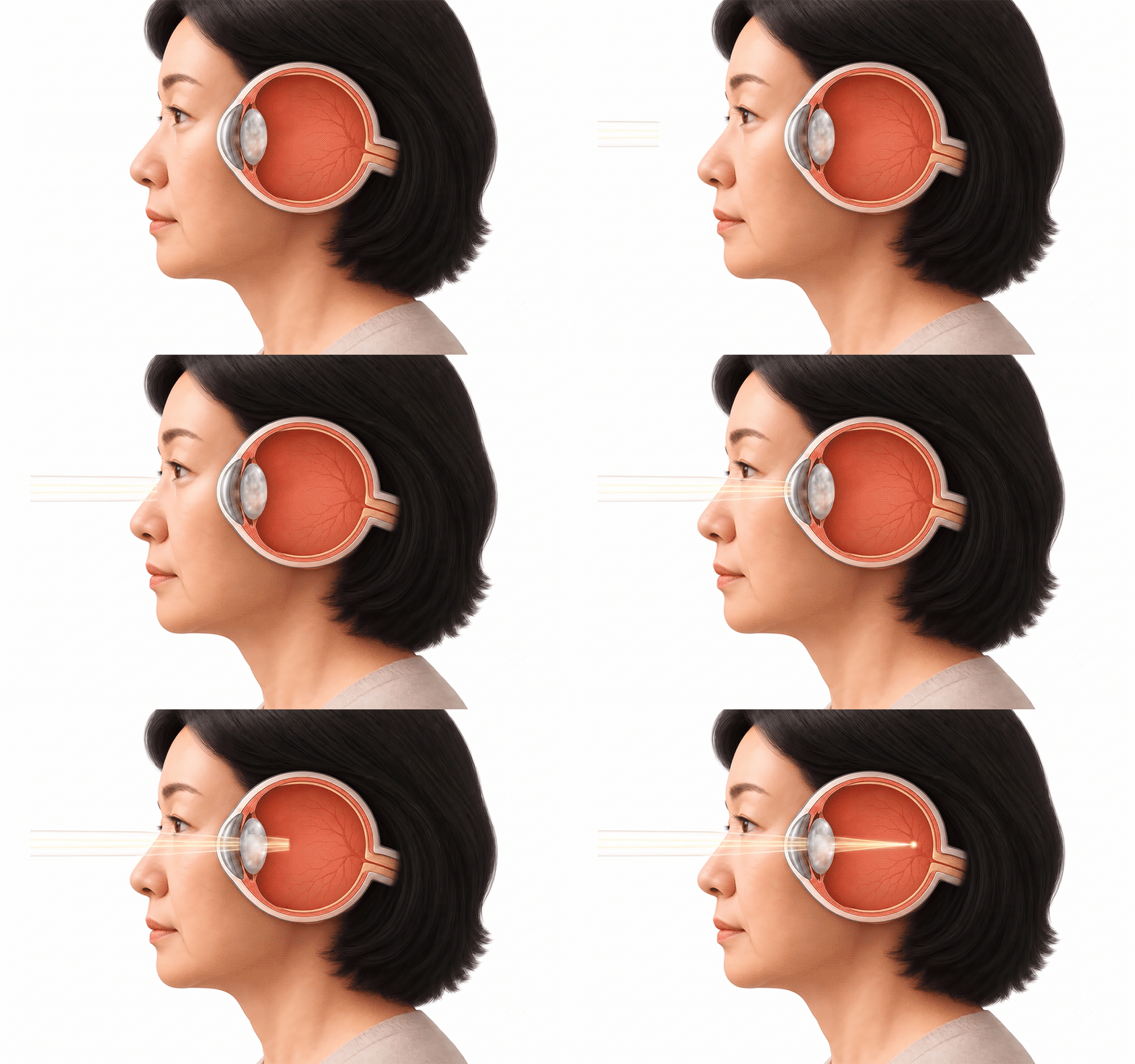
In middle-aged and older adults, rapid changes in vision can commonly occur not only due to intraocular pressure fluctuations or retinal disease, but also due to nuclear sclerosis, in which the central portion of the lens becomes harder. As the density of the lens nucleus increases, optical distortion can occur, abnormally strengthening the lens’s focusing power.
Medically, this is often described as a lenticular myopic shift, where distance vision becomes blurry while near vision may seem clearer even without glasses. This is not a sign that the eyes are improving; it is a temporary refractive fluctuation that can accompany a progressive cataract process.
Cortical cataracts are also not uncommon, and if the resulting opacity blocks the visual axis—especially near the center of the lens—vision may drop rapidly. Therefore, rather than feeling reassured by temporary changes, it is important to have the degree of lens opacity accurately evaluated by an ophthalmologist.
3. If I can see well without reading glasses, does that mean my eyes got “younger”?
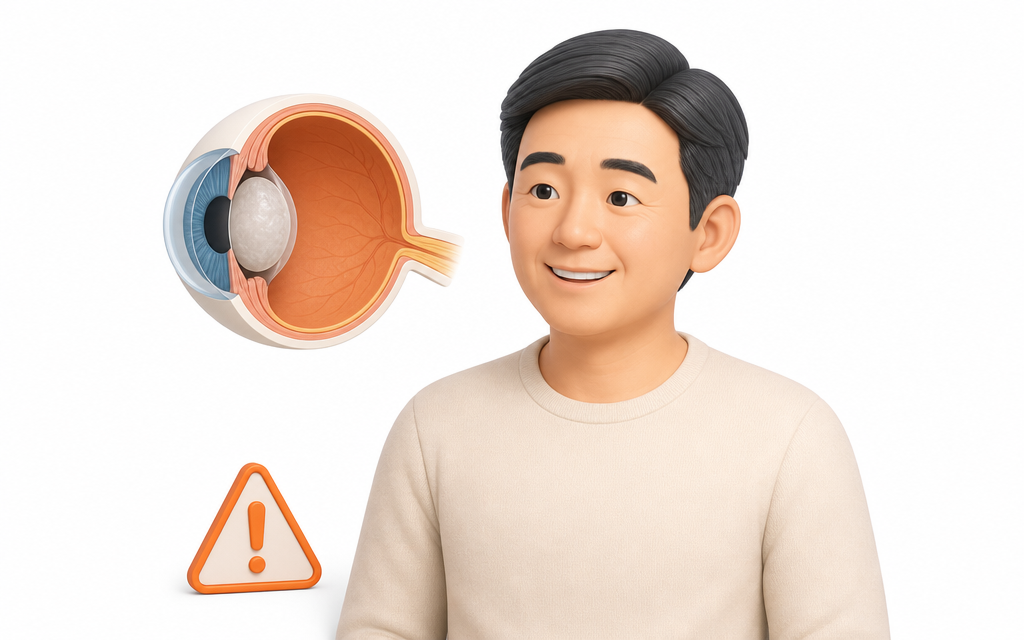
Being able to read small print up close without glasses does not mean your eyes have become younger. It can be an illusion caused by a hardened lens acting more like a convex lens. During this period, dependence on reading glasses may temporarily decrease, but as protein changes progress, contrast sensitivity—the ability to distinguish differences between light and dark—can significantly deteriorate.
This distortion in visual function is an unstable state that may appear only briefly just before the inside of the eye becomes noticeably hazy. You should not assume there is no lens opacity simply because near text looks clearer than before.
In particular, you should also pay attention to whether nighttime lights flare severely or your overall vision becomes hazy. It is important to clearly distinguish and respond appropriately to the difference between natural aging and the refractive fluctuations seen in early nuclear sclerotic cataracts.
4. What visual discomfort happens when the lens hardens?

An age-hardened lens can disrupt how incoming light is refracted, blurring where the eye’s focus lands. When the transparent protein fibers that function like a camera lens become yellowed, the lens’s refractive power can steepen, causing images to focus in front of the retina.
As a result, your glasses prescription may fluctuate frequently, and the “useful life” of a reading-glasses prescription can become much shorter. In addition, lens opacity scatters light, worsening glare and headlight flare during night driving. Ultimately, you may experience a foggy, blocked, and frustrating haze in your vision that reduces quality of daily life.
These discomforts may not be resolved simply by changing your glasses prescription. If symptoms persist, it is advisable to have the lens evaluated as well.
5. What comprehensive tests are needed before changing glasses?
Rather than increasing your reading-glasses power without a plan, comprehensive testing should come first to assess the lens and retinal status. In particular, for people in their 50s and older, the prevalence of age-related macular degeneration, retinal vein occlusion, hypertensive retinopathy, and diabetic retinopathy increases—so detailed retinal and macular examinations are recommended as well.
If changes are early, it may be safer to monitor the eye’s condition periodically with diagnostic equipment rather than rushing into surgery. Instead of fixating on the numbers on an eye chart, it is more appropriate to plan treatment based on the degree of functional visual difficulty you experience in everyday life.
✅Key components of a comprehensive ophthalmic exam
- Slit-lamp microscopy: Checks the presence and degree of lens opacity and hardening.
- Detailed refraction test: Measures your current prescription accurately.
- Retina and macula evaluation: Checks for retinal disease or macular abnormalities.
6. Frequently Asked Questions (FAQ)
Q. If my glasses prescription changes often within a year, is it a serious disease?
A prescription change does not necessarily mean a severe eye disease, but it can be a sign of lens opacity. Rather than assuming it is presbyopia, it is safer to confirm the cause with an ophthalmologist.
Q. If I can suddenly see my smartphone well without reading glasses, is that a good sign?
Clearer near vision can be a temporary refractive change that occurs as the lens hardens. It does not mean the eye has become healthier, so it is best to have it checked at an eye clinic.
Q. Do cataract eye drops prevent vision changes?
Evidence that prescription eye drops can slow progression is limited, and it is also difficult to reverse a hardened lens. They may be used as a supportive measure to help slow protein changes, so clinical care and monitoring should be done together.
Q. How do I choose an intraocular lens?
Multifocal lenses can provide focus for near, intermediate, and distance vision, but they may cause nighttime glare or halos. Newer products have improved light efficiency, materials, and design, so the decision should be made with your clinician based on lifestyle and retinal status.
This health content has been reviewed by medical professionals, compiled from authoritative domestic and international sources, and is regularly updated in accordance with the latest clinical guidelines.
Sources
- Korea Disease Control and Prevention Agency (KDCA) National Health Information Portal, “Screening for Eye Diseases in Older Adults and Guidelines for Managing Adult Refractive Errors,” 2024.
- American Academy of Ophthalmology(AAO), 'Cataract in the Adult Eye, Preferred Practice Pattern Section 4', 2022.
- Graefe's Archive for Clinical and Experimental Ophthalmology, 'Refractive shift and nuclear density variation in early age-related cataracts', 2022, Vol. 260, No. 8.
※ The copyright for all content on this blog belongs to medihi. Unauthorized copying, distribution, or derivative use is strictly prohibited, and violations may result in legal action without prior notice.