

This guide reviews the long-term intraocular lens (IOL) options used after cataract surgery—monofocal, multifocal, and EDOF (extended depth of focus)—including practical pros/cons and how to choose based on your lifestyle. It also covers key medical considerations related to astigmatism, diabetes, and retinal conditions, as well as post-op follow-up for recurrent blur due to posterior capsule opacification (PCO), often called “secondary cataract.”
“There are so many IOL types. Is the expensive one always better?”

Choosing an IOL means selecting a lens that will remain inside your eye long term. Once surgery is scheduled, it’s completely normal for the decision to feel more difficult—and for anxiety to increase. Rather than defaulting to the most expensive option, it’s important to match the lens to your eye measurements and your day-to-day visual needs.
This article summarizes medically sound, safety-focused criteria to help you make an informed IOL choice.
1. Intraocular lenses (IOLs): Same goal, so why do choices differ?
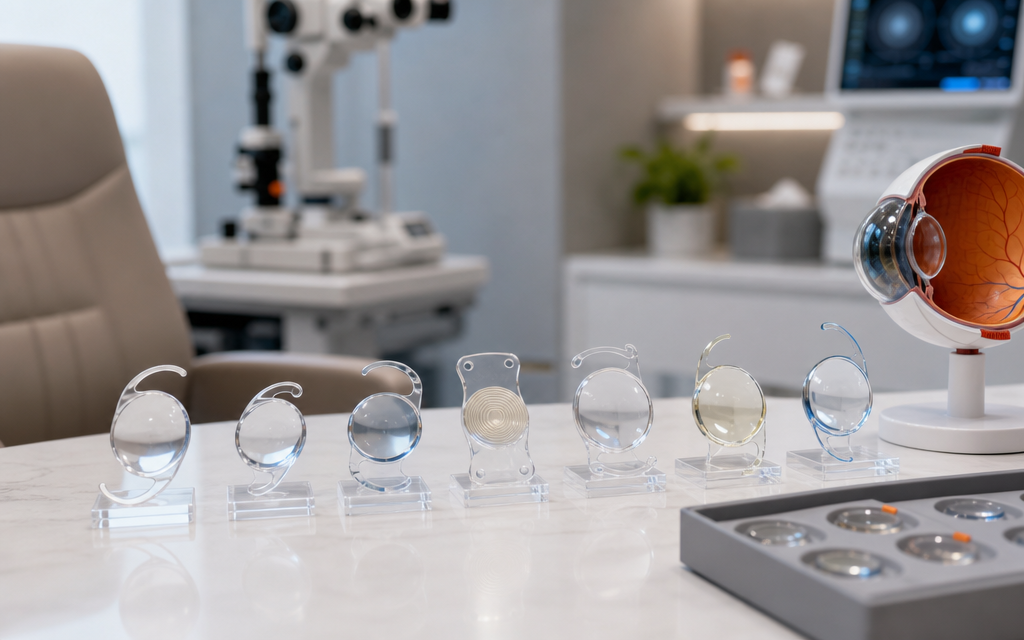
The core goal of cataract surgery is to remove the cloudy natural lens and replace it with an intraocular lens (IOL) to restore vision. IOLs are broadly categorized as monofocal or multifocal, based on how they distribute and focus light.
The more a single lens is designed to cover multiple distances (far to near), the more complex the optics become because light must be allocated across focal points. For some people, this reduces dependence on glasses; for others, it can increase night-time symptoms such as glare, halos, or light scatter.
IOL selection is not about which lens is “better” or “worse.” It’s about what you prioritize—greater glasses independence versus better night-time visual quality. Importantly, before preference, medical suitability should be assessed first, including macular status, corneal astigmatism, and pupil size.
2. Monofocal vs multifocal: What’s the real-life difference?

A monofocal IOL is set to focus at a single distance (typically distance vision). It is generally easier to achieve stable distance outcomes, and the risk/burden of dysphotopsia (e.g., glare, halos) tends to be lower. However, reading glasses may be needed for near tasks such as smartphone use or reading.
A multifocal IOL splits light to provide vision at multiple distances. It can cover near to intermediate ranges and offers a major advantage in reducing glasses dependence. However, because light is divided, contrast sensitivity may decrease somewhat in dim environments. The risk of glare or halos around streetlights during night driving is relatively higher.
A camera analogy can help. A monofocal IOL is like a fixed prime lens: distant scenery looks crisp, but you may need an added “magnifier” for close-up shots. A multifocal IOL is more like a convenient zoom lens: very practical in daily life, but—due to its optical structure—may be more prone to reduced clarity in low-light conditions.
[Monofocal vs Multifocal IOL Comparison]
| Category | Expected Benefits | Possible Limitations |
|---|---|---|
| Monofocal IOL | Stable recovery of distance vision, lower burden of nighttime glare | Possible need for reading glasses during near work |
| Multifocal IOL | Significant reduction in dependence on glasses in daily life (near & intermediate distance) | Potential for nighttime glare, halos, and reduced contrast sensitivity |
If you drive frequently at night or are often in high-glare/backlit environments, a monofocal IOL may be advantageous. If you do a lot of near work and dislike repeatedly putting on and taking off reading glasses, a multifocal IOL may be appealing.
✅Checklist for Finding My Personal Life Standards
- I drive frequently at night.
- I’m sensitive to glare or light scatter.
- My biggest stress is constantly putting on and taking off reading glasses.
- I spend a large portion of my day on near tasks like smartphone use or reading.
3. EDOF (extended depth of focus) and enhanced monofocal lenses: Options that support “intermediate vision”

Modern life isn’t limited to distance and near vision. Common targets such as a cutting board while cooking, a car dashboard, and especially a computer monitor are all at “intermediate” distance. This is why intermediate-vision–enhancing lenses have emerged as a middle ground between monofocal and multifocal designs.
- EDOF (extended depth of focus) lenses
These lenses increase depth of focus, aiming to provide a smoother visual range from distance to intermediate. In camera terms, it’s like increasing depth of field so objects across a range remain reasonably clear. Night-time symptoms can vary depending on the optical design (e.g., diffractive vs non-diffractive).
- Enhanced monofocal lenses
These lenses build on the optical stability of standard monofocal IOLs while modestly improving intermediate vision. They may be considered if you want better monitor-distance function while minimizing multifocal-type glare/halos. However, with both EDOF and enhanced monofocal lenses, thin reading glasses may still be needed for fine near work (e.g., small-print reading).
4. What if you have astigmatism, diabetes, or retinal disease?

If you have other eye conditions or special circumstances, lens selection often needs to be more conservative. That’s because ocular health can be the decisive factor in real-world lens performance—sometimes more than lifestyle. Common examples include corneal astigmatism and retinal disease.
If you have corneal astigmatism around 1.0 diopter or higher, a toric IOL may be considered.
If astigmatism is not corrected, you may still experience ghosting/double images or blur after surgery. A toric IOL is like a precision instrument that must be aligned accurately—rotational stability (maintaining the intended axis inside the eye) is critical. Therefore, detailed preoperative corneal topography is essential.
If you have diabetes or conditions such as age-related macular degeneration or glaucoma, the decision should be made even more carefully.
Diabetes itself is not an absolute contraindication to cataract surgery, but if diabetic retinopathy or macular edema is present, treating and stabilizing those conditions should come first. Because multifocal IOLs split light, patients with reduced retinal or optic nerve function may notice a greater drop in contrast sensitivity.
✅Checklist: Confirm eye-health conditions
- I’ve been told in the past that I have significant astigmatism.
- I have diabetes and take medication, or I’ve been advised to get retinal exams.
- I have a history of treatment for macular degeneration, glaucoma, or similar conditions.
In these situations, rather than insisting on a multifocal IOL, securing stable distance vision with a monofocal or enhanced monofocal IOL may be a safer and more beneficial long-term choice.
5. Why does vision become blurry again after surgery?

Many people are surprised when their vision becomes cloudy again months to years after an initially successful surgery. It’s easy to assume the cataract has returned, but this is often a natural phenomenon called posterior capsule opacification (PCO), commonly referred to as “secondary cataract.”
PCO occurs when the posterior capsule (the back part of the lens capsule left in place to support the IOL) becomes cloudy. Even with a clear IOL in place, vision can seem hazy—like dust on a protective filter in front of a camera lens. In many cases, vision can be improved without a new incision using an outpatient Nd:YAG laser capsulotomy.
However, symptoms are not always due to the IOL or PCO alone. Worsening dry eye can make vision fluctuate, and residual refractive error may remain. Rarely, if a patient cannot adapt to multifocal dysphotopsia, an IOL exchange may be considered. Because an exchange is a reoperation with additional risk, setting realistic expectations from the first decision-making step is crucial.
6. Frequently Asked Questions (FAQ)
Q. I drive often at night—can I still choose a multifocal lens?
Because multifocal IOLs split light by design, glare or halos may occur at night. The degree varies by lens design (diffractive, EDOF, etc.).
Q. I have severe astigmatism—what happens if I get a standard lens?
If you have clinically meaningful corneal astigmatism (roughly around 1.0 diopter or higher) and undergo cataract surgery with a standard (non-toric) IOL, you may still experience blur or smearing due to uncorrected astigmatism. However, irregular astigmatism (e.g., keratoconus) may not be an indication for a toric IOL, so discuss toric candidacy after preoperative corneal topography.
Q. After cataract surgery, can I completely stop using glasses?
Even with a multifocal IOL, complete glasses independence is not guaranteed. Depending on ocular condition, residual astigmatism, and dry eye, thin supplemental glasses may still be needed for very small print or tasks in dim lighting. With a monofocal IOL, reading glasses are generally necessary for near work.
Q. If my vision becomes blurry again after surgery, when should I go back to the clinic?
If your vision becomes cloudy again after some time, PCO is a common cause. Also, if dry eye symptoms or glare/halos persist and significantly interfere with daily life, it’s safest to return to the clinic where you had surgery for evaluation.

Choosing an IOL is not about finding “the most expensive lens with the most features.”
Start by setting your own priorities: which distance you use most in daily life, and which you want to avoid more—glasses inconvenience or night-time glare.
Just as you focus a camera lens, think about where you want to place the focus in your life. Combined with your surgeon’s assessment of corneal and retinal health, you can arrive at the most appropriate choice. The more specifically you describe your daily visual habits during preoperative consultation, the more likely you are to achieve a satisfying outcome.
Sources
- The Korean Ophthalmological Society. (2020). Cataract Clinical Practice Guidelines.
- Lee, J., Seo, K., & Kim, E. (2002). Comparison of contrast sensitivity in eyes implanted with monofocal and multifocal intraocular lenses. Journal of the Korean Ophthalmological Society.
- Khandelwal, S. S., et al. (2019). Comparison of multifocal and monofocal intraocular lenses: A systematic review and meta-analysis. Journal of Cataract & Refractive Surgery.
※ The copyright for all content on this blog belongs to medihi. Unauthorized copying, distribution, or derivative use is strictly prohibited, and violations may result in legal action without prior notice.
Recommended reads
 medihi