

In This Article
If your vision frequently feels blurry in your 40s to 60s, it may not be simple eye fatigue alone—cataract & presbyopia changes, dry eye, and other age-related factors often overlap. When both distance and near vision are unclear, or when glare/halos are present, a comprehensive ophthalmic evaluation is important to identify structural causes. This guide summarizes how to pinpoint the cause, what “red-flag” symptoms to watch for, and practical criteria for choosing an intraocular lens (IOL) when cataract surgery is being considered.
1. Conditions that commonly cause blurry vision
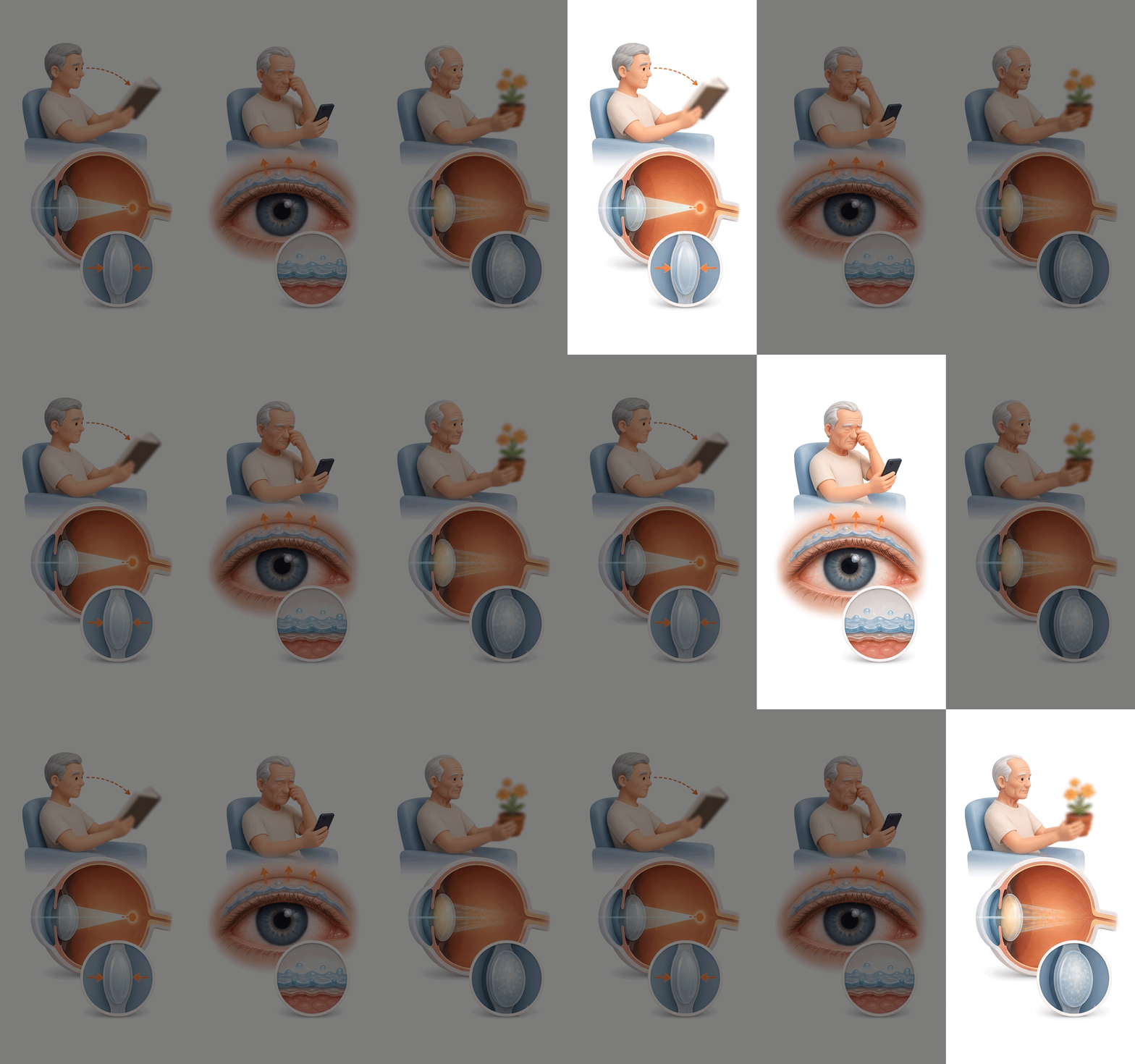
In middle-aged and older adults, blurry vision often results not from a single cause but from a combination of presbyopia, dry eye, and early cataracts.
Presbyopia occurs when the eye’s natural lens loses elasticity, making it difficult to focus on close-up text. Dry eye occurs when the tear film becomes unstable, causing vision to alternate between clear and blurry with each blink. Early cataracts develop when the lens itself becomes cloudy, making the entire field of vision look hazy, as if through fog.
Because these three conditions can feel very similar subjectively, it is generally better to confirm the cause through an eye exam using diagnostic equipment rather than adjusting reading-glasses strength on your own and waiting.
2. Warning signs that call for a comprehensive eye exam

If both distance and near vision are blurry, if glare is significant, or if you experience monocular double vision (seeing two or more images even when one eye is covered), you should get a detailed evaluation promptly.
Temporary eye fatigue usually improves with adequate rest. However, when structural changes inside the eye begin, discomfort tends to persist and can interfere with daily life. In particular, if the following symptoms recur, a comprehensive ophthalmic assessment is recommended.
✅Key symptoms that require urgent ophthalmic evaluation
- A heavy, overall blur across the entire field of vision regardless of distance
- Severe glare/halos around streetlights or car headlights at night
- No improvement in vision even after updating eyeglass prescription
- Monocular double vision: objects appear doubled or overlapped even when viewing with only one eye
These symptoms may indicate more than presbyopia alone and can be important signals of combined abnormalities involving the lens, cornea, retina, or optic nerve.
3. Detailed testing to identify structural causes
A comprehensive evaluation is performed alongside a slit-lamp exam, assessing the ocular surface, lens clarity, and whether there are abnormalities in the retina or optic nerve.
To accurately determine the condition inside the eye, ophthalmology clinics perform multiple diagnostic tests. First, medical history is reviewed to identify underlying conditions and current medications. Medications for benign prostatic hyperplasia (such as tamsulosin) can affect iris behavior during surgery, so it is important to inform your clinician.
Next, after visual acuity and refraction testing, the key step is the slit-lamp biomicroscopy exam. Using high-magnification optics, the clinician carefully evaluates the cornea and checks for lens clouding to assess cataract stage and progression. A fundus exam and optical coherence tomography (OCT) are used to check whether other vision-affecting conditions—such as diabetic retinopathy, macular degeneration, or glaucoma—are also present.
4. Intraocular lens (IOL) types and selection criteria
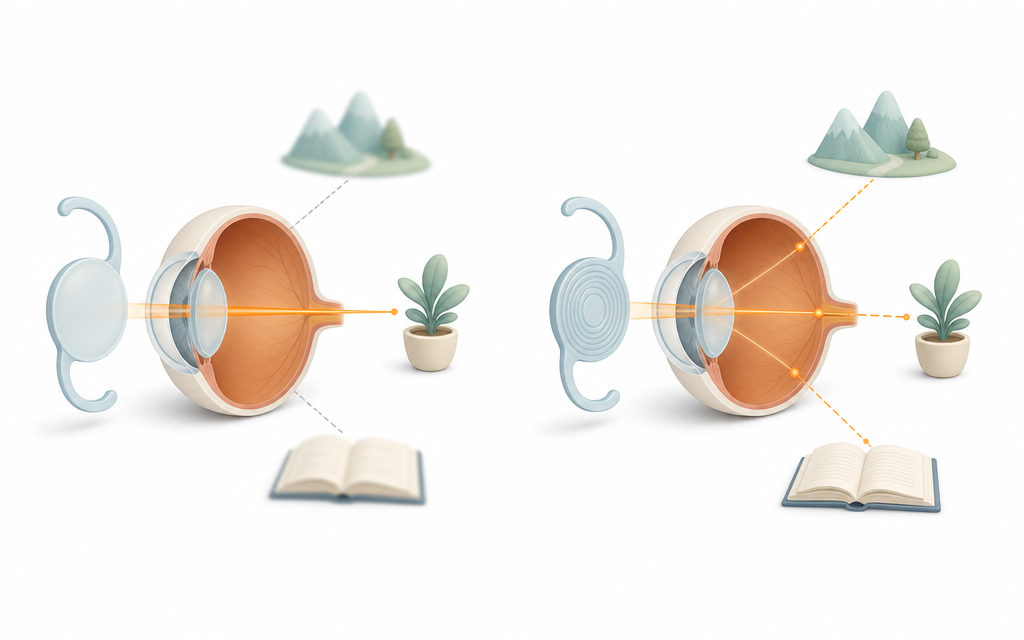
Monofocal or multifocal lenses are selected by considering the patient’s occupation, how often they drive at night, and the degree of inconvenience in daily life.
The timing of cataract surgery is not determined by the eye-chart number alone. Scheduling is typically adjusted based on functional decline in everyday activities such as reading, driving, and work, as well as the level of real-life discomfort.
✅Comparison of characteristics by IOL type
- Monofocal lens: Focuses on either distance or near vision. It tends to have fewer night glare/halo side effects and is generally considered safer in that regard, but reading glasses may be needed.
- Multifocal lens: Creates focus at multiple distances and can reduce dependence on glasses, but may be associated with night glare/halos and reduced contrast sensitivity.
5. Why ocular surface management matters before surgery
Treating dry eye first can reduce errors in IOL power calculations and improve the quality of vision after surgery.
When the ocular surface is dry and irregular, biometric measurements used for lens power calculation can produce inaccurate corneal curvature values.
Stabilizing the corneal surface is recommended through the use of artificial tears and treatment of tear-gland inflammation when needed. This is especially important for patients who previously had vision correction surgery such as LASIK or LASEK, because measurement error can be larger—making preoperative surface management even more important.
6. Frequently Asked Questions (FAQ)
Q. Close-up text looks blurry—does that mean cataract & presbyopia?
If near vision is the first to lose focus, cataract & presbyopia (presbyopia) is more likely. However, early cataracts can also cause temporarily similar blurring due to subtle changes in the lens’s refractive function. For safe and accurate differentiation, it is advisable to confirm whether lens clouding is present through a slit-lamp exam.
Q. I recently updated my glasses, but my vision is still blurry—what tests do I need?
If blurriness does not improve even after a precise prescription update, a structural cause beyond simple refractive error (myopia, astigmatism, etc.) should be considered. It is appropriate to evaluate the cornea and lens with a slit-lamp exam and to perform a fundus exam (and OCT when indicated) to check the retina and optic nerve.
Q. If I’m told I have early cataract findings, do I need to decide on surgery right away?
An early cataract diagnosis does not mean you must rush into surgery. In early stages, it is common to improve lighting in daily environments and monitor changes regularly. Surgery is typically scheduled later, when clouding progresses and the patient’s perceived visual inconvenience and functional decline become more significant.
Q. Can vision become blurry again years after cataract surgery?
If vision becomes cloudy again over time after cataract surgery, posterior capsule opacification (secondary cataract) may be suspected. This occurs when epithelial cells proliferate on the back of the capsular “bag” that holds the IOL, causing it to become hazy. A brief in-office laser procedure (Nd:YAG) may help restore clearer vision.
This health content has been reviewed by medical professionals, compiled from authoritative domestic and international sources, and is regularly updated in accordance with the latest clinical guidelines.
Sources
- Journal of the Korean Ophthalmological Society, Clinical outcomes of diffractive multifocal IOL exchange, 2023
- Frontiers in Medicine, Relationship Between Tamsulosin Use and Surgical Complications of Cataract Surgery, 2022
- JAMA Ophthalmology, Visual Outcomes and Optical Quality of Accommodative, Multifocal, EDOF, and Monofocal IOLs, 2022
※ The copyright for all content on this blog belongs to medihi. Unauthorized copying, distribution, or derivative use is strictly prohibited, and violations may result in legal action without prior notice.