

In This Article
Blurred vision in your 40s and 50s can be influenced by both cataract & presbyopia, so it’s important to distinguish the cause first. Presbyopia LASIK is a vision correction procedure that reshapes the cornea, while cataract surgery treats a clouded natural lens by removing it and implanting an intraocular lens (IOL). Because these two procedures target different structures, the right direction should be decided after checking the current condition of both the lens and the cornea.
1. Presbyopia LASIK vs. cataract surgery—what’s the difference?
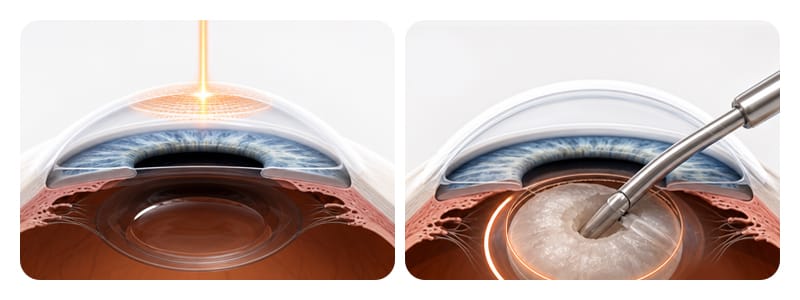
The key to distinguishing presbyopia LASIK from cataract surgery is determining whether your visual discomfort comes from a corneal refractive issue or from clouding of the natural lens. Presbyopia LASIK uses a laser to reshape the cornea (the outer surface of the eye) to adjust focus, whereas cataract surgery removes the clouded natural lens and replaces it with an IOL.
If your natural lens is still clear and transparent but your focusing ability has decreased—typical of early cataract & presbyopia—presbyopia LASIK may be considered as an option. On the other hand, if cataract-related clouding is already progressing, reshaping the cornea alone may not restore clear vision. That’s why, rather than choosing a procedure name first, the first step is confirming whether the lens is still clear or whether clouding has begun.
2. What does a slit-lamp exam check?
A slit-lamp exam is used to directly assess whether the natural lens is clear and how much clouding is present. Because it uses a high-magnification microscope and a focused beam of light to examine the eye from the front structures through to the lens, it is helpful for differentiating cataract & presbyopia—especially when symptoms overlap.
Refraction testing and visual acuity testing performed alongside it can confirm your current prescription and how much it has changed. If needed, a dilated fundus exam can evaluate the retina and optic nerve, and corneal testing plus dry eye evaluation can assess corneal shape and tear film stability. If your glasses prescription has been changing frequently, or if glare and blur have worsened in bright environments, these changes can also be reviewed during the exam process.
3.Which treatment is right for my eyes?
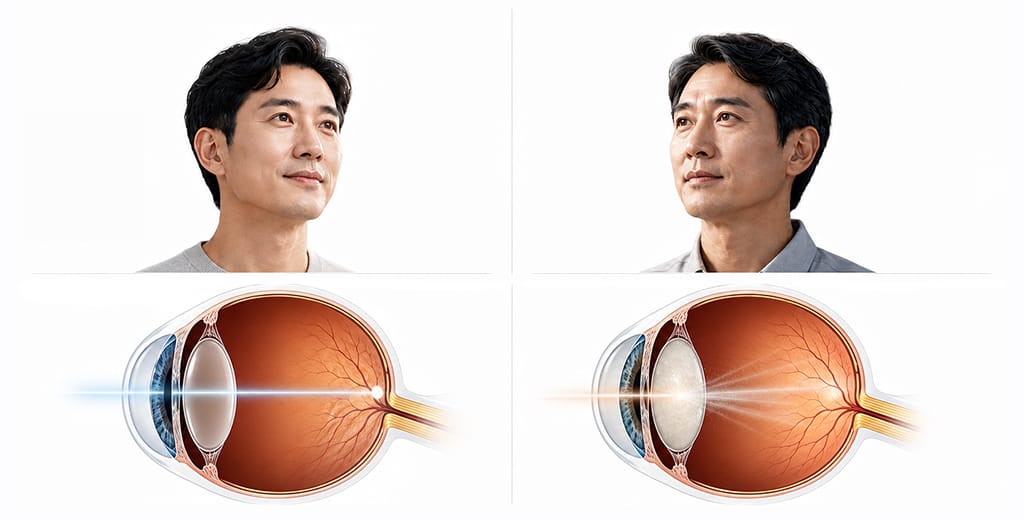
If there is little to no lens clouding and your cornea is thick enough—often in early-to-mid 40s with early cataract & presbyopia—presbyopia LASIK may be considered to help balance distance and near vision. In this situation, corneal shape and the presence of dry eye are also evaluated to determine whether surgery is appropriate.
Conversely, if you are in your late 40s or beyond your 50s and lens clouding and reduced night vision appear together, cataract surgery may be an alternative. When cataract is the main cause of blurred vision, correcting only the cornea can lead to vision declining again as lens clouding continues to progress. This is why the decision should be based not on age alone, but on both lens transparency and corneal status.
4. How do you choose an intraocular lens (IOL)?

When selecting a multifocal IOL for cataract surgery, it’s important to consider which viewing distances you rely on most in daily life and how much nighttime activity you have. Multifocal lenses split light into multiple focal points to help you see both far and near, which can make streetlights or car headlights appear more spread out, hazy, or surrounded by glare/halos at night.
If you drive frequently at night or are particularly sensitive to crisp vision in low-light settings, the characteristics of multifocal or extended depth-of-focus (EDOF) IOLs may feel more bothersome, including the possibility of reduced contrast sensitivity. In that case, you can compare pros and cons with your clinician, including standard monofocal IOLs or other functional IOL options that take nighttime visual stability into account. Before surgery, it can help to clarify your expectations around night driving, computer work, and the use of glasses or reading glasses.
5. If you’ve had LASIK/LASEK before, what should be considered?
Even if you previously had LASIK or LASEK, that history does not itself make cataracts develop earlier. However, it becomes an important variable when calculating the IOL power for cataract surgery.
Because the cornea after laser vision correction can have a different curvature than before, using standard methods to calculate IOL power may increase the risk of error. Therefore, if you have a history of vision correction surgery, you should inform your clinician before cataract surgery, and precise measurements using corneal topography and specialized IOL calculation methods may be needed. This information is also reflected when setting the target vision outcome.
6. Frequently Asked Questions (FAQ)
Q. If near text looks blurry, how can I tell cataract & presbyopia apart?
Cataract & presbyopia can both cause blur, but the mechanism differs. Presbyopia mainly reduces focusing ability, making near text look blurry. Cataracts cloud the lens itself, which can make both distance and near vision look hazy—like looking through fog. Glare and reduced night vision may also occur, and a slit-lamp exam is used to confirm whether lens clouding is present.
Q. If I have early cataracts, do I need surgery right away?
Early cataracts are not typically treated with immediate surgery based on diagnosis alone. Some people reduce discomfort by updating their glasses prescription or adjusting lighting and monitoring changes over time. The timing of surgery is decided by also considering real-world functional impact on reading, work, and driving.
Q. If I drive a lot at night, can multifocal or EDOF lenses be uncomfortable?
Multifocal or EDOF IOLs are designed to provide focus across multiple distances, but at night some people may notice glare/halos or reduced contrast sensitivity. If night driving is a major part of your routine, you can compare lens options—including monofocal lenses—by weighing the advantages and trade-offs of each.
Q. What changes might suggest I should consider a comprehensive eye exam?
If it’s difficult to read smartphone or book text even with reading glasses, or if lights spread severely while driving at night, you may consider a consultation. An exam may also be needed to identify the cause if objects appear doubled or if your glasses prescription changes frequently over a short period.
This health content has been reviewed by medical professionals, compiled from authoritative domestic and international sources, and is regularly updated in accordance with the latest clinical guidelines.
Sources
- Korean Ophthalmological Society (KOS), Clinical Guidelines for Adult Cataract and Refractive Surgery.
- Korea Disease Control and Prevention Agency (KDCA) National Health Information Portal, Guidance on age-related ocular changes and cataract management.
- American Academy of Ophthalmology (AAO) EyeWiki, Presbyopia and Cataract Surgical Management, 2024.
※ The copyright for all content on this blog belongs to medihi. Unauthorized copying, distribution, or derivative use is strictly prohibited, and violations may result in legal action without prior notice.