

In This Article
If a lot of gum shows when you smile and your teeth also appear uneven in size, it’s more important to first break down the underlying causes than to simply “reduce the gums.” A gummy smile can be influenced by skeletal structure, gums, lips, and tooth position at the same time. This post summarizes practical criteria—from differentiating the cause to designing the gumline and tooth proportions together.
1. What causes excessive gum display?
In aesthetic assessment, some use “more than 3 mm of gingival display when smiling broadly” as a reference point for a gummy smile. However, even with a similar amount of gum showing, the cause can differ.
If you think of teeth as windows, the upper jawbone is the window frame, the gums are the window film, and the lips are like blinds. Depending on which structure most affects gingival display, the treatment approach can change.
✅What to check by cause
- Skeletal factor: When the maxilla is vertically long, causing more gum to show
- Gingival factor: When the gums cover a large portion of the teeth, making the teeth look short
- Lip factor: When the upper lip elevates excessively during smiling
- Tooth-position factor: When the front teeth have moved downward, exposing the gums along with them
Evaluation typically starts with photos, a smiling video, and an oral exam. If needed, an intraoral scan or radiographic imaging can be used to confirm the relationship between skeletal structure and the gums.
2. Why do teeth look short?
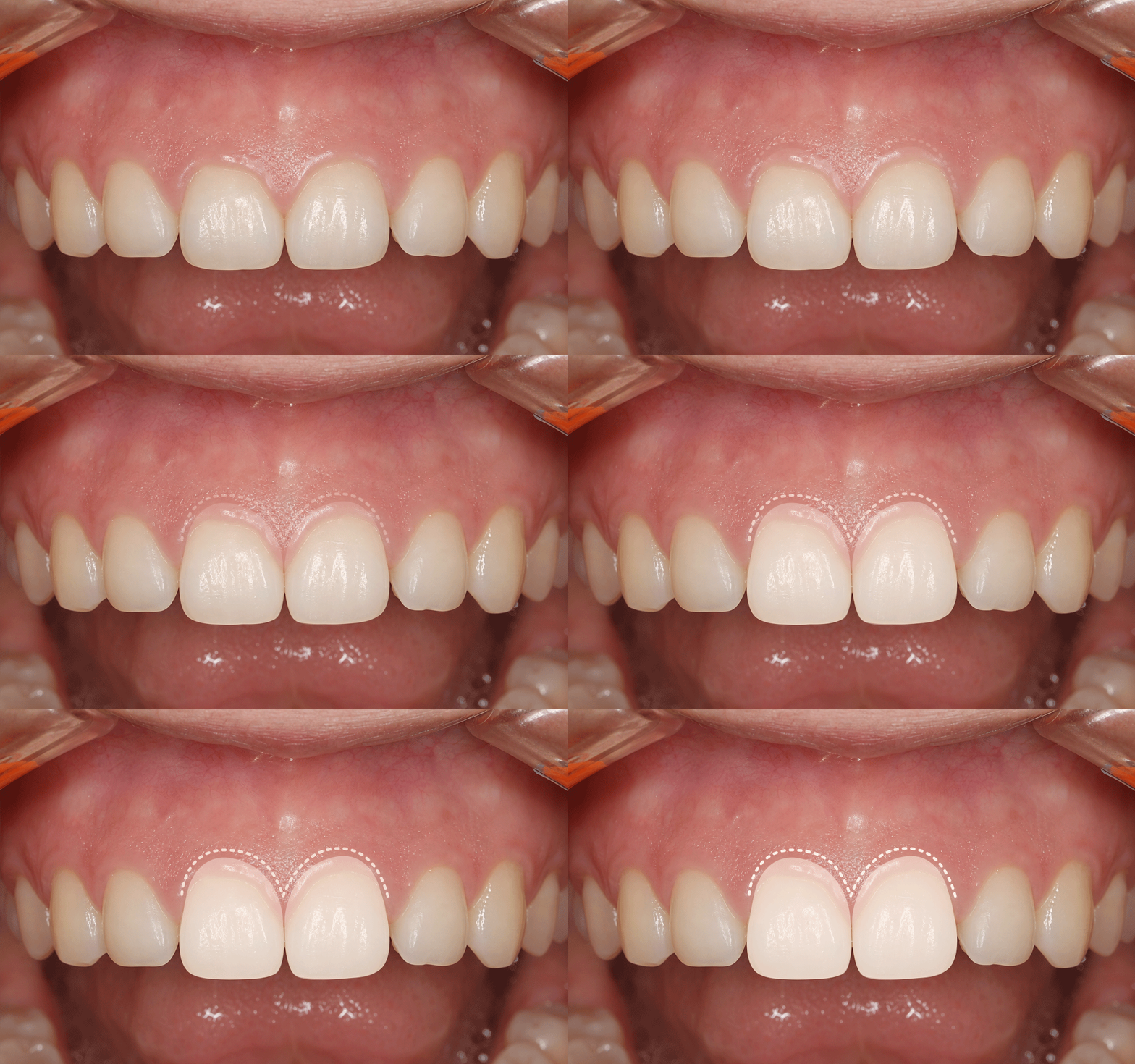
Even if teeth look short, the actual tooth size may not be small. Altered passive eruption (APE) refers to a condition in which tooth length is close to normal, but the gingival margin has not migrated apically enough—so the visible part of the tooth appears short and boxy.
If the teeth look generally short and round or square, and the gums seem thick and covering, APE may be considered. Accurate differentiation requires assessing tooth length, the gumline, and the position of the alveolar bone together.
If the teeth themselves are small, proportions can be adjusted with prosthetic treatment. If the teeth are heavily covered by gingival tissue, esthetic crown lengthening may be discussed. In that case, the extent of resection should be determined while considering the alveolar bone position and biologic width.
3. If the lips are the cause, what treatments are considered?
If there is no major issue with the gums or skeletal structure, and the upper lip rises excessively only when smiling, hypermobility of the upper lip is assessed. If muscle activity is the main cause, botulinum toxin may be considered as a short-term option. If structural adjustment of the lip is needed, lip repositioning surgery may be discussed.
Botulinum toxin temporarily reduces gingival display by decreasing muscle contraction; its effect can diminish over time, so repeat treatment may be needed. Lip repositioning surgery adjusts the mucosa to limit how far the lip can rise, and outcomes can vary between individuals.
Neither method is always “better.” The appropriate option should be selected based on the cause after evaluating the lips together with skeletal and gingival conditions.
4. Why are the gumline and tooth proportions evaluated together?
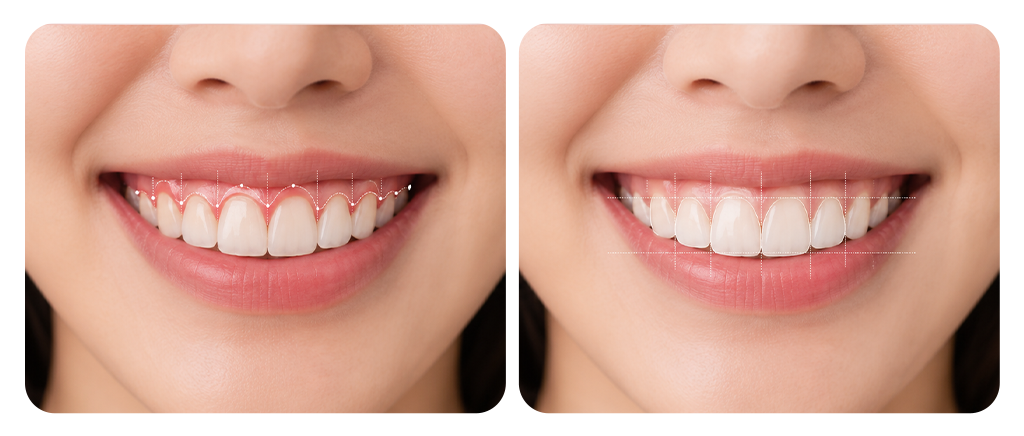
After adjusting a gummy smile, the gingival margin line and tooth shape should be assessed together to balance smile proportions. In dentistry, the gumline is often described as “pink esthetics,” while tooth shape and proportions are described as “white esthetics.”
If gingival heights are uneven, the gumline may be adjusted first through periodontal treatment. Then, if tooth length or shape still needs refinement, veneers may be considered. Veneers are a prosthetic treatment in which the outer tooth surface is prepared and ceramic is bonded to adjust form and proportions.
✅What to confirm during an esthetic treatment consultation
- Confirm whether they assess where gingival display mainly originates among skeletal, gingival, lip, and tooth-position factors.
- Check whether they determine the sequence first: gumline adjustment vs. tooth-proportion design.
- Confirm whether gum treatment considers root and alveolar bone position and biologic width.
If needed, digital simulation can be used to align treatment goals and the amount of reduction.
5. How should the treatment sequence be determined?
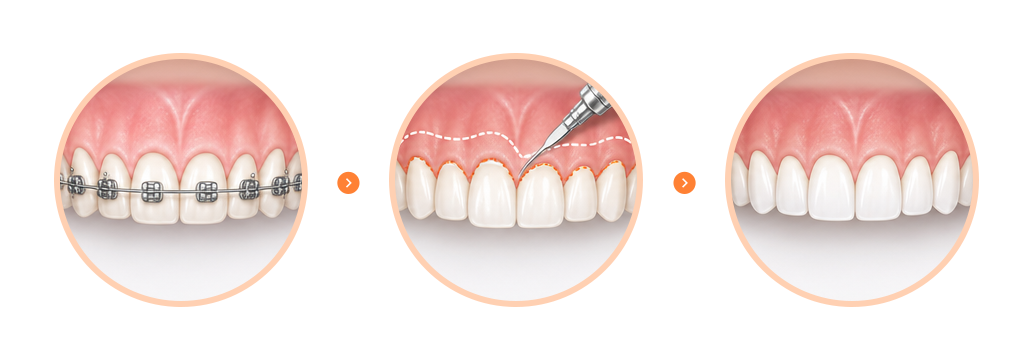
In adults, a gummy smile may involve multiple contributing factors, so determining the treatment sequence is important. If skeletal structure, gums, tooth position, and lip movement overlap, it may be difficult to adjust overall proportions with a single procedure.
If tooth alignment is irregular or the front teeth have moved down excessively, orthodontic treatment may be considered first. Then, remaining gingival asymmetry can be corrected, and veneers can be reviewed if tooth length or shape still needs improvement.
Rather than deciding on multiple treatments all at once from the beginning, it is preferable to separate the causes and plan the sequence starting with options that place less burden on the tissues.
6. Frequently Asked Questions (FAQ)
Q. How can I tell whether my gummy smile is caused by the gums or the lips?
Photos, a smiling video, an oral exam, and—if needed—radiographic imaging are used to evaluate tooth length, the gumline, and lip movement together. This helps determine how much each factor contributes to gingival display.
Q. Can tooth sensitivity occur after crown lengthening?
Temporary sensitivity can occur if structures closer to the root become exposed or during adjustment of the alveolar bone. Duration and severity vary by individual, so the treatment extent and aftercare plan should be coordinated with the clinician.
Q. How long does the effect of botulinum toxin last?
It varies depending on facial muscle activity, but reduced gingival display may be observed for several weeks to several months. Because the effect can decrease over time, discuss a maintenance plan with the clinician.
Q. When is it a good idea to get a detailed diagnosis?
If excessive gingival display when smiling bothers you, or if your teeth look unusually short and the gumline and tooth proportions appear uneven, you may consider a consultation. Identifying the cause first helps determine the appropriate sequence among orthodontic treatment, gum treatment, lip treatment, and prosthetic options.
This health content has been reviewed by medical professionals, compiled from authoritative domestic and international sources, and is regularly updated in accordance with the latest clinical guidelines.
Sources
- Journal of Periodontal & Implant Science (JPIS). Facial, dental, periodontal, and tomographic characteristics. 2024.
- Clinical Oral Investigations. Clinical efficacy of lip repositioning in the treatment of gummy smile: a systematic review and meta-analysis. 2022.
- Clinical Oral Investigations. Effect and longevity of botulinum toxin in gummy smile: a meta-analysis. 2022.
※ The copyright for all content on this blog belongs to medihi. Unauthorized copying, distribution, or derivative use is strictly prohibited, and violations may result in legal action without prior notice.