

If you’ve been unsure whether your child’s malocclusion is driven by genetics or everyday habits, this guide brings everything together in one place—how to tell the difference, a home checklist for habit correction, and when to schedule the first orthodontic evaluation.
“My child sleeps with their mouth open.”
“When they smile, their jaw looks a little forward.”
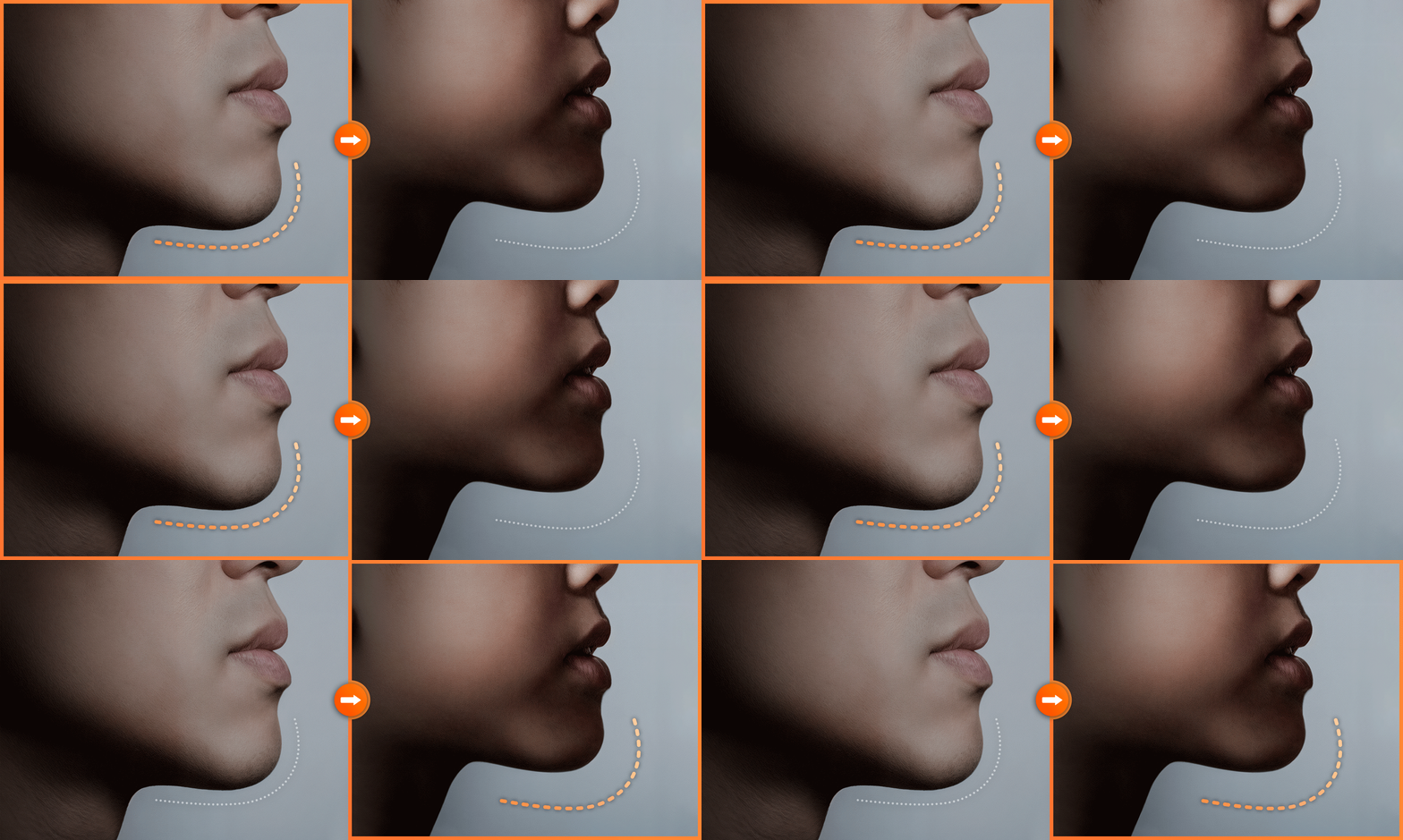
You’ve probably said something like this at least once. These may look minor, but they can be signals that growth-phase orthodontic care is worth considering.
Many parents delay care thinking, “We can deal with braces later.” But jaw growth has a more important golden window than most people realize.
This article helps parents distinguish likely causes (genetics vs lifestyle habits), introduces simple at-home management steps, and explains when to book the first orthodontic checkup.
1.Is malocclusion genetic—or caused by habits?
Malocclusion often appears through a combination of skeletal design (genetics) and functional patterns (daily habits). When you understand which is more likely driving your child’s situation, you can respond faster and avoid missing the golden window for growth-phase care.
- Genetic factors
- If a parent has an underbite or a receding chin pattern, similar tendencies may appear in the child.
- Jaw size and tooth alignment can be strongly influenced by heredity, which is why early evaluation is especially important.
- Acquired lifestyle habits
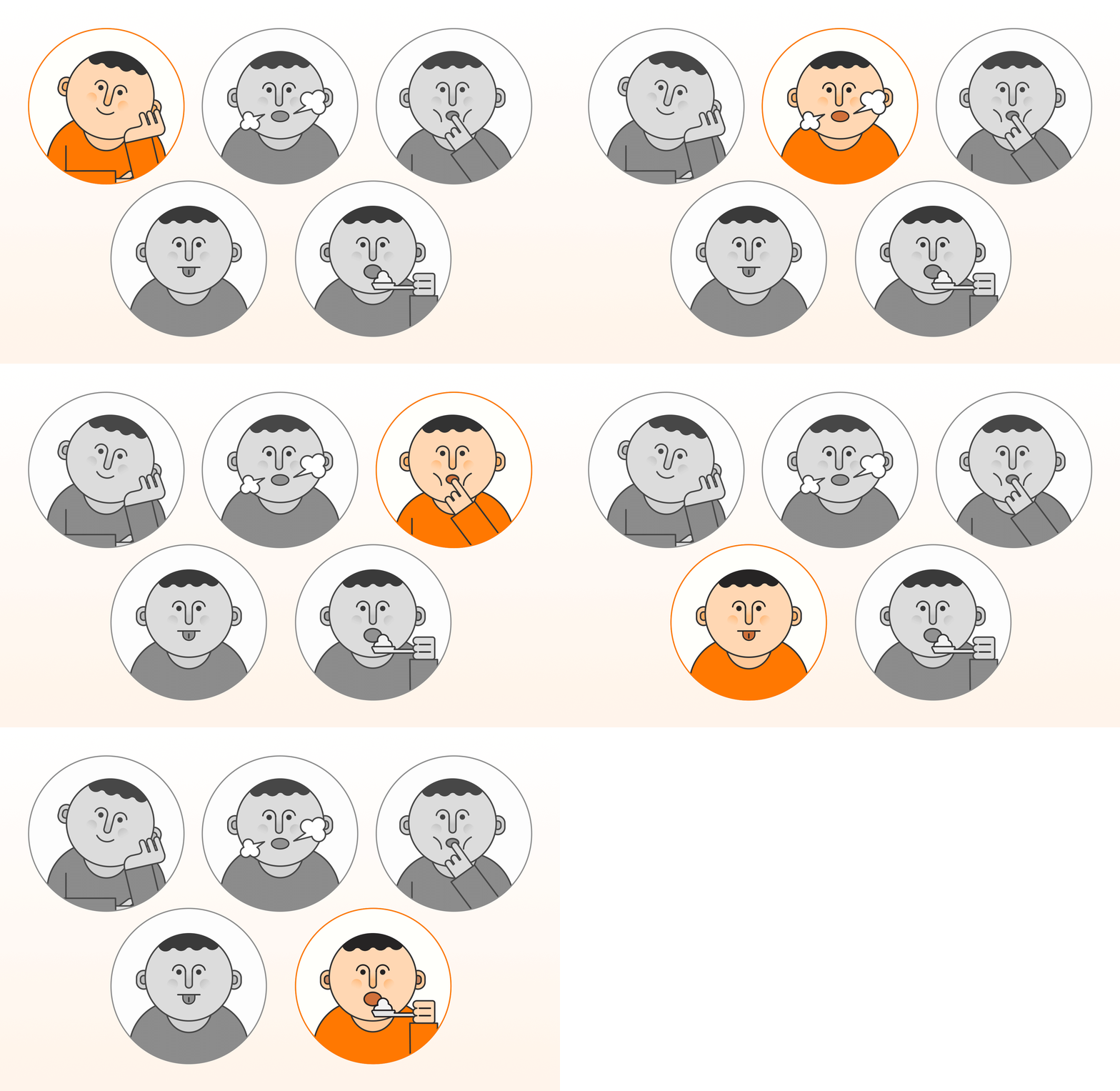
- Habits such as mouth breathing, thumb sucking, tongue thrusting, and chewing only on one side can interfere with jaw and dental development and worsen malocclusion.
- Correcting harmful habits early can also help children who have a genetic tendency.
[Quick guide: Genetics vs habits]
| Category | Common signs | What to check at home | First response | When to see a clinic |
|---|---|---|---|---|
| Genetic (skeletal) | Underbite/receding chin, jaw protrusion/retrusion in side profile | Compare side profiles with parents, take a side-profile photo of the child | Posture awareness, avoid one-sided chewing | Early consult around age 6–7 |
| Habit-related (functional) | Mouth breathing, tongue thrusting, thumb sucking | Record ~1 minute of sleep video, check daytime mouth opening, notice frequent lower-lip dryness/cracking | Nasal-breathing practice, encourage chewing tougher foods | Start habit correction immediately + consult |
| Mixed | Genetic tendency + habits | Combine checks above | Strengthen habit correction + growth monitoring | Specialist evaluation recommended |
2.What can you do first at home?

Children grow every day—and parents can support that growth with healthy routines: balanced eating, sufficient sleep, and better daily habits.
Facial and jaw growth is influenced not only by genetics, but also by repeated behaviors. Jawbones and surrounding muscles can respond to everyday forces, and small, consistent parental support can help guide a child’s growth potential in a healthier direction.
The habits below aren’t just “tips”—they can become a simple routine that supports healthier jaw development. Try practicing them together in a positive, encouraging way.
Healthy habit guide for jaw growth
- Breathe through the nose (nasal breathing practice)
- Practice breathing only through the nose for 5 minutes a day. Activities like blowing up balloons or whistling can encourage use of the muscles around the mouth. Having a child gently hold a thin straw while watching TV or reading can also help them engage oral muscles and reduce open-mouth posture.
- Chew evenly (bilateral chewing habit)
- Observe whether your child alternates chewing on both sides. Encouraging balanced chewing can support more symmetrical jaw development.
- Eat tougher foods (build chewing strength)
- Chewing trains jaw muscles and provides stimulation that can help create space for teeth to erupt. Offer snacks that require chewing, such as cucumber, carrots, or nuts.
- Limit device time (posture)
- Long periods of looking down at a phone or tablet can strain the jaw and neck and disrupt posture. Set time limits and encourage upright posture.
- Avoid resting the chin on a hand (posture correction)
- Help your child avoid habits like propping the chin or lying down while reading. Posture can influence jaw and spine health.
3.Why does the “golden time” for growth-phase orthodontics matter?

Timing can make a major difference in both the process and outcomes of malocclusion care.
During growth, the jawbones are still adaptable—so growth can become your strongest “ally.” If this stage is missed, you lose the chance to take advantage of natural growth, and treatment can become more complex and more burdensome.
For example, during growth, it may be possible to guide the direction of jaw development—such as helping limit excessive lower-jaw growth or encouraging growth of an underdeveloped upper jaw. In addition, creating space for permanent teeth as they erupt may help reduce the chance of extractions later.
In adulthood, the same problems may require more invasive approaches—such as extractions or surgical procedures. That’s why this golden time can be a decisive window for simplifying treatment and reducing physical and psychological burden.
[What changes if you miss the golden time?]
| Category | Growth-phase care | Adult care |
|---|---|---|
| Jawbone status | Growth direction can be guided | Growth complete → limited bone change |
| Treatment approach | Expansion/functional appliances | Higher chance of extractions/surgery |
| Treatment duration | About 1–2 years on average; easier adaptation | Often longer and more burdensome |
| Outcomes | Uses growth to support natural improvement | Higher risk of surgical intervention |
4.When should you visit a clinic?
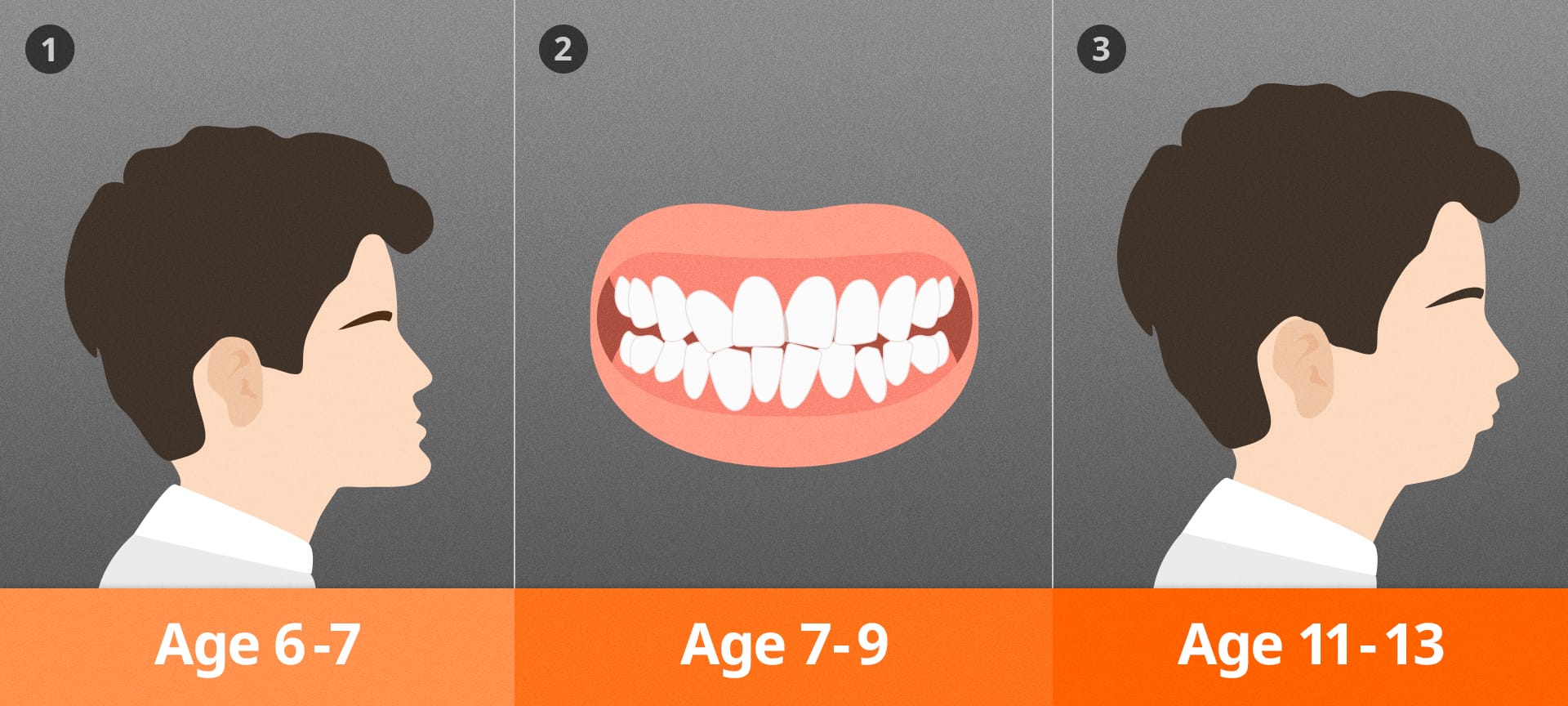
A first orthodontic evaluation is often most appropriate around age 6–7, when the first permanent teeth erupt.
At this stage, changes in upper/lower jaw relationships can be assessed more accurately. However, not every malocclusion starts at the same time—effective timing can differ depending on the pattern.
- Underbite (reverse bite): age 6–7, early evaluation
- When the lower teeth cover the upper teeth, early care is often recommended once identified.
- It can appear even during baby teeth stages, and early intervention aimed at guiding growth may reduce future surgical risk.
- Receding chin / protrusive upper teeth: around age 11–12, use pubertal growth
- When lower jaw growth is relatively insufficient and upper teeth appear more protrusive, using the pubertal growth phase (around ages 11–12) can be effective.
- Functional appliances or clear aligner systems may be used as part of the plan.
- Crowding: around age 7–9, consider expansion
- If permanent teeth lack space, arch expansion may be used around ages 7–9 to create space.
- This may improve the chance of alignment without removing permanent teeth later.
- Habit-related issues (mouth breathing, thumb sucking): any age, act early
- Malocclusion driven by harmful habits should be addressed as early as possible.
- If habits persist, jaw and tooth changes may continue and become harder to reverse.
5.Frequently Asked Questions (FAQ)
Q. If we do early treatment, can teeth shift again later?
Yes, it can happen. Because the jaw and face continue to grow during childhood and adolescence, teeth may tend to move after treatment. This is a common part of growth, and long-term stability can often be supported by wearing retainers as directed and maintaining healthy habits.
Q. Is clear aligner treatment alone enough?
For mild alignment issues or minor malocclusion, clear aligners alone may be sufficient. However, if jaw growth guidance is needed—such as in skeletal patterns where the lower jaw is too prominent or the upper jaw is underdeveloped—additional functional appliances may be required. A personalized plan depends on a proper diagnosis.
Q. Will it cost a lot or take a long time?
Cost and duration can vary depending on timing and severity. Because growth-phase care can use natural growth, it may be less burdensome than complex adult treatment that involves surgery. The safest approach is to confirm expected costs and timelines after a detailed evaluation.
Q. Can habit correction alone be enough?
If malocclusion is caused primarily by habits, habit correction alone may lead to noticeable improvement. Habit-related patterns such as tongue thrusting or thumb sucking can sometimes improve significantly with consistent correction. If the jawbone position or size is the main issue, habit correction is still helpful—but orthodontic treatment may also be needed.

Growth-phase orthodontics is not simply about straight teeth. It can be an important investment in your child’s lifelong health, development, and confidence. Malocclusion can affect more than appearance—it may influence breathing, speech, and chewing function, which in turn can affect quality of life. That’s why careful observation and early recognition matter. If you notice even small signs, don’t hesitate to seek professional guidance. When parents recognize signals early, treatment can often become simpler and safer—and your child’s future may look brighter than it does today.
Sources
- Korean Academy of Pediatric Dentistry. (n.d.). Children’s Dental Guide: The Importance of First Permanent Teeth and Early Checkups.
- Korean Association of Orthodontists. (n.d.). Pediatric and Adolescent Orthodontic Treatment Information.
- American Association of Orthodontists. (n.d.). Your Child’s First Orthodontic Check-up: Age 7 is the Right Time.
※ The copyright for all content on this blog belongs to Medihi. Unauthorized copying, distribution, or derivative use is strictly prohibited, and violations may result in legal action without prior notice.
Recommended reads
 medihi