

In This Article
Many people mistake scalp scaling or hair loss for simple seborrheic dermatitis and miss the right window for treatment. If you notice warning signs such as hair snapping off or scalp pustules, it may be a fungal infection rather than simple dermatitis. Recently, cases of tinea capitis have been rising sharply due to dermatophyte transmission from companion animals. If you have symptoms, it’s also helpful to check your pet’s skin condition—such as hair loss or scaling. To help prevent irreversible hair follicle damage, review clear criteria for distinguishing tinea capitis and the appropriate testing methods.
1. If it looks like dandruff but your hair is breaking off
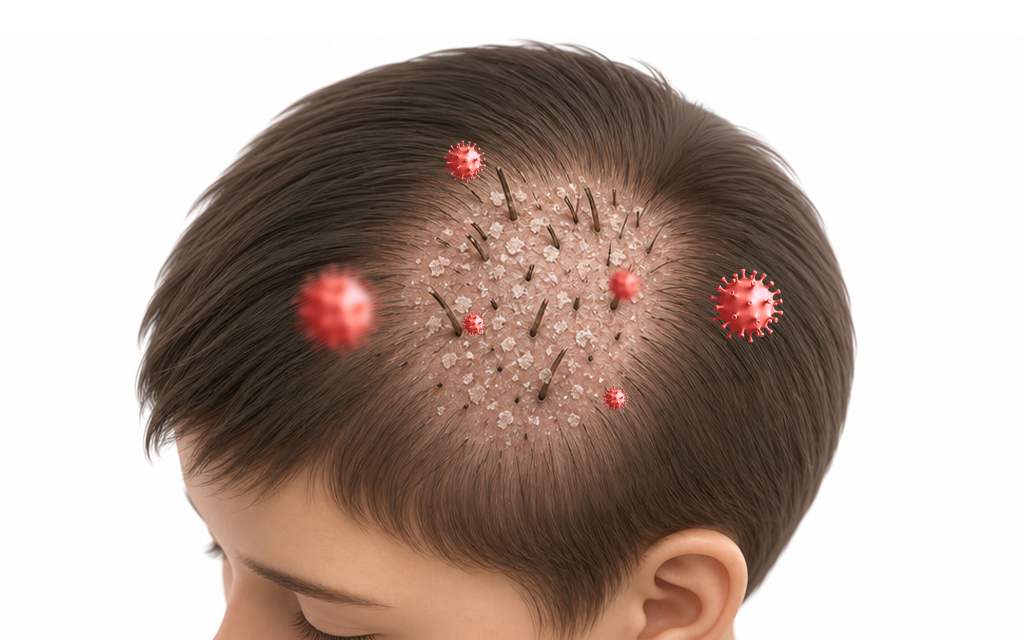
If white, dandruff-like scale appears on the scalp and the hair breaks easily and sheds, you should suspect tinea capitis rather than simple dandruff. When dermatophytes (a type of fungus) invade the hair shaft and hair follicle, they disrupt the hair’s protein structure. Even if the outside looks relatively normal, the inside can become hollow and extremely fragile—so the hair can’t hold up and snaps off in short pieces.
Unlike seborrheic dermatitis, which mainly involves scale building up on the skin surface, this is a serious situation in which infection causes structural damage. If you also notice “black dots,” where broken hairs look like tiny dark specks stuck in the follicular openings, or patchy areas of hair loss, the likelihood of an infectious condition is very high.
2. The risks when pus and crusting are present
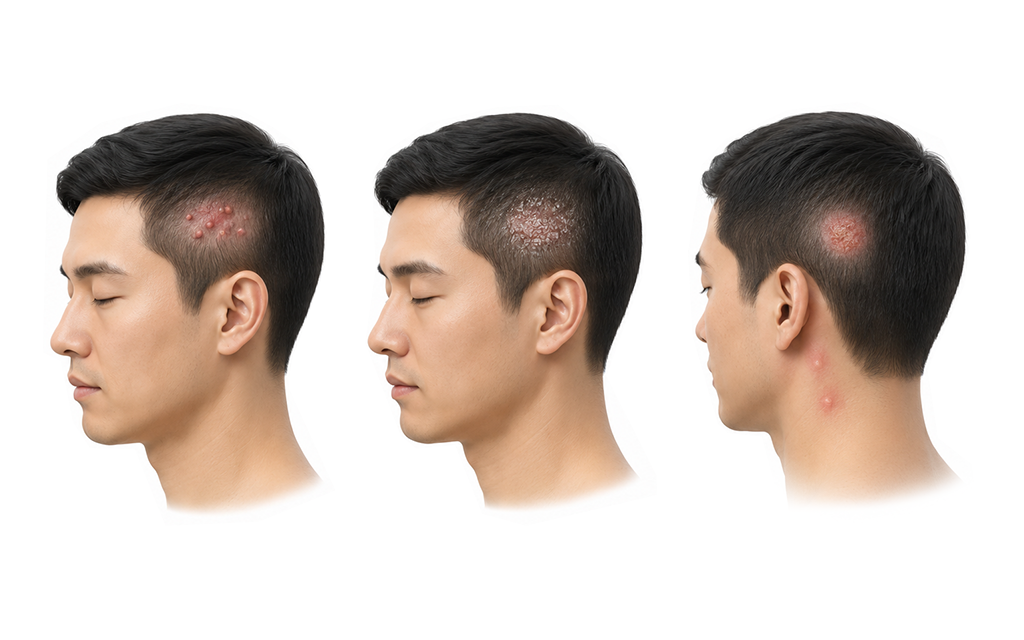
A thick crust formed from dried oozing fluid or pus-filled bumps on the scalp—known as a kerion—indicates a severe inflammatory state caused by an intense immune response. In more severe cases, immune cells overreact to the fungus, leading to marked scalp swelling, pus accumulation, and significant pain.
If this condition is not treated appropriately and care is delayed, hair follicles can be permanently damaged, increasing the risk of scarring (cicatricial) alopecia in which hair does not regrow. If scalp pain worsens rapidly, or if lymph nodes behind the ear become swollen and you can feel a lump, you should seek medical care without delay.
3. What tests are needed to diagnose tinea capitis?
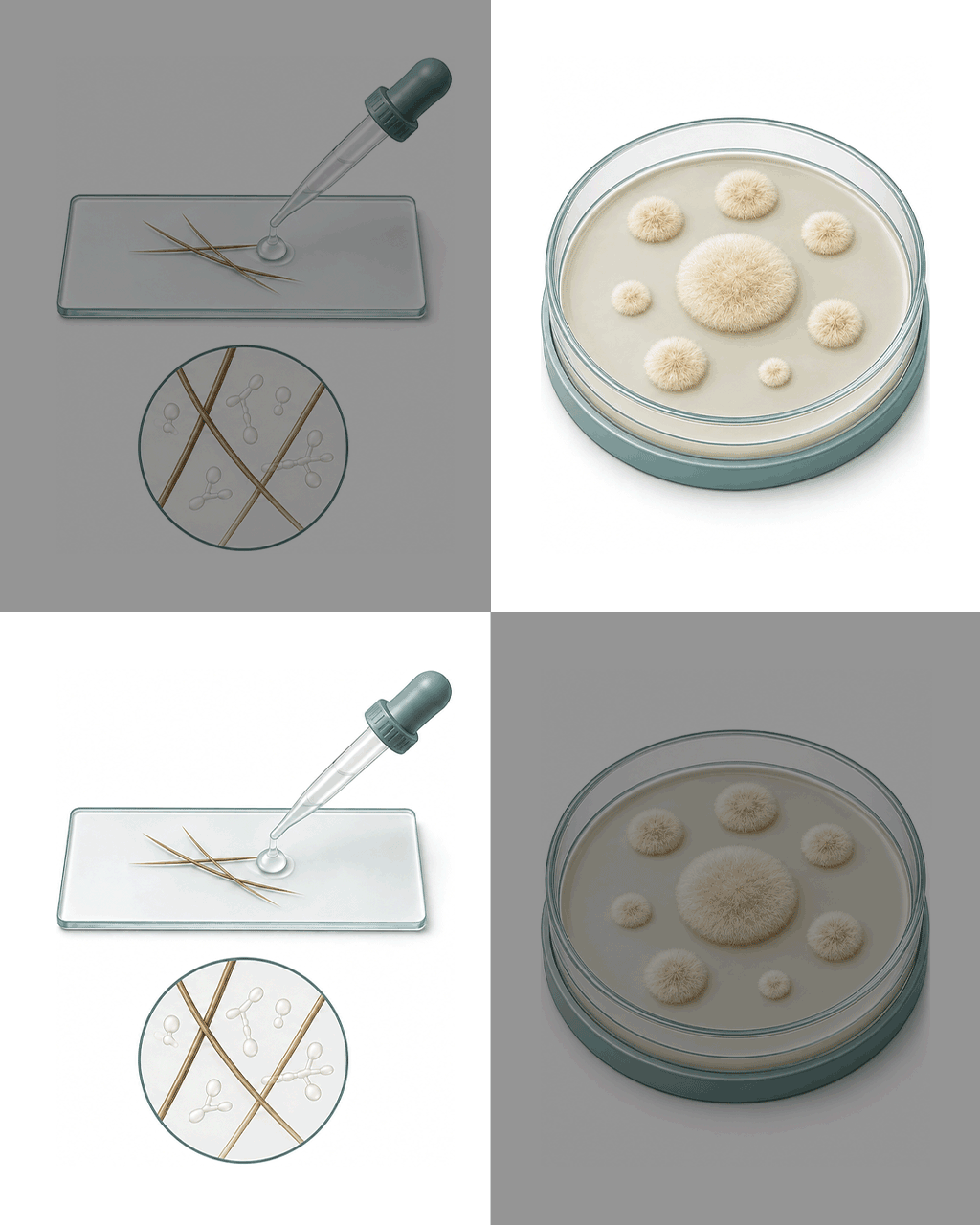
To diagnose tinea capitis accurately, it’s essential not to rely on appearance alone. Confirming fungal infection with a KOH direct examination and a fungal culture should be considered. Early symptoms can closely resemble other scalp conditions—such as seborrheic dermatitis, scalp psoriasis, eczema, or alopecia areata—making visual differentiation difficult.
✅Key tests for differential diagnosis
- KOH direct examination: Suspicious hairs or scale are collected from the lesion, treated with potassium hydroxide, and examined under a microscope to quickly check for fungal elements.
- Fungal culture: The organism is cultured to identify the specific causative species, which helps guide selection of the most appropriate treatment.
As an adjunct, a Wood’s lamp examination (using a special ultraviolet light) may be used to help evaluate pigment disorders or fungal/bacterial infections. However, fluorescence occurs only with certain species, so even a negative result cannot completely rule out tinea capitis.
4. Why shampoo alone is often not enough
The fungus that causes tinea capitis does not only remain on the scalp surface—it can also live inside the hair shaft and deep within the hair follicle. For this reason, antifungal shampoos or topical ointments alone have clear limitations. When medication is applied only to the surface, it is structurally difficult for it to reach and eliminate fungi established deep around the hair root.
Therefore, oral systemic antifungal medication is typically the mainstay of treatment so the drug can reach the infection within the follicle. Antifungal shampoo is commonly used alongside as a helpful adjunct therapy to reduce fungal spores on the scalp surface and help prevent transmission to others. Caution is needed because using a topical steroid alone without an accurate diagnosis may worsen symptoms.
5. Do adults and older adults also need to be evaluated for tinea capitis?
Tinea capitis is often thought of as a childhood condition, but it also occurs in adults and older adults. The assumption that “adults don’t get it” can lead to delayed diagnosis. In particular, middle-aged and older adults may mistake it for simple dandruff and rely on self-treatment, which can allow inflammation to worsen—so careful differentiation is important.
In older adults, thick crusting or oozing can obscure other severe skin conditions unrelated to infection, making basic fungal testing a key criterion for clinical decision-making.
✅Age-specific checkpoints for differentiating tinea capitis
| Age Group | Key Differential Criteria & Precautions |
|---|---|
| Children & Adults (Common) | Prioritize differentiating tinea capitis when broken hair shafts, black dots, patchy alopecia, and scaling are present |
| Adults (Middle-Aged) | Avoid overuse of self-selected shampoos; monitor liver function and drug interactions if taking concurrent oral medications |
| Elderly | For chronic, thick ulcers or crusts, consider biopsy evaluation to rule out non-infectious conditions (such as malignancies) |
6. Frequently Asked Questions (FAQ)
Q. If scalp scaling and hair loss appear together, what tests should I get?
To quickly check for fungal infection, the top priority is a KOH direct examination using hairs and scale collected from the affected area. In many cases, a fungal culture is also performed to identify the exact species.
Q. How can I tell the difference between hair loss where hair falls out from the root and tinea capitis hair loss?
In many common types of hair loss, hairs often shed from the root. In tinea capitis, however, infection weakens the hair structure so it breaks easily just above the scalp. The “black dot” appearance—tiny dark stubs that look like dots in the follicles—tends to be prominent.
Q. Can an over-the-counter antifungal shampoo alone treat it?
Medicated shampoo is an adjunct therapy that helps wash away fungal spores on the scalp surface and reduce transmission to others. To eradicate fungi living deep inside the hair follicle, oral antifungal medication is typically the core of treatment.
Q. Will hair that fell out or broke due to tinea capitis never grow back?
With early diagnosis and appropriate treatment, hair usually grows back well. However, if it progresses to a kerion with pus or treatment is delayed for a prolonged period, severe follicle damage can increase the risk of scarring hair loss.
This health content has been reviewed by medical professionals, compiled from authoritative domestic and international sources, and is regularly updated in accordance with the latest clinical guidelines.
Sources
- Cochrane Database of Systematic Reviews, Systemic antifungal therapy for tinea capitis in children, 2016
- Mycoses, Retrospective two-centre study on prepubertal children with Tinea capitis in Korea, 2020
- Annals of Dermatology, Analysis of adult patients with tinea capitis in southeastern Korea: A 30-year retrospective study, 2020
※ The copyright for all content on this blog belongs to medihi. Unauthorized copying, distribution, or derivative use is strictly prohibited, and violations may result in legal action without prior notice.