

This post reviews what it can medically indicate when you cannot put weight on your leg after an acute sports-related knee injury. It explains the limitations of initial X-ray imaging, when more detailed testing may be needed, and step-by-step treatment benchmarks for a safer return to daily life.
“It’s hard to step on it—will it get better if I rest for a few days?”
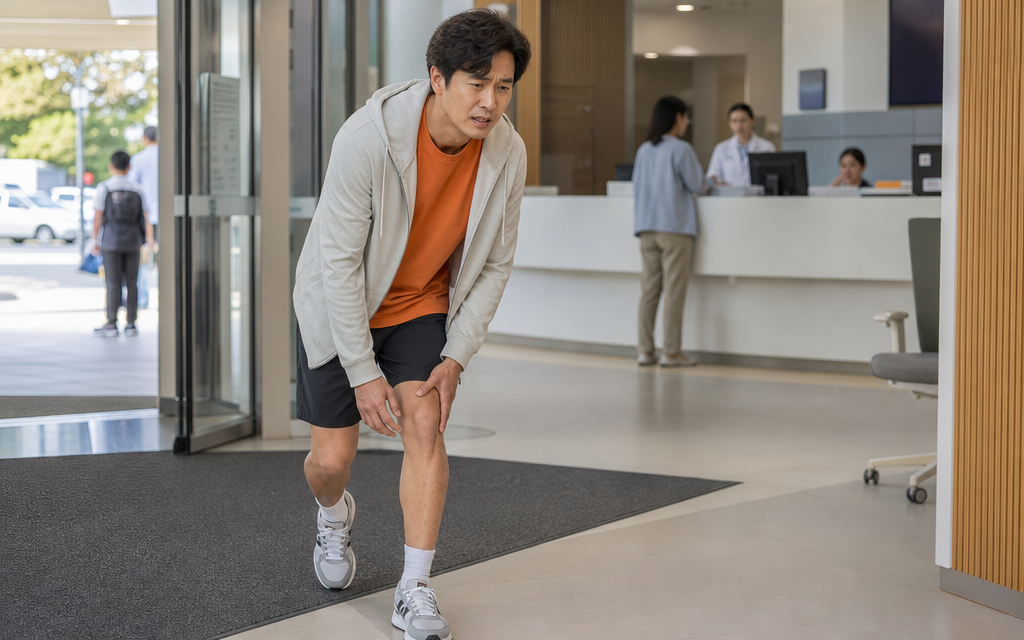
Many people come in with the same concern. The more active you normally are, the more unfamiliar and frightening it can feel when walking suddenly becomes difficult.
But this is not simply “your fault” for overdoing exercise. It may be a natural warning signal your body turns on to prevent further damage to the joint.
In this article, we’ll look at key warning signs you may notice after a sports-related knee injury. Review the limits of early X-ray testing, when a more detailed evaluation is considered, and what recovery benchmarks matter.
1.If you heard a “pop” in your knee, when should you suspect a ligament tear?
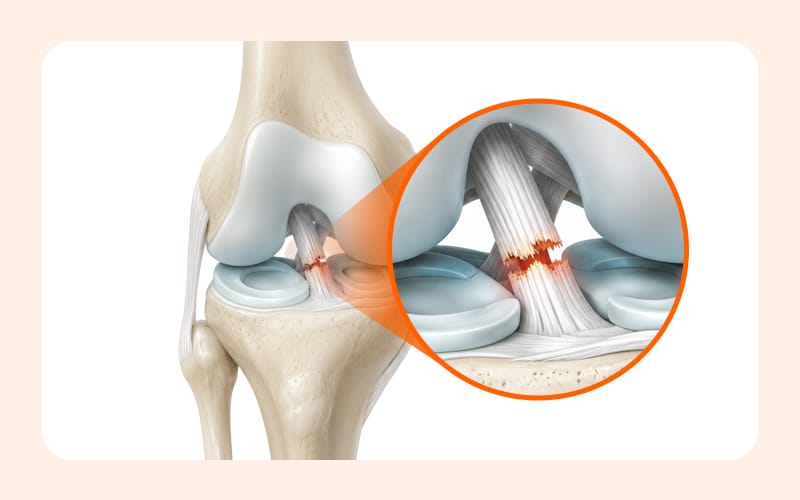
Acute injuries often occur during movements that involve sudden changes in direction, such as basketball or soccer. The same can happen when you land awkwardly after a jump. If, at the moment of injury, you felt a distinct “pop” inside the knee—as if something tore—you should take it seriously. This can be a signal suggesting a higher likelihood of an ACL or posterior cruciate ligament (PCL) tear, or a meniscal injury.
Symptoms can vary depending on which internal structure is injured. Some people feel their leg “give way” while walking, with the knee buckling to the side (giving-way). Others experience a mechanical “locking” sensation, where the leg cannot fully straighten beyond a certain angle and feels stuck. This may be related to a piece of torn meniscus getting caught in the joint space and creating a physical blockage.
If your leg feels like it collapses under you, or you feel significant pressure and cannot support your weight, it should not be brushed off. When stabilizing structures are injured, bleeding can occur inside the joint, leading to rapid swelling. The same applies if the knee continues to feel stuck at a specific angle. In these situations, an orthopedic evaluation and imaging assessment are recommended without delay.
2. Why pain may not improve even when a knee X-ray looks normal
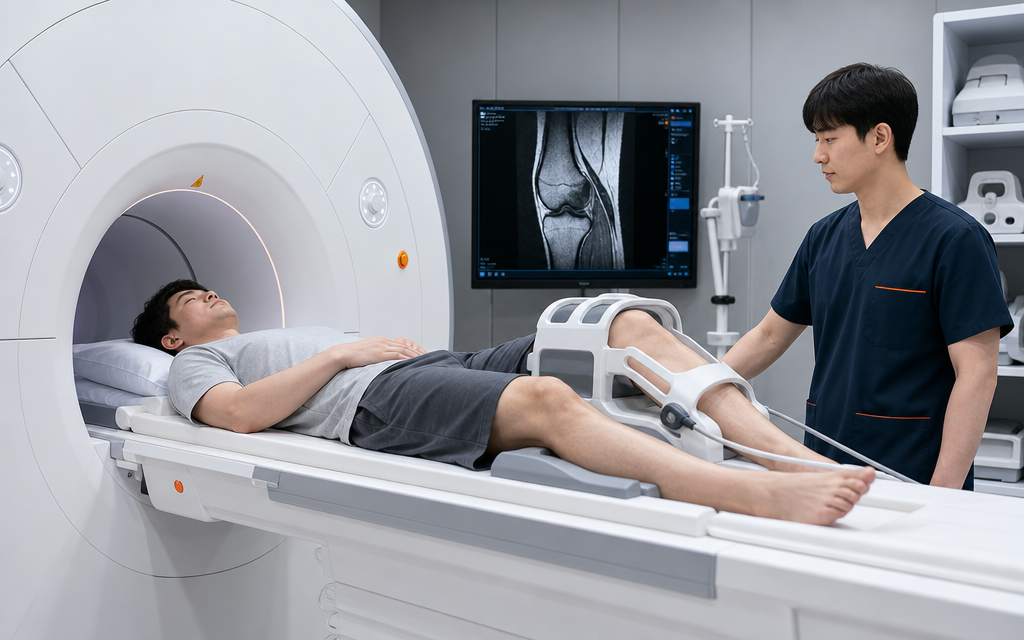
When you arrive at the hospital, clinicians first check quickly for fractures or major dislocations. For this, a basic radiographic test—an X-ray—is typically performed as the first step. If you cannot bear weight or have strong point tenderness, bone injury cannot be ruled out. Often, people are told that this initial test is “normal,” and they may feel reassured and assume it is just a mild sprain.
However, a useful comparison is a car accident. An X-ray is like checking whether the car’s rigid outer frame (the bones) is dented. Even if the frame looks intact, the car may not drive normally if internal shock-absorbing components are damaged. Similarly, even when the bone shape appears normal, there may still be injury to internal ligaments, the meniscus, or cartilage.
This is exactly the part many people miss. On an X-ray, the areas that appear as “empty space” are where important soft tissues exist. If there is no fracture but you still cannot comfortably put weight on the leg after several days, internal injury may be suspected. In that case, based on the physical exam findings, it can be safer to consider a more detailed evaluation such as MRI, which shows soft tissues more clearly.
✅Five warning signs that may warrant early evaluation
- Inability to bear weight and stand independently immediately after the injury
- Rapid knee swelling within a few hours after injury
- Severe pain when pressing around the patella (kneecap)
- Difficulty bending the knee beyond 90 degrees or fully straightening it
- A feeling of instability while walking, as if the knee will buckle or slip out
3. How to decide between knee surgery vs rehabilitation
Being diagnosed with a ligament or meniscal injury does not automatically mean you will go straight to surgery. Treatment direction can vary widely depending on the injured area, the severity of the tear, and your activity goals. Some people plan recovery with the goal of returning to everyday walking and light strolls. Others strongly want to return to high-intensity sports.
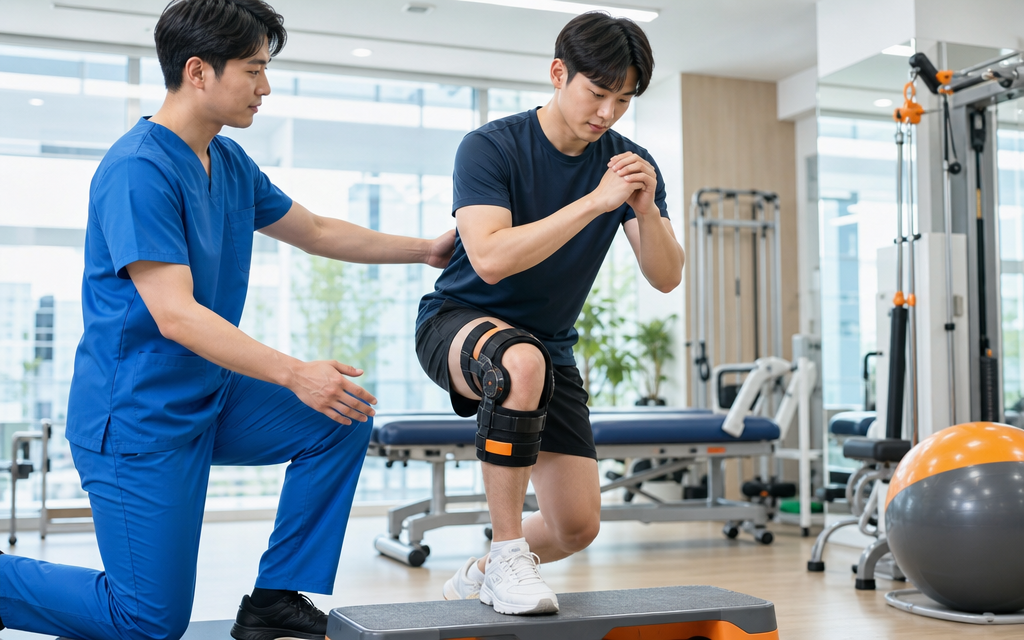
If there are few associated injuries and your activity demands can be adjusted to focus on daily walking, a non-surgical approach may be considered first. Wearing a brace and doing rehabilitation to strengthen surrounding muscles may help. On the other hand, if cartilage injury is present or knee wobbling is clear, returning to high-intensity sports may be difficult. In such cases, surgical treatment—such as reconstructing the injured ligament—can be discussed with a specialist.
Even if you choose non-surgical care, there are key points you must follow during rehabilitation. If you rely too heavily on a brace out of fear of pain, the joint may become stiff. The muscles around the knee can also weaken quickly. Gradual, stepwise rehabilitation that slowly reintroduces weight-bearing—within a safe range that protects the injured tissue—should be combined as an essential part of recovery.
✅Questions worth checking before your clinic consultation
- Immediately after the injury, were you able to step down and walk a few steps on your own?
- Did swelling begin right away, or did it start the next day?
- When bending or straightening the leg, do you feel something “catch” at a specific angle?
4. Why “functional recovery” matters far more than a “rest period” for an injured knee
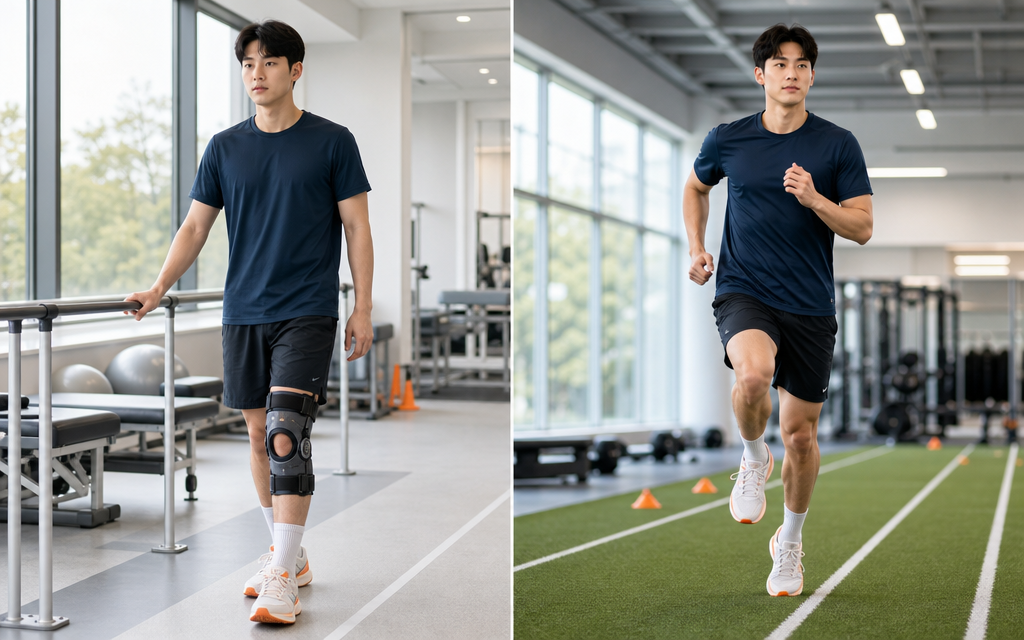
There is one question patients ask most often during treatment: when can they start exercising again like before? Many people expect that once a certain amount of time has passed—such as three months—the body will naturally recover. As a result, they may try to decide the end point of rehabilitation based on calendar time alone.
But relying on time alone can be riskier than expected. Healing of internal structures is like test-driving a car after replacing parts. If you push it too hard before the components are firmly stabilized, it can lead to bigger damage. The most important benchmark is whether strength in the injured leg and the joint’s load-bearing function have actually recovered.
Less pain at rest does not mean the knee can tolerate sports activity. When you jump and land, the knee must be able to handle load without wobbling.
This kind of real functional recovery should come first before returning, for safety. Gradual rehabilitation that increases intensity step by step—walking, then running, then changing direction—is one of the most reasonable ways to protect the joint.
5. When the knee is swollen and hard to walk on, does a warm compress help?
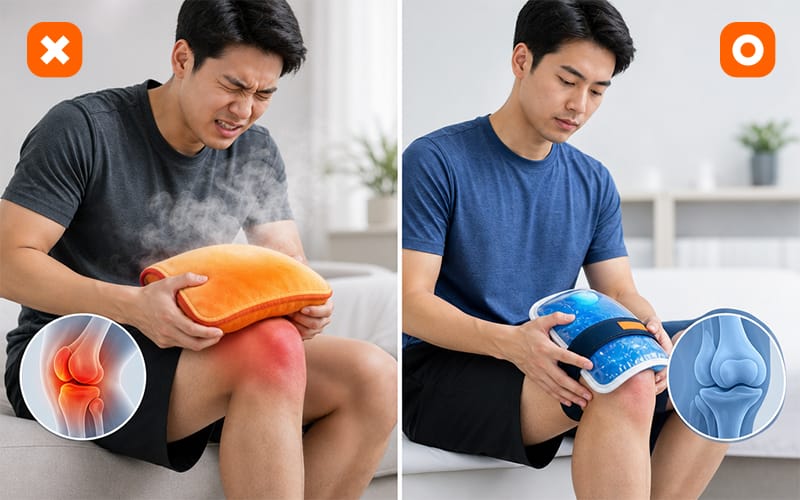
When walking becomes difficult immediately after an injury, many people rush to try a warm compress. They may believe that relaxing tight muscles and improving circulation will speed recovery. Heat therapy can help relax muscles in chronic fatigue or long-standing stiffness. However, in the acute phase—when swelling and warmth are prominent—heat can worsen discomfort, so caution is needed.
This is similar to pouring hot water onto an overheated car engine that is already smoking. Early on, it is important to first reduce micro-bleeding around the injured tissue and bring down rapid swelling. Cold compresses are commonly used to help control early pain and swelling. Transitioning to heat later should be adjusted flexibly based on symptom progression and the diagnosis.
Even if swelling improves with appropriate early care, it does not mean all structural damage has healed. If you return to daily activity too quickly just because pain temporarily decreases, you may overload the tissue. If needed, using crutches or a brace to reduce weight-bearing load on the joint can be helpful. And it is wise to wait for an orthopedic specialist’s diagnosis.
✅Safe principles for early cold compress use
- Protect the skin: Wrap ice in a thin towel so it does not touch the skin directly.
- Short, repeated sessions: Rather than applying for a long time at once, repeat in short intervals of about 15–20 minutes.
- Stop immediately: If pain or abnormal sensation worsens during use, stop right away.
6.Frequently Asked Questions (FAQ)
Q. If my X-ray is normal, are there situations where I still need a more detailed test?
Yes, that may be necessary. X-rays are useful for identifying fractures or major dislocations, but they are limited in evaluating internal soft tissues. Even without fracture findings, if you have difficulty bearing weight or significant instability, additional evaluation such as MRI may be considered depending on the physical exam results.
Q. How should I apply cold compresses early on to control pain?
It is generally recommended to protect the skin by wrapping ice in a thin towel and applying it multiple times in short intervals. Rather than keeping it on for too long at once, it is safer to stop immediately if pain or tingling becomes severe. Adjustments should be made based on the degree of swelling, following medical guidance.
Q. What should I do if my knee feels like it is locking?
If the knee cannot straighten or bend at a certain angle, it may occur when a torn meniscal fragment becomes caught between joint surfaces. Do not forcefully try to straighten the joint. Keeping the leg at the most comfortable angle and getting a medical evaluation first is safer.
Q. How do you distinguish cases that can recover with rehabilitation alone from those where surgery is considered?
The direction depends on your activity goals and the injury pattern. If returning to daily life is the main goal and joint stability is relatively maintained, rehabilitation focused on bracing and strengthening may be considered first. If you want to return to high-intensity sports but have clear instability or associated structural injuries, surgical treatment may also be considered in consultation with your clinician.
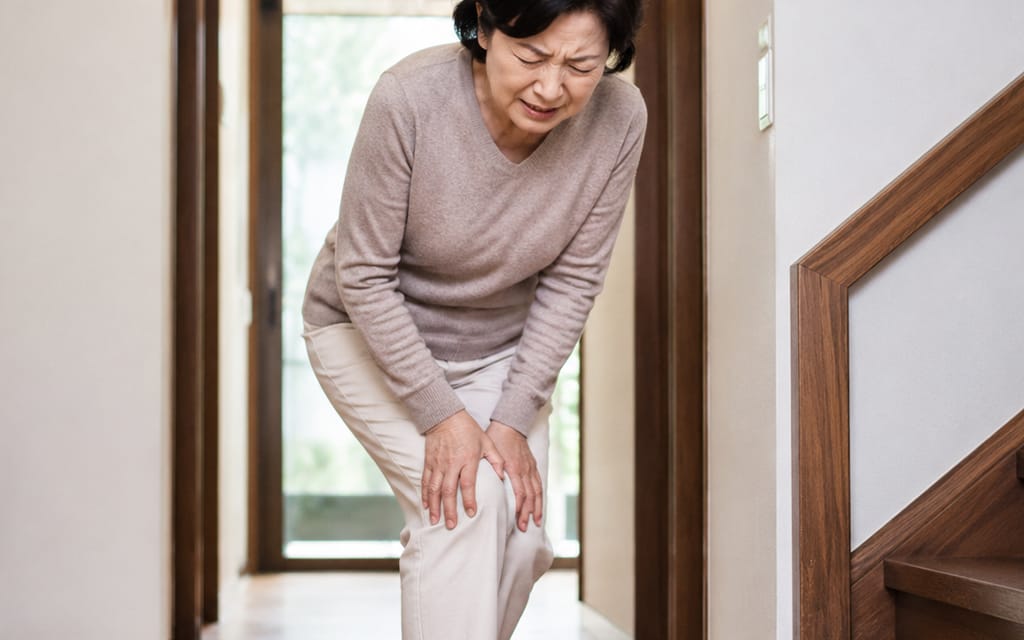
A sudden injury that makes it hard to move can make anyone feel anxious. However, rather than focusing only on short-term pain relief over a few days, it is important to confirm the joint’s structural condition safely. Continuing systematic, function-based rehabilitation—rather than time-based decisions—tends to be far more beneficial in the long run. This can become a solid foundation for enjoying daily life and sports in a healthier way for longer.
Sources
- Korea Disease Control and Prevention Agency (KDCA), National Health Information Portal: guidance on knee joint injuries (last accessed 2023)
- Ministry of Health and Welfare notice: coverage criteria for MRI and related public materials (2022)
- ACR Appropriateness Criteria®: Acute Trauma to the Knee (2020)
※ The copyright for all content on this blog belongs to medihi. Unauthorized copying, distribution, or derivative use is strictly prohibited, and violations may result in legal action without prior notice.