

This post organizes the mechanism and key differentiation points for *mechanical locking*—when the knee cannot fully straighten. Check clear criteria for deciding between surgery and conservative treatment.
Quite a few on-site workers come in saying, “It feels like something is stuck inside my knee, and I can’t straighten it.” This can be a trace of a demanding life—years of quietly enduring heavy loads.
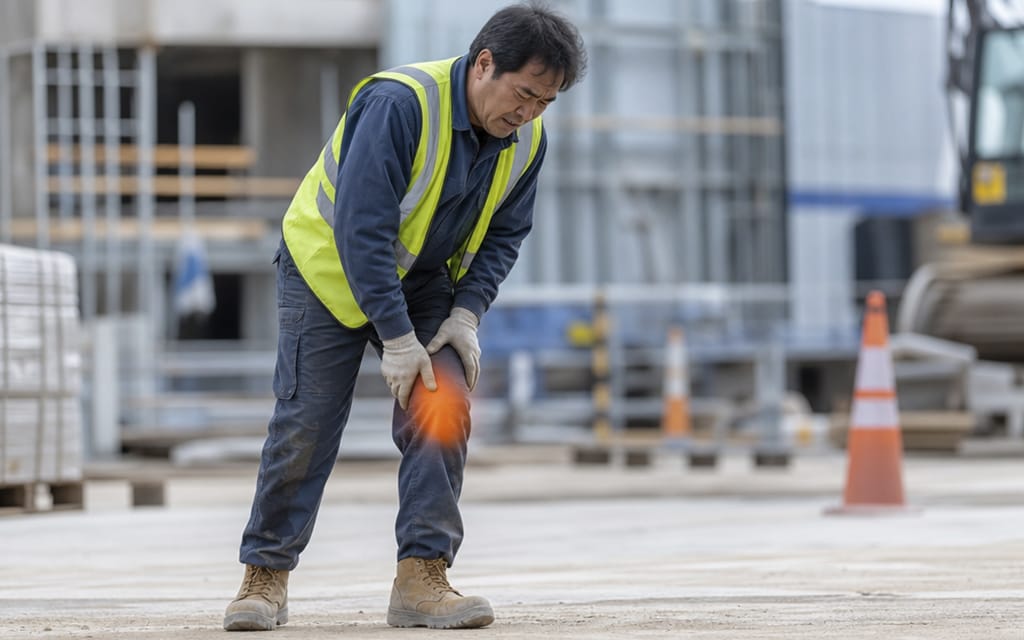
However, if the joint angle is truly blocked, the current structure needs to be assessed objectively.
In this article, we take a detailed look at how *mechanical locking*—a physical blockage of motion—occurs. We also summarize standards for setting a safe and reasonable treatment direction while taking degenerative changes into account.
1. A knee that won’t straighten—how is it different from simple catching or muscle tightness?
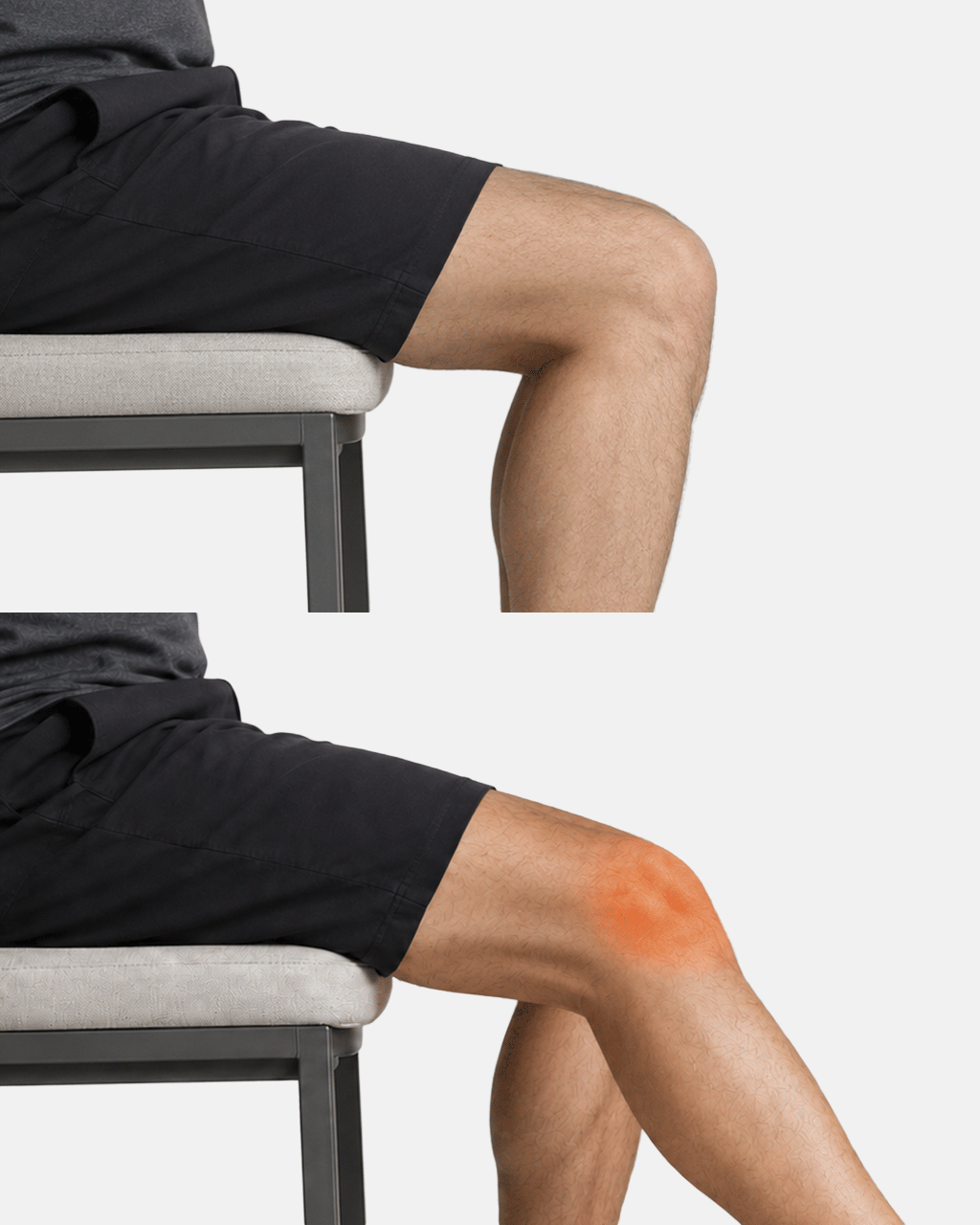
When you do physically demanding work on-site, the muscles around the knee can tense up easily. This kind of simple muscle tightness often relaxes naturally over time. Even light stretching can restore smoother joint movement.
But if the knee won’t straighten at a certain angle—and bending it is also difficult—the pattern is different.
Typical “catching” or clicking often feels like something briefly “brushing past” inside the joint. In contrast, true locking (mechanical locking) is a state where, mid-movement, pain and obstruction make it difficult to bend or straighten any further. It’s similar to a thick rubber door seal getting wedged in a hinge-side gap so the door won’t close. A torn piece of cartilage can become trapped between joint surfaces and physically block the angle.
An extension limitation where the knee cannot fully straighten may be a signal that raises suspicion for a displaced meniscal tear. However, after middle age, swelling and protective limitation of motion can also occur due to degenerative osteoarthritis. So it’s difficult to conclude that “not being able to straighten” automatically means structural damage. A careful process—through physical examination and imaging—is essential to distinguish stiffness from pain versus a true mechanical block.
2. What if squatting movements put pressure on the knee?
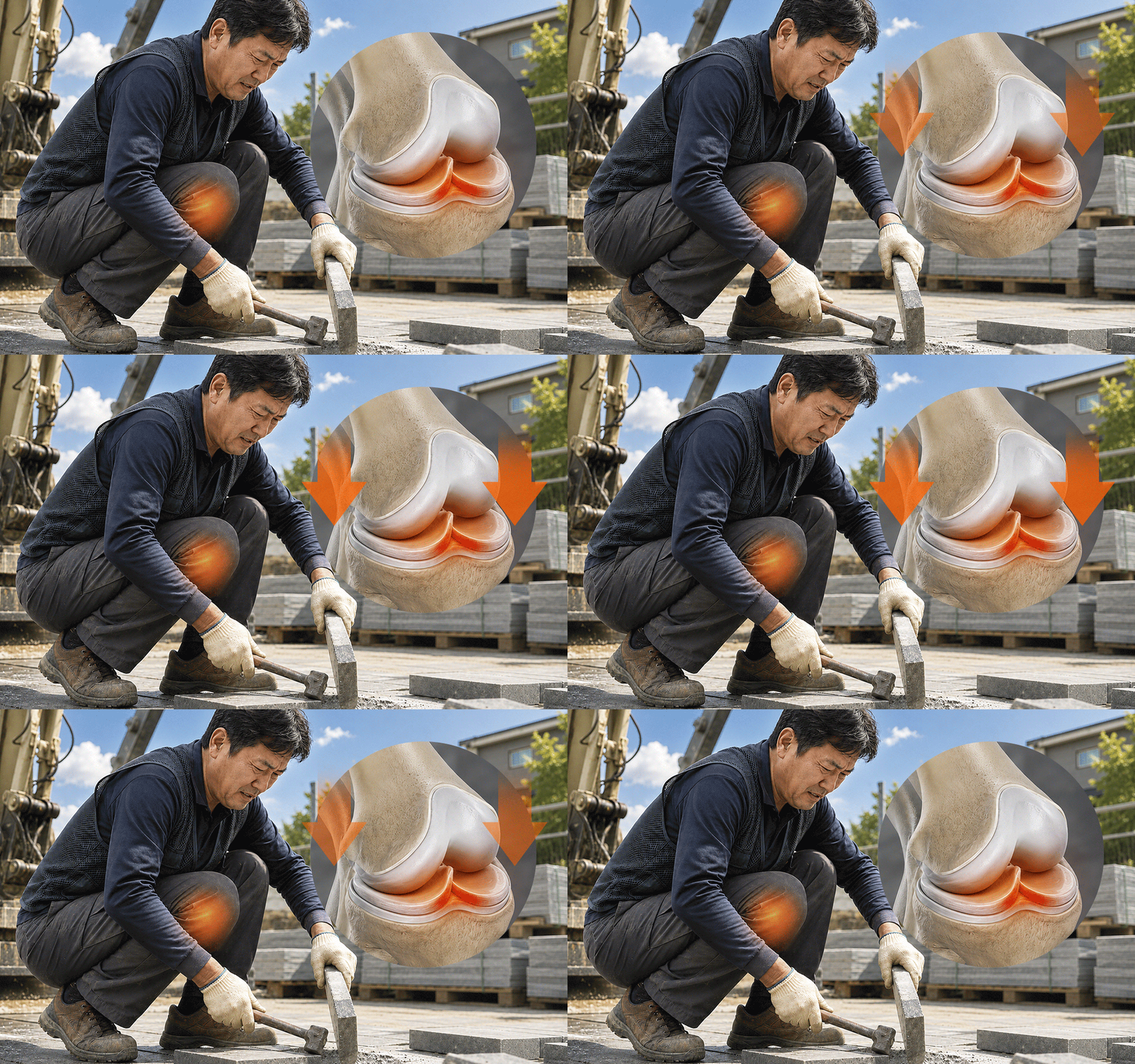
In on-site jobs, it’s common to hold a squatting posture for long periods. Some workers repeatedly handle heavy loads while kneeling. This posture places substantial pressure on the meniscus—the cushioning structure between the knee bones—and can gradually weaken it. If you suddenly pivot while bearing weight, the meniscus may not tolerate the accumulated load, increasing the risk of tearing or slipping out of position.
When strong pressure is applied with the knee bent, the meniscus can be pushed backward. If you then stand up suddenly, the displaced fragment can become firmly wedged between joint surfaces. This creates a physical blockage that prevents the knee from straightening. Forcing the knee to straighten can apply additional force to the trapped fragment, worsening damage and causing severe pain—leading to a locking episode.
In work environments that repeatedly involve bending and straightening the joint, the tear area can expand more easily. That’s why it’s important to correct work habits to distribute load more efficiently. Adjusting everyday movement patterns and moderating workload intensity are essential parts of treatment.
✅Self-check for on-site worker knee locking (before/after work)
- Is the angle at which your knee fully straightens clearly different from the other leg?
- When standing up from a squat, do you feel a sudden “catch” at a specific angle?
- Have episodes of brief blockage followed by release been repeating recently?
- Beyond simple stiffness, do you feel as if the joint is physically getting stuck?
3. Why can’t an X-ray alone identify the cause of knee locking?
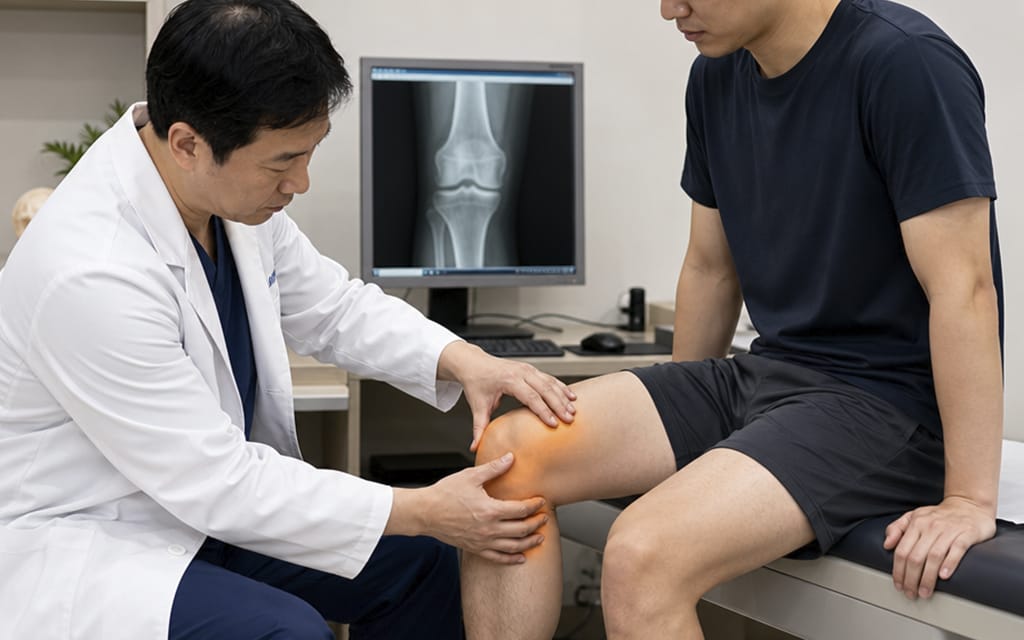
If your knee is swollen and won’t straighten, the first step at a clinic is typically an X-ray. X-rays are very useful for checking overall bone shape and joint space. However, soft structures like the meniscus or ligaments—which cushion between bones—do not appear on X-ray images. So even if the bones look normal on X-ray, the meniscus may still be significantly damaged.
To compensate for these limitations, clinicians combine imaging with a careful physical exam. They gently press around the knee to check for distinct joint-line tenderness. They may also rotate the knee and assess for catching during maneuvers (e.g., McMurray, Apley’s test). If these findings strongly suggest a structural meniscal tear, more detailed testing is considered.
If there is a clear history of trauma and pain accompanied by a sudden loss of extension, early evaluation is important. Deeper discussion is also needed when functional impairment makes on-site work impossible. In such cases, MRI is used to assess the precise tear location and whether it is displaced. Based on this, a structured treatment plan is developed to match the individual’s meniscal condition.
4. Torn meniscus: partial resection vs repair—which is more favorable long term?
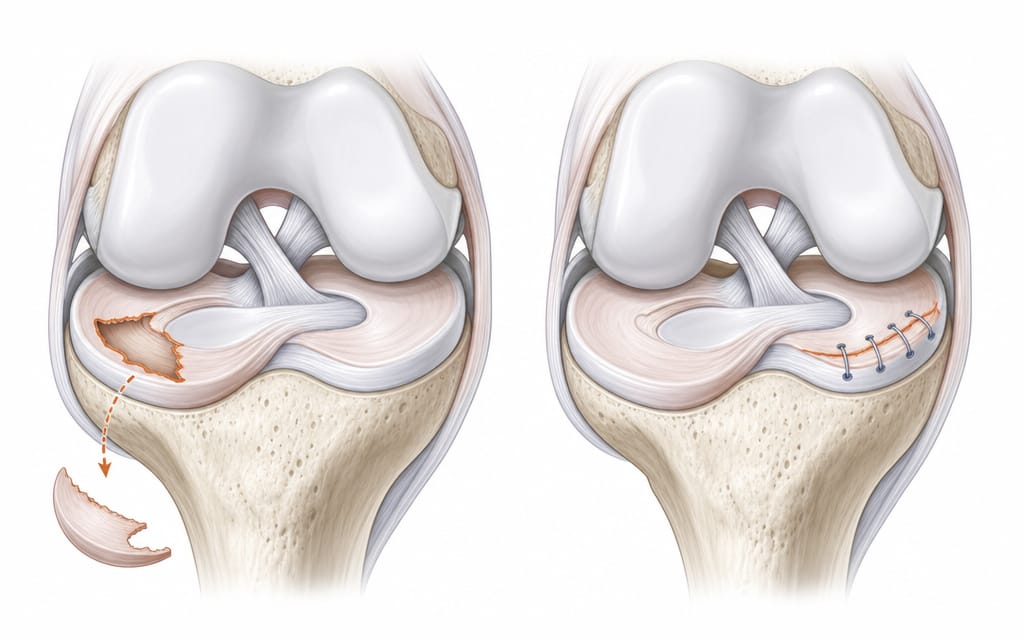
If active treatment is needed, the treatment method for the torn meniscus must be chosen carefully—whether to trim part of it or to stitch it back in place and preserve it. In the past, partial resection (trimming frayed, torn portions) was common, partly because the procedure is simpler and short-term recovery can allow a faster return to on-site work.
However, when considering the long-term “remaining lifespan” of the joint, the standards change. If you tear out the door seal stuck in the gap, the door may open and close more easily right away. But over time, cold air can leak through, reducing the original protective function. Similarly, removing meniscal tissue reduces the cushioning surface area that supports the bones, which can increase the risk of worsening arthritis later.
More recent medical standards prioritize a conservative, tissue-preserving approach whenever possible—keeping as much of the original meniscus as feasible. If blood supply to the tear area is adequate and the tissue is strong, repair can be more favorable long term. On the other hand, there are situations where the meniscal tissue is worn down and unable to hold sutures. In those cases, a limited resection or continued conservative management may be the safer choice.
✅Self-check items to confirm with your clinician during consultation
- Does a certain posture make the “something tightly stuck inside the knee” sensation worse?
- When standing up from a squat, does the knee fail to straighten smoothly in one motion?
- When you lightly press around the joint line, is there clear, sharp tenderness?
5. Degenerative meniscal tears—when is conservative treatment possible?
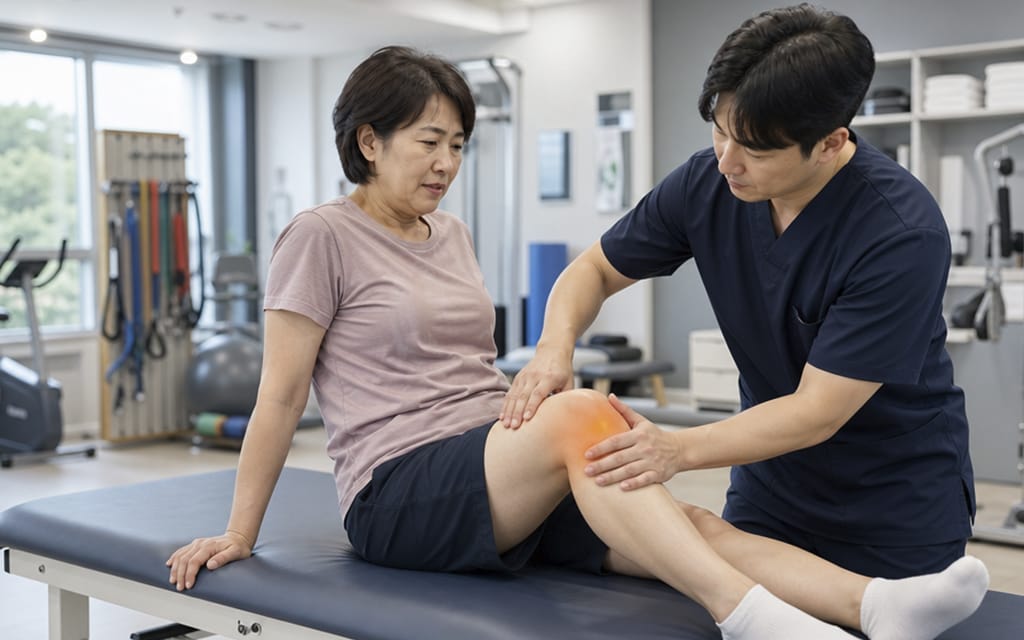
Mechanical locking in middle-aged and older adults does not occur only from acute trauma. With age, degenerative changes often accompany it—such as osteophyte formation around the joint or loose bodies within the joint. Even if imaging confirms a meniscal tear, that finding may not be the only cause of discomfort. If degenerative osteoarthritis has already begun, surrounding tissues can respond in complex ways.
In such situations, it’s important to avoid deciding on surgical intervention too quickly based solely on a tear finding. Long-term follow-up studies have rated the clinical value of conservative treatment highly for degenerative tears. Consistent, structured load management and physical therapy can be beneficial over time. Trimming torn meniscal fragments does not stop the progression of osteoarthritis itself.
However, what if the meniscal fragment is displaced and completely blocks joint motion? In that case, early evaluation to determine whether the range of motion is truly mechanically blocked may be helpful. Depending on the results, the plan can be decided step by step—whether to continue conservative care for longer or consider limited surgery. The decision should prioritize protecting the joint’s remaining lifespan rather than focusing only on short-term symptom relief.
6.Frequently Asked Questions (FAQ)
Q. My knee is locked and won’t straighten well—should I treat this as an emergency?
If there is persistent extension limitation where the knee cannot fully straighten, the situation should be monitored carefully. But the priority is to differentiate true mechanical locking from inability to straighten due to swelling and pain. If a displaced meniscal fragment is blocking the joint, early evaluation and a stepwise treatment plan are safer.
Q. I’m a 40s–50s on-site worker—can a meniscus-preserving repair be possible?
Age alone does not rule out repair. The decision is made by considering blood supply at the tear site and the overall health of the remaining meniscal tissue. Even in middle age, preserving tissue is reviewed as a priority to help delay future osteoarthritis.
Q. Are there limitations to X-rays? Do I need an MRI?
X-rays are essential for checking bone shape and joint space, but soft cartilage tissue is not visible. If mechanical locking is frequent or daily life is significantly affected by clear functional impairment, MRI can help identify the exact tear location and whether it is displaced.
Q. If I have surgery, when can I return to on-site work (squatting, lifting heavy loads)?
Recovery time varies greatly depending on the tear pattern and the treatment method. In particular, after a meniscus-preserving repair, deep knee bending and weight-bearing activities are strictly restricted early on. To support stable recovery and prevent re-injury, the return-to-work timeline should be carefully coordinated with your clinician.

Mechanical locking where the knee cannot fully straighten is often a structural signal that should not be dismissed lightly. Still, the key is distinguishing whether it is true locking caused by a fragment caught in the joint, or a protective limitation due to inflammatory pain. In addition, the safe treatment direction is determined by considering the degree of age-related degenerative change in combination.
The sweat you’ve poured into handling heavy loads on-site may have remained as a heavy burden on your knees. But if you objectively assess your current joint condition and find the right alternatives, you can regain a more stable daily life. We hope the criteria summarized today help you make a calmer and more reasonable decision.
Sources
- Journal of the Korean Orthopaedic Association (J Korean Orthop Assoc), 2024. (Domestic retrospective analysis reporting clinical characteristics of surgical patient groups)
- National Health Information Portal, Symptoms and diagnostic criteria for knee meniscal injury, 2023.
- van de Graaf VA et al., Effect of Physical Therapy vs Arthroscopic Partial Meniscectomy in People With Degenerative Meniscal Tears: 5-Year Follow-up of the ESCAPE Randomized Clinical Trial, JAMA Network Open, 2022.
※ The copyright for all content on this blog belongs to medihi. Unauthorized copying, distribution, or derivative use is strictly prohibited, and violations may result in legal action without prior notice.
Recommended reads
 medihi