

“I’m afraid a tooth might suddenly pop out when I chew something hard, so I only chew on one side.”
“When I brush, it feels like the tooth moves too, and it makes me anxious.”
When you’re brushing in front of the mirror and a tooth feels like it “wobbles” the moment the toothbrush touches it, your mood can sink even without pain. It’s easy to brush it off with thoughts like, “Am I just being sensitive?” or “It’s probably temporary.” And when you’re faced with hard foods like nuts or meat, chewing itself can start to feel cautious.
But the longer that “cautiousness” continues, the more your daily routine can gradually change. Today, rather than amplifying fear, we’ll lean on the shared perspective commonly communicated by trusted organizations such as the WHO, ADA, and FDA—how to think about tooth looseness, and when it may be reasonable to include it in your personal “time to get checked” criteria.
1. Fact-check: “If I’m getting older, teeth can loosen anyway, right?” Is that really true?
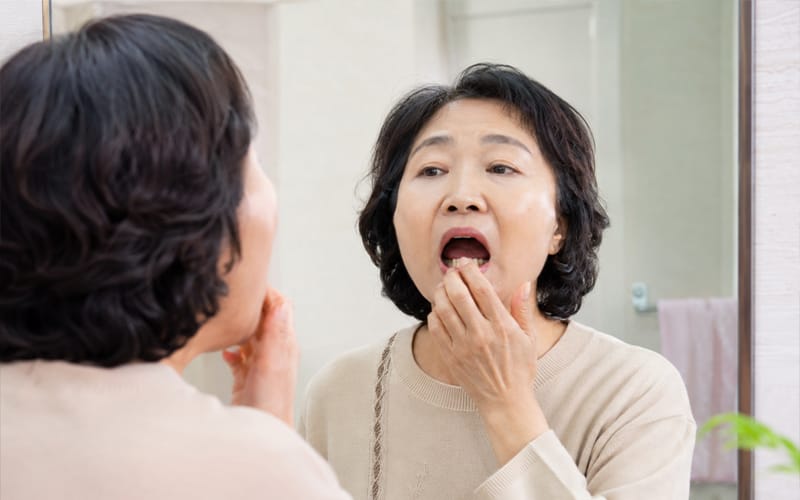
When people notice tooth looseness, the thoughts that come up are often very similar:
“Teeth can naturally loosen a bit as you age.”
“It doesn’t hurt, so it can’t be a big problem.”
“I heard that after scaling (tartar removal), teeth can feel looser.”
“An implant is artificial, so even if it feels loose, isn’t it less risky?”
However, guidance from reputable organizations suggests it’s difficult to view tooth looseness as merely a simple, natural part of aging. The WHO (World Health Organization)
notes that severe gum disease is a major global burden, and that accumulated oral health problems can affect everyday functions—like chewing and speaking—as well as quality of life. In other words, before dismissing it as “just age,” there’s a reasonable basis for setting some personal criteria for when to get things checked.
The ADA (American Dental Association) also repeatedly explains in public-facing guidance that when gum health worsens, the structures supporting the teeth can weaken—leading to tooth looseness or even tooth loss. The key point is that these organizations commonly emphasize that pain may be absent. Deciding to “wait and see because it doesn’t hurt” can be an easy conclusion when you don’t have enough information.
If you have an implant, it’s generally safer not to assume it’s fundamentally different. In FDA consumer guidance, implants are described as requiring good oral hygiene and regular checkups, and if discomfort or a problem is noticed, professional evaluation is recommended. Put simply: whether it’s your natural tooth or an implant, if you feel looseness or discomfort, it’s hard to confidently conclude “it’s fine” based on self-observation alone—and that perspective can be considered the baseline.
2. Hidden changes: What can happen in daily life if you leave it alone

Tooth looseness can be unsettling because even without significant pain, daily life may start to change. At some point, you may naturally stop chewing on the side with the loose tooth. It might begin with avoiding only hard foods, but over time, some people find that the entire act of eating becomes cautious. You hesitate in front of foods like meat, squid, or nuts, and gradually shift toward softer choices. Some people notice meals taking longer, or feel that the “enjoyment of eating” has decreased.
Another issue is food getting stuck. In the past, a quick rinse might have been enough, but suddenly you may notice food trapping between teeth more often. If your gums feel sensitive when using an interdental brush or floss to remove it, the process itself can become stressful. You might also feel “unclean” again soon after brushing.
And a surprisingly impactful change can be a shift in your bite (how chewing feels). If you start noticing sensations like, “Today feels different from yesterday,” or “This tooth hits first,” you may feel your pronunciation is awkward when speaking, or that your jaw tires more easily. Individual experiences vary, but if reduced function continues, some people also describe a sense that the area around the mouth feels less “supported” than before (including changes in the impression around the lips).
This is ultimately the same point repeatedly addressed in WHO and ADA materials. So rather than using “the looseness I feel right now” to label a diagnosis, it may be more practical to treat it as a signal to check whether your everyday function has started to shift.
3. Self-check: An objective checklist to confirm right now
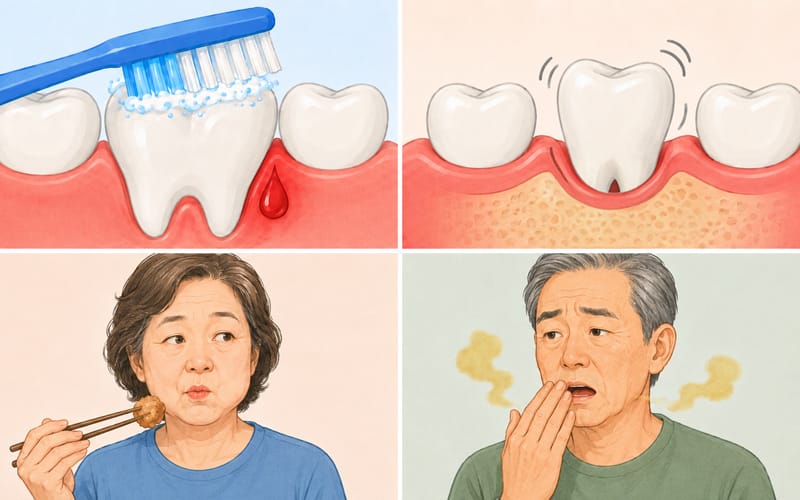
The items below are not a medical interpretation. They are everyday signals—organized based on criteria communicated by reputable organizations—that move you closer to “a checkup is recommended.” Please use natural, day-to-day changes as your reference.
- Repeated gum bleeding during brushing or meals
If you often see blood on your toothbrush, or notice bleeding patterns such as when biting into fruit, it can be a reasonable criterion to include. - Tooth looseness is repeatedly noticeable beyond a vague “feeling”
If you repeatedly feel a “wobble” while chewing or brushing, it may be a criterion to consider an exam rather than only monitoring on your own. - Your chewing habits have changed (chewing on one side/avoiding hard foods)
If anxiety makes you avoid chewing on a specific tooth, or you consciously avoid foods you used to enjoy, it may be a sign that lifestyle changes have already begun. - Bad breath or food trapping has clearly increased compared to before
If an unpleasant feeling returns quickly even after brushing, or you notice more frequent food trapping between teeth, it’s a good idea to include these changes in your criteria as well.
If two or more of the above continue for more than two weeks, or if you feel the looseness has suddenly worsened, self-care alone may not be enough to ease your anxiety. Even if you have an implant, if you also notice “looseness, instability when chewing, or gum bleeding,” it may be safer to include it in the same checkup criteria—consistent with the intent of FDA consumer guidance.
Sources
- World Health Organization (WHO), Global Oral Health Status Report, 2022
- American Dental Association (ADA), Oral Health Topics: Periodontitis, 2021
- Korea Disease Control and Prevention Agency (KDCA) National Health Information Portal, Information on Periodontal Disease (Gum Disease), 2020
※ This content is intended for general health information and does not replace professional diagnosis or treatment based on an individual’s condition. For an accurate assessment, a dental visit is recommended.