

A pediatric eye exam is not simply about whether you need to rush to the clinic right now. It becomes much easier to decide when you focus on (1) when the national child health screening begins its “vision questionnaire” and “quantitative visual acuity test,” and (2) when to move on to a comprehensive eye exam if there are warning signs. This post summarizes the key timing parents of 3–5-year-olds should not miss—especially the first true vision test window (around 42–48 months)—and the exception criteria for when symptoms or risk factors mean you should be evaluated earlier.
“When exactly should I check whether my child has poor eyesight?”

Because children often cannot clearly describe visual discomfort, many parents struggle with when to schedule a pediatric ophthalmology visit. Even if nothing seems wrong so far, you may worry that missing the right timing could affect your child’s eye health.
In the exam room, clinicians pay close attention to whether families miss the opportunity to screen for amblyopia (when visual development does not fully mature), refractive errors, and strabismus during the preschool years. That is why Korea’s national infant/child health screening system and international recommendations (USPSTF) both emphasize the need for screening between ages 3 and 5.
1. First Pediatric Eye Exam: What’s the difference between a “vision questionnaire” and a “quantitative visual acuity test”?
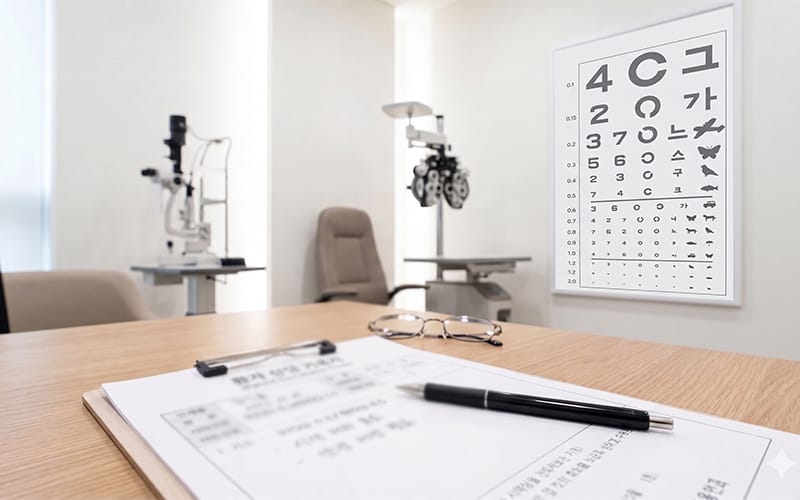
In the national infant/child health screening program, it may look like everything is grouped under “eye exam,” but in reality two different steps are combined.
One is the “vision questionnaire,” which checks for signals such as suspected strabismus or abnormal visual behaviors through caregiver Q&A. This can begin early in infancy, and its purpose is closer to risk-signal screening.
The other is what caregivers usually think of as a “real vision test”: a “quantitative visual acuity test” based on a vision chart. This test screens for amblyopia or refractive-error risk by measuring vision using pictures or numbers on a wall chart. It’s like the difference between asking whether a child walks well in daily life versus placing them on a track and directly measuring how fast they can run.
The key difference is when each begins. Based on the national screening operational criteria, the vision questionnaire may be repeated across multiple visits, but the quantitative visual acuity test is typically included starting around the 42–48 month window.
Ads often emphasize early detection alone, but in practice you first consider whether the questionnaire flagged any signals and whether your child is old enough (and cooperative enough) to complete a quantitative test. Understanding this distinction can ease the worry of, “Why does it feel like my child hasn’t had an eye exam until now?”
✅Timeline Summary: “Questionnaire vs. Quantitative Test”
- Vision questionnaire: conducted at every round (caregiver-observation-based detection of risk signals)
- Quantitative visual acuity test: typically conducted at 42–48 months, 54–60 months, and 66–71 months
2. Why is vision testing at ages 3–5 (especially around 42–48 months) so important?
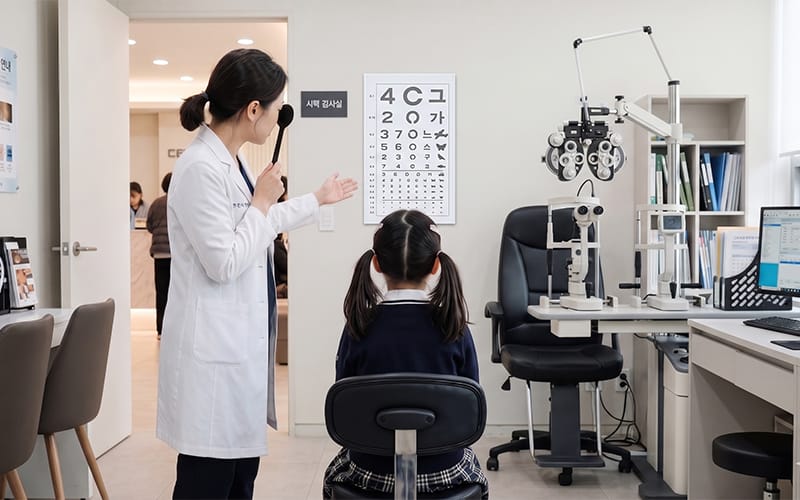
Ages 3–5 are a period when the visual neural network connecting the eyes and brain develops actively, making it an important age range for screening for amblyopia and its risk factors. During this time, children are more likely to cooperate with picture-based charts or standard vision charts, which increases the chance of checking vision quantitatively. International guidance (USPSTF) also supports at least one screening for amblyopia and risk factors between ages 3 and 5.
A common misunderstanding among parents is: “If my child runs around and seems fine in daily life, can’t we do the vision test later?” However, amblyopia or refractive errors can be asymptomatic, and children may compensate through their behavior.
It’s similar to checking clothing size in a fitting room. Even if an outfit looks fine at a glance, the shoulder line or length may be off. A quantitative visual acuity test helps screen risk by confirming—using objective numbers—whether a child who “seems to see well” is actually seeing well. Because identifying causes and managing them earlier can often be advantageous when planning care, preschool screening continues to be emphasized.
✅ Checkpoints for Parents
- When completing the national screening questionnaire, check whether there were any signs of visual abnormality (e.g., eye drifting) noted
- Confirm whether your child has entered the 42–48 month window and is eligible for the quantitative visual acuity test
- Observe whether compensatory behaviors repeat (squinting, holding things very close, etc.)
3. If we follow the national child health screening vision test schedule (42–71 months), is that enough?

For parents of children aged 3–5, it is a good idea to treat the national screening
timeline—especially around 42–48 months—as the benchmark for the “first vision test,” and make sure it is not missed.
However, the national screening is primarily a screening test. Even if the result is “normal,” it does not by itself mean a confirmed ophthalmic diagnosis. Conversely, if the result suggests a “possible abnormality,” the safer next step is to confirm through a comprehensive eye exam at an ophthalmology clinic. A comprehensive evaluation may include refraction testing (including cycloplegic refraction when needed) and strabismus assessment.
Another variable is your child’s cooperation. Some children may cry, refuse to answer picture/number prompts, or resist covering one eye, making chart-based testing difficult. Just as you might change your approach rather than forcing a child to try on clothes in a fitting room, it may be better to avoid pushing too hard—either retry later (after adjusting for condition and mood) or transition to alternative screening methods and a comprehensive exam at an eye clinic. The key is ensuring that the evaluation your child needs continues without interruption.
4. If my child is under 3 or cannot cooperate well, can device-based screening replace
chart testing?
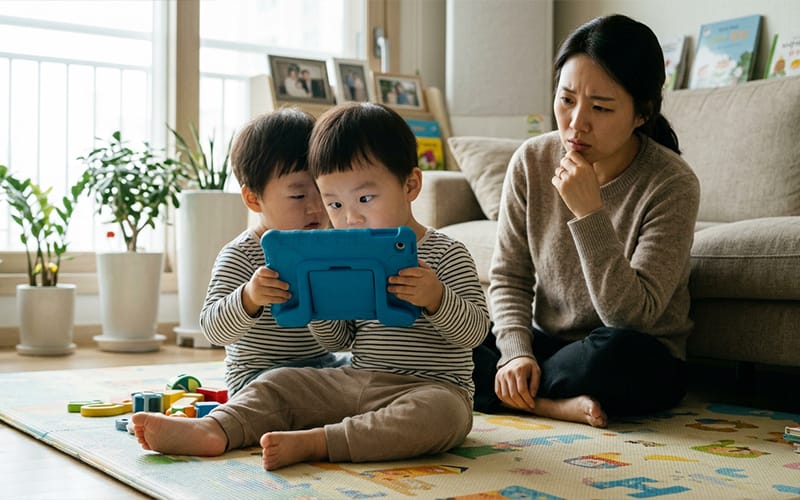
Under age 3, standard chart-based visual acuity testing can be difficult due to limits in cognition and cooperation. In such cases, experts explain that device-based screening tests using specialized camera-like tools (such as photoscreening) may be used as a supportive option. This method uses reflected light from the eyes to detect refractive-error risk.
For children who struggle to cooperate, you can set clear criteria like the following.
📌 Criteria for checking vision in children under 3 or with limited cooperation
- Situation 1: No symptoms, no notable family history, and the child is gradually able to recognize picture targets
→ Recommended action: Avoid forcing testing, and use the 42–48 month national screening as the baseline timing for the first quantitative test. - Situation 2: Even under age 3, the child watches TV extremely close, frequently tilts their head, or has obvious eye drifting/crossing
→ Recommended action: Do not wait—discuss with a clinician and consider advancing pediatric ophthalmology evaluation, including early screening using devices.
The most important caution is that device-based screening is only an “alarm” to detect risk factors. You cannot conclude there is no issue simply because the device screening did not flag anything. If the screening is positive—or if it is negative but suspicious symptoms persist—you should be connected to a comprehensive ophthalmic exam for confirmation.
5. If you’re worried about strabismus or amblyopia, what criteria make “when to check”
clearer?
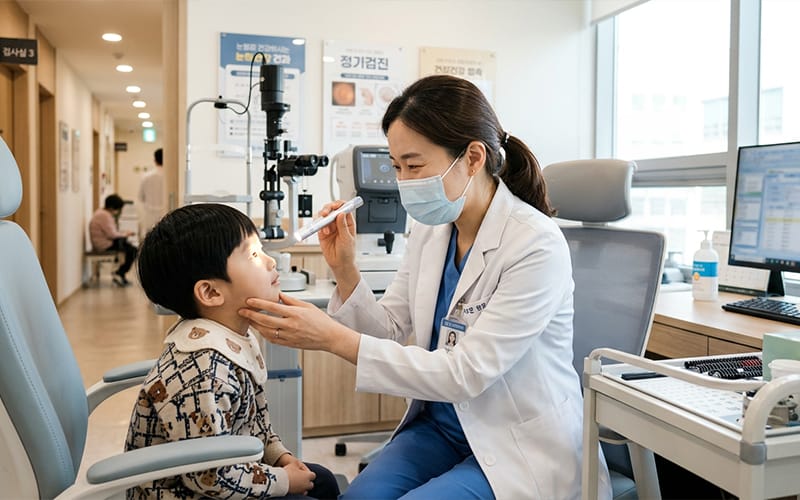
When parents worry that a child’s eyes might be “bad,” two concerns are often mixed together. One is “detecting amblyopia,” and the other is “symptoms of strabismus.” Amblyopia is a condition in which vision does not improve adequately during development even without structural abnormalities; causes can include strabismus, anisometropia (unequal refractive power), or high refractive error.
Strabismus is when the eyes are not aligned and do not look at the same point, so one eye may appear to drift inward/outward/up/down. Because strabismus can lead to amblyopia and reduced binocular vision function, if true strabismus is suspected, binocular vision assessment and treatment may be needed.
It is very difficult to make a definite judgment at home based only on the position of light reflections in photos. Rather than relying on appearance or daily adaptation for reassurance, the most stable approach is to keep the quantitative visual acuity test (around 42–48 months) as your main baseline—and if there are warning signs or a family history, connect to a careful comprehensive exam even earlier.
6. Frequently Asked Questions (FAQ)
Q. When is an appropriate time for my child’s (age 3–5) first pediatric ophthalmology checkup?
If there are no particular suspicious symptoms, it is reasonable to use the national screening timing around 42–48 months—when the first quantitative visual acuity test is included—as your baseline. However, if your child frequently squints severely, sits extremely close to the TV, and there is a clear family history, it is better to discuss earlier pediatric ophthalmology evaluation regardless of age.
Q. If the national screening vision test result is “normal,” can we skip going to an eye clinic?
The vision test in the national child health screening program is primarily a screening test. It is safer to interpret “normal” as meaning the child passed the screening criteria at that time. If symptoms persist or new signals are observed—such as suspected strabismus or frequent eye rubbing—it may be necessary to confirm again with a comprehensive exam.
Q. Is testing impossible for children under 3 who cannot read picture charts?
For children under age 3, chart-based testing may be difficult due to cooperation limits, but it is not necessarily impossible. Device-based screening using specialized camera-type tools (such as photoscreening) can be used as a supportive option. However, because this is not a definitive diagnosis, clinician judgment and linkage to a comprehensive exam are
important for interpretation.
Q. When should we move up an ophthalmology visit or consultation earlier than the scheduled screening?
When there is a clear family history, such as a parent or sibling with high refractive error or strabismus. Also, if your child repeatedly tilts their head to look at things, or reacts with unusually strong distress or refusal when one eye is covered, it is safer to bring forward a comprehensive pediatric ophthalmology consultation regardless of timing.

Pediatric ophthalmology screening starts with clearly understanding the difference between the vision questionnaire and the quantitative visual acuity test. The quantitative visual acuity test included in the national child health screening around 42–48 months is a very important test for screening refractive errors and amblyopia risk that may be hidden without symptoms.
Even if your child is under 3 and cannot reliably read a chart yet, there is no need to panic. Rather than forcing the test, you can wait for the appropriate timing—while still seeking help through early device-based screening if clear suspicious behaviors are observed.
Worrying about your child’s vision does not mean you have done anything wrong as a parent. Using the age-based screening timeline and exception criteria summarized today, I hope you can create a calm, comfortable plan that fits your child’s situation.
Sources
- Ministry of Health and Welfare / Korea Disease Control and Prevention Agency (KDCA), National infant/child health screening items (including vision questionnaire / vision test windows)
- KDCA National Health Information Portal, amblyopia information
- U.S. Preventive Services Task Force. Vision Screening in Children Aged 6 Months to 5 Years, 2017
※ The copyright for all content on this blog belongs to medihi. Unauthorized copying, distribution, or derivative use is strictly prohibited, and violations may result in legal action without prior notice.