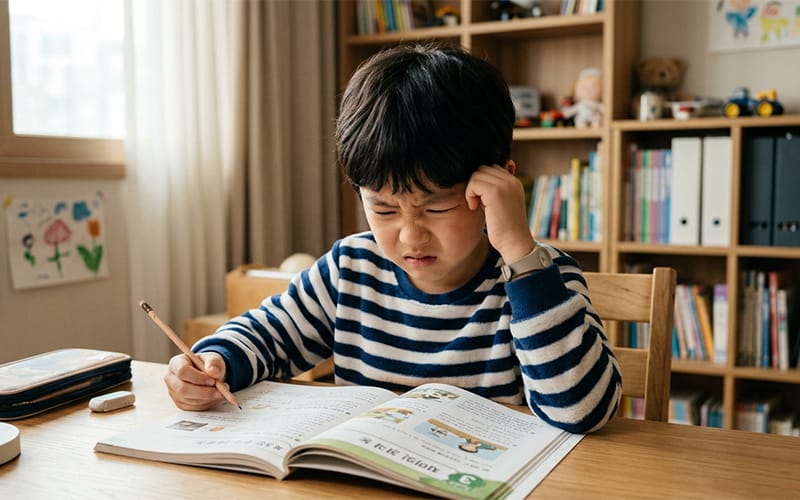

Pediatric myopia develops through a combination of genetic and environmental factors. More important than whether a child “inherits” a parent’s eyesight is establishing regular follow-up exams aligned with the child’s visual development and setting clear, realistic standards for environmental management at home.
“I had poor eyesight and wore glasses too… Will my child take after me and end up with much worse vision later?”
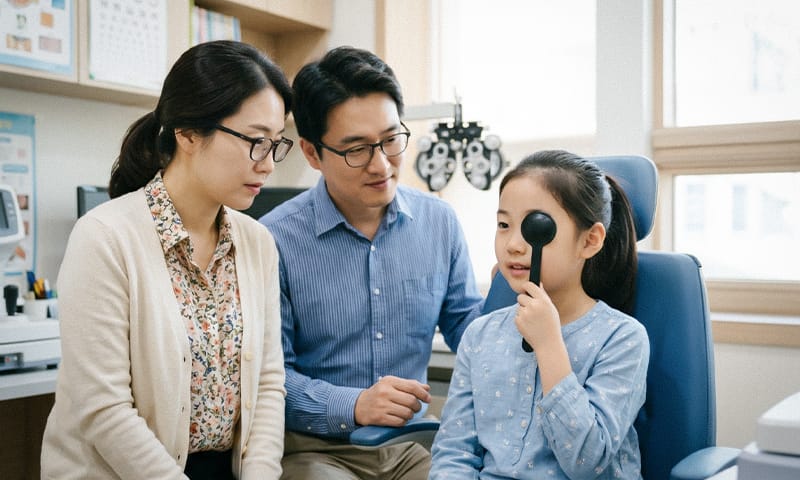
Parents who come to the clinic often feel anxious and blame themselves for their child’s declining vision. The more likely a parent is to wear glasses, the more they worry their child’s eyes will “go bad early” because they take after them—and many express guilt.
Because family history of pediatric myopia is an important clinical clue for predicting future visual development and planning follow-up, one of the first things clinicians check when starting a child’s vision care is family history. If there is high myopia or certain ophthalmic conditions in the family, a more detailed approach may be needed. However, a child’s vision decline is not determined solely by a parent’s genes.
Family history is simply a signal that a child’s eye health should be observed earlier and more carefully—it is not a definitive outcome that determines the child’s vision.
1. Why parents who wear glasses feel anxious—and why family history doesn’t determine vision
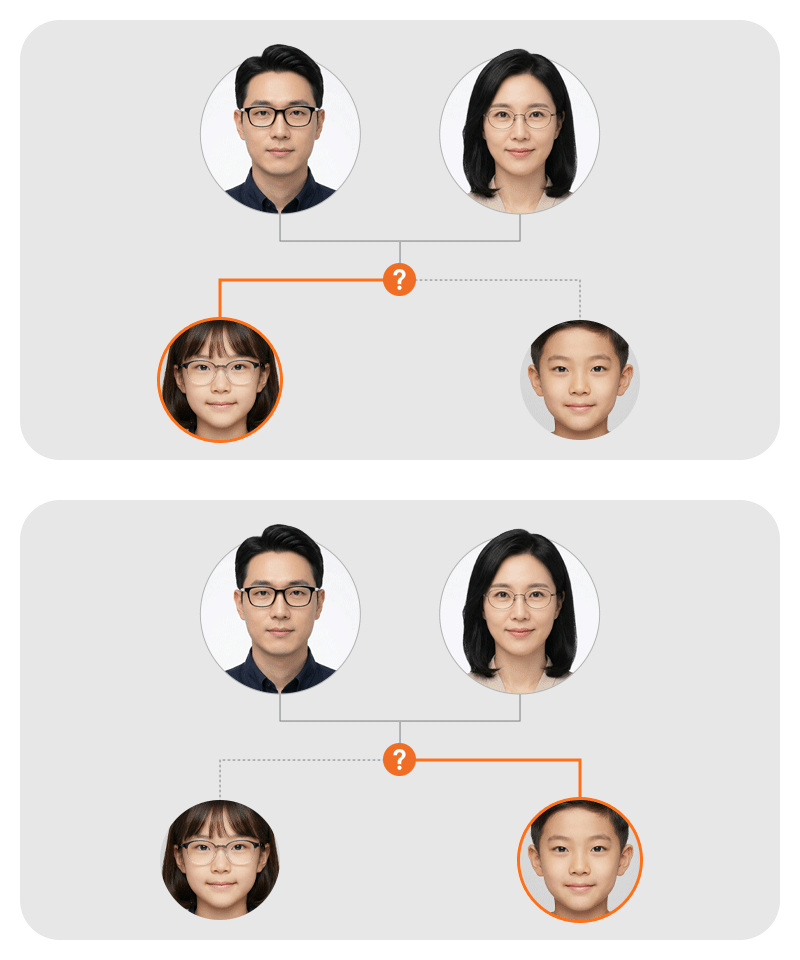
Many people assume that if a parent has poor eyesight, the child will inevitably have poor vision as well. But in clinical practice, genetic influence in pediatric myopia can be compared to “seeds” and “soil.”
Inherited factors may be a “seed” that is more vulnerable to myopia. However, it is difficult to attribute a child’s myopia simply to genetics. Without “soil”—environmental factors such as excessive smartphone use or insufficient outdoor activity—things do not necessarily progress in a negative direction.
So there is no need to give up in advance or feel overly anxious just because there is a family history. As a first-line strategy at home, families can adjust daily habits—taking breaks during near work and increasing outdoor activity, for example.
Depending on individual differences, these efforts may help reduce the risk of developing myopia. Above all, not missing checkups and starting care early is a practical way to reduce anxiety.
2. Pediatric eye exams: When to start, and what should be tracked?
If there is a family history, the timing of the first exam matters. In Korea, the national infant and toddler health screening program includes questionnaires and tests related to visual abnormalities from 14 days to 71 months of age. The foundation is to complete these screenings without missing any. After that, it is safer to confirm refractive status accurately through a specialist eye exam around ages 3–4 or before starting school.
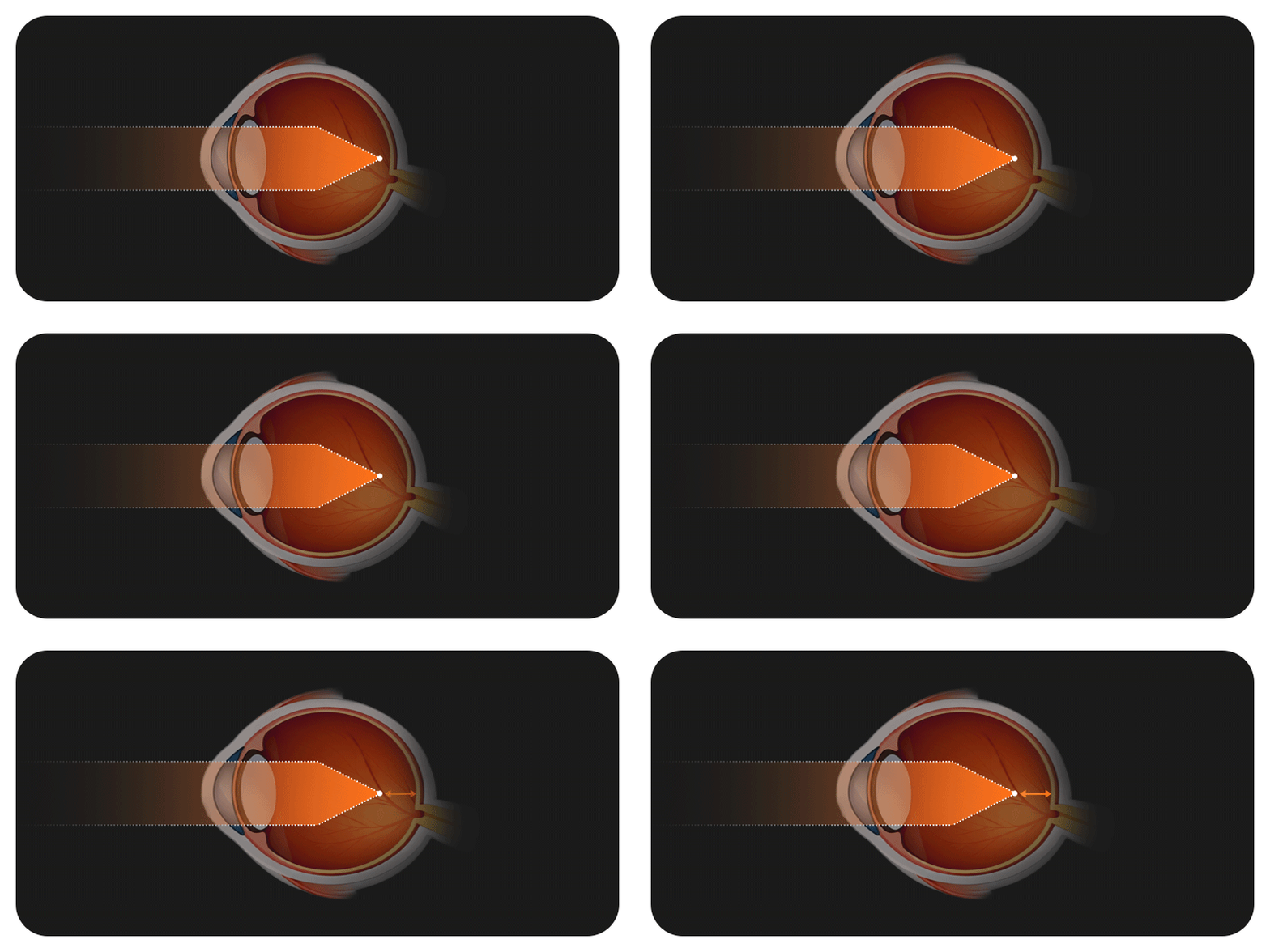
Many parents feel reassured after checking only the numbers on a vision chart. But from a medical perspective, managing pediatric myopia is similar to tracking a child’s height growth curve. It is necessary to observe changes in the eye’s “axial length” (the front-to-back length of the eyeball).
As the eye grows, if the axial length increases faster than average, the focal point forms in front of the retina and myopia develops. It’s the same principle as a projector image becoming blurry when the projector is too far from the screen. Therefore, rather than relying on a single visual acuity value, the key is to record and track the rate of change in eyeball length.
✅Three things that should be recorded and checked in the clinic
- Refractive error (prescription): Confirm the current degree of progression of myopia or astigmatism
- Axial length: Compare how quickly the eye’s front-to-back length is growing versus age-matched averages
- Fundus and optic nerve: Check whether there are any underlying abnormalities in internal eye structures
3. Why delaying glasses can be disadvantageous for visual development
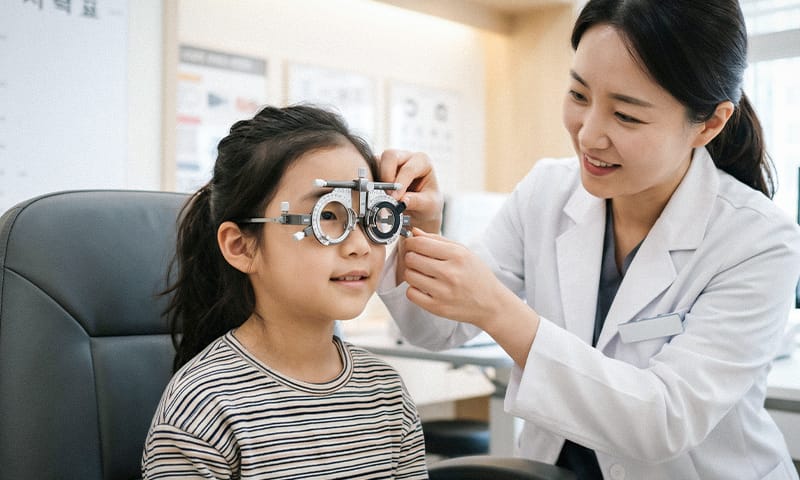
Some parents try to delay glasses as much as possible due to the misconception that wearing glasses early makes eyesight worsen faster. Even when a child complains that the board looks blurry, it is not uncommon for parents to hesitate about getting a prescription. However, glasses are not the cause of declining vision—they are an essential corrective tool that helps deliver a clear image to the brain.
Delaying correction when it is needed can negatively affect a child’s visual development. Childhood is a critical period when the brain’s visual cortex is developing. If clear visual input is repeatedly not delivered properly to the brain through the optic nerve, it can go beyond everyday inconvenience and delay visual development itself.
If correction is needed but postponed for a long time, it may increase the risk of amblyopia, where normal vision may not be achieved even with high-prescription glasses in adulthood. If a child is experiencing discomfort in daily life due to reduced vision, receiving a glasses prescription based on an objective evaluation by an ophthalmologist is a safe measure to protect the eyes.
4. Options to slow myopia progression: How to choose what fits your child
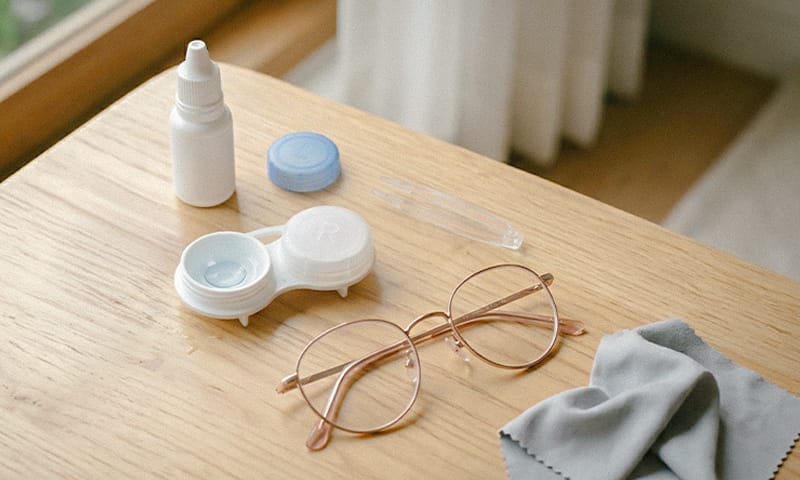
If a child’s refractive error has already progressed into myopia, the focus shifts away from trying to “restore it back to normal” and toward slowing the rate of progression and managing it. Commonly discussed options include low-dose atropine eye drops, orthokeratology (“dream lenses”) that temporarily change corneal shape, and special glasses designed for myopia control.
If you are unsure which method to choose, you can discuss it with the clinician based on the child’s age and the family’s ability to manage the regimen.
[Comparative analysis table by treatment method for myopia reduction]
| Management Option | Key Features | Parental Checkpoints | Precautions |
|---|---|---|---|
| Low-Concentration Atropine | Evaluates slowing myopia progression via eye drops | Is daily, regular instillation feasible? | Concentration adjustments may be needed based on individual responses (e.g., glare, near blur) |
| Ortho-K Lenses (Dream Lenses) |
Worn during sleep to correct daytime vision concurrently | Is hygiene management such as lens cleaning feasible? | Infection risk management is essential; requires regular ophthalmic clinic visits |
| Specialized Glasses / Lenses | Non-surgical approach using peripheral defocus optical design | Can daily eyeglass wear be consistently maintained? | Verify product-specific indications and consider the child's daily routine |
| Lifestyle Factor Management | Increasing outdoor activities and regulating near-work duration | Is it a routine that can be practiced consistently in daily life? | Not intended as a "cure" to reverse myopia that has already progressed |
| MiSight (Daily Disposable Soft Lenses) |
Daytime-wear, daily disposable soft lenses to slow myopia progression | Are there activities unsuitable for contact lens wear (e.g., swimming, napping)? | Adhere to recommended daily wear time (at least 10+ hours) and single-use guidelines |
No matter which treatment is chosen, it is essential for safety to visit regularly and check corneal status and axial length as part of ongoing vision management.
5. Early-onset myopia before school age: Why it shouldn’t be dismissed as “just genetics”
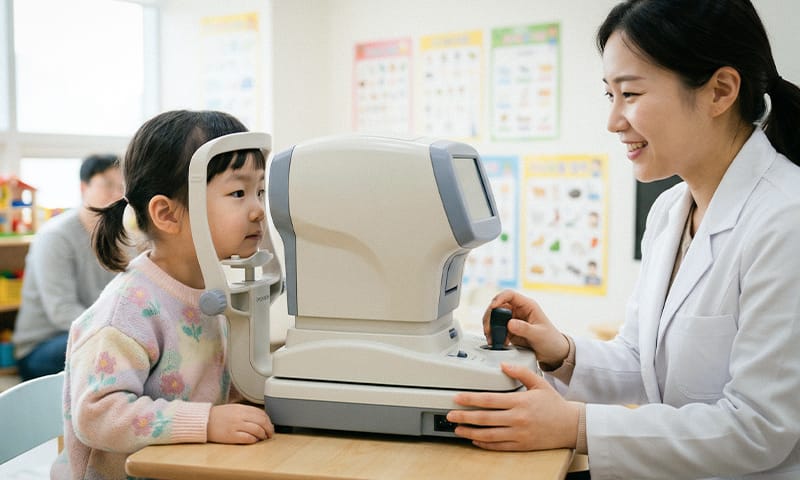
In many school-age children, myopia often progresses gradually around the time they start elementary school as near work increases. However, some children show severe refractive error or signs of high myopia from an early age, such as before age 3–4.
In these situations, some parents resign themselves, thinking the child started early because the parent has poor eyesight. But from a clinical perspective, early-onset high myopia or high myopia before school age may be a warning sign that is difficult to attribute to simple inheritance alone.
Severe refractive error appearing at this stage may differ from typical myopia patterns where axial length simply grows a bit faster. There may also be atypical cases involving congenital structural abnormalities inside the eye, retinal lesions, or systemic underlying conditions.
Therefore, if refractive error values found during infant/toddler health screenings or a first vision test deviate markedly from age-matched averages, it is recommended not to stop at a simple glasses prescription, but to have a comprehensive evaluation of the overall eye condition by a pediatric ophthalmology specialist.
6.Frequently Asked Questions (FAQ)
Q. If both parents have myopia, from what age is it safer to start eye exams?
First, it is important to complete the vision questionnaires and tests according to the infant and toddler health screening schedule without missing any. After that, even if there are no particular warning signs, it is advisable to visit an eye clinic around ages 3–4—when communication becomes easier—to check refractive status and visual development.
Q. Are there signs at home that might make parents suspect myopia?
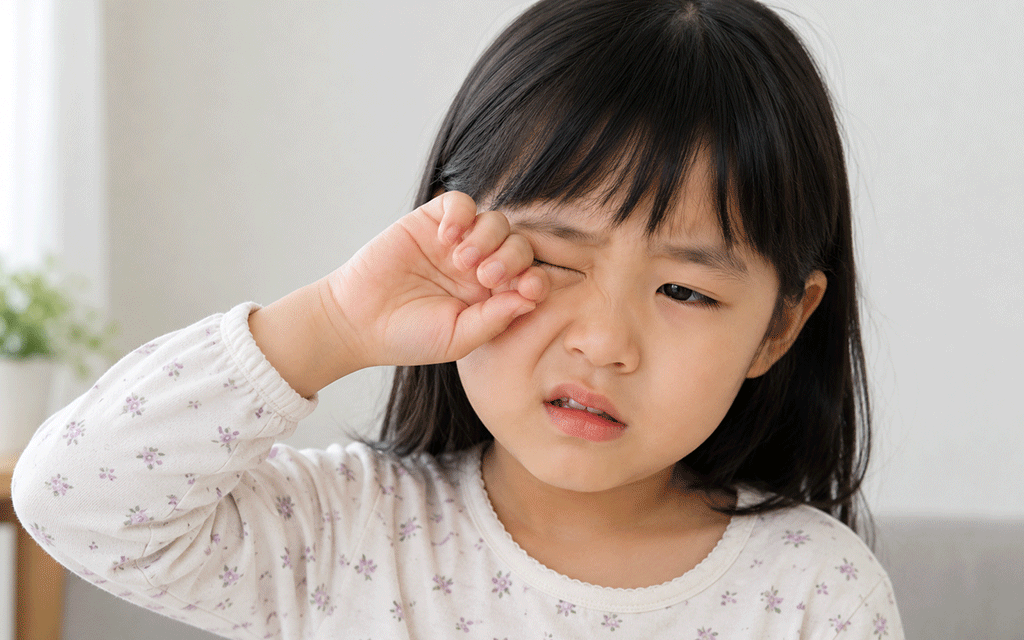
If a child frequently tries to watch TV or read books from very close up, or often squints when looking at distant objects, you can suspect a refractive error. Frequent eye rubbing or a habit of tilting the head to see may also appear, so if these signs are present, moving the exam date earlier can be helpful.
Q. Is outdoor play really effective for preventing pediatric myopia?
Studies consistently report that outdoor activity—spending a certain amount of time in daylight—may help reduce the risk of developing myopia. However, it is difficult to view it as a treatment that restores already-developed myopia back to normal. It is desirable to maintain lifestyle habits that reduce near work and increase outdoor activity.
Q. Which is a better choice: dream lenses or low-dose atropine?
Both are known to potentially help slow myopia progression in some studies, but there is no single universally “better” answer. For example, if hygiene management is difficult or the child is very young, atropine may be considered; if living without glasses is needed and parents can manage lens care, dream lenses may be considered. The decision should be made with the clinician based on the child’s condition and the home environment.
To summarize, a parent’s eyesight can be one factor that increases a child’s likelihood of myopia, but it is not a definitive outcome that determines vision for life.
If there is a family history, it can actually be an opportunity to start earlier—regularly tracking the eye’s internal growth curve (axial length) and finding the right timing for appropriate intervention. Prescribing glasses when vision declines is not what makes eyesight worse; it is an essential protective measure that supports normal visual development in the brain.
It is natural for parents to feel sad when their young child needs glasses. But there is no need to blame yourself excessively and attribute everything to genetics. If you consistently monitor your child’s eye growth with clinicians and manage the environment appropriately, you can become the most reliable support in protecting your child’s clear vision.
Sources
- Korea Disease Control and Prevention Agency (KDCA) National Health Information Portal, guidance on pediatric refractive errors
- National Health Insurance Service (NHIS), vision abnormality screening system in the infant and toddler health screening program
- Journal of the Korean Ophthalmological Society, analysis of myopia prevalence and related factors among Korean children and adolescents, 2021
※ The copyright for all content on this blog belongs to medihi. Unauthorized copying, distribution, or derivative use is strictly prohibited, and violations may result in legal action without prior notice.
Recommended reads
 medihi