
Are you worried because your child’s vision suddenly seems worse? Before you assume that squinting or other changes mean “true” vision loss and rush to get glasses, it’s important to check whether this is pseudomyopia (so-called “false myopia”) and manage it safely. Below is a clear, parent-friendly guide to proper pediatric vision care.
“Did my child’s eyesight get worse because they use a smartphone too much?”
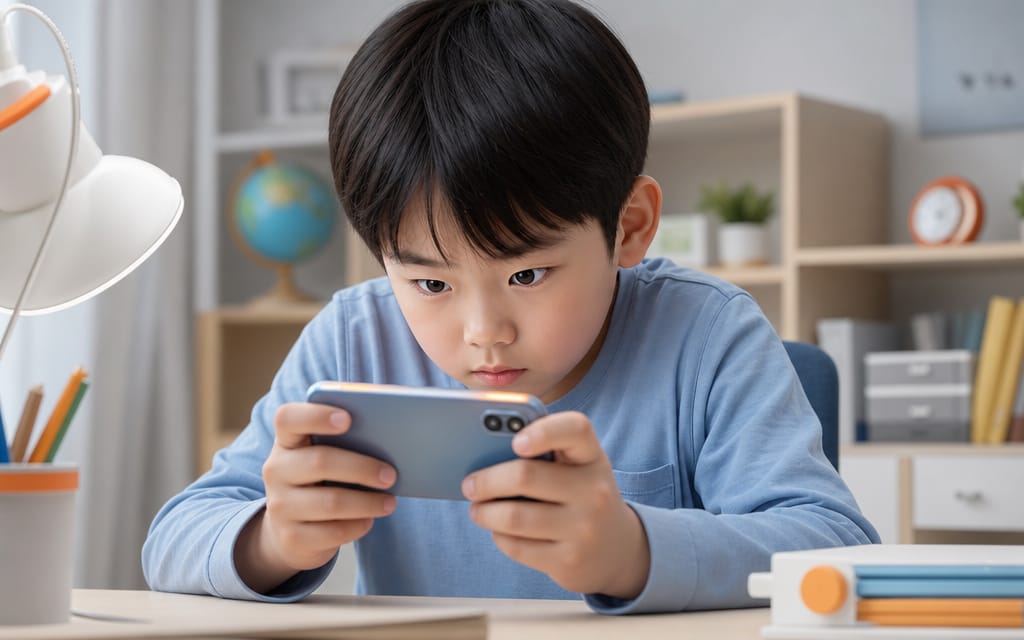
If your child starts squinting after using a smartphone a lot, or says they can’t see far away, it’s natural to worry that their eyesight has gotten worse. From a pediatric ophthalmology perspective, however, the first step is to determine whether blurry distance vision—even if a myopic prescription shows up on testing—is due to an actual structural change in the eye (“true myopia”) or a temporary issue caused by the eye’s focusing muscle becoming tense (“pseudomyopia”).
If it is pseudomyopia, the temporary drop in vision can often be improved and managed with an accurate diagnosis and the right approach. Before choosing a glasses prescription based only on a basic vision test number, let’s walk through the key standards of pediatric vision care that parents should know.
1. Why it can be risky to go straight to an optical shop when your child’s vision suddenly worsens
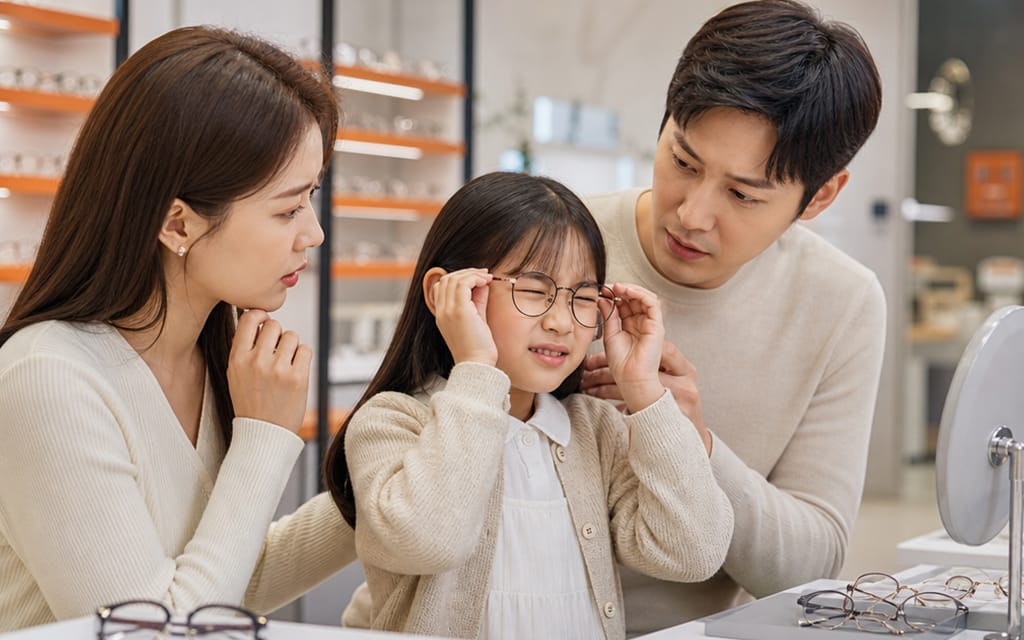
When a child suddenly says the classroom board looks blurry or starts squinting at the TV, many parents wonder whether they should get glasses right away. But unlike adults, children’s vision can be highly variable. If you measure vision and decide on a glasses prescription too quickly without a thorough exam, significant errors are more likely.
When children and teens spend a long time looking at books or smartphones up close, the focusing (accommodative) muscle inside the eye can contract excessively. Because children have strong accommodative ability, after near work they may continue to hold that tension even when looking far away, instead of relaxing smoothly. Medically, this is called an accommodative spasm, and the resulting temporary drop in distance vision is referred to as pseudomyopia (false myopia).
The problem is that if you measure vision without first relaxing this accommodative tension, the testing device may show the eyes as much more myopic than they truly are. If glasses are prescribed based on that measurement, the child may receive an overly strong myopic prescription—an overcorrection. Overcorrected glasses can increase eye strain and worsen visual discomfort. That’s why, in children, it is especially important to confirm true refractive status through a precise exam that temporarily relaxes accommodation (cycloplegic refraction).
2. Pseudomyopia vs. true myopia: temporary tension vs. structural change in the eye
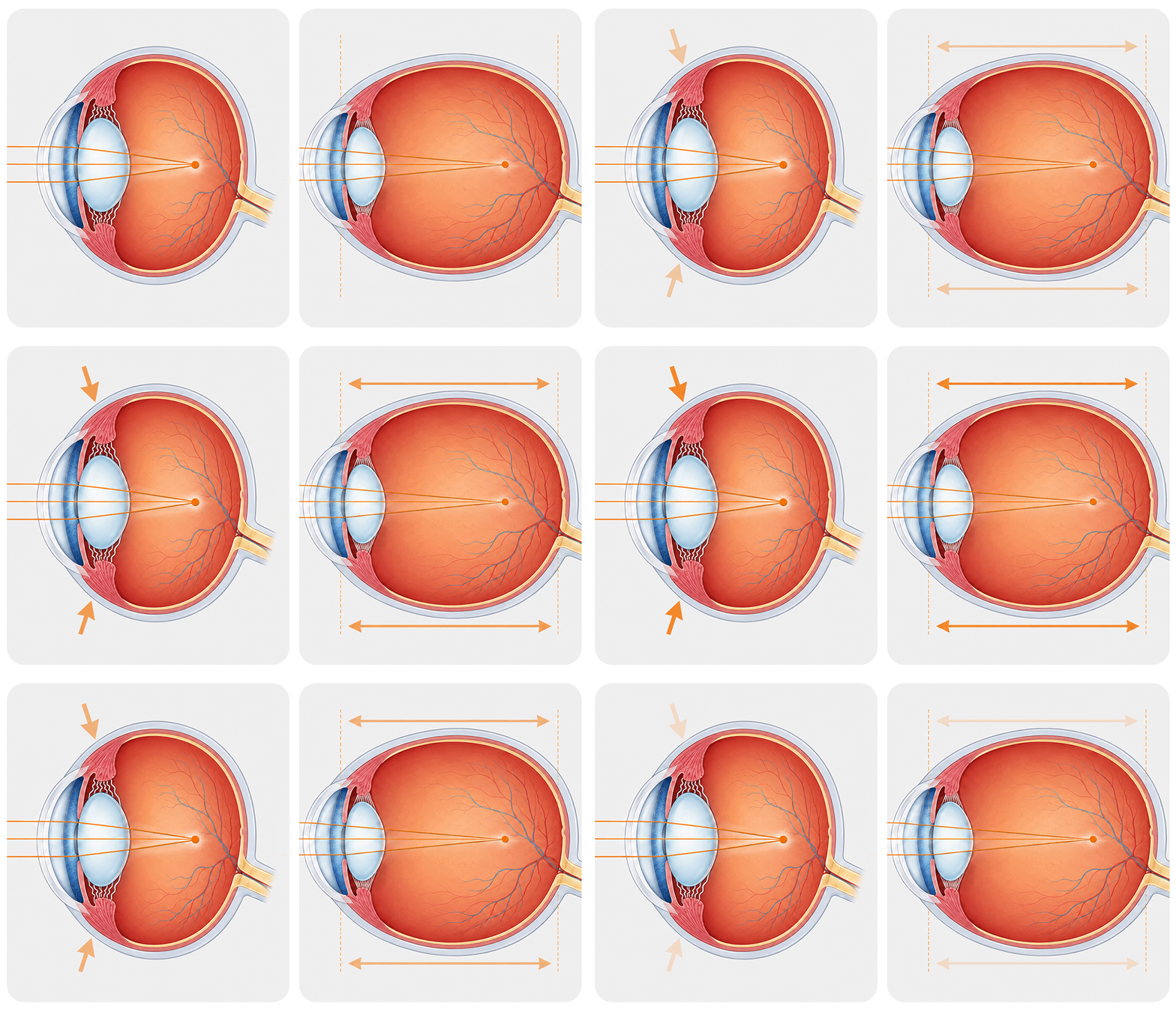
Pseudomyopia—where vision temporarily worsens—and true myopia—caused by actual structural changes in the eye—differ in their underlying mechanism.
- Pseudomyopia (false myopia): A functional condition in which the eye’s accommodative muscle (ciliary muscle) contracts excessively, making distant objects temporarily hard to see.
- True myopia (real myopia): A structural change in which the eye’s front-to-back length (axial length) becomes longer, causing the focus to form in front of the retina. Because the shape of the eye itself has changed, it does not return to the original state simply with rest.
Children today are frequently exposed to digital devices such as smartphones and tablets and may spend long periods focusing on small, close screens. This environment increases near work and eye fatigue, which can trigger pseudomyopia. It may also contribute to chronic accommodative tension, which can influence progression toward true myopia over time.
[At a glance: differences between pseudomyopia and true myopia]
| Category | Pseudomyopia (Temporary Refractive Error) | True Myopia (Structural Myopia) |
|---|---|---|
| Cause | Excessive contraction of ciliary muscle inside the eye | Physical lengthening of the axial length of the eye |
| Eye Condition | Temporary accommodative spasm (reversible) | Permanently fixed due to structural changes |
| Solution | Sufficient rest, accommodative relaxation, lifestyle modification | Vision correction matching prescription (eyeglass prescription, etc.) |
If you suspect your child may have pseudomyopia, check the list below.
✅ Signs that may suggest pseudomyopia (4 things to observe at home)
- They say things look blurrier more often in the late afternoon or evening than in the morning.
- They squint excessively when looking at a book or smartphone screen up close.
- It takes longer than usual for their eyes to refocus when switching from far to near.
- Near-work time has increased significantly recently due to heavier studying or more learning-device use.
3. A recommended approach to prevent overcorrection: when cycloplegic refraction may be advised
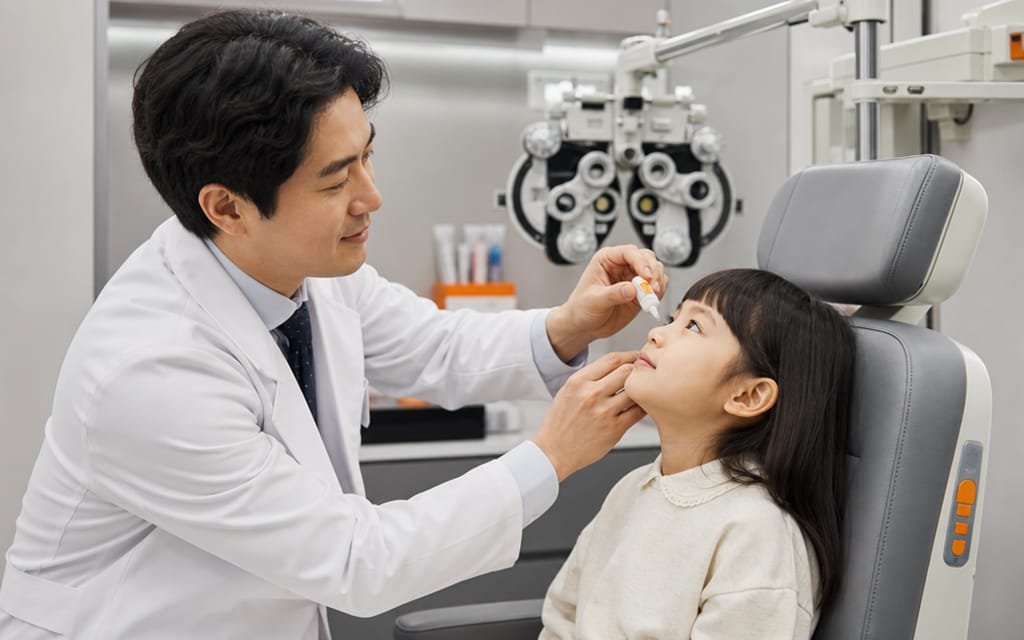
If a child is experiencing temporary accommodative issues, relying only on standard non-cycloplegic refraction devices to measure prescription can lead to a high chance of error. A key safeguard that helps prevent measurement error and the resulting risk of overcorrection is cycloplegic refraction. This test is performed after instilling special eye drops that temporarily suppress accommodation. With the focusing muscle relaxed, the clinician can measure the eye’s inherent refractive error more clearly.
According to research published in Korean academic journals, even in children and adolescents older than 10, substantial differences in refractive values before and after cycloplegia continue to be reported. Therefore, when considering a first-time glasses prescription or when a child’s vision seems to fluctuate unusually, this type of detailed diagnostic testing may be recommended. The goal is to determine whether the issue is temporary tension or a structural refractive problem that truly needs correction.
4. Everyday alternatives to reduce “children’s eye fatigue” in digital exposure and study environments
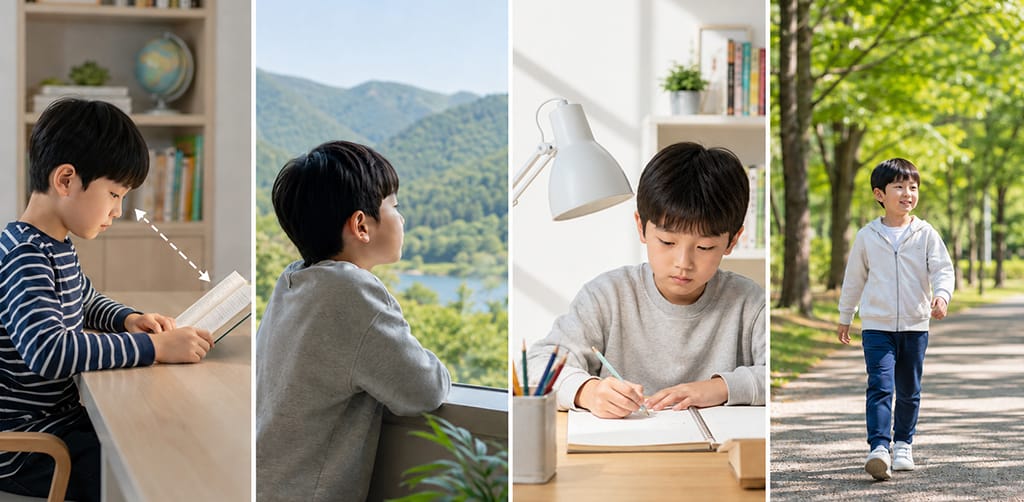
To manage pediatric pseudomyopia appropriately rather than leaving it unaddressed, it’s important not to rely entirely on medication or tools. Careful adjustments to daily lifestyle and environment should be part of the plan. In particular, it helps to balance and break up near-work activities such as device use and reading.
If your child’s eye fatigue mainly occurs during smartphone use, it can be beneficial to keep a consistent viewing distance and take sufficient breaks between continuous viewing. If blurriness also occurs during everyday reading or studying, adjusting indoor lighting appropriately can help. In addition, increasing outdoor activity to ensure exposure to natural light may be beneficial. Multiple clinical reports have associated outdoor activity with relaxation of accommodative function and with positive factors in managing myopia risk.
✅Daily practice checklist to reduce children’s eye fatigue
- Guide your child to keep books and screens farther from the eyes during reading or smartphone viewing.
- After a set period of near work, rest the eyes by looking at distant objects (e.g., out a window).
- Adjust study-space lighting so it is neither too dim nor glaring—aim for comfortable brightness.
- Encourage light walks or outdoor activities during daylight hours to increase natural light exposure.
5. Why ignoring pseudomyopia can be risky—and the value of regular pediatric eye exams
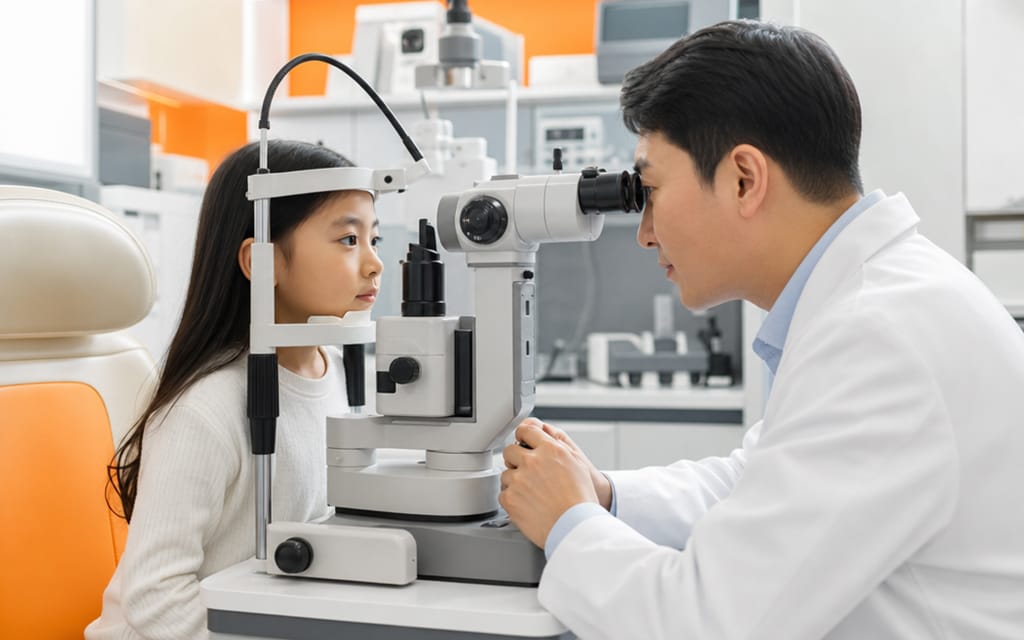
There is a reason pseudomyopia should not be dismissed as “just temporary.” If accommodative tension is not properly relieved and unhealthy habits continue, the long-term risk of transitioning to true myopia may increase.
In fact, overseas research has reported that children observed to have pseudomyopia showed a relatively higher likelihood of progressing to true myopia compared with children without pseudomyopia. While details can vary depending on study conditions, this provides meaningful support for early lifestyle correction and ongoing monitoring of accommodative status during the pseudomyopia stage.
Therefore, for vision care during growth, it is advisable to begin regular checkups from the early stage—when suspicious signs first appear.
6. Frequently Asked Questions (FAQ)
Q. My child suddenly says they can’t see distant letters. Should I get them glasses immediately?
A sudden drop in distance vision may be pseudomyopia, a temporary phenomenon caused by muscle tension inside the eye. Until you confirm the true status through a detailed exam such as cycloplegic refraction, it is safer not to decide and fit a glasses prescription on your own.
Q. Will my child feel very uncomfortable after cycloplegic refraction?
Because the eye drops temporarily relax accommodation, your child may experience light sensitivity or difficulty seeing small, close text for a certain period. This improves as the effect wears off. On the day of the exam, sunglasses or a hat can be helpful for outdoor activities.
Q. If my child is diagnosed with pseudomyopia, do they always need eye-drop treatment?
Eye drops are not mandatory for every child. After accurate ophthalmic differentiation, if accommodative tension is severe or if fatigue does not improve with lifestyle adjustments alone, a clinician may carefully consider short-term drops that help relax accommodation.
Q. When should I consult an ophthalmologist about my child’s vision changes?
A visit is recommended if your child frequently squints when looking at distant objects, or often complains of headaches or eye fatigue during reading or studying. In particular, if reduced vision repeatedly occurs after screen viewing, it is advisable to undergo a detailed evaluation at an eye clinic, potentially including cycloplegic refraction.
Hearing that your child’s vision has suddenly worsened can be frightening, and the idea of needing glasses can feel overwhelming. However, children’s eyes during growth have very strong accommodative ability, so temporary fatigue and tension are often directly reflected in vision test results.
What’s needed now is not to rush into increasing prescription strength, but to confirm true refractive status by relaxing internal focusing tension through cycloplegic refraction. If you keep this standard at the center and begin step-by-step lifestyle adjustments, you can help manage your child’s clear vision safely over the long term.
Sources
- Dong-gi Lim, Seong-hyeok Moon. “Usefulness and clinical comparative analysis of cycloplegic refraction in children and adolescents.” *Journal of the Korean Ophthalmological Society*, 2020, Vol. 61, No. 11, pp. 1321–1327.
- So-yeon Park, Jae-hyeok Choi. “Association between digital device use patterns and subjective ocular fatigue symptoms among Korean adolescents.” *Journal of the Korean Ophthalmological Society*, 2023, Vol. 64, No. 3, pp. 210–218.
- British Journal of Ophthalmology. "Pseudomyopia as an independent risk factor for myopia development in school-aged children: a prospective cohort study". 2024, Vol. 108, No. 2, pp. 294-300.
※ The copyright for all content on this blog belongs to medihi. Unauthorized copying, distribution, or derivative use is strictly prohibited, and violations may result in legal action without prior notice.
Recommended reads
 medihi