

Have you been unsure whether the shoulder pain you’re feeling is frozen shoulder or a rotator cuff tear? This post brings together the key clinical criteria used to tell the two apart, how to check them, and which treatment approach tends to fit each condition.
“Aren’t they all just the same kind of shoulder inflammation?”
“I’m scared of surgery, so I can’t do it.”

Many people keep enduring ongoing shoulder pain with only pain-relief patches because they’re afraid of surgery. As we enter middle age, changes in the shoulder can be a natural part of aging. While advertisements may highlight a specific procedure for shoulder pain, in real clinical practice the first—and most important—step is distinguishing whether the joint has become stiff or whether a tendon has been injured.
At this point, one key criterion clinicians check first is: “When someone else lifts your arm, does it glide smoothly all the way up?” In medical terms, this is called passive range of motion (PROM). This single finding can completely change the direction of your shoulder treatment plan.
1. A key way to differentiate shoulder conditions: what you learn when someone else lifts your arm
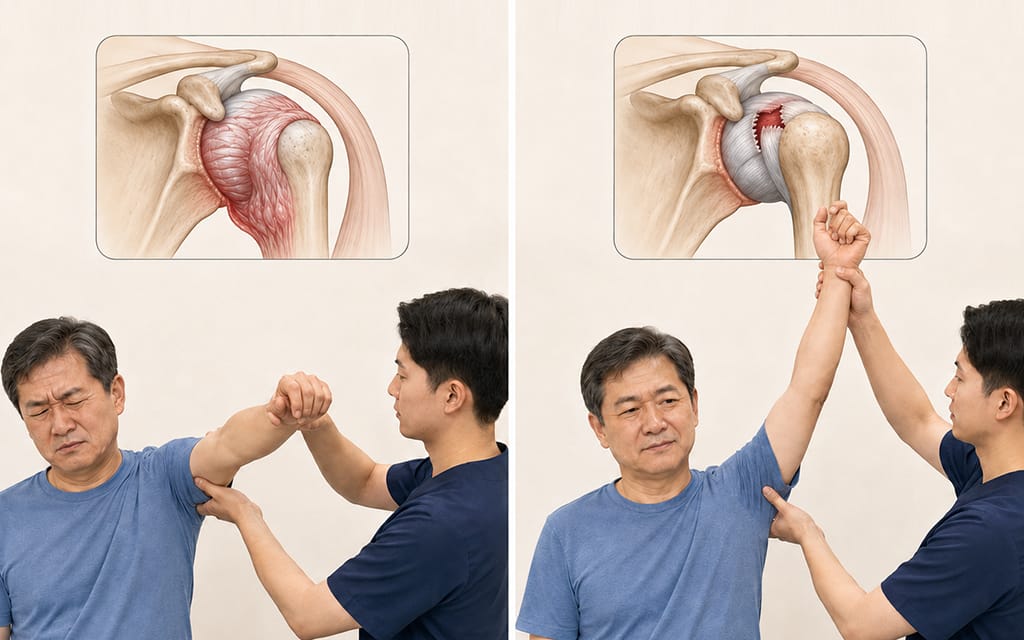
A limitation in lifting your arm by yourself (reduced active range of motion) is common across many shoulder conditions. But there is a particularly reliable way to differentiate them: how the joint responds when you relax your shoulder and another person lifts your arm.
If, no matter how much someone tries to lift it, your arm hits a hard stop at a certain angle and will not go up any further, it suggests the joint has become stiff and “stuck.” Medically, this points to adhesive capsulitis (frozen shoulder), where the joint capsule becomes inflamed and stiff. This is described as a limitation in passive range of motion (PROM).
On the other hand, what if it’s difficult to lift your arm on your own, but when someone else lifts it, it goes up relatively smoothly? That suggests the joint capsule itself remains flexible, but there is a problem with the tendons or muscles responsible for actively lifting the arm. A common example is a rotator cuff tendon tear, or a significant loss of related strength.
However, you should not jump to the conclusion that PROM limitation automatically means frozen shoulder. Range can also decrease when pain is extremely severe or when other lesions are present. For that reason, PROM is best used as an initial clue, and it is safer to confirm with a physical examination.
2. A “dropping arm” and sudden weakness: when to suspect rotator cuff injury
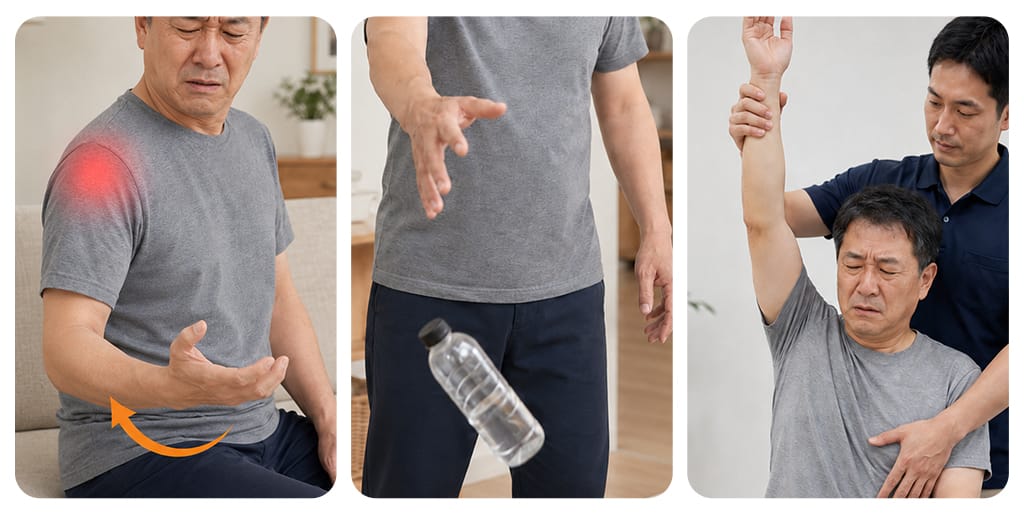
The rotator cuff consists of four key tendons that allow the arm to move freely. Rotator cuff injury is like the screws of a door hinge becoming loose or damaged. Tendon conditions vary widely—from mild degenerative change (tendinopathy), to partial tears, to full-thickness tears. This differs from frozen shoulder, where the entire joint becomes stiff, and the symptom pattern patients feel is different.
A characteristic feature is a sharp, shooting pain when lifting the arm overhead or rotating it outward. In particular, noticeable weakness stands out—when lifting an object, strength doesn’t engage properly and the arm may suddenly “drop.” If PROM is relatively preserved but weakness is present, that is a strong clue for rotator cuff injury.
If you keep repeating strenuous movements while the tendon is injured, symptoms may worsen or functional loss may increase. Rather than repeatedly forcing painful movements, it’s better to avoid provoking actions and promptly check whether there is a structural problem.
✅ Symptom checklist suggesting rotator cuff injury
- A sharp, shooting pain occurs when rotating the arm outward.
- When lifting something, you’ve felt your arm lose strength and “drop.”
- It’s hard to lift your arm by yourself, but when someone else lifts it, it goes up relatively well.
3. Ultrasound and MRI: when imaging is especially important (beyond X-ray)
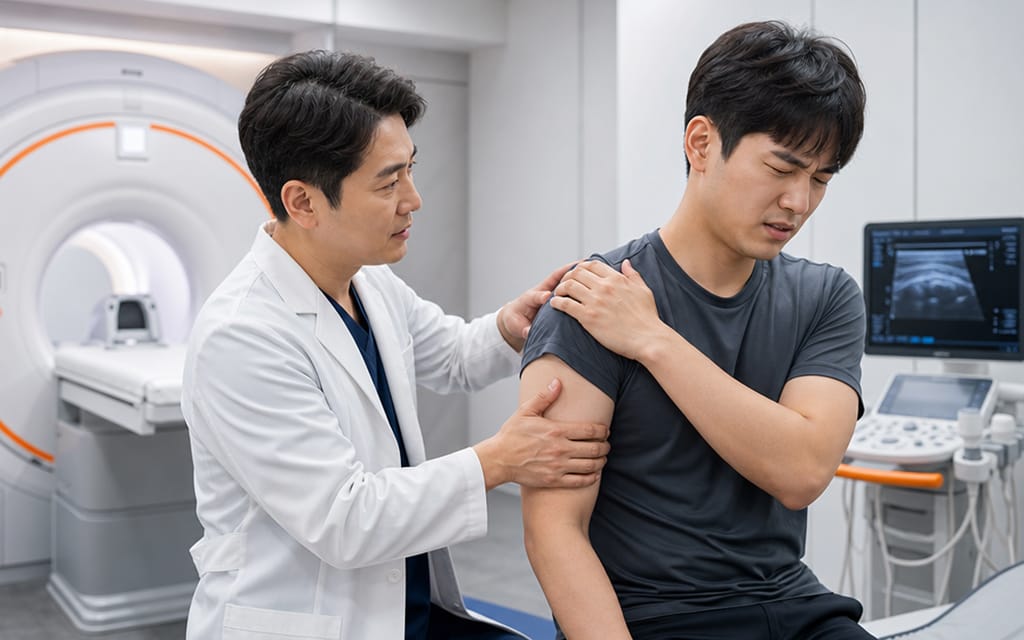
Frozen shoulder and rotator cuff conditions also differ in how they are diagnosed. Frozen shoulder is strongly based on clinical evaluation, where the clinician directly checks joint movement. By assessing how stiff the joint is and the pain pattern, the clinician can estimate the condition to a certain extent. In contrast, when a rotator cuff condition is suspected, imaging plays a larger role in addition to exam findings.
That’s because treatment planning is more accurate when you can visually confirm how much the tendon has worn down or torn. X-rays are used first to check the overall shape of the bones and whether calcification is present. Ultrasound is useful for dynamically assessing rotator cuff tears and inflammation in the clinic. MRI helps precisely evaluate the extent of the tear and the condition of surrounding muscles.
In particular, if there is a clear traumatic event—such as a fall or a strong impact—followed by a sudden, marked loss of strength in the arm, it is reasonable to prioritize imaging with the possibility of a tendon tear in mind. Rather than performing tests automatically, clinicians consider the need based on response to initial conservative treatment and the degree of functional impairment.
✅ Clues that support considering imaging and a more detailed evaluation
- After an impact or fall, did you suddenly lose strength in the arm?
- Has it been weeks to months since the pain started, yet daily life is still difficult?
- Even with assistance, does the arm not lift at all beyond a certain angle?
- Has severe night pain that disrupts sleep persisted for several days?
4. Waiting it out vs active rehab: safer treatment direction depending on your condition
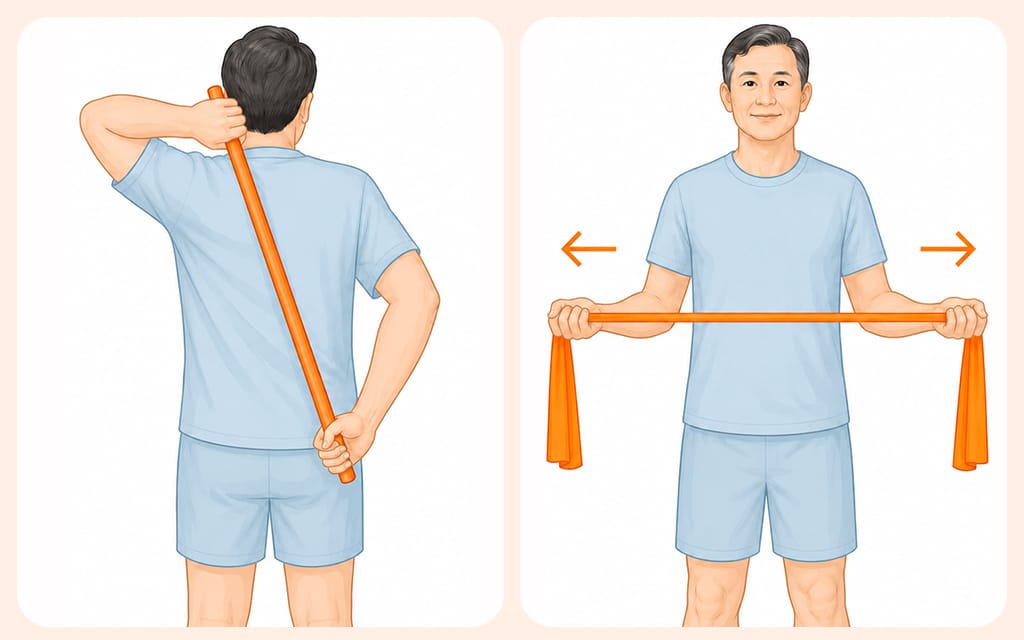
For both conditions, it is common to start with conservative rehabilitation rather than thinking about surgery from the beginning. However, because the causes of pain differ, the goals of treatment also differ. The rehab approach you should focus on depends on your shoulder’s condition.
If you are diagnosed with frozen shoulder, the most important process is gently restoring mobility to a stiffened joint. A structured, stretching-focused rehab program that gradually increases range of motion within tolerable pain levels can help.
If rotator cuff tendinopathy or a partial tear is suspected, the approach is different. It is better to avoid excessive range-of-motion stretching or strenuous overhead movements that provoke pain. Instead, it is generally safer to proceed with rehabilitation that builds strength through gradual resistance exercises while controlling pain. If a full-thickness tear is severe and functional loss is very clear, surgery to restore the structure may be considered carefully.
5. What if both conditions occur together? The order of solving the problem
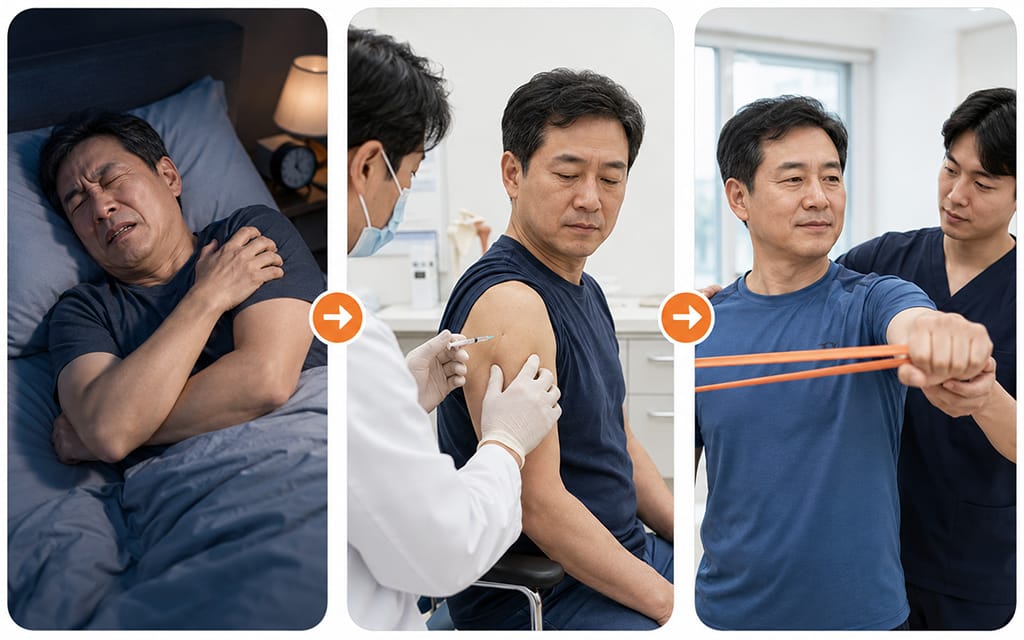
In the clinic, it is very common for conditions not to separate neatly into just one diagnosis like a textbook example. Frozen shoulder and rotator cuff tears are not mutually exclusive and can occur together. A frequently observed scenario is that, due to rotator cuff pain, the arm is used less for a long time, and the joint capsule also becomes stiff.
When the two conditions are mixed, clinicians address the factor causing the greatest difficulty first, step by step. The priority is to control severe pain from inflammation or night pain that disrupts sleep. If pain is so intense that even basic rehabilitation is difficult, an intra-articular steroid injection may help with short-term pain control depending on the situation.
However, when giving injections, underlying systemic conditions must be considered. In patients with diabetes, temporary blood sugar fluctuations can occur, so extra caution is needed. The timing of repeat injections should be discussed carefully with the clinician. A reasonable sequence is: relieve pain sufficiently, then loosen the stiff joint, and finally strengthen the tendons.
6. Frequently Asked Questions (FAQ)
Q. If my arm won’t go up even when someone else lifts it, is frozen shoulder more likely?
Yes. If you cannot lift it yourself and the joint also feels stuck at a certain angle even with assistance, that is an important clue for frozen shoulder. This is called a limitation in passive range of motion (PROM) and is one of the first criteria checked during evaluation.
Q. If I feel pain and my strength gives out when lifting my arm, what should I suspect?
If you feel that strength doesn’t engage properly and the arm “drops,” a rotator cuff condition can be strongly suspected. It may suggest a state where the tendon is partially damaged or inflamed and cannot support strength normally.
Q. What is the purpose of an injection for severe pain, and what should I be careful about?
A joint injection is an adjunct option to reduce severe inflammation and pain in the short term, helping rehabilitation proceed more smoothly. However, if you have diabetes, blood sugar may rise temporarily, and frequent repeated injections are generally avoided. The purpose and number of injections should therefore be discussed carefully with the clinician.
Q. When should I seek medical care promptly for shoulder pain?
If after a fall or impact you suddenly cannot lift your arm at all or you have a clear, sudden loss of strength. Also, if pain and movement limitation persist for several weeks and everyday activities such as getting dressed or washing your hair become significantly difficult, it is recommended to get evaluated without delay.

Shoulder pain after middle age is often difficult to explain with a single simple cause. Whether the arm lifts smoothly when someone else raises it is a primary criterion for initial differentiation. Separating the pain pattern from the presence or absence of weakness can lead to a more reasonable evaluation.
You may feel anxious that you might need surgery right away. However, most shoulder conditions are approached step by step, starting with safe, conservative treatment. Rather than feeling overwhelmed, discuss your current limitations and discomfort exactly as you experience them with your clinician so you can establish a safe treatment plan.
Sources
- Korea Disease Control and Prevention Agency (KDCA), National Health Information Portal. Health information on adhesive capsulitis (frozen shoulder) (ROM assessment and treatment overview). (Accessed: 2024)
- Official health information from major Korean hospitals. Guidance on frozen shoulder and rotator cuff conditions (active vs passive ROM, role of imaging). (Accessed: 2024)
- AAOS(American Academy of Orthopaedic Surgeons). Rotator Cuff Injuries Clinical Practice Guideline. 2025.
※ The copyright for all content on this blog belongs to medihi. Unauthorized copying, distribution, or derivative use is strictly prohibited, and violations may result in legal action without prior notice.
Recommended reads
 medihi