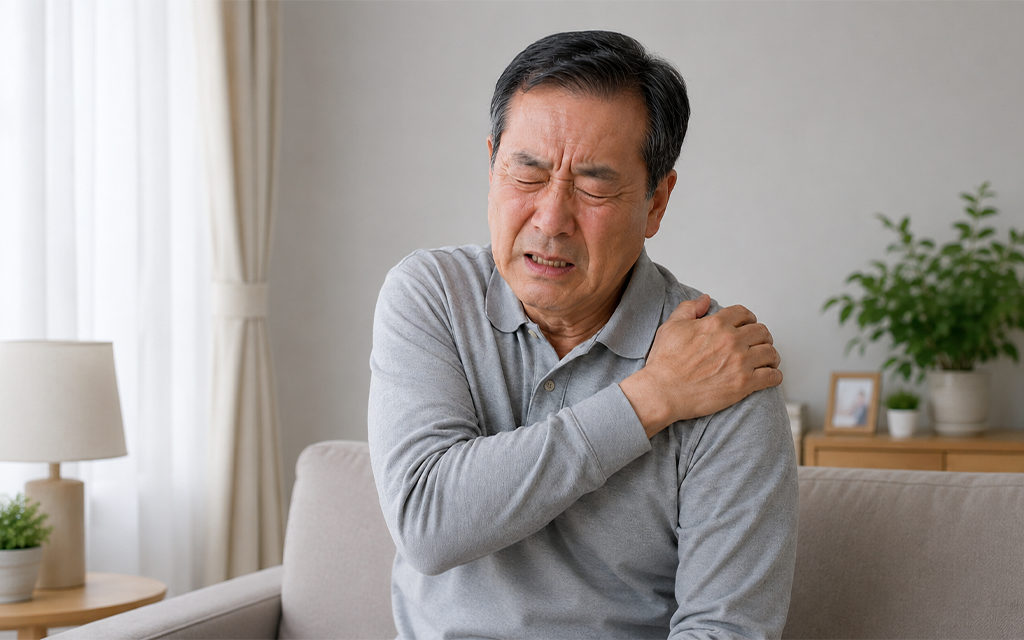

This article reviews the risks of leaving post-traumatic shoulder pain (rotator cuff tear) and associated loss of strength untreated. It explains the mechanism of “false recovery,” which can make you think you’ve healed on your own, and provides practical criteria for making appropriate treatment decisions.
“I thought I just tweaked a muscle, so I put on a pain patch and tried to tough it out.”
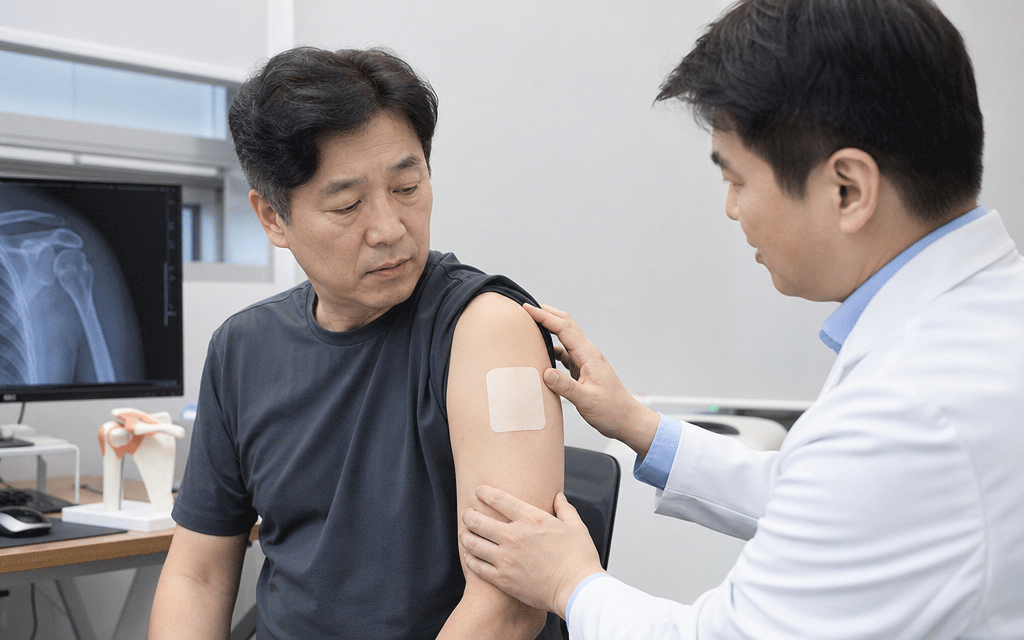
Many men in their 50s who develop post-traumatic shoulder pain (rotator cuff tear) initially believe it will resolve on its own with time. However, even if pain temporarily improves, you should be cautious if you still can’t raise your arm properly or if weakness persists.
People often say, “I tore a shoulder ligament,” but a rotator cuff tear actually refers to injury of the tendons that move and stabilize the shoulder. Just as a snapped rubber band doesn’t easily reattach by itself, if pain decreases but your arm still won’t lift, it may indicate a structural tendon injury that is unlikely to heal spontaneously. Even if you’ve brushed it off until now, it’s important to accurately assess what’s happening from this point forward.
1. Shoulder weakness after trauma: how to tell it apart from simple muscle soreness
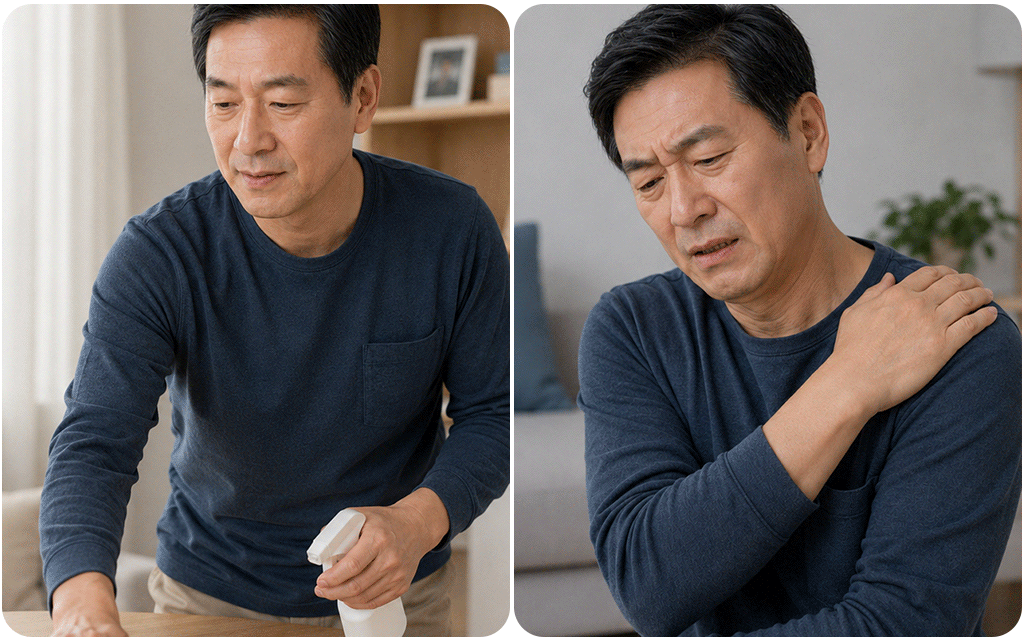
When your shoulder hurts after an injury, many people rest and use a pain patch. If the pain eases a little, it’s easy to assume it was just mild muscle tightness. But simple muscle soreness and a rotator cuff tear are fundamentally different. Muscle soreness typically improves gradually after a few days of rest, and range of motion returns to baseline.
With a rotator cuff tear, however, even if pain decreases, loss of shoulder strength often remains evident. Shoulder tendons are like the cable of a pulley used to lift heavy loads. If some strands of the cable snap, force is not transmitted properly when you try to lift.
Your arm may suddenly “drop” without strength at a certain angle. If you can only raise it fully by pushing it up with your other hand, tendon injury may be involved. This type of shoulder weakness does not simply resolve with time. If weakness appears after trauma—even if it becomes noticeable later—it warrants careful evaluation.
2. Why you can’t relax just because the pain improves and your arm lifts again: the mechanism of “false recovery”

A few weeks after a shoulder injury, swelling and inflammation may subside and pain can gradually lessen. Surprisingly, the arm may start lifting better again. Many people assume they’re fully recovered at this point and delay seeking care.
But this does not necessarily mean the tendon has reattached or returned to normal. It may be due to compensation—nearby muscles taking over the role of the injured tendon. Clinically, this is often referred to as “false recovery.”
Think of it like a car’s wheel alignment. Even if the alignment is off, the car still rolls and you can still drive. But surrounding parts take on extra stress, and over time the tires develop uneven wear. The shoulder is similar. Other muscles may help you move so it looks like you’re improving, but prolonged compensation can alter overall shoulder mechanics. Pain relief and true tendon healing are not the same.
✅ Self-checklist for “false recovery”
- Right after the injury, you could barely lift your arm for a few days.
- Now you can move it, but it still feels stiff and weak.
- You can’t lift it on your own, but it goes all the way up if you support it with the other hand.
- Movement has improved, but nighttime pain remains and disrupts sleep.
3. Frozen shoulder vs. rotator cuff injury: how to check based on your shoulder movement
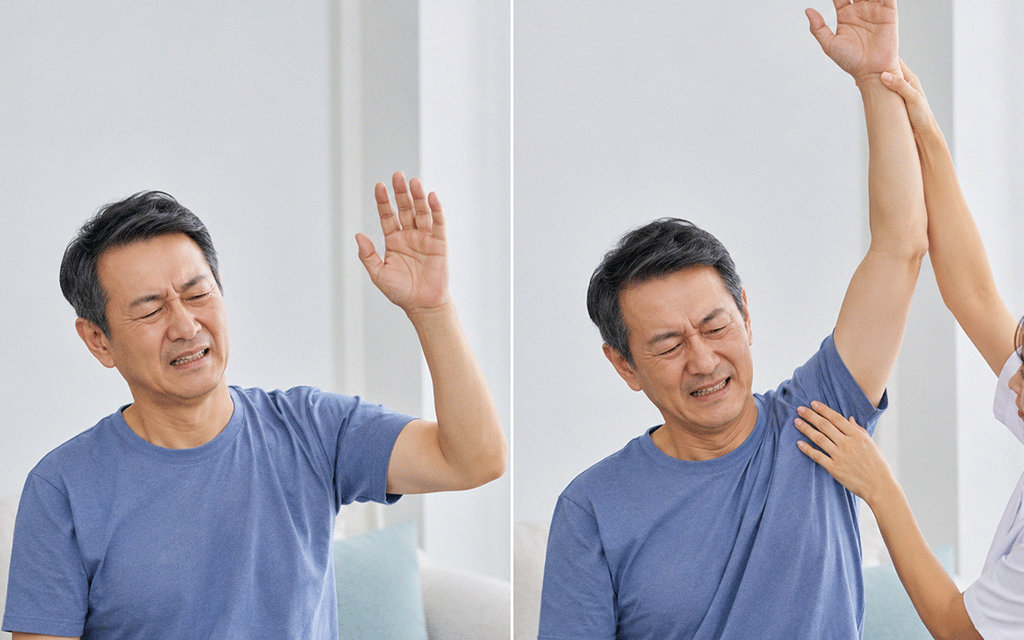
After your 50s, if your shoulder hurts and becomes difficult to move, it’s easy to assume it’s frozen shoulder. But frozen shoulder and a rotator cuff tear differ in cause and management, so distinguishing them matters. One of the most intuitive criteria is: “Does the arm lift when someone else helps?”
Frozen shoulder occurs when the capsule surrounding the joint becomes stiff and contracted. You can’t lift your arm with your own strength, and even if someone else tries to raise it for you, there is a firm, stiff end-feel and it doesn’t lift well. This is called limitation of passive range of motion.
In contrast, a rotator cuff injury is more like a pulley cable mechanism failing. Because of strength loss, lifting the arm on your own is difficult. But when someone else supports and lifts your arm, the shoulder joint itself often moves upward relatively smoothly. If trauma was the trigger and weakness started immediately afterward, it’s reasonable to consider rotator cuff injury as a leading possibility.
4. What changes can progress inside the shoulder when a rotator cuff tear is left untreated
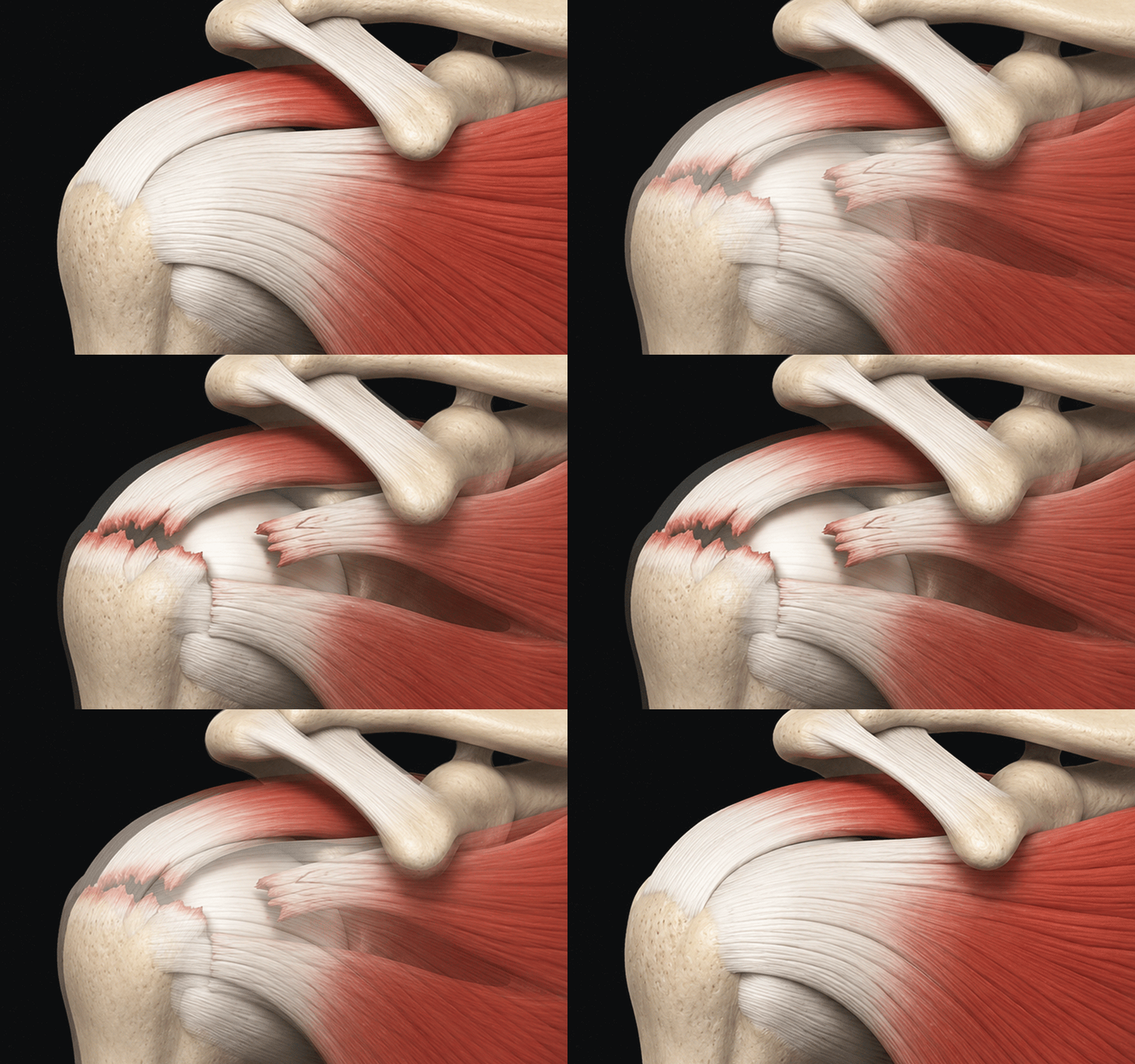
If a rotator cuff tear is not addressed and is left untreated long-term, degenerative changes can quietly progress inside the shoulder. Over time, the torn tendon may retract medially (tendon retraction). The tear can also gradually enlarge.
An especially important change is muscle deterioration. When a muscle can’t function properly because its tendon is torn, the muscle may slowly shrink in size (muscle atrophy). Fatty infiltration (fatty degeneration) can also occur as fat replaces the muscle.
This is similar to how prolonged uneven tire wear can eventually require more extensive repairs. Muscle that has undergone fatty degeneration may be an unfavorable factor for fully restoring function later—even if the tendon is surgically repaired. Because delaying care can increase the difficulty of future treatment, early, careful evaluation is advisable.
📌Checklist to review during a medical consultation
- Is my current weakness consistent with findings of a rotator cuff tear?
- Could the reduction in pain reflect “false recovery”?
- In my case, which is more appropriate—ultrasound or MRI?
- If surgery is considered, what timing and rehabilitation burden should I expect?
5. Conservative care vs. surgery: reasonable criteria for choosing what fits your condition
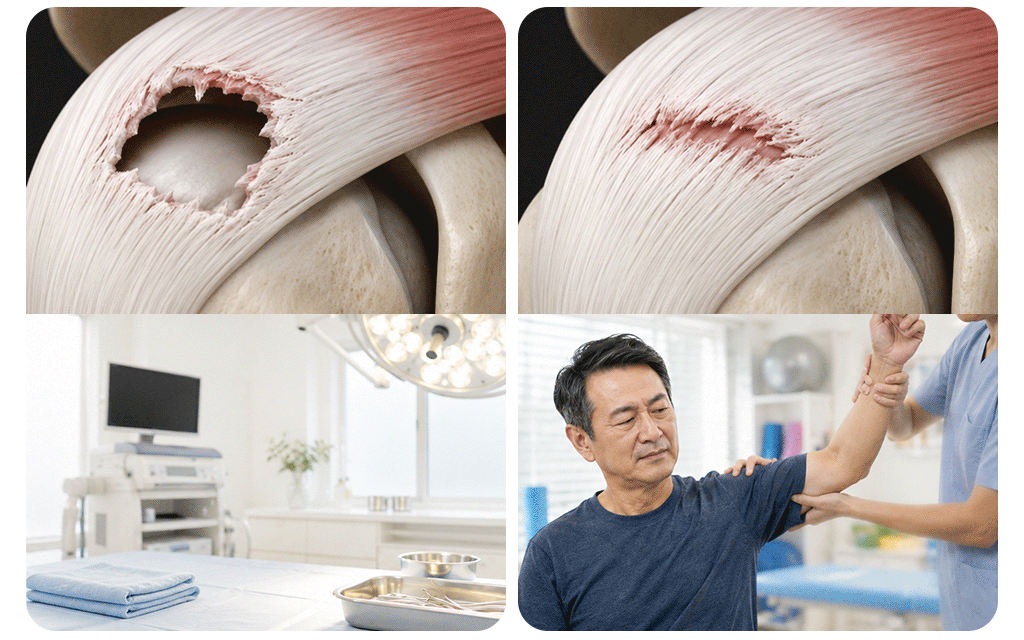
A rotator cuff tear does not automatically mean surgery is required. The choice between conservative care and surgery depends on your symptoms and the tear pattern.
If you have a traumatic full-thickness tear—such as after suddenly lifting something heavy or falling—and there is clear functional loss when raising the arm, early repair may be advantageous. A “wait and see” approach can allow tear enlargement and tendon retraction to progress.
On the other hand, if the tear is degenerative (from gradual wear with age) or a partial-thickness tear with mild symptoms, conservative treatment is often tried first. This may include medication, physical therapy, and therapeutic exercise to improve function. Corticosteroid injections may be used for short-term pain control, but repeated or frequent injections may be unfavorable for tendon health, so they should be used judiciously.
If you notice weakness along with pain soon after trauma, don’t delay evaluation—consult a specialist and map out a treatment plan that fits your condition.
6. Frequently Asked Questions (FAQ)
Q. A few days after the injury, my pain decreased—do I still need to go to the hospital?
If there was a period right after the injury when your arm felt weak or wouldn’t lift, caution is warranted. The pain reduction may reflect “false recovery” due to compensation by surrounding muscles. For example, even if a key tendon (supraspinatus) is injured during arm elevation, the deltoid may compensate, making it look like the arm lifts better and the pain improves. Because pain relief does not necessarily mean structural recovery, an orthopedic evaluation is worth considering.
Q. How can I tell frozen shoulder from a rotator cuff tear at home?
A helpful clue is what happens when someone else lifts your painful arm for you. With frozen shoulder, the joint is stiff, so it doesn’t lift well even with assistance. With a rotator cuff tear, you may not be able to lift it yourself, but it often lifts relatively smoothly when assisted. However, the two conditions can overlap, so accurate differentiation requires a clinician’s examination.
Q. What’s the difference between ultrasound and MRI, and when are they needed?
Ultrasound can be useful for an initial assessment, allowing a relatively quick, real-time evaluation of tendon integrity while the shoulder moves. MRI, in contrast, more clearly shows detailed structural information—such as tear size, degree of retraction, and fatty degeneration of muscle—which helps in planning treatment. The appropriate test depends on the physical examination findings.
Q. If I delay care for a rotator cuff tear, does treatment become more difficult?
With prolonged delay, the tear can enlarge and the tendon can retract medially. Muscles that are not functioning normally may weaken, and fatty degeneration can progress. These structural changes can increase the difficulty of later repair and may worsen functional recovery, so early evaluation is the safer approach.

Dismissing shoulder pain as “just temporary muscle soreness” and leaving it untreated can compromise long-term shoulder function. In particular, mechanical tendon injury of the rotator cuff after trauma may not improve simply with time.
More important than how much it hurts is whether your shoulder can perform its primary function—raising the arm—smoothly and reliably. Rather than feeling reassured just because it hurts less, consider early evaluation to establish sound decision-making criteria and reduce the likelihood of a larger “repair burden” later.
Sources
- Seoul National University Hospital medical information: Rotator cuff tear and the clinical course of shoulder joint disorders, including non-surgical treatment guidance
- Journal of Korean Orthopaedic Sports Medicine: Analysis of fatty degeneration and muscle atrophy before and after rotator cuff tear surgery, 2013
- Journal of Orthopaedic Surgery and Research, Comparison of functional outcomes following early and delayed arthroscopic repair for traumatic and non-traumatic rotator cuff injuries, 2024
※ The copyright for all content on this blog belongs to medihi. Unauthorized copying, distribution, or derivative use is strictly prohibited, and violations may result in legal action without prior notice.
Recommended reads
 medihi