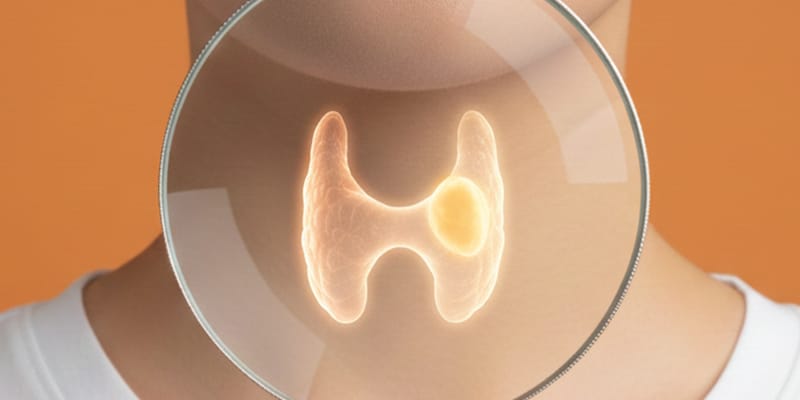

Thyroid cancer is often called a 'kind cancer' due to its favorable prognosis. However, this nickname does not imply that treatment is unnecessary. We explain the critical difference between medical neglect and clinical observation, along with the clear criteria that determine whether surgery is required.
"I heard from others that it's a kind cancer and they are living without surgery. Can I do the same?"

Many patients visit the clinic asking this with a mix of hope and anxiety. It is natural to worry whether relying on the term 'kind cancer' might allow the disease to grow, or conversely, whether rushing into surgery will result in a lifetime of medication.
However, this choice should not be based on vague intuition but on clear medical standards. Today, we will clarify those standards for you.
1.Why the Nickname 'Kind Cancer' Puts Patients at Risk

Thyroid cancer is often referred to as 'snail cancer' or 'kind cancer.' This nickname exists because 'papillary carcinoma,' the most common type of thyroid cancer, progresses slowly and has a high survival rate.
The crucial point is that while 'kind cancer' is a nickname, 'low-risk group' is a medical classification (diagnosis). Even when hearing the same words, medical professionals provide explanations based on 'classification,' not a 'nickname.' Failure to understand this distinction can lead to the misconception that it is a "cancer that doesn't require treatment," causing patients to miss vital signals that intervention is necessary.
Thyroid cancer varies significantly in nature depending on its type and stage. While there is papillary cancer with an excellent prognosis, there are also aggressive types like anaplastic carcinoma that progress rapidly. Even within papillary cancers, if there are 'aggressive variants,' one can never be complacent.
Therefore, concluding that "thyroid cancer does not require surgery" is dangerous. The accurate medical fact is: "Only for early-stage papillary carcinoma that meets specific criteria can we monitor it without immediate surgery."
2.The Difference Between Monitoring and Neglect: The 'CCTV' Analogy
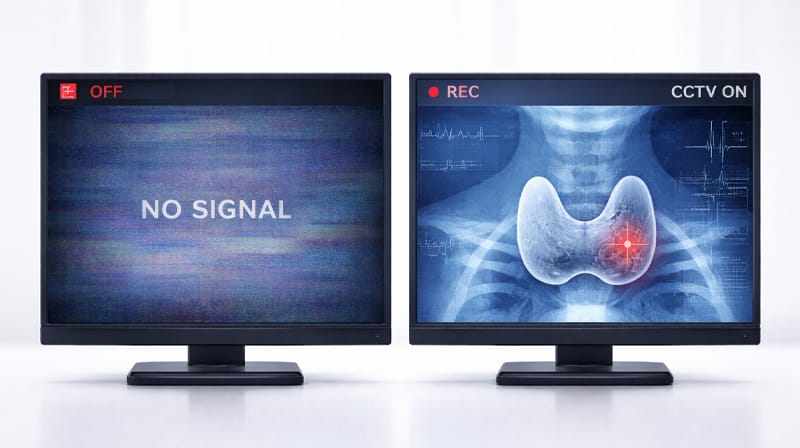
The approach of observing progress without immediate surgery is called 'Active Surveillance.' Many people confuse this with "just leaving it alone (neglect)," but medically, the two are entirely different.
This difference can be compared to a security system (CCTV).
- Neglect: Turning off the CCTV and taking no action. You have no way of knowing what dangerous changes are occurring inside.
- Active Surveillance: Turning on high-performance CCTV and monitoring the screen 24/7. As long as nothing happens, you continue to watch; however, if even a minor abnormal signal (progression) is detected, you are ready to intervene (surgery) immediately.
| Category | Simple Observation | Active Surveillance | Neglect (Dangerous) |
| Target | Benign nodules or suspected cancer | Confirmed low-risk microcarcinoma | Discontinuing follow-up after diagnosis |
| Purpose | To see if it turns into cancer | Monitoring for progression/metastasis | No purpose / Avoidance |
| Response | Maintain regular check-ups | Immediate switch to surgery if changes occur | Found only after symptoms worsen |
'Active Surveillance' is not simply about not going to the hospital. It is a sophisticated 'medical act' of tracking cancer changes through standardized ultrasound exams at set intervals.
If a patient arbitrarily stops visiting the hospital due to overseas stay or personal reasons, it ceases to be surveillance and becomes dangerous 'neglect.'
[Are You Safely Under 'Surveillance'?]
- I know the exact date of my next exam scheduled by my specialist.
- At each exam, I receive explanations not just about the size but also the change in the shape of the cancer.
- I am prepared to go to the hospital immediately if abnormal symptoms such as voice changes or lumps occur.
3.Critical Conditions Where Surgery is Safer Even Below 1cm

You may have heard that "if the size is smaller than 1cm, surgery is not necessary." This is half true and half false.
Size is just one important criterion; it is not absolute. Medical professionals prioritize 'location' and 'risk of invasion' over size.
If the cancer is very small, say 0.5cm, but is located right against the vocal cord nerve (recurrent laryngeal nerve) or the trachea (windpipe), the story changes. This is because even a slight growth could lead to loss of voice or breathing difficulties.
It is like a small ember that must be extinguished immediately if it is right next to a gas stove.
Furthermore, if ultrasound shows signs of the cancer breaking through the thyroid capsule or if lymph node metastasis is suspected, surgery is considered a priority regardless of size. In other words, the correct judgment is not "it's okay because it's small," but "it can be monitored because it is small, in a safe location, and has no metastasis."
4.Am I a Candidate for 'Active Surveillance'?

Ultimately, whether you can delay surgery and monitor the condition depends on whether you meet all 'low-risk conditions.' Recent clinical guidelines suggest active surveillance as an option only for patients who pass strict criteria.
[Exclusion Criteria Where Surgery is Recommended]
- High-risk Location: Cancer is adhered to the trachea, esophagus, or vocal cord nerves, or protrudes outside the capsule.
- Aggressive Nature: Suspected lymph node metastasis or suspected aggressive subtypes (variants).
- Unmanageable: Environments where regular follow-up is impossible or cases of extreme psychological anxiety.
If you have a 'gentle papillary carcinoma under 1cm' that does not fall into the exclusion categories above, [Active Surveillance] can be considered. However, if even one condition is not met, [Surgery] may be the more reasonable choice.
Patient 'compliance' is also vital. Since regular precision exams are the lifeblood of active surveillance, if you are not confident in strictly adhering to the exam cycle, removing the lesion through surgery may actually be safer.
[ Consultation Checklist]
- Is the location of my cancer maintaining a safe distance from the trachea and vocal cord nerves?
- Are there any findings of lymph node metastasis, extrathyroidal extension, or suspected aggressive variants on ultrasound?
- If we switch to surgery while monitoring, what specific changes would trigger that decision?
5.'Surgery Now' vs. 'Wait and See': Criteria for a Choice with Fewer Regrets

Choosing active surveillance does not mean a promise to "never have surgery for life." It means "adjusting the timing for surgery rather than doing it right now."
In fact, there are cases where the cancer grows during active surveillance, leading to a transition to surgery. The important point is that research shows if the transition to surgery occurs at the appropriate time under expert supervision, the treatment prognosis may not be significantly worse compared to those who had surgery from the start. (Note: This assumes strict follow-up observation.)
At this point, the patient's 'values' become a critical criterion.
If you are someone for whom "the mere fact that there is cancer in my body causes too much anxiety," it is better to choose surgery for psychological peace of mind, even if surveillance is medically possible. On the other hand, if you wish to "delay surgical scarring or medication for as long as possible," following a strict surveillance protocol while postponing surgery is a wise strategy.
There is no single correct answer. A process of making a decision together with your medical team, synthesizing the objective risks of your cancer (location, metastasis) and your subjective values, is required.
6.Frequently Asked Questions
Q. If I choose active surveillance and have surgery later, will the results be poor?
The current consensus is that if you have regular exams following a specialist's guide, the treatment outcome is not significantly disadvantaged even if surgery is performed when changes are detected. However, this is only valid when the scheduled follow-up appointments are strictly kept and may vary depending on the individual's condition.
Q. Must I have surgery if it is over 1cm?
Size is not an absolute criterion. However, since larger tumors have a higher likelihood of invading surrounding tissues or metastasizing, surgery is often considered a priority. The key is not the size itself, but the shape on ultrasound (risk level), lymph node metastasis, and locational risks. These are evaluated collectively.
Q. Should I stop eating seaweed like kelp or laver if diagnosed with thyroid cancer?
There is no need to completely cut out seaweed from your regular diet. The link between thyroid cancer occurrence and iodine intake is not clear, and extreme restriction can lead to nutritional imbalances. However, during periods when 'Radioactive Iodine Therapy' is scheduled after surgery, you must follow the medical team's instructions.
Q. When should I seek a hospital consultation?
If a nodule was found during a health check-up or if you only received an explanation that it is a "kind cancer" without specific information on subtype, metastasis, or location, it is recommended to consult a thyroid specialist (Endocrinology / Endocrine Surgery / ENT) to confirm your accurate risk classification first.

The core of thyroid cancer treatment is not "surgery for everyone" or "neglect for everyone." 1. First, you must confirm if your cancer is in a safe location and of a nature that allows for 'Active Surveillance.' 2. Second, if you choose active surveillance, remember that this is not the end of treatment but the beginning of 'precision management (CCTV monitoring).' 3. Third, your level of anxiety and personal values are just as important as medical findings. Do not miss the timing for treatment by being overly complacent with the term 'kind cancer,' nor should you rush into unnecessary surgery due to vague fear. If you consult sufficiently with a specialist who knows your condition best, you can make the safest and most reasonable choice for your current situation.
Sources
- Korean Thyroid Association, Revised Recommendations for the Management of Thyroid Nodules and Cancer, 2023. (International Journal of Thyroidology)
- Korean Thyroid Association, Management Guidelines for Differentiated Thyroid Cancer (Summary), 2024. (International Journal of Thyroidology)
- European Thyroid Association (ETA), Guidelines for the Management of Thyroid Nodules, 2023. (European Thyroid Journal)
※ The copyright for all content on this blog belongs to medihi. Unauthorized copying, distribution, or derivative use is strictly prohibited, and violations may result in legal action without prior notice.
Recommended reads
 medihi