

Here is a summary of the first thyroid warning signs you should check when experiencing unexplained fatigue, rapid weight changes, and persistent palpitations. We provide the criteria for determining when a blood test is necessary amidst vague symptoms.
In the clinical setting, we check whether the fatigue or weight changes a patient complains of actually match their hormone levels. This is because while symptoms are subjective, objective data (blood test results) do not lie.
Thyroid hormones are a core mechanism that regulates our body's metabolism. Even minute changes in these levels affect the entire body, but the symptoms appear very similar to other diseases.
Many people brush it off, thinking, "I'm unusually tired lately, it must be my age," or "My heart is racing because of stress."

In particular, women in their 40s to 60s often confuse these with menopausal symptoms, which can delay diagnosis. Even if you postponed testing because the symptoms were ambiguous, it is not unusual.
What is the most trusted criterion medical professionals use when judging the presence of a thyroid disorder? It is not just the intensity of the symptoms felt by the patient.
However, if thyroid dysfunction is left untreated, it can place a burden on heart rhythm and bone health, making early detection crucial. Let's look at the criteria for distinguishing whether your body's signals are just a simple drop in condition or a hormonal imbalance that requires medical confirmation.
1.Changes When Your Body's 'Boiler' Breaks Down

The thyroid is like our body's 'boiler' or 'thermostat.' It burns energy to generate heat and regulates the speed of our metabolism.
There are broadly two ways this boiler can break down: it overheats (hyperthyroidism) or it cools down too much (hypothyroidism).
What happens if the boiler overheats out of control? Because it burns fuel fiercely, you lose weight (fuel) even if you eat a lot. Your body generates heat, you sweat, and your heart pounds quickly as if the engine is overloaded. This is the typical state of hyperthyroidism. Conversely, what if the boiler cools down completely? Since it cannot burn fuel, you gain weight even without an appetite. Your body feels chilly, movements become sluggish, and you suffer from extreme lethargy. These are the signals of hypothyroidism.
Medically, whether this 'energy metabolism speed' is out of the normal range is viewed as the core measure.
2.How to Distinguish 'Thyroid Symptoms' from Menopause or Stress

The problem is that the 'boiler breakdown' signals explained earlier are very similar to menopause or stress-induced illnesses. Many people mistakenly think, "It seems like I'm just having a severe menopause," until they visit a hospital.
In fact, the heat, sweating, and palpitations of hyperthyroidism are similar to the hot flashes and rapid heartbeats of menopause. The fatigue and depression of hypothyroidism are also easily dismissed as midlife depression.
However, the decisive difference lies in the 'accompanying physical changes.' Please check the characteristics of your symptoms through the checklist below.
[Checklist to Distinguish Thyroid Abnormalities vs. Menopause Symptoms]
- Suspected Hyperthyroidism
[ ] My food intake has increased, but my weight is actually decreasing.
[ ] My bowel movements are more frequent, or I often have diarrhea.
[ ] My heart beats fast and strong even when I am sitting still.
- Suspected Hypothyroidism
[ ] My food intake has decreased, but I am gaining weight and feeling swollen.
[ ] I feel the cold much more severely than others, and my skin is dry.
[ ] My constipation has worsened, and my memory has noticeably declined.
If these symptoms persist even after stress factors have disappeared or you have rested sufficiently, caution is needed. This may not be a simple psychological issue.
While menopause is a natural process of hormonal decline, a thyroid disorder is a disease state that requires treatment. Rather than worrying about symptoms alone, checking your hormone levels with a blood test is the safest and fastest solution.
3.Why a 'Blood Test' Is Recommended First Over Complex Detailed Tests
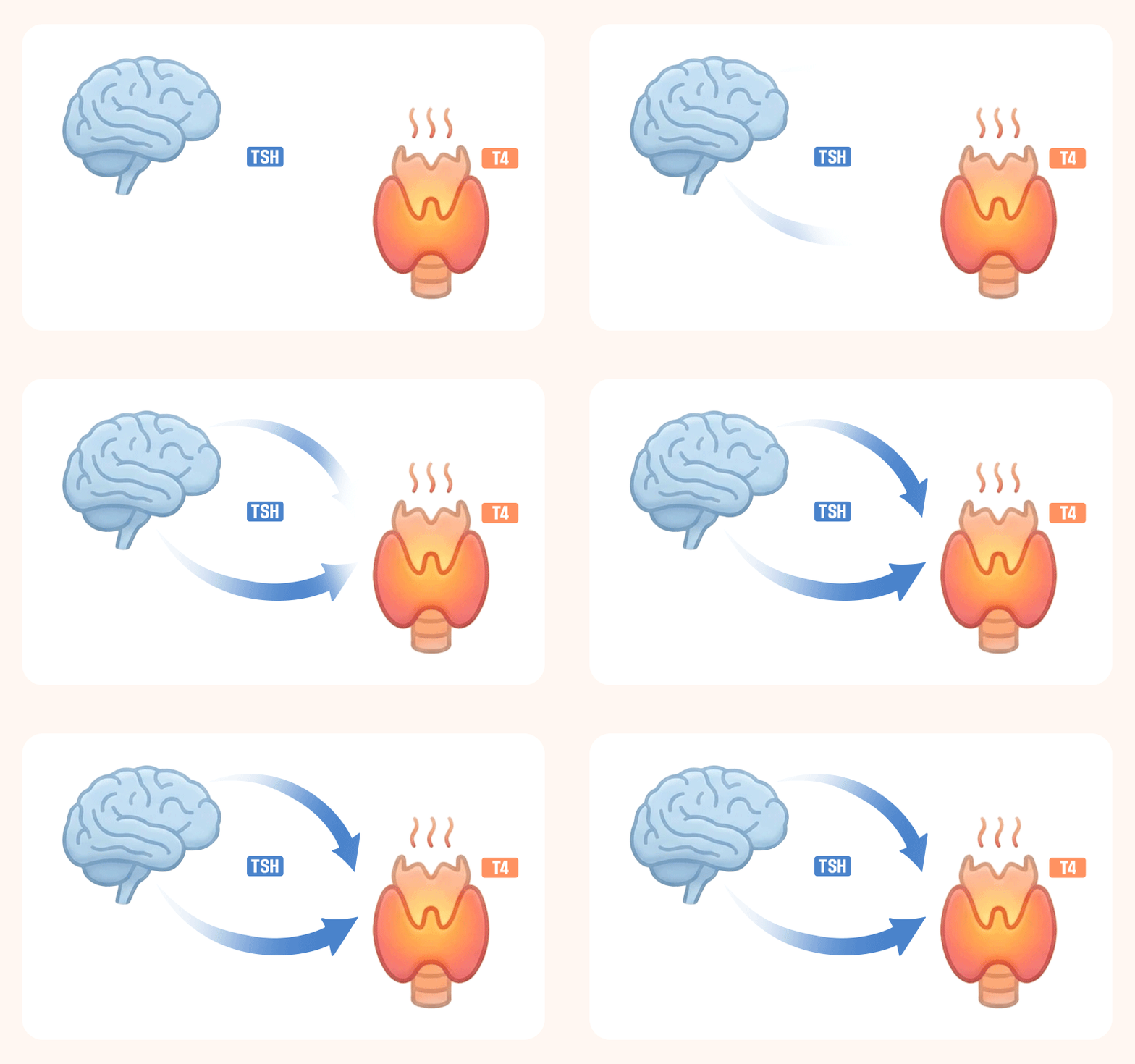
When people think of thyroid tests, they often think of a neck ultrasound first. However, the most basic and essential tool for confirming dysfunction is a blood test (Thyroid Function Test, TFT).
The principle of the test is simple. It is the process of checking how much heat our home boiler (thyroid) is actually producing (Free T4), and how strongly the brain (pituitary gland) is instructing the boiler to run (TSH). The interpretation of the test results can be easily understood as follows:
- If the brain's instructions are weak, but the heat is boiling: It is suspected that the thyroid has escaped the brain's control and overheated on its own, meaning hyperthyroidism.
- If the brain is giving strong instructions, but the heat doesn't rise: It is suspected that the thyroid's performance has dropped and cannot follow the brain's commands, meaning hypothyroidism.
In this way, blood tests (TSH, Free T4) are the most basic and essential starting point for confirming thyroid dysfunction.
However, the interpretation of the levels can vary depending on medications you are taking, pregnancy status, or accompanying diseases. Since an ultrasound is a structural test that looks at the shape or lumps (nodules) of the thyroid, a blood test should come first if fatigue or weight changes are your main concerns.
4.You Should Get Tested Without Delay in These Cases

Just because symptoms are vague doesn't mean waiting is the answer. Under certain conditions, prompt medical confirmation may be necessary. We recommend checking your condition against the criteria below.
First, if severe palpitations persist even when resting, or if you rapidly lose weight without reason.
This could indicate a worsened state of thyroid function imbalance, and an internal medicine evaluation should be considered.
Though rare, there are life-threatening emergency situations. These are critical states that occur when thyroid hormone regulation completely collapses.
'Alarm' Signals That Require an Immediate Hospital Visit
- High fever and altered consciousness: A fever of 38 degrees Celsius or higher accompanied by clouded consciousness or delirium.
- Severe tachycardia and shortness of breath: Your heart beats as if it will burst, and it is difficult to breathe.
- Hypothermia and coma: Body temperature drops abnormally, and consciousness is lost.
Symptoms like the above could be an emergency such as a 'thyroid storm' or 'myxedema coma'. In these cases, you must visit an emergency room or hospital without delay. For other general symptoms, if they interfere with your daily life, it is advisable to consult with medical staff to determine an appropriate testing time rather than worrying alone.
5.Is It Always Dangerous If You Feel a Lump in Your Neck?

If you feel a lump in the front of your neck or hear that you have a 'thyroid nodule' during a checkup, you might immediately feel scared.
However, not all lumps found in the neck are cancer. In reality, benign nodules (such as cysts) are far more common, and in the majority of these cases, immediate surgery is not required. What's important is a 'risk-based approach'.
Rather than simply the fact that there is a lump, the core focus is on what shape it has on the ultrasound (K-TIRADS classification). Experts predict the risk of malignancy (cancer) using ultrasound images and perform a biopsy (such as fine-needle aspiration) only when absolutely necessary.
Recent major guidelines do not recommend uniform thyroid ultrasound screening for asymptomatic adults. This is to prevent overdiagnosis. However, the story is different if you feel a lump in your neck, have a hoarse voice, or have difficulty swallowing food.
These become subjects for evaluation for the purpose of 'diagnosis' to find the cause, not 'screening'. Therefore, if you have the above symptoms, it is safe to confirm the nature of the nodule through an ultrasound examination.
6.Frequently Asked Questions (FAQ)
Q. I am tired and gaining weight; should I get a thyroid test first?
A. Fatigue and weight gain are symptoms of hypothyroidism, but there are also many other causes, such as lack of exercise or dietary habits. However, if symptoms persist for more than a month even after improving lifestyle habits, it is efficient to rule out a thyroid cause with a blood test.
Q. If I have palpitations, should I get a heart test or a thyroid test?
A. Palpitations can be a heart problem, or they can be the heart beating fast due to an excess of thyroid hormones. In clinical practice, an electrocardiogram and a thyroid function test are usually performed together to differentiate the cause.
Q. Is it helpful to eat a lot of seaweed or kelp, which are said to be good for the thyroid?
A. Koreans already consume enough iodine through their diet. If you have hyperthyroidism or certain autoimmune diseases, excessive iodine intake can actually interfere with treatment. It is more advisable to maintain a balanced diet.
Q. Do I only need to check the TSH level in a blood test?
A. TSH (Thyroid Stimulating Hormone) is the most sensitive indicator, but it may not be enough on its own. To accurately assess the condition, Free T4 (Free Thyroxine) is usually tested together, and T3 or autoantibody tests may be added as needed.

Abnormal thyroid symptoms are distress signals sent by our body regarding metabolic regulation. If left neglected, they can not only cause a loss of daily vitality but also affect heart and bone health in the long run. First, the more ambiguous the symptoms, the more you should check your blood test results. The answer to whether the cause of fatigue and palpitations is hormones or stress lies in the blood. Second, if you are in the menopausal age group, more careful observation is required. Since it is a period where hormone changes overlap, it is advisable not to dismiss symptoms as mere aging. Third, for neck lumps, follow an expert's risk assessment. Rational management based on ultrasound findings is needed rather than vague fear. A reasonable suspicion that the discomfort you are feeling now might not be simple fatigue becomes the first step to restoring your body's balance.
Sources
- Korea Disease Control and Prevention Agency National Health Information Portal, Health Information on Hyperthyroidism/Hypothyroidism, 2023.
- Korean Thyroid Association & Korean Society of Thyroid Radiology, 2023 Korean Thyroid Imaging Reporting and Data System (K-TIRADS) Clinical Guidelines, 2023.
- NICE Guideline [NG145], Thyroid disease: assessment and management, 2019.
※ The copyright for all content on this blog belongs to medihi. Unauthorized copying, distribution, or derivative use is strictly prohibited, and violations may result in legal action without prior notice.
Recommended reads
 medihi