

We explore realistic medication guidelines that help absorb thyroid hormones while protecting your daily routine. By understanding the drug's mechanism, you can continue your treatment smoothly without having to give up coffee.
"Is it okay to drink the morning coffee I enjoy every day along with my thyroid medication?"

When starting thyroid hormone (Levothyroxine) treatment in the clinic, the first thing the medical staff checks is your daily morning medication habit.
Particularly, office workers with busy morning commutes often feel at a loss, wondering if they must immediately stop the morning coffee they drink every day because of their thyroid medication.
In actual clinical practice, we place more weight on checking the medication interval to preserve the absorption rate rather than forcing you to cut out coffee entirely.
It is very exhausting if the daily joy of a routine turns into guilt because of a daily medication. Once you understand how the medication and coffee react in our bodies, you can maintain your treatment smoothly without ruining your daily life.
1. Why Does Absorption Decrease If I Drink Coffee Immediately After Taking Levothyroxine Tablets?

Thyroid medication (Levothyroxine tablets) must dissolve in the stomach, pass through the intestines, and be sufficiently absorbed into the blood to do its job.
This process is similar to a dry sponge (intestinal mucosa) fully absorbing water (medicine). The medicine must enter when the stomach is sufficiently empty for the sponge to absorb the efficacy deeply. What happens if you drink coffee right after taking the medicine?
Beyond simply delaying absorption, the efficacy of the drug itself may disappear. The reason is the 'binding' between the ingredients in coffee and the drug. Tannin components, such as chlorogenic acid found in coffee, tightly bind with levothyroxine molecules the moment they meet, forming a 'giant complex'.
This complex is too large to pass through the pores of the intestinal mucosa in our bodies. Ultimately, the unabsorbed drug components are excreted out of the body through feces.
At this point, many people misunderstand that coffee ingredients directly damage the thyroid gland itself. However, in reality, it is closer to blocking the pathway for the drug to enter the blood.
Medically speaking, there is no need to strictly cut out coffee itself. You just need to ensure a clear time gap so that the medicine can be sufficiently absorbed into the body's sponge.
2. Can I Drink Morning Coffee While Preserving the Efficacy of Levothyroxine?

It is not realistic to advise holding off on coffee unconditionally during a busy morning preparing for work.
Instead, it is more advantageous to set a clear, conservative standard of a 1-hour interval. Taking the medication with pure water and waiting at least 1 hour greatly helps preserve the intestinal absorption rate. Of course, even after just 30 minutes, the drug is absorbed to some extent.
However, the absorption rate may fluctuate depending on your daily stomach condition or the concentration of the beverage. Especially during the morning commute, unexpected variables like running late or public transit delays can easily shorten your wait time.
Therefore, considering daily variables, setting 60 minutes as a safety margin is a way to reduce mistakes.
Even if you opt for decaffeinated coffee, the principle remains the same. Decaf also has specific components and acidity that can affect the stomach environment. Therefore, it is reasonable to allow the exact same 1-hour wait time.
Example of a 1-Hour Morning Commute Routine for Office Workers
- Immediately upon waking: Take hormone medication with 1 cup of pure water.
- Wait 60 minutes: Utilize this time for showering, getting ready, and commuting.
- After 1 hour: Safely enjoy your morning coffee after arriving at the office.
3. What to Check Before Increasing Thyroid Medication When TSH Levels Fluctuate?

When fluctuations in Thyroid-Stimulating Hormone (TSH) levels are found during regular check-ups, many patients become anxious, wondering if their disease has worsened. Just because the levels fluctuated does not mean it can be concluded that the disease has rapidly deteriorated.
You must check the influence of the dosing interval, concurrent medications, and test conditions together, not just simple absorption issues. It might be the accumulated result of days when the dry sponge was already wet with other foods and could not properly absorb the medicine.
Rather than blindly increasing the medication dose because the numbers changed, the first step is to reflect on your usual medication habits.
You need to see if you missed the morning fasting rule or if your coffee drinking times were irregular. In particular, calcium supplements, iron supplements, and aluminum-containing antacids can strongly interfere with drug absorption and should be spaced at least 4 hours apart from thyroid medication.
Also, the biotin ingredients frequently consumed by modern people can interfere only with the test results, regardless of actual hormone health.
- Medication Habit Checklist to Review When TSH Levels Fluctuate
- Did I maintain a 1-hour interval from beverages other than water or coffee when taking it in the morning?
- Did I leave at least a 4-hour interval from calcium, iron, and antacid nutritional supplements?
- Did I take high-dose nutritional supplements containing biotin before the recent test?
- Were the medication times and fasting conditions kept consistently the same on weekends and weekdays?
4. 3 Realistic Alternatives for Office Workers Who Cannot Wait 1 Hour in the Morning

Not everyone's morning schedule can be the same. If it is extremely difficult to keep a 1-hour morning interval due to your work environment, there is no need to overdo it.
Based on your lifestyle pattern, you can carefully try to apply one of the following three alternatives in consultation with your medical staff.
First, if you do not have late-night snacks after dinner and have secured a sufficient fast, taking it before bedtime may be advantageous. It does not overlap with your morning routine, reducing the possibility of interference from coffee.
Second, if maintaining a morning fast is completely impossible, there is a method of taking it with meals and readjusting the dosage under medical monitoring. Third, if the absorption interference of the tablet is severe and a prescription change is possible, you can consider switching to a liquid formulation.
However, the success or failure of these alternatives depends on the individual's lifestyle pattern. If you frequently eat late-night snacks, taking it before bedtime can actually work against absorption.
Therefore, it is reasonable to find an optimal alternative with your medical staff by analyzing your dietary habits and sleep patterns in detail.
5. Why 'Consistency' Is More Important Than 'Time' to Maintain Stable Treatment
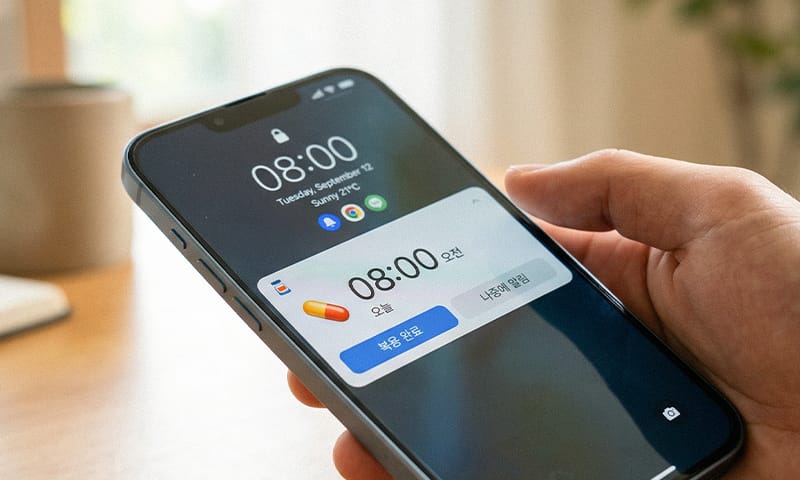
There is a part that is surprisingly easy to miss in the process of continuing thyroid treatment.
What is more meaningful than taking medication in a flawless environment is the consistency of keeping the conditions exactly the same every day. If the medication time or fasting conditions vary daily, the absorption rate will constantly fluctuate.
Let's assume that one day you take it early in the morning, another day at lunch, and on weekends you swallow it with coffee. If the amount of medicine the intestinal sponge absorbs fluctuates wildly every day, it becomes difficult for the medical staff in charge to accurately grasp the patient's hormone status.
Consequently, it may take much longer to find the proper medication dosage for your body. If you have chosen to drink coffee 1 hour after taking it in the morning, we recommend that you steadily maintain that pattern.
If you chose to take it before bed, it is advantageous to maintain a similar late-night fasting state every day. Establishing firm rules that fit your lifestyle pattern is a wise approach to preserving the drug's efficacy without losing your daily life.
6.Frequently Asked Questions (FAQ)
Q. Can I drink a latte with milk or decaffeinated coffee instead of an Americano after taking the medicine?
To fully absorb the medicine, taking it with pure water is the baseline. Beverages other than pure water, like lattes or decaf, can change the stomach environment. Therefore, to avoid affecting drug absorption, it is conservative and safe to leave a minimum interval of 1 hour, exactly the same as regular coffee.
Q. I forgot and drank coffee first, is it better to skip the medication that day?
Arbitrarily stopping your medication does not help hormone stability. Even if you drank coffee first, it is better to adjust your meal times to secure a sufficient fasting state again and then take the medicine. If this situation repeats frequently, you should discuss changing the dosing time with your medical staff.
Q.How much time should I leave between the medicine and supplements like iron or calcium?
Iron supplements, calcium supplements, and antacids (stomach medicine) are components that can interfere with the absorption of thyroid hormones much more strongly than coffee. Therefore, as a rule, you should separate the times for these medications and take them with a long interval of at least 4 hours.
Q.I am strictly following the prescribed medication method, but when should I visit the clinic if my fatigue continues?
If symptoms such as severe fatigue, frequent palpitations, or rapid weight changes persist for more than 2-3 weeks even though you strictly followed the regular fasting medication and the 1-hour interval, you need to visit the clinic. It may not be a simple habit issue, but a point where a precise readjustment of the drug dosage itself is required.

We summarize realistic standards for those who are torn between thyroid treatment and their daily morning coffee. First, coffee does not directly damage the thyroid gland, but it can delay the process of the intestinal mucosa fully absorbing the medicine. Second, if you maintain your morning dose, we recommend swallowing the medicine with pure water and enjoying your coffee after at least 1 hour has passed. Third, if waiting 1 hour is realistically too demanding, do not force it, and look for alternatives that fit your daily life, such as taking it before bedtime or changing the formulation. Just by making sure to take your medicine steadily without forgetting every day, you are already making an excellent effort. If you understand your body's absorption mechanism and just create small, consistent rules, it is okay not to feel excessive anxiety over a cup of morning coffee.
Sources
- Benvenga et al., Altered intestinal absorption of L-thyroxine caused by coffee, Thyroid, 2008
- Skelin et al., Levothyroxine Interactions with Food and Dietary Supplements—A Systematic Review, Pharmaceuticals, 2021
- Korea Disease Control and Prevention Agency (2024). National Health Information Portal: Correct medication usage for patients with thyroid diseases.
※ The copyright for all content on this blog belongs to medihi. Unauthorized copying, distribution, or derivative use is strictly prohibited, and violations may result in legal action without prior notice.
Recommended reads
 medihi