

When considering veneers, looking at the "price tag" first often leads to more anxiety. In this article, we will guide you step-by-step through the key criteria you need to check when getting veneers in Korea, so you can make a safe and informed decision.
"Why is the price difference for veneers so large between clinics in Korea?"
"If I go to a place that is too cheap, will my teeth become weak?"
It is natural to have these concerns if you understand the power of a smile in social life. We deeply empathize that for those visiting Korea from abroad, "maintaining long-term health" is a far more important value than simply "becoming pretty."
Rather than vaguely looking for the cheapest option, try checking how meticulous the "internal design" is first, with a mindset of cherishing your teeth. Just like choosing the right contact lenses or laying the foundation for a lifelong home, here are the standards you can meticulously examine.
1."Is it dangerous if it's too cheap?" 5 Things to Check Before the Price Tag
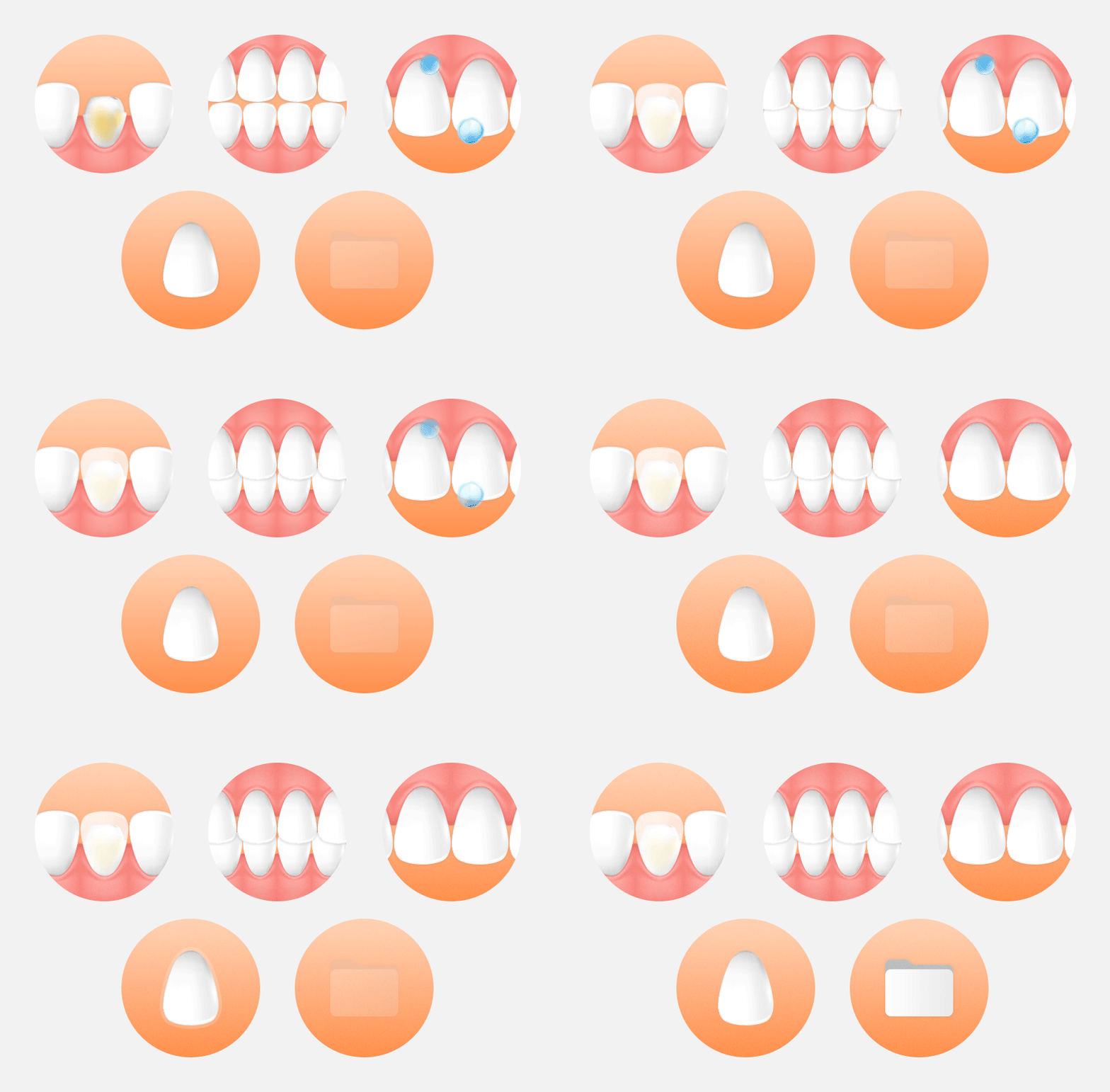
The real meaning behind the question, "Is it dangerous if it's cheap?" is actually this:
"Are the essential processes to keep my teeth healthy fully included?"
Veneers are not a treatment that covers the entire tooth like a crown.
It is a procedure where the front surface of the tooth is thinly prepared, and a thin ceramic shell is precisely bonded.
Therefore, the result is not determined by the material alone but largely depends on the "details of the process," such as the bonding environment (moisture control), fit (margin), and occlusion design.
Think of "prescription glasses."
Even if the lens quality is excellent, if the prescription, face shape, or lens angle doesn't match yours, you can't wear them because of dizziness.
Veneers are the same.
It is important not just to look at the "ceramic" itself, but to see if it is precisely designed to fit you.
So, before looking at the cost, we recommend checking these 5 questions first.
(How specifically a clinic answers these questions essentially explains the "reason for the price.")
- Is there a plan for provisional restoration (temporary veneers)?
- This step protects your teeth during the fabrication period and allows you to adapt to the design first.
- Necessity may vary depending on the case.
- Are the try-in (intermediate check) and occlusal adjustment fully planned?
- The "bonding day" is not the end; fine-tuning the bite (occlusion) is crucial for the prognosis.
- For international patients, even small discomforts after returning home can become major stressors.
- How is moisture control (isolation from saliva/blood) managed during bonding?
- Contamination from saliva or blood can significantly reduce bonding strength.
- Since veneers are an adhesion-based treatment, this step is particularly critical.
- How are the margin (edge) position and fit designed?
- Inaccurate margins can be linked to discoloration, gum inflammation, and plaque accumulation.
- Simple notions like "placing it deep under the gum looks prettier" can be misconceptions.
- For international patients, are there records and communication plans for aftercare?
- A clear "Aftercare Plan" reduces anxiety.
- Checklist: Summary of scans/photos/materials/bonding protocols, availability of remote consultation, and plans for coordination with local dentists.
These five questions are not about asking for the price, but questions to protect the foundation and prognosis of your teeth.
The more specific the answers, the more solid your choice can be.
2."There are too many types..." Which Option Fits My Teeth?
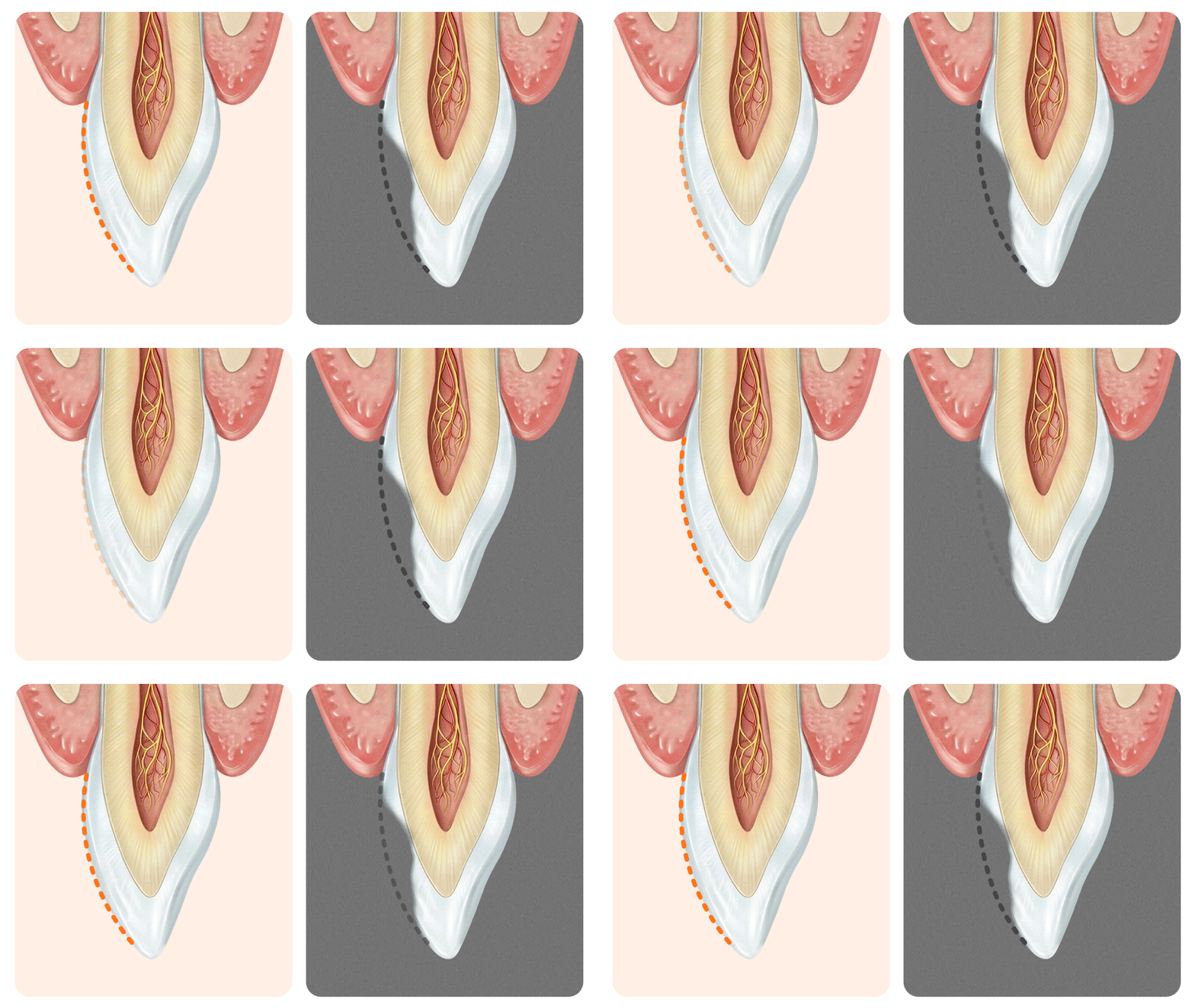
When choosing veneer options, many people think of "design preference" first.
However, the safe order is usually the opposite.
It is more important to check the foundation status (Enamel) of your teeth first.
Let's think of the "foundation of a house."
No matter how beautiful a house is, if the ground is weak, it cracks and shakes.
In veneers, that ground is the Enamel.
While research generally reports high long-term survival rates for veneers, it is consistently confirmed that survival rates and maintenance-free rates tend to decrease as Dentin exposure increases.
So the conclusion is very simple.
"Minimal Preparation + Maintaining Enamel Bonding" is the core.
Then, how should we organize the options?
It’s not about "which type is unconditionally better," but it depends on the conditions.
- Ceramic Veneers (Standard)
- Used for improving minor alignment/discoloration/shape issues.
- Excellent aesthetics and durability.
- Possibility of fracture/chipping/debonding exists.
- Occlusal design and moisture control/bonding are critical.
- Ultra-Thin Minimal-Prep Veneers (Select Cases)
- Can be considered when tooth alignment is nearly normal and the goal is minor improvement.
- However, it is not a standard applicable to everyone and has case limitations.
- Forcing this application can lead to thickness or occlusion issues.
- Direct Composite Resin
- Can be considered for small chips/gaps/minor defects.
- Same-day completion may be possible, and repair/modification is relatively easy.
- However, long-term maintenance (staining/wear) varies depending on the situation.
The important conclusion here is this:
"How much of my enamel can be saved" comes before the "type."
And next comes bonding, occlusion, and aftercare.
3.Why 'Visits / Stay / Aftercare' Change the Result

When considering treatment in Korea from abroad, the most realistic question is this:
"Can I finish it safely within my schedule?"
While veneers tend to have high long-term success rates, for overseas residents, 'Visits / Stay / Aftercare' can directly affect the success or failure of the treatment.
Please remember that expressions like "One-Day" or "2 Visits" are conditional.
Visits: "2 or more visits" is standard; additional visits may be needed.
- Standard planning often involves at least 2 visits (Diagnosis/Prep/Scan \rightarrow ->Bonding).
- However, in reality, additional visits may be required for try-in, occlusal adjustment, and final check.
- Plans change depending on design modifications, gum condition, and bite stability.
Stay: A tight schedule can compromise "Precision."
- Veneers are custom-made, requiring time for fabrication, fit verification, and modification.
- If the schedule is too tight, occlusion checks or adjustments may not be sufficient.
- Completeness is more important than speed.
Aftercare: "Records" reduce anxiety after returning home.
- For international patients, records are vital. They create conditions that make it easier for local dentists to respond if problems arise after returning home.
- The 3-Record Set:
- Scans/Photos (including before/after)
- Material Information
- Bonding Protocol Summary (if possible)
- Communication Plan:
- Availability of remote consultation
- Coordination plan with local dentists (if necessary)
"Same-day completion" can be convenient, but it is not the standard for all cases.
If you live overseas, set your criteria on whether the plan is safe even after you return, rather than just finishing quickly.
That will eventually be the most comfortable path.

What makes your heart heavy when considering veneers is the price, but what protects your smile for a long time is the standard.
First, check first and foremost how much enamel can be preserved (Minimal Preparation).
Second, see if the process of bonding (including moisture control) and occlusal design is thoroughly verified.
Third, if you reside overseas, strictly check if the plans for Visits/Stay/Aftercare and securing records are realistic.
Sources
- Korea Disease Control and Prevention Agency (KDCA), National Health Information Portal. Overview, Procedure, and Management of Laminate Veneers.
- Alqutaibi, A. Y., et al. (2025). "Meta-analysis related to long-term survival rates of ceramic laminate veneers."
- Komine, F., et al. (2024). "Literature review on clinical performance and importance of bonding/surface treatment of ceramic laminate veneers."
※ The copyright for all content on this blog belongs to Medihi. Unauthorized copying, distribution, or derivative use is strictly prohibited, and violations may result in legal action without prior notice.
Recommended reads
 medihi