

The biggest concern for international patients after getting veneers is how to handle potential issues once they return home. This guide provides a checklist for continuous care, including the role of remote consultations, criteria for visiting a local clinic, and how to prepare a "Dental Record Package."
"I just got back from Korea—what if my veneers chip or fall off?"
"If I visit a local dentist, will they know what materials were used in Korea?"
When considering veneers abroad, the most important question isn't the procedure itself—it’s the continuity of care after you return home. Because veneers are influenced by variables like bonding, occlusion (bite), and lifestyle habits, having a clear roadmap for post-op issues is your most realistic safety net.
This guide outlines an aftercare checklist focusing on three pillars: Remote Consultation Channels, Local Clinic Visit Criteria, and the Dental Record Package.
1. If an Issue Occurs Post-Return, What Should You Check First?
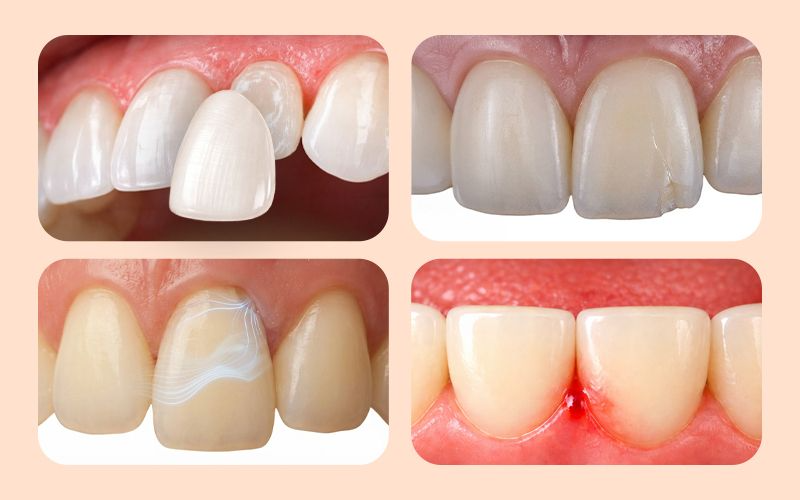
When a problem arises, the first step is to categorize the symptom. Veneer-related issues generally fall into four categories:
- Debonding: The veneer has completely detached or feels loose.
- Fracture: A chip or crack at the edge or surface of the prosthetic.
- Sensitivity: Nerve irritation or pain from hot/cold stimuli.
- Gums: Redness, swelling, or bleeding around the gum line.
Immediate Action Steps (First Aid):
- Storage: If a veneer falls off, do not throw it away. Place it in a clean container with moist gauze or water to prevent it from drying out.
- The Golden Rule: Never use household superglue. This contaminates the tooth and the prosthetic, making professional rebonding impossible and causing permanent damage.
- Decision Making: Determine if the situation can start with a remote consultation or requires an immediate physical visit to a local dentist.
2. Remote Consultation vs. Local Clinic: When to Go Where?
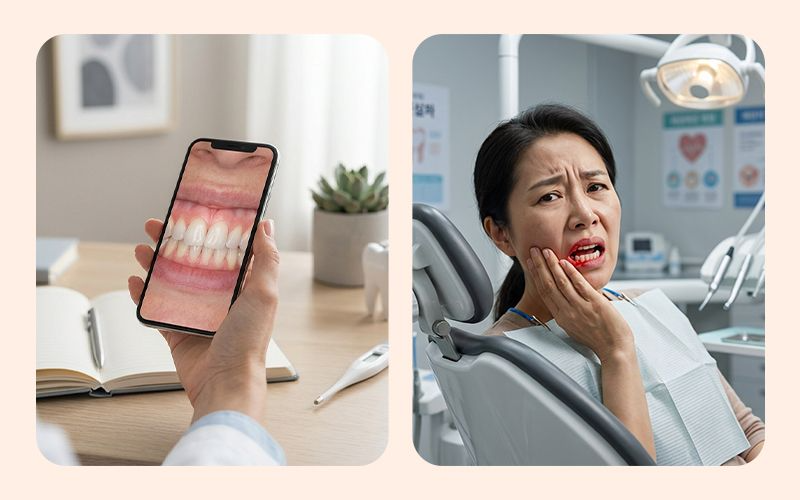
Remote Consultation (Teleconsultation) acts as your "GPS." It helps triage the situation through photos and videos, providing guidance on the next steps and organizing information for a local doctor.
[Situations for Remote Consultation]
- Assessing the extent of a fracture via photos to determine priority.
- Determining if sensitivity is within the normal recovery range or due to bite interference.
- Getting guidance on hygiene for minor gum swelling.
[Situations Requiring an Immediate Local Visit]
- Functional Instability: The veneer has fallen off or is wobbling.
- Physical Damage: Visible fractures or sharp edges causing discomfort while eating.
- Signs of Infection: Severe pain, swelling, spontaneous pain, or pain that keeps you up at night.
- Acute Gum Issues: Severe inflammation or suspected periodontal complications.
3. Preparing for a Local Dental Visit: The Record Package

The biggest barrier to "Veneer Repair Abroad" is that local dentists lack specific information about your treatment. Without knowing the prep depth, bonding protocol, or material used, local dentists may take an overly conservative approach.
To avoid this, request a "Dental Record Package" in English from your Korean clinic before departure:
- Clinical Summary: Tooth numbers, prep depth (diagrams/descriptions), and the materials/bonding protocols used.
- Occlusal Data: Details on bite adjustments made and notes on parafunctional habits (grinding/clenching).
- Visual Records: Pre- and post-op photos and X-rays to help the local doctor understand the changes.
- Aftercare Guide: Instructions on how to contact the Korean clinic and specific "Red Flag" symptoms for local intervention.

Ltinerary planning isn't just about the number of days; it's about the structure. A successful trip includes Buffer Time after the final bonding for observation and bite adjustments.
If you rush to the airport immediately after bonding, you lose the chance to fix minor interferences that could lead to fractures later. When choosing a clinic, don't just ask "How pretty will I look?" Ask: "Is this clinic prepared to protect me even after I leave Korea?"
Sources
- Morimoto et al., Main Clinical Outcomes of Feldspathic Porcelain and Glass-Ceramic Laminate Veneers: A Systematic Review and Meta-Analysis of Survival and Complication Rates, International Journal of Prosthodontics, 2018.
- Layton et al., The survival and complication rates of porcelain laminates, Journal of Dentistry, 2012.
- Migas et al., Teledentistry: A Review of the Literature, Journal of Personalized Medicine, 2022.
※ The copyright for all content on this blog belongs to medihi. Unauthorized copying, distribution, or derivative use is strictly prohibited, and violations may result in legal action without prior notice.
Recommended reads
 medihi