

This post summarizes the medical criteria used to determine the interval between cataract surgery in both eyes. Depending on your individual ocular condition, you can identify the approach most likely to support safer, more accurate visual recovery.
“Is it possible to have surgery on both eyes at once?”

It’s natural to want to reduce the burden of frequent hospital visits. However, the eyes are highly sensitive organs. Prioritizing patient safety over convenience is more likely to lead to a stable recovery.
When planning bilateral cataract surgery, clinicians first assess infection risk and the target visual outcome. Many patients hope that operating on both eyes in one day will be simpler. In the clinic, however, the key question is whether strict “separate-surgery” protocols can be implemented safely. Decisions are made cautiously, guided by signals from domestic cohort studies and shared principles in international guidance—especially strict aseptic separation and early postoperative follow-up.
1. “Same-day bilateral surgery” is not truly simultaneous
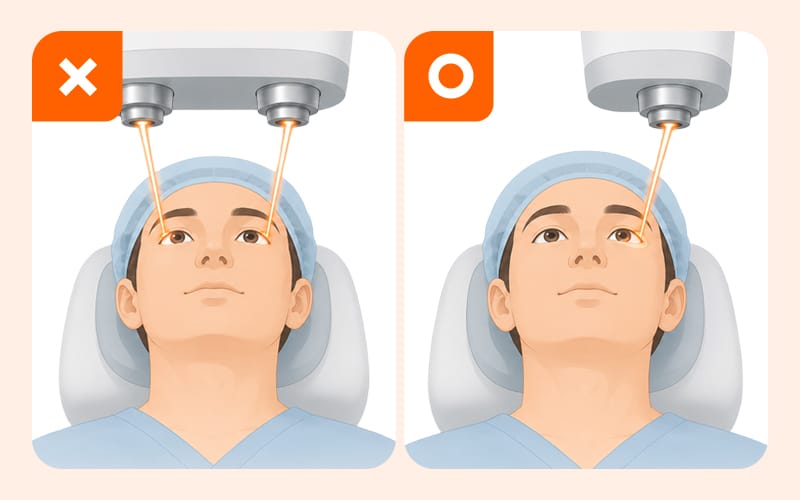
When people hear “surgery on both eyes on the same day,” it’s easy to picture both eyes being treated at the same time. But immediate sequential bilateral cataract surgery (ISBCS) is not performed simultaneously. After the first eye is fully completed, the entire setup is reset from the beginning before operating on the other eye.
It’s similar to renovating two rooms on the same day. After finishing the first room, the workers wash their hands and bring out completely new tools and materials. Only then do they start the second room. In the operating room, instruments, disposable supplies, and medications are likewise strictly separated.
This separation is essential to prevent infections such as postoperative endophthalmitis. Under strict medical standards, the two eyes should be treated as completely separate surgeries. If an unexpected issue occurs during the first-eye procedure, postponing the second-eye surgery to another day is considered the safer standard.
✅ Checklist before planning same-day bilateral (ISBCS)
- Are surgical instruments, disposables, and medications completely separated for each eye?
- Are the patient identity, surgical site (left/right), and intraocular lens (IOL) power cross-checked by two staff members?
- Is there a clear principle to postpone the second eye if a problem occurs in the first eye?
- Is an early follow-up schedule secured (e.g., the next day)?
2. Unexpected benefits of spacing the surgeries apart

Delayed sequential bilateral cataract surgery (DSBCS)—operating on one eye first and the other at a later date—can feel inconvenient. However, it allows clinicians to confirm the refractive outcome of the first eye and fine-tune the surgical plan for the second eye.
Although IOL power is determined through detailed preoperative measurements, small deviations can occur after the lens settles inside the eye. With an interval between surgeries, the “first room renovation” (first-eye surgery) provides real-world refractive results, and that feedback can be applied to the “second room renovation” (second-eye surgery).
If the first eye’s outcome differs slightly from what was expected, adjusting the IOL power selection for the other eye may be considered. The magnitude of error and patient satisfaction vary depending on ocular status and IOL type, but overall this approach can help achieve refractive targets. For patients who place a high value on refractive precision, this is often the more conservative option.
3. How to decide the right interval for your eyes

When deciding the interval, clinicians consider infection risk, refractive-precision goals, and the feasibility of follow-up visits. If you are in a low-risk group with no other eye disease and good overall health, same-day sequential surgery may be considered. This can reduce the number of hospital visits and shorten the period of visual imbalance between the two eyes.
On the other hand, if underlying conditions are present, spacing the surgeries is safer. Because ocular status and recovery speed vary by individual, it’s important to understand your own situation accurately. Use the table below to review the overall recommended approach.
| Patient Condition & Priority Criteria | Recommended Surgical Approach |
|---|---|
| Low-risk group / Minimizing visit burden | • Consider immediate sequential bilateral cataract surgery (ISBCS) • Provided strict instrument separation protocol is applied |
| Diabetes / Retinal disease / Concern for macular edema | • Delayed sequential bilateral cataract surgery (DSBCS) recommended • Observe inflammatory response and wound healing variability |
| High myopia / Premium IOLs (multifocal, etc.) | • Consider delayed sequential bilateral cataract surgery (DSBCS) • Refine accuracy using feedback from first eye results |
| History of strabismus / Risk of diplopia | • Delayed sequential bilateral cataract surgery (DSBCS) recommended • Evaluate binocular visual balance and neuroadaptation |
If you have a history of strabismus or conditions associated with a higher risk of diplopia, scheduling should be adjusted even more carefully. A rapid change in binocular visual balance can worsen dizziness. A stepwise approach—after confirming recovery in the first eye—is advisable.
Ultimately, the interval should be determined not by “convenience,” but by an individualized risk assessment.
4. Safety checks you must confirm before surgery

The core of safe treatment is not whether everything can be finished quickly in one day. The most important factor is a robust infection-prevention system. Even if both eyes are treated on the same day, the team must systematically re-check that left- and right-eye procedures are accurately and completely separated.
Major international ophthalmology guidelines emphasize cross-checking the IOL by at least two medical staff members. Even for highly standardized procedures, cross-verification is an essential system-level safety net that helps prevent critical errors.
Large domestic cohort data have shown periods in which endophthalmitis incidence was somewhat higher in same-day sequential bilateral surgery groups. However, because these studies are based on claims data, they have limitations—such as difficulty directly verifying the actual level of aseptic separation or the patient-selection criteria used. For this reason, in Korea, key safety points are commonly described as: selecting low-risk patients, performing fully separated surgeries, and ensuring early follow-up.
✅What to check during consultation
- When operating on both eyes, are instruments and medications completely separated?
- Is the IOL power cross-checked in the operating room by at least two staff members?
- Can the second surgery be flexibly postponed depending on the first eye’s outcome?
5. Don’t miss these points for visual balance and recovery

Even if the operating-room process goes smoothly, true visual recovery depends on postoperative care. If both eyes were treated on the same day, keep early follow-up appointments (such as the next day) to check intraocular pressure and inflammation. Early follow-up is central to preventing serious complications such as endophthalmitis.
If you travel long distances frequently or live overseas, plan your schedule especially carefully. It’s not enough to be available only on the day of surgery—you may need to stay for several days for monitoring. Using prescribed antibiotic and anti-inflammatory eye drops on time plays a decisive role in controlling inflammation.
If surgeries are spaced apart, vision may improve first in the operated eye, temporarily affecting balance. You may perceive distances differently when using stairs or moving at night. Until recovery in the second eye is complete, be cautious about safety incidents such as falls.
6. Frequently Asked Questions (FAQ)
Q. What do you usually base the decision on (same-day vs. spaced surgery)?
Clinicians first evaluate systemic comorbidities, ophthalmic comorbidities (including retinal disease), and infection risk. They also consider whether the first eye’s outcome should be reflected in planning for the second eye (refractive target), as well as whether early postoperative follow-up is feasible. The decision is made by integrating these factors.
Q. If I have diabetes or retinal disease, how does the plan change?
Extra caution is needed because susceptibility to inflammation may be higher, and postoperative risks such as macular edema can be a concern. A spaced approach is often recommended—operating on one eye first and monitoring recovery closely. It is generally more conservative and safer to stabilize systemic status (e.g., glycemic control) in coordination with internal medicine before scheduling the other eye.
Q. Does the first eye’s outcome affect the IOL power for the second eye?
Yes, it can. Although calculations are based on preoperative measurements, small errors may occur depending on the eye’s internal anatomy and postoperative lens position. With an interval, the first eye’s outcome can be used to refine refractive precision when selecting the IOL for the second eye.
Q. After surgery, until when—and with what symptoms—should I contact the clinic immediately?
The first 1–2 weeks after surgery are the period when you should respond most sensitively to changes. If you experience a sudden, noticeable drop in vision, severe pain, or rapidly worsening redness, contact the clinic immediately and come in as instructed.

The timing and interval for bilateral cataract treatment is an important medical decision. It should be determined by a comprehensive assessment of your ocular condition, underlying diseases, and the refractive accuracy you aim to achieve after surgery.
If you use the principles summarized here as a framework and discuss them 충분히 with your clinician, you can make a reasonable choice that fits your situation. With a carefully designed, safety-focused treatment plan, we hope you can enjoy clear, bright vision comfortably for a long time.
Sources
- Korea Disease Control and Prevention Agency (KDCA), Standard Precautions Guidelines for Healthcare-Associated Infections, 2021
- Journal of the Korean Ophthalmological Society, Comparison of the Efficacy and Safety of Simultaneous Bilateral Cataract Surgery and Sequential Bilateral Cataract Surgery, 2023
- Graefe’s Archive for Clinical and Experimental Ophthalmology, Recent trends and outcomes in immediate and delayed sequential bilateral cataract surgeries: a nationwide cohort study in South Korea, 2025
※ The copyright for all content on this blog belongs to medihi. Unauthorized copying, distribution, or derivative use is strictly prohibited, and violations may result in legal action without prior notice.
Recommended reads
 medihi