

Even if your visual acuity tests as “normal,” experiencing everyday glare and haziness can be an early sign of cataract & presbyopia. This article summarizes the key visual functions and diagnostic criteria that active adults in their 60s should review when deciding whether cataract treatment is needed.
“My health screening said my vision is 1.0—so why does everything look foggy?”

In the exam room, many patients with “good vision” still describe a frustrating sense of blur. It’s common to assume that if visual acuity is good, eye health must also be good—but cataracts can still be present even when the numbers look fine.
This can be a natural age-related change, and if you understand your eye’s condition and the proper diagnostic standards, it can be managed safely. Below, we organize why cataracts can develop despite good acuity and what criteria are used to evaluate them.
1. Why a vision chart can’t explain “foggy vision” in real life
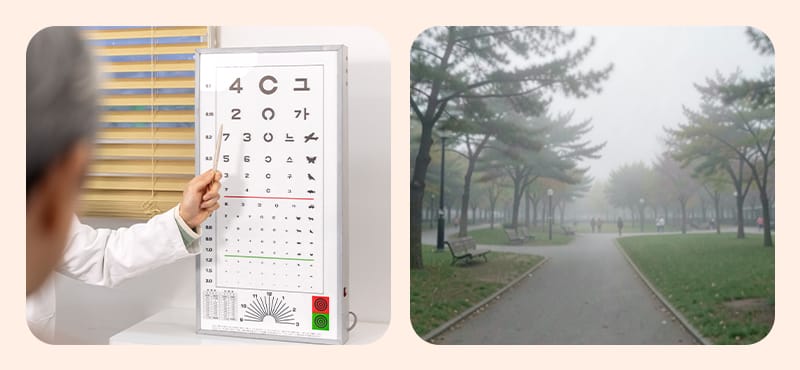
To understand how cataracts can occur regardless of visual acuity, imagine tiny scratches on a car windshield or a thin layer of frost. In bright daylight, you can still clearly see the license plate of the car ahead. But when you enter a tunnel or face oncoming headlights at night, light hits those fine scratches and scatters in all directions—momentarily washing out your view.
Early cataract changes, where clouding begins in the eye’s natural lens, work in a similar way. Incoming light doesn’t pass through cleanly; instead, it hits the cloudy area and spreads out, creating “light scatter.” At night, the pupil dilates to let in more light, and that wider opening allows light to pass through peripheral cloudy zones as well—often making glarefeel worse.
Because a standard eye chart is read under bright lighting with high-contrast black-and-white letters, you may still score a “normal” 1.0. However, even if the chart score stays stable, reduced ability to distinguish subtle differences—such as difficulty recognizing objects on an overcast day—may appear first. This is a decline in functional vision. If symptoms persist, it’s advisable to visit an eye clinic to identify the cause.
2. If you can read without reading glasses: “my eyes got younger” vs. lens changes
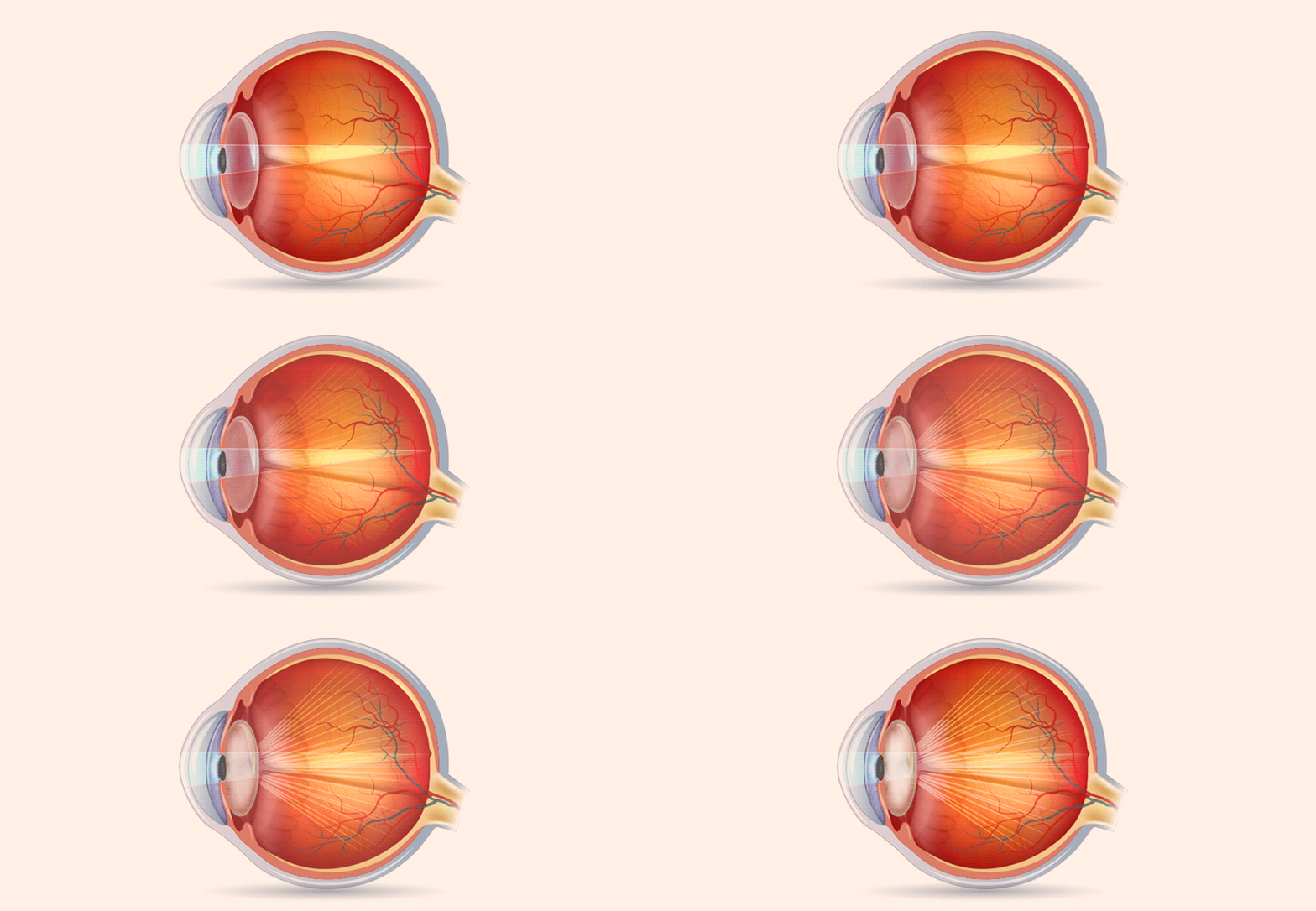
When the curvature of a car windshield changes slightly, the angle at which light bends also changes. Similarly, when the central portion of the eye’s natural lens hardens, its refractive power shifts. This is often observed when the nucleus of the lens becomes hardened in certain cataract patterns, as the lens center becomes denser and effectively more “bulged” than before.
Medically, this is described as a myopic shift due to nuclear sclerosis. During this phase, some people suddenly find that small smartphone text looks clearer even without reading glasses. It can feel like your eyes have “gotten younger,” but if these changes repeat, it’s worth checking for early cataract changes as well.
If your glasses prescription changes frequently over a short period—leading you to visit the optical shop multiple times—it can be difficult to dismiss it as simple age-related near-vision change alone. As clouding progresses, refractive power may keep shifting. Rather than repeatedly replacing glasses and spending time and money, it’s more important to first visit an eye clinic to closely assess whether structural changes in the lens have begun.
✅ Early cataract suspicion checklist
- Do streetlights or headlights spread and flare severely when driving at night?
- Do signs look unusually blurry on rainy or foggy days?
- Has glare in bright places become worse than before?
- Have you recently started seeing near text clearly without reading glasses?
3. Clouding location that routine tests can miss: why a dilated slit-lamp exam may be
needed
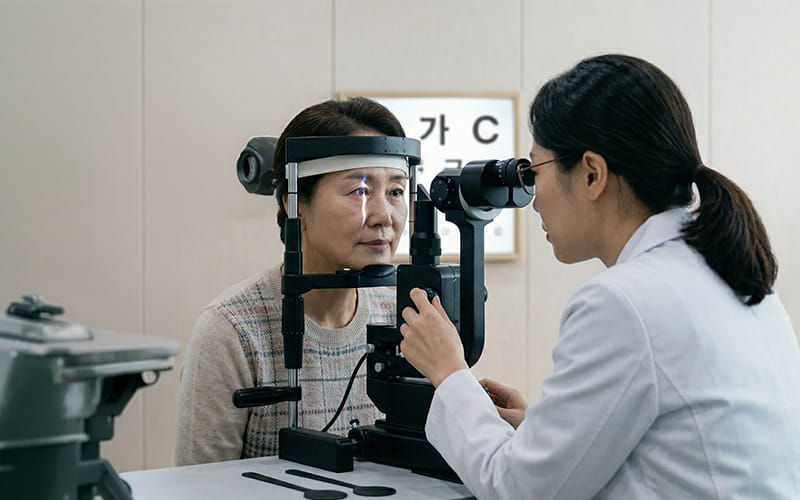
The functional discomfort described above is difficult to detect with a simple vision chart alone. For early, detailed diagnosis, clinicians often perform dilation (widening the pupil with eye drops) and then examine the eye using a slit-lamp microscope. With the pupil widely opened, a specialized beam of light allows the clinician to inspect deeper structures of the lens in detail.
A cataract does not mean the entire lens turns uniformly white all at once. Depending on where the clouding occurs, the symptoms a patient experiences can be completely different.
| Cataract Type | Opacity Location & Characteristics | Primary Perceived Symptoms |
|---|---|---|
| Nuclear Cataract | Hardening of the lens center (nucleus) | Temporary improvement in near vision, frequent prescription changes |
| Cortical Cataract | Opacity in the outer edge (cortex) of the lens | Nighttime light blurring/halos, blurry vision |
| Posterior Subcapsular Cataract | Opacity in the thin membrane at the back of the lens | Severe glare in bright places, decline in vision |
In other words, identifying where the clouding is and how advanced it is helps explain the real-life discomfort more accurately. Even if the eye looks fine externally, mapping the inside of the eye through a detailed exam is the first step toward an appropriate treatment plan.
4. After diagnosis: surgery now vs. monitoring—how to choose a safer option for you

In most cases—except for certain situations such as acute glaucoma—cataract surgery is not an emergency procedure. While a lens that has already become hardened cannot be made transparent again with eye drops or oral medication alone, the timing of intervention can often be adjusted. Treatment direction can vary significantly depending on a patient’s daily environment and occupational needs.
If you drive at night for work or spend a lot of time outdoors with frequent exposure to strong light, even early-stage glare can pose a major safety concern. This tendency is sometimes seen more often in men, and in some cases, cortical cataract can develop severely in one eye even in the 40s. Rather than assuming you are “too young” for it and leaving it unaddressed, if your vision remains persistently hazy, it’s advisable to undergo a cataract evaluation at an eye clinic.
On the other hand, if you rarely go out at night, mainly do household routines or light walks, and your discomfort is minimal, the approach can be different. In that case, it may be safer to maintain monitoring—adjusting glasses prescriptions appropriately and checking the progression rate through regular exams. Surgical appropriateness depends not only on whether clouding exists, but on how much symptoms interfere with daily life.
Also, some people in their 70s still have relatively mild lens clouding and good corrected vision. In such cases, it may be reasonable to observe rather than proceed immediately with surgery. However, because age-related lens clouding and hardening happen to everyone and cannot be fully prevented, cataracts in the 80s tend to be more advanced. For this reason, ophthalmologists often recommend that patients consider cataract surgery during their 70s, depending on symptoms and daily-life impact.
✅ Lifestyle checklist to prepare before your clinic consultation
- At what time of night does oncoming headlight glare feel the most severe?
- In the last 6 months, has your vision remained hazy even after changing your glasses prescription?
- Have you started avoiding certain outdoor activities because your vision feels more uncomfortable in bright light than before?
5. Choosing an intraocular lens: why “lifestyle” matters more than simple “vision recovery”

If you decide on surgery after a period of monitoring, the cloudy natural lens is removed and a new intraocular lens is implanted. The optical characteristics of the lens you choose can significantly affect how visually comfortable you feel after surgery.
Intraocular lenses have been continuously improved in performance and design since they were first developed decades ago. Today, multifocal intraocular lenses—designed to help with distance, intermediate, and near vision—are widely used. The glare/halo effects and dim-vision sensations that can occur as part of the multifocal mechanism have also been improved considerably through advances in materials and design.
Of course, if you prefer to avoid such side effects, another option is to choose a standard monofocal lens that provides a single clear focal point, and then use glasses to compensate for other distances after surgery.
Medically, clinicians should evaluate the patient’s overall lifestyle—such as whether the goal is to reduce dependence on glasses and how much driving the patient does. If you are an active adult in your 60s, it’s recommended to organize your main daily viewing distances and routines in detail and work with your clinician to find the most suitable option.
6. Frequently Asked Questions (FAQ)
Q. Can it still be a cataract even if my vision test is normal?
Yes, it can. Even if you can still read a high-contrast eye chart, night vision or contrast sensitivity (the ability to distinguish subtle light-dark differences) may decline first. If fog-like blur persists regardless of the visual acuity number, it’s a good idea to get examined.
Q. What tests confirm early cataracts?
The pupil is dilated using eye drops. Then a slit-lamp microscope exam is performed to identify the exact location and degree of lens clouding in detail using a specialized light beam.
Q. If changing my glasses makes my vision clearer, should I still consider surgery?
If adjusting your prescription to match refractive changes allows you to function comfortably in daily life, you don’t need to rush into surgery. However, because the clouding itself can continue to progress, it’s safer to discuss timing through regular follow-ups.
Q. What lifestyle information should I prepare for a consultation, and when should I visit?
If you share your most common working/viewing distances throughout the day and key daily habits, it helps your physician decide on postoperative target focus distances and whether a monofocal or multifocal intraocular lens is more appropriate.
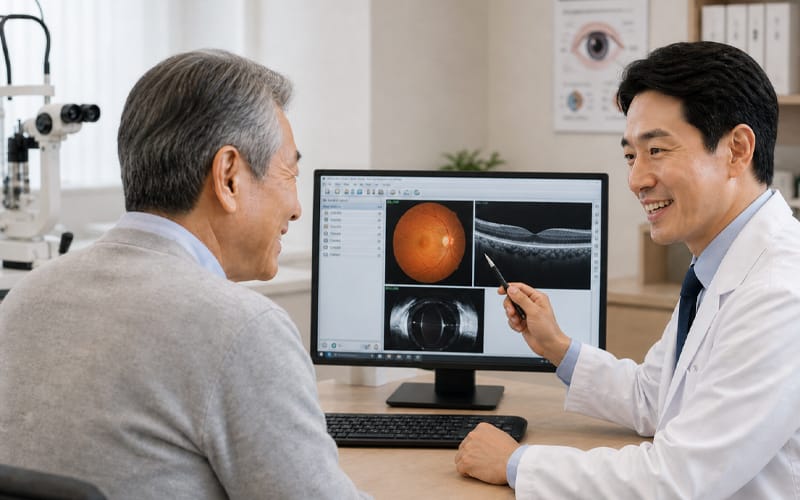
We’ve reviewed practical criteria for recognizing and responding to early cataracts. Rather than focusing only on a “1.0” eye chart result, it’s important to prioritize functional symptoms you notice in real life—such as glare during night driving and reduced contrast sensitivity.
If daily inconvenience becomes significant, you can review surgical options step by step with your clinician. If not, you can maintain safer monitoring by adjusting your environment and following up regularly. By calmly recording your symptoms and responding based on your lifestyle patterns, you can maintain a clear and comfortable daily life.
Sources
- Korean Ophthalmological Society (KOS), Cataract Diagnosis and Treatment Guideline (Revised Patient Edition), 2022
- Health Insurance Review & Assessment Service (HIRA), 2022 Cataract Surgery
Appropriateness Evaluation and Quality Management Measures Report, 2022 - Smith J. et al., “Contrast Sensitivity in Early Cataract Patients with Good Visual Acuity,” Ophthalmology and Therapy, 2022
※ The copyright for all content on this blog belongs to medihi. Unauthorized copying, distribution, or derivative use is strictly prohibited, and violations may result in legal action without prior notice.
Recommended reads
 medihi