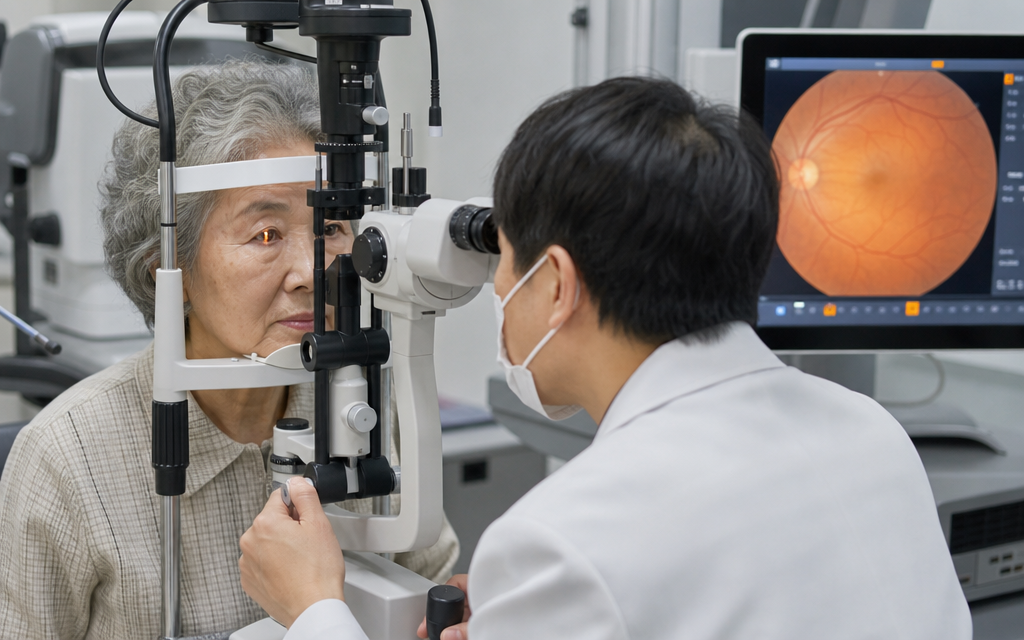

Even if your eyesight seems “good,” you can still experience glare and nighttime fatigue. Below is how a step-by-step, function-focused cataract evaluation helps identify the real cause of visual discomfort—beyond what an eye chart can show.
“My eyesight is good—so why do my eyes feel so blurry?”

In the clinic, it’s common to meet patients who report discomfort even though their best-corrected visual acuity is normal. It’s easy to assume that good numbers mean there’s no problem, but eye health and visual quality in daily life don’t always match the eye chart.
When your eyes feel uncomfortable, the first thing we focus on is not just the number you can read on the chart. Even if corrected vision measures well, that alone isn’t enough to feel reassured. If your day-to-day vision feels worse—more glare, more haze, more fatigue—there may be an underlying change that deserves a closer look.
That uneasy feeling that your eyes “aren’t what they used to be” may be more than simple tiredness. To find the real cause, it helps to start with function-focused testing rather than relying only on a basic vision measurement.
1. If the eye chart looks normal, why does glare get worse?
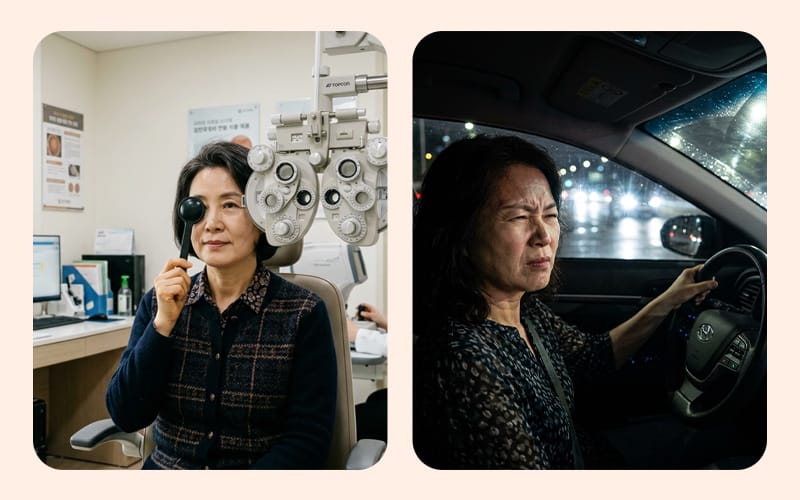
Even a high-performance camera can’t take a crisp photo if the lens is fogged. The eye works in a similar way. Your vision measured with glasses may still come back “normal,” but if the natural lens becomes cloudy, light scatters inside the eye—often showing up as glare, halos, or a washed-out view.
Reading an eye chart is a short, controlled test. Daily life is long-duration visual “endurance.” In a bright exam room, high-contrast letters can look clear. But in real-world settings—especially at night—oncoming headlights may spread and flare in all directions. Standard testing can miss these subtle but meaningful declines in visual quality.
2. Simple presbyopia vs. cataracts: why symptoms alone are hard to tell apart

Blurred vision and eye fatigue are shared signals across many eye conditions, and multiple causes can overlap—so it’s often difficult to distinguish them by symptoms alone. Clinically, it’s essential to determine whether the issue is “fog on the lens” (lens opacity) or a problem with the “retinal sensor” (retina/optic nerve).
If nearby text becomes hard to see, many people suspect presbyopia. If the tear film dries out and becomes unstable, vision can look hazy and eyes may feel tired. Even with normal eye pressure, glaucoma can progress significantly before noticeable dimness appears. Various retinal disease processes can also reduce vision.
In other words, surface discomfort alone can’t confirm what’s happening deeper inside the eye.
✅ Symptom-based checkpoints: conditions to consider
- Suspected dry eye: The tear film dries out, causing gritty irritation and a sandy foreign-body sensation.
- Suspected presbyopia: It becomes difficult to focus on small text up close, such as on a smartphone screen.
- Suspected cataracts: Even with glasses, vision looks foggy or hazy, and nighttime glare/halos are pronounced.
- Suspected glaucoma/retinal issues: Peripheral vision narrows first, or objects appear distorted or warped.
3. Why a comprehensive exam is necessary instead of a numbers-only vision test
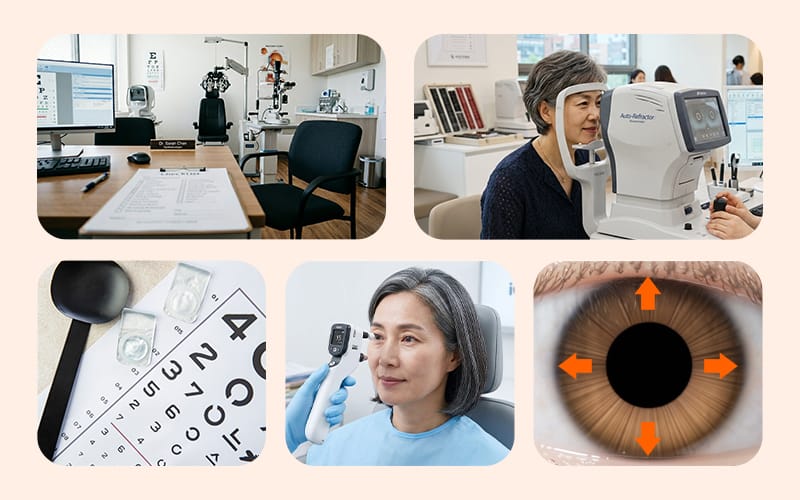
A function-focused evaluation is not a single test that ends after reading a chart. It starts with careful history-taking—pinpointing when discomfort is worst (night driving, bright lights, prolonged monitor work). Then a slit-lamp exam is performed to closely inspect the natural lens and the front of the eye.
This is like checking for smudges on a camera lens while also cross-checking whether the “sensor” inside is healthy. Only a comprehensive assessment can explain fatigue and discomfort that the eye chart alone cannot.
✅ Five basic pillars of a cataract evaluation
- History-taking: Identify when symptoms are worst. Night driving and prolonged monitor work can be key clues.
- Slit-lamp exam: Directly observe the degree of lens clouding and the condition of the cornea/anterior segment.
- Refraction and visual acuity testing: Determine whether updated glasses could meaningfully improve symptoms.
- Intraocular pressure check: Avoid missing hidden warning signs, including glaucoma that can occur even with normal pressure.
- Dilated fundus evaluation: Dilate the pupil to assess the retina, macula, optic nerve, and other internal structures.
4. If daily life feels difficult, should surgery be considered proactively?

The timing of surgery is not determined only by whether visual acuity numbers have dropped according to guidelines. If lens clouding is mild and daily life is not significantly affected, it may be reasonable to monitor over time rather than proceed immediately. In such cases, other contributors—such as dry eye or presbyopia—can be addressed first.
However, for individuals approaching their 80s, the situation can be different. Because cataracts tend to progress with age in both clouding and hardening of the natural lens, cataract surgery may be medically advisable around this age even if the person feels they are “managing fine.”
There are also people whose night vision becomes so poor that they can no longer drive at night. Reduced visibility can increase the risk of missteps on stairs and falls. When safety and daily function are affected, it’s reasonable to actively consider surgery based on exam findings.
Additionally, some people who have never worn progressive or reading glasses may struggle to adapt when presbyopia-related cataracts lead them to start wearing glasses. If glasses are extremely difficult to tolerate and uncorrected vision has declined, cataract surgery may also be considered.
If surgery is chosen, the natural lens is removed and an appropriate intraocular lens (IOL) is selected. Many people prefer multifocal IOLs because they can reduce dependence on reading glasses. However, due to the lens design, some degree of nighttime glare/halos may remain—so the choice should be made carefully based on lifestyle.
✅Must-check points before cataract surgery and IOL counseling
- Do you spend a large portion of your day driving at night or doing outdoor activities after dark?
- Do you frequently do near-vision precision tasks such as reading, smartphone use, or monitor work?
- Are you typically sensitive to glare/halos from streetlights or vehicle headlights at night?
5. Additional advanced testing: how to improve accuracy without unnecessary over-testing

Sometimes, basic exam results do not fully explain the cause of discomfort. In that case, selective functional testing may be considered to analyze how light enters the eye and is processed by the visual system. Not every patient needs high-cost advanced testing from the start.
If chronic retinal disease is suspected alongside lens clouding, additional imaging such as OCT may be performed. If nighttime glare is the main complaint, glare and contrast sensitivity testing may be selectively added. Choosing only tests that directly relate to the symptoms helps prevent unnecessary testing while improving diagnostic precision.
This is similar to how navigation works: it doesn’t show every possible detour at once. It checks where the blockage is, then recalculates only the needed route. Focusing on the most relevant clues reduces patient fatigue and supports a more accurate diagnosis.
6. Frequently Asked Questions (FAQ)
Q. If my vision is good, do I still need a cataract exam?
Yes. Even if the eye chart numbers remain good, functional vision can still decline. If nighttime vision feels uncomfortable or glare is significant, changes inside the eye may already be starting. For accurate evaluation, it is safer to undergo a basic ophthalmic exam.
Q. My glare is severe but my vision test is normal. What do you check?
A slit-lamp exam is used to assess whether there is lens clouding and to evaluate the front structures such as the cornea. A dilated fundus evaluation checks for abnormalities in the retina and optic nerve. If nighttime glare is the main issue, glare and contrast sensitivity testing may be selectively added as needed.
Q. How do multifocal and monofocal lenses differ depending on lifestyle?
If you do a lot of near work—such as reading or detailed indoor tasks—and want to reduce dependence on glasses, a multifocal lens may be advantageous. On the other hand, if you frequently drive at night and are sensitive to glare/halos, a monofocal lens—with strong distance contrast sensitivity at night—may be a safer and more comfortable choice.
Q. When is it a good idea to consult an eye clinic?
If night driving that used to feel routine suddenly becomes burdensome, or if your vision looks hazy and spreads under bright lighting, caution is needed. If these symptoms repeat and begin to interfere with work or daily life, it may signal a decline in visual quality, and a detailed evaluation is recommended.

First, even if your best-corrected visual acuity is 1.0, discomfort such as glare in daily life or reduced nighttime vision can still remain noticeable.
Second, a function-focused evaluation is not a single test; it is performed carefully using core components such as history-taking, slit-lamp examination, intraocular pressure checks, and dilated fundus evaluation.
Third, the right timing for surgery is determined not simply by a numerical decline, but by functional limitations in daily life and safety risks such as falls.
Feeling anxious because your eyes don’t feel the same as before is a natural response. A reasonable diagnostic process and thorough discussion with your clinician can help you make decisions that fit your daily life and visual needs.
Sources
- National Evidence-based Healthcare Collaborating Agency (NECA). Educational material on safety guidelines for presbyopia and cataract surgery. 2023.
- Korean Ophthalmological Society. Cataract disease information and diagnostic guideline guidance.
- JAMA Ophthalmology. Risk of Falls and Fractures in Adults With Cataract. 2023.
※ The copyright for all content on this blog belongs to medihi. Unauthorized copying, distribution, or derivative use is strictly prohibited, and violations may result in legal action without prior notice.
Recommended reads
 medihi