

Before cataract surgery, precise preoperative testing is essential to determine the intraocular lens (IOL) power that best matches your eye. This article reviews the key types of measurements and practical standards for minimizing error. It also explains why dry eye often needs to be treated first to improve measurement accuracy, and how retinal and optic nerve testing can influence postoperative satisfaction.
“I thought I just needed a vision test because my eyesight feels blurry—why are there so many devices, and why do the tests take so long?”

When planning cataract surgery, one of the first hurdles many patients face is the long list of tests. It’s completely natural to wonder why the process is so extensive.
There is a clear reason for performing multiple, multi-angle preoperative evaluations. In the pre-surgery stage, one test often leads directly to one clinical decision. Cataract surgery is not only about removing the cloudy lens—it is also a precise “design” process to determine the IOL power that fits your eye. In this article, we’ve organized the main types of detailed ocular measurements that can affect surgical outcomes, along with practical criteria for making informed choices.
1. Isn’t a Vision Test Enough? Why Precision Measurements Are Needed
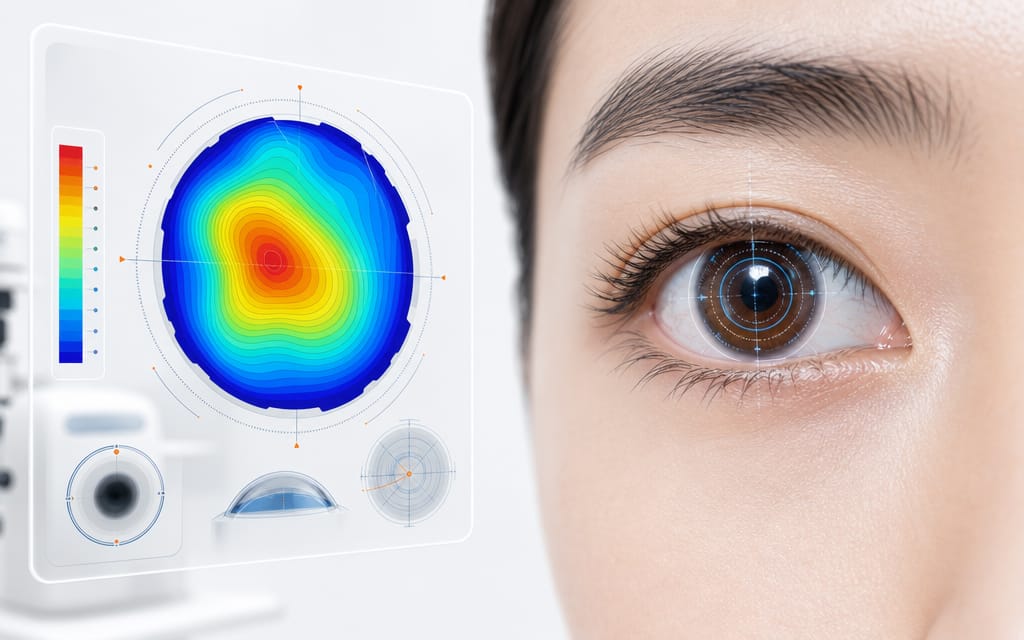
A standard eye chart test is an important indicator of your current vision, but it has limitations when it comes to setting a target postoperative refraction or calculating the IOL power that matches that goal. To plan refractive outcomes after surgery, precise ocular biometry—measuring key structural values of the eye—is essential.
Every person’s eyes differ in shape and size. Axial length (front-to-back eye length), corneal curvature, astigmatism axis, and anterior chamber depth can all vary. If these differences aren’t captured accurately, even small refractive errors can occur.
This is similar to a tailor measuring your body to make a suit that truly fits. If they only roughly measure sleeve length, the suit won’t sit properly. Likewise, to select the optimal IOL power, the eye’s structure—and whether there are any underlying conditions—must be clearly assessed.
2. Key Measurements and Core Tests That Determine IOL Power
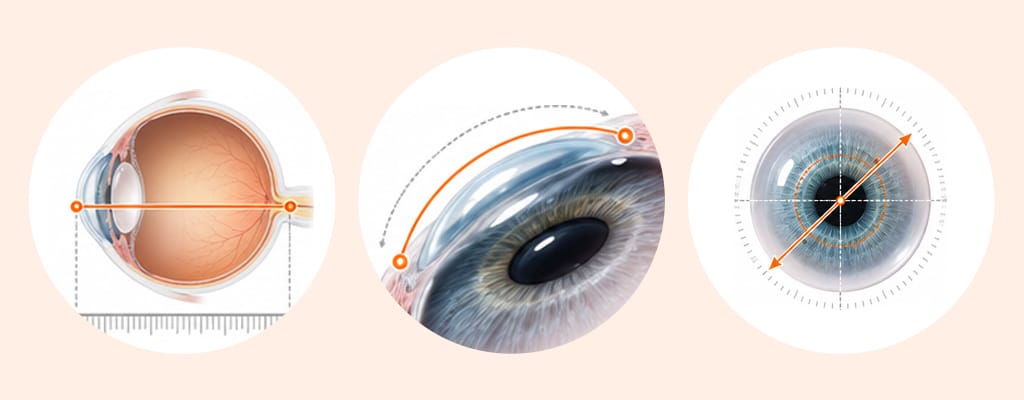
The three most fundamental inputs for calculating IOL power are: axial length (eye length), corneal curvature (keratometry), and the astigmatism axis. These are the core measurements that form the backbone of IOL calculations.
A survey-based study on cataract surgery trends in Korea (KSCRS 2020) reported that optical biometry is commonly used for IOL power calculation. This is a non-contact method that uses laser-based measurement, and it is known for high reproducibility.
In addition, measuring anterior chamber depth (ACD) to estimate the space where the lens will sit, white-to-white (WTW) corneal diameter, and performing corneal topography to evaluate corneal surface asymmetry can enable more refined lens selection.
✅Key tests for finding the IOL that fits you
- Axial length (eye length) measurement: The most basic and essential test measuring the front-to-back length of the eye.
- Anterior chamber depth (ACD) test: Confirms the depth and available space inside the eye where the IOL will be positioned.
- Corneal topography: Analyzes corneal surface regularity and subtle refractive irregularities to characterize the type of astigmatism.
3. When Different Devices Give Different Results: How to Reduce Error (Repeat Measurements on the Same Device)
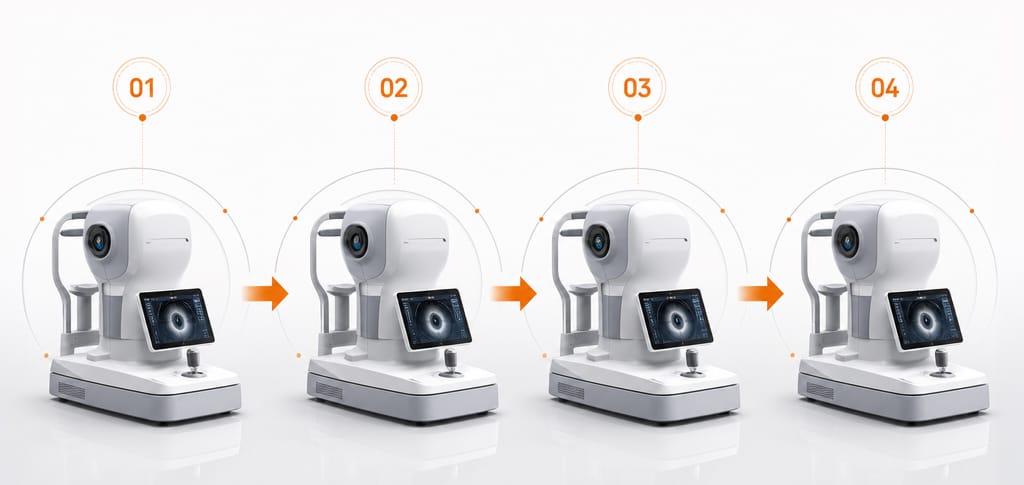
It’s easy to assume that if the equipment is modern, results should be identical no matter which device is used. In reality, small differences can appear depending on the manufacturer’s design and measurement algorithms. Even axial length—often relatively stable—may be measured using slightly different reference points across devices, and the predicted IOL power can vary even more.
That’s why it is crucial to repeat measurements multiple times under the same conditions using the same device, to obtain consistent, reproducible results and a reliable average. It’s the same logic as measuring with the same ruler several times to confirm the true length.
Only after stable, consistent values are secured can the margin of error be narrowed when applying IOL calculation formulas. Clinicians then select the most appropriate, up-to-date formula optimized for the patient’s axial length characteristics to determine the final IOL power—built on the reliability of repeated measurements.
4. If You Have Dry Eye, Why Postpone Testing and Treat the Tear Film First?

If you’re told on the day of testing that your dryness is severe and you should start eye drops and return in a few days, it may feel inconvenient—as if your schedule is being extended. However, this step is an important safeguard for more accurate IOL power calculation.
When the tear film is unstable, the corneal surface becomes irregular and rough. Measuring corneal refractive power in this state can cause corneal curvature and the astigmatism axis to vary from one measurement to the next, increasing the likelihood of calculation error.
It’s like trying to measure fabric that is badly wrinkled—each time you place the ruler, the measurement changes. Just as you would iron and smooth the fabric before cutting it for a tailored outfit, stabilizing the tear film before re-measuring helps achieve more accurate IOL power selection.
✅Pre-surgery self-checklist for accurate ocular measurements
- Did you stop wearing contact lenses according to the timeframe instructed by the medical team?
- Have you been using the prescribed dry eye drops consistently as directed?
- On the day of measurement, did you avoid rubbing your eyes, and did you get enough sleep the night before?
5. The Role of Retinal & Optic Nerve OCT in Postoperative Satisfaction
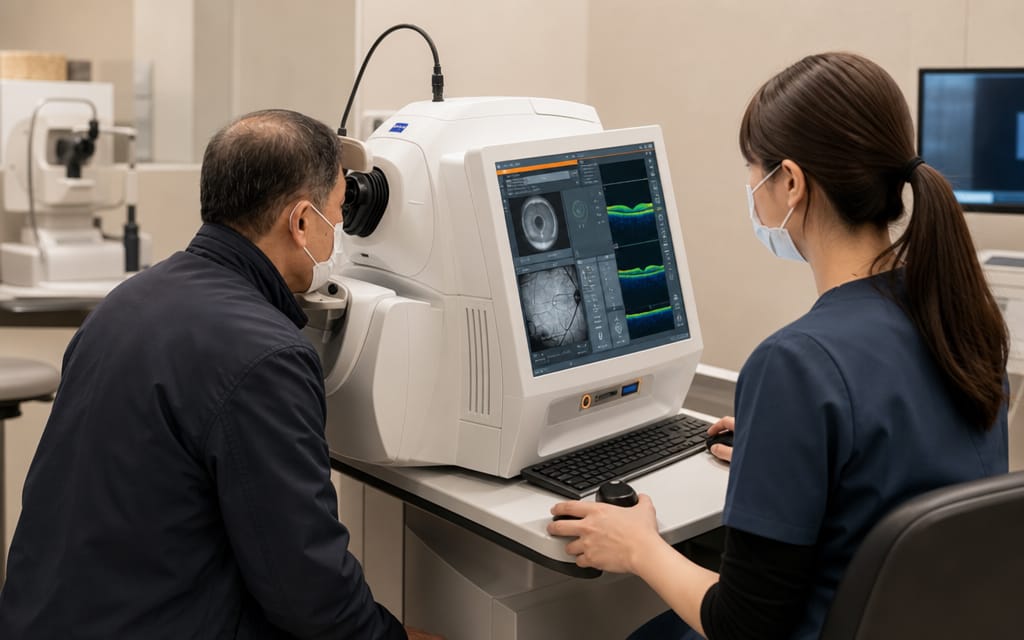
If precisely measuring the cornea and axial length is the “lens power design,” then evaluating the health of the retina and optic nerve helps determine the *upper limit of expected vision*. If there is disease in the retina at the back of the eye—which functions like film that receives light—vision improvement may be limited even with an appropriate lens.
A representative test used for this purpose is retinal and optic nerve OCT (optical coherence tomography). This exam helps detect hidden conditions before surgery, such as macular degeneration or glaucoma-related changes. In many cases, previously unrecognized eye disease is discovered early through OCT.
OCT becomes even more important for patients considering presbyopia-correcting or multifocal lens options. Choosing a multifocal lens only after confirming retinal and optic nerve health can help reduce issues like glare/halos and improve satisfaction. If abnormal findings are observed, the plan can be adjusted to better match the patient’s condition—for example, prioritizing a monofocal lens.
[Precautions by patient condition before cataract surgery and the role of precision measurements]
| Patient Condition | Preoperative Considerations | Role of Precision Biometry & Testing |
|---|---|---|
| General Cataract | Assess daily discomfort and presence of comorbidities | Calculate target IOL power based on axial length and corneal curvature |
| Accompanied by Dry Eye | Schedule remeasurement after ocular surface treatment | Prevent power calculation errors by reducing curvature and astigmatism axis fluctuations |
| High Myopia | Check for accompanying retinal diseases | Evaluate retina and optic nerve conditions associated with high myopia |
| History of Refractive Surgery | Analyze corneal topography more closely | Calculate IOL power using specialized post-refractive formulas that account for altered corneal shape |
6. Frequently Asked Questions (FAQ)
Q. If I have astigmatism, do I always need a toric (astigmatism-correcting) IOL?
It depends on the magnitude and pattern of astigmatism shown on corneal topography. If you have regular corneal astigmatism above a certain level, a toric lens may significantly help provide clearer vision. However, if the astigmatism is irregular or mild, a standard (non-toric) lens may be sufficient. The decision is made based on a specialist’s detailed evaluation.
Q. Is it normal for test results to differ slightly across devices?
Yes. Due to differences in device design and measurement algorithms, predicted IOL power and some anterior segment parameters may vary slightly. To reduce this variability and improve reliability, ophthalmology clinics repeat measurements multiple times using the same device to secure consistent values.
Q. My dry eye is severe—can’t I schedule surgery right away?
Severe dry eye can roughen the corneal surface, making corneal curvature and astigmatism axis measurements more error-prone. To achieve the intended postoperative vision more consistently and avoid unnecessary refractive error, it is generally recommended to stabilize the tear film with eye drops first and then repeat measurements, even if it feels inconvenient.
Q. If retinal/optic nerve OCT shows an abnormality, does that mean I can’t have surgery?
An abnormal finding does not automatically mean surgery is impossible. OCT is performed to more accurately predict expected postoperative vision and to select the most appropriate lens type. Depending on the type and severity of the finding, the surgical plan can be adjusted—for example, choosing a monofocal lens instead of a multifocal lens.

Preoperative testing for cataract surgery can feel complicated and time-consuming. But it is not “testing for the sake of testing.” From precision measurements that reduce error to checking retinal status, each step is part of creating a carefully tailored blueprint to achieve the most comfortable vision after surgery.
There is no need to worry simply because there are many tests. Accurately measuring the eye’s foundational parameters—axial length, corneal curvature, and astigmatism axis—controlling interfering factors such as dry eye, and carefully reviewing retinal health via OCT are all part of establishing a safe starting point. With enough time and close coordination with your medical team, you can build a treatment plan that best fits your eyes.
Sources
- Cataract Surgery Practice in the Republic of Korea: A Survey of the KSCRS 2020. Korean J Ophthalmol. 2021.
- Darcy et al., Accuracy of 9 intraocular lens power calculation formulas, Journal of Cataract & Refractive Surgery, 2020.
- Journal of the Korean Ophthalmological Society. Comparative study of IOL power calculation formulas for monofocal and multifocal intraocular lenses in a Korean patient population. 2020.
※ The copyright for all content on this blog belongs to medihi. Unauthorized copying, distribution, or derivative use is strictly prohibited, and violations may result in legal action without prior notice.
Recommended reads
 medihi