

Explore the key characteristics of multifocal intraocular lenses (IOLs) that can help reduce dependence on glasses after cataract surgery, along with practical, medically sound criteria for making a safe choice.
“After the surgery, will I be able to enjoy my hobbies without wearing glasses at all?”

This is a common question among people who enjoy active, varied leisure activities. Many hope that after surgery they can set aside inconvenient glasses and regain comfortable vision in everyday life.
However, multifocal lenses do not guarantee a completely glasses-free life for everyone. A realistic goal is not a “mystical” experience of never needing glasses again, but meaningfully reducing how often you need to reach for glasses—and how much you rely on them in daily life.
1. Monofocal vs. Multifocal: How to Choose a Lens
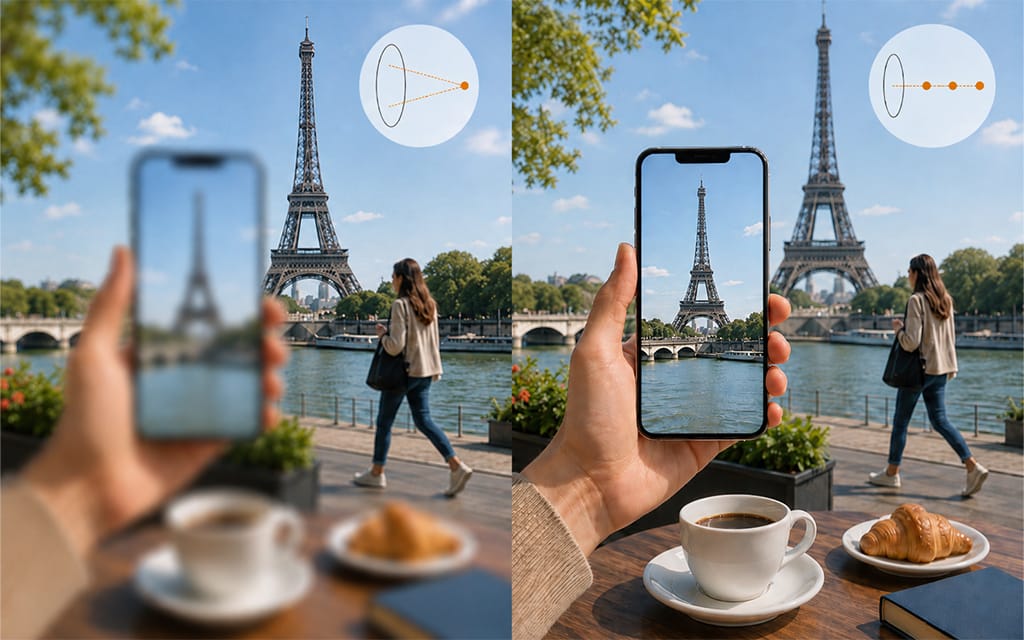
During cataract surgery, the cloudy natural lens is replaced with an intraocular lens. Broadly, IOLs fall into two categories: monofocal and multifocal. To understand the essential difference, it helps to start with a basic optical fact: the limited amount of light energy entering the eye is like electricity shared through a power strip.
A monofocal design concentrates that “power” into a single device—maximizing performance at one chosen focal distance. Because focusing energy is concentrated either for distance or near, you typically need glasses to see clearly at the distance you did not choose.
A multifocal design, on the other hand, is like plugging multiple devices into one power strip and splitting the power among them. It distributes incoming light energy across multiple focal points. Because light is divided among several focal zones, perceived contrast and crispness at each individual focus can feel somewhat softer or less vivid than with a monofocal lens.
At this stage, it helps to consider whether your priority is maximizing a single focal distance, or reducing the hassle of putting on glasses for different distances throughout the day.
2. Monofocal vs. Trifocal vs. Extended Depth of Focus (EDOF): Finding the Right Lens for Your Lifestyle
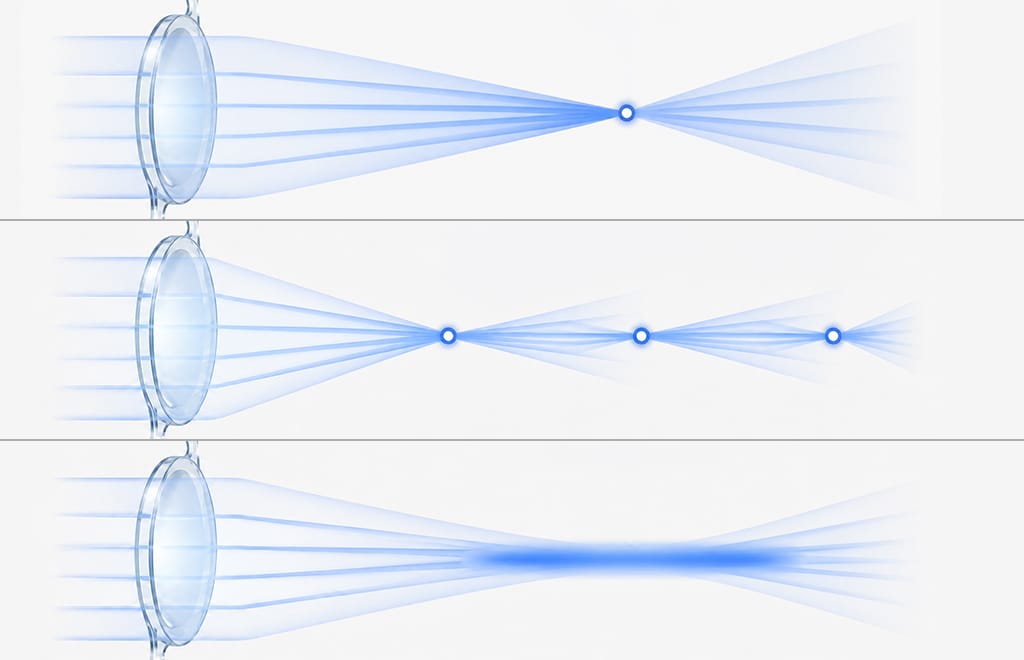
Just as you match a golf club’s shaft stiffness and length to your swing, you need to match a lens to your typical viewing distances. The key reference point is the distance you look at most often during a normal day.
A monofocal lens provides only one selected focal range, while a multifocal lens provides multiple focal points. Among multifocal options, a trifocal design splits light into three focal points: distance, intermediate, and near. The principle used to distribute light is called diffraction. Because diffractive multifocal IOLs allocate a substantial portion of light to near vision, they can provide strong near visual performance after surgery. If you frequently check your smartphone or spend a lot of time reading small print and still want a multifocal lens, a trifocal design may be a good candidate.
An EDOF lens provides smooth, highly functional vision at intermediate distances around 60–80 cm (computer monitors, car dashboards, cooking, etc.). However, for precise near tasks at about 33–40 cm (reading small print, using a smartphone in dim lighting), clarity may be lower than with a trifocal lens. As a result, you may still need thin reading glasses for detailed near work.
Recently, not only in Korea but also in Western countries such as the U.S., a “mix-and-match” approach has been increasingly used: implanting a refractive-design EDOF lens (strong for distance-to-intermediate) in one eye and a diffractive-design trifocal lens (strong for near) in the other. By leveraging binocular vision—how the brain combines input from both eyes—this approach may help achieve clearer vision across a wider range of distances. However, this method generally assumes that both eyes receive IOLs made of the same material from the same manufacturer to minimize mismatch, and that there are no retinal abnormalities. Therefore, it is important to carefully compare functional characteristics based on your ocular condition and lifestyle.
| Category | Monofocal IOL | Trifocal IOL | EDOF (Extended Depth of Focus) IOL |
|---|---|---|---|
| Focal Range | Selected single focal point (distance or near) | Three focal points: distance, intermediate, and near | Continuous range from distance to intermediate distance |
| Contrast Sensitivity Level | Clear contrast definition | May be slightly reduced due to optical splitting | Relatively clearer compared to trifocal IOLs |
| Nighttime Visual Disturbances | Low risk of glare and halos | Potential glare and halos at night | Relatively mild level of glare and halos |
| Suitable Lifestyle | Frequent night driving, prioritizing clarity at a specific distance | Reading, fine detailed work, smartphone-centric lifestyle | Golf, hiking, travel, computer monitor work |
| Need for Supplementary Glasses | High likelihood of needing glasses/reading glasses for unselected distances | May need reading glasses for fine tasks in very dim light | May need reading glasses when reading fine print at ~30–40 cm |
✅Checklist: My typical viewing distances & lens fit
- I spend a long time reading text on a smartphone or book (30–40 cm)
- I frequently look at navigation, computer screens, or kitchen countertops (60–100 cm)
- I enjoy dynamic leisure hobbies weekly, such as golf, hiking, or camping
- I’m willing to occasionally use light reading glasses for precise tasks in dim environments
- I do a lot of night driving
3. Night Glare and Halos (Dysphotopsia): Why Do They Happen?
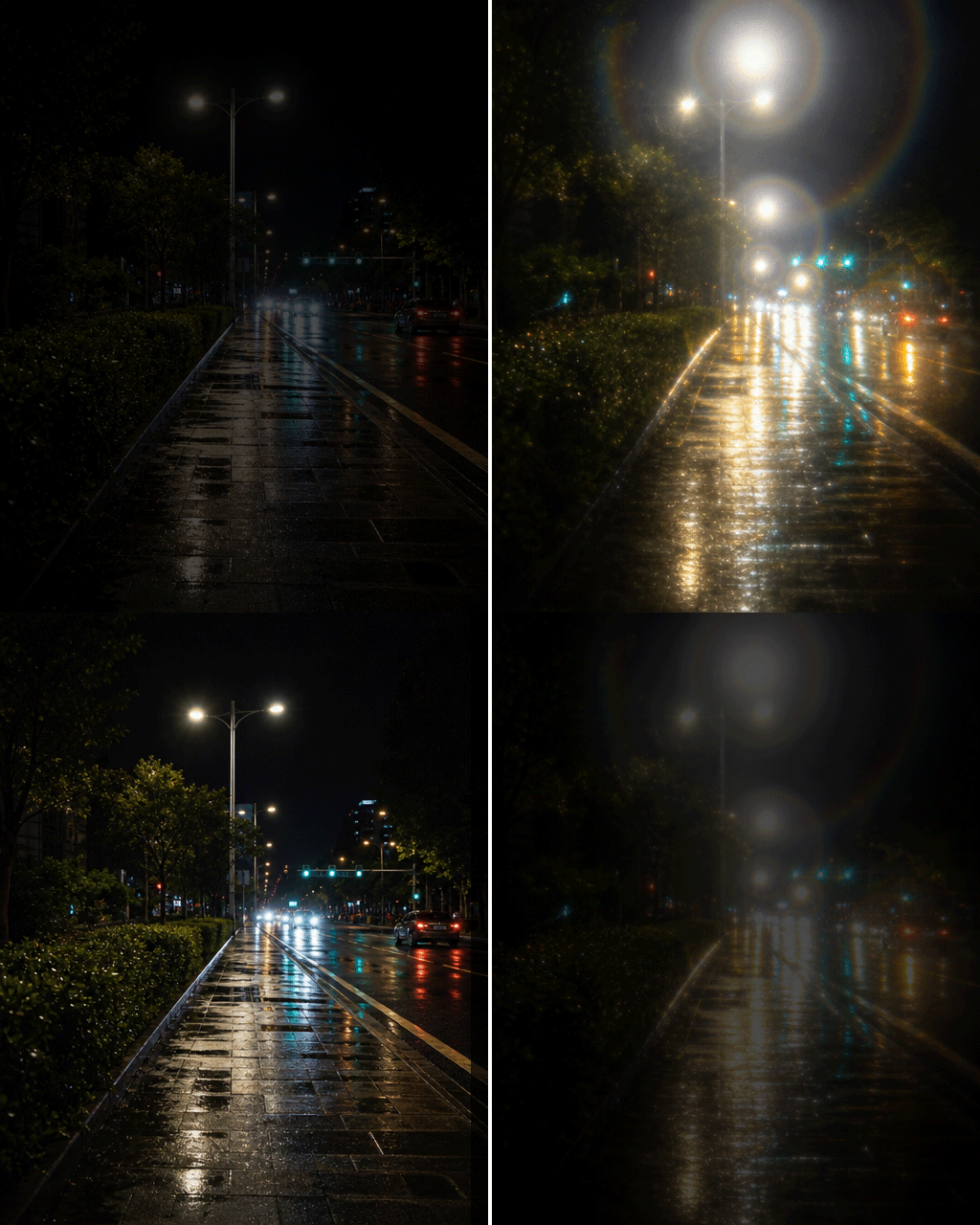
One symptom that can accompany multifocal lenses due to their optical principles is dysphotopsia, such as night glare and halos. This can appear as light spreading around streetlamps on a dark road, or overlapping concentric rings around lights.
On very dark roads, the pupil naturally dilates to gather more light onto the retina. Because the already-limited light energy is split across multiple focal zones, contrast sensitivity—your ability to distinguish an object from its background—can decrease. This effect may be more noticeable in situations such as rainy nights or backlit environments.
These symptoms often improve as the brain gradually recalibrates through a process called neuroadaptation. The adaptation period can take several months, and the pace varies by individual. If you frequently drive at night, it is advisable to discuss this in advance with your clinician and review alternatives together.
4. If You Have Glaucoma or Macular Disease, Why a Monofocal Lens May Be the Safer Priority
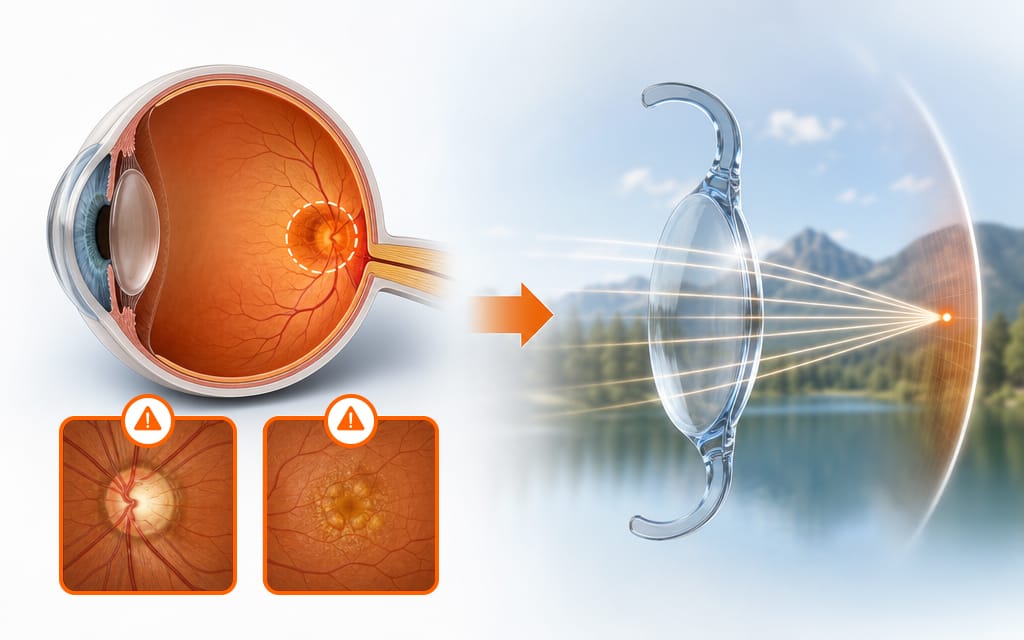
The biggest deciding factor when choosing between multifocal or EDOF lenses is whether you have underlying eye disease. The retina and optic nerve—where incoming visual information is ultimately processed—need to be healthy enough to handle the visual input smoothly.
If you have retinal disease such as retinal vascular occlusion, epiretinal membrane, or macular hole, your contrast sensitivity may already be affected. Implanting a light-splitting lens in a retina with reduced function may increase the risk that object outlines feel overly blurred, worsening visual discomfort.
In these situations, choosing a monofocal IOL—which concentrates light energy into a single focal point to preserve clarity—may be a safer approach. If dry eye or corneal astigmatism is present, it may be beneficial to treat dry eye in advance and consider options such as toric (astigmatism-correcting) features, alongside careful preoperative planning. Prioritizing stability and reducing risk from underlying conditions is often the path toward higher long-term satisfaction.
✅Checklist: Baseline eye health “fitness” check
- I’ve been told I have findings suggestive of glaucoma, macular degeneration, or other retinal disease (family history or screening)
- I have thin corneas or high astigmatism and have always relied on prescription glasses
- I must drive on highways at night at a certain intensity due to work or routine
- I’m sensitive to small focusing errors or light spread and tend to feel stressed by them
5. Cloudy Vision Again After Surgery—Is It a Lens Problem?

Some people enjoy their post-surgery freedom, then one day notice a sensation like fog in their vision. It is easy to assume the lens has “worn out,” but this may instead be posterior capsule opacification (PCO), often referred to as a “secondary cataract,” which is a common part of healing and aging after surgery.
To secure the intraocular lens, the surgeon preserves the natural lens capsule (the posterior capsule). Over time, epithelial cells can gradually proliferate on the back wall of this capsule, forming a whitish membrane. Cell migration occurs continuously in the body, and because the capsule is still part of your own tissue structure (serving as the “bag” that holds the IOL), secondary cataract can be a natural phenomenon that may occur at some point after surgery. It is not caused by contamination or material breakdown of the lens itself, so excessive worry is usually unnecessary.
For these symptoms, a non-invasive outpatient procedure called YAG laser posterior capsulotomy may be considered. It works by creating an opening in the capsule—often compared to making a hole in clear cellophane—to clear the visual axis, and it is typically performed only once. Because the central capsule opening remains permanently open after the laser procedure, one advantage is that the same secondary cataract does not recur. However, potential risks such as temporary intraocular pressure elevation or macular edema may occur, so careful pressure control and close follow-up are important.
6. Frequently Asked Questions (FAQ)
Q. If I choose a multifocal/EDOF lens, can I see both my smartphone and books without glasses?
For everyday distances, you may be able to function without glasses. However, if you need to read very small print for long periods or perform detailed tasks in dim environments, it is recommended to occasionally use light reading glasses to reduce visual fatigue and improve comfort.
Q. I often play night golf or drive at night—could multifocal lenses be a disadvantage?
Because these lenses split incoming light energy, some degree of light spread around night lights and partial reduction in contrast sensitivity can occur. If your nighttime activity level is very high and you are sensitive to light interference, it may be more advantageous to carefully compare EDOF or monofocal lenses.
Q. If I have glaucoma or diabetic retinopathy, is a monofocal lens safer?
If visual field narrowing or retinal function decline affects the baseline capacity of the optic nerve and retina, multifocal IOLs that disperse light may not be recommended in some cases. Because they can add to a sense of dimness in a weakened visual system, considering a monofocal IOL that concentrates focusing energy to secure clarity may be a more conservative and safer long-term choice.
Q. If my vision feels blocked and uncomfortable again after surgery, when is the right time to come in?
If your clear postoperative vision becomes hazy—like looking through a milky filter—enough to interfere with active leisure, or if sign lights appear unusually spread out, it is better to schedule an exam without delay. This allows prompt evaluation for posterior capsule opacification or the onset of a new retinal condition, followed by appropriate management.

Multifocal intraocular lenses are a treatment option that may help you enjoy outdoor activities and hobbies with less inconvenience from glasses in everyday life. However, they do not provide the same level of visual comfort for everyone.
Start by identifying the viewing distances that dominate your daily routine, and consider whether your retina and optic nerve can handle this visual system without strain. With detailed consultation based on precise diagnostic measurements, you and your ophthalmologist can work toward a safe visual plan that supports a clearer, more comfortable day-to-day life.
Sources
- Korean Ophthalmological Society – Korean Academy of Medical Sciences Clinical Practice Guideline Committee, Indications and Clinical Guidelines for Cataract Surgery, 2017
- National Evidence-based Healthcare Collaborating Agency (PACEN), Summary of Value Assessment for Multifocal Intraocular Lenses, 2023
- Choi et al., Tecnis Symfony EDOF 양안 삽입 다기관 관찰, Korean Journal of Ophthalmology, 2020
※ The copyright for all content on this blog belongs to medihi. Unauthorized copying, distribution, or derivative use is strictly prohibited, and violations may result in legal action without prior notice.
Recommended reads
 medihi