

If, after your 60s, you suddenly find it easier to read nearby text, it may not mean your vision has “recovered.” It can be a sign of refractive change caused by progressing cataract. Below, we explain what’s happening inside the eye and outline practical criteria for deciding when it’s safest to seek care.
“I can read my smartphone without reading glasses now. Did my eyes get better?”

Some people notice that near vision—previously difficult due to cataract &
presbyopia—suddenly becomes comfortable one day. Unfortunately, this is often less a reason to celebrate and more a situation that deserves careful attention.
In real clinical practice, this can be one of several signs that the crystalline lens is hardening. A sudden change in what you can see may feel welcome, but it’s important to understand what physical changes may be occurring inside the eye.
1. If Nearby Text Suddenly Looks Clearer: Why Your Eyes Aren’t “Getting Younger”
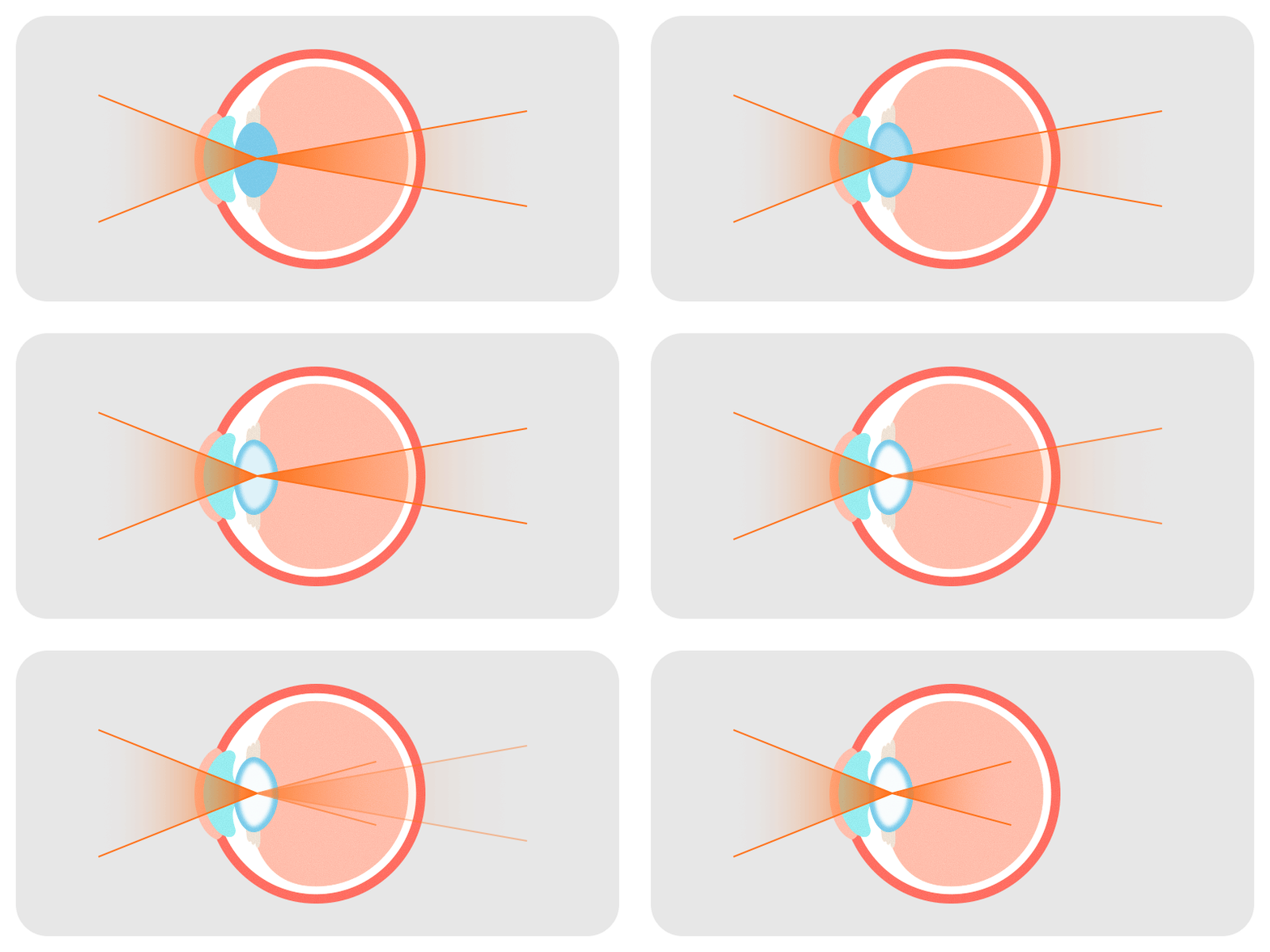
As we age, the eye’s normally clear crystalline lens can become cloudy, and its once-flexible elasticity gradually decreases as it hardens. This is referred to as early cataract. Many people think cataract only means “vision gets worse.” However, some mistakenly believe their vision has improved because they can read up close without reading glasses. Medically, this is often called a “myopic shift due to cataract” (sometimes described clinically as cataract-induced myopization).
To understand this, you need to look at how the lens changes. The central part of a
previously clear lens gradually becomes harder with aging—this is called nuclear sclerosis. It’s as if an extra thick, convex lens has formed inside the eye. Temporarily, light bends more strongly, and focus can shift toward near distances.
Just as painkillers may temporarily mask pain without treating the underlying cause, the joy of not needing reading glasses is not necessarily a sign that eye health has improved. It may even be a process in which the condition progresses while the “warning signal” becomes less obvious. The sensation of improved near vision can be similar. Because how you perceive this varies depending on whether you were originally nearsighted or farsighted and on the degree of cataract & presbyopia, it’s better to treat “needing reading glasses less” as a reason to check for disease progression.
2. Presbyopia vs. Early Disease: Can You Tell Based on Symptoms Alone?
Both cataract & presbyopia and refractive changes are common with age, and both can make vision feel inconvenient—so it’s difficult to distinguish them on your own. That’s why a detailed eye exam becomes even more important.
With simple cataract & presbyopia, vision can be corrected with reading glasses or
prescription glasses, allowing you to see clearly. If the lens has hardened, you may
temporarily see well up close even without reading glasses. Still, you should avoid
concluding what’s happening based on symptoms alone. You also need to keep in mind the possibility that retinal disease such as glaucoma or macular degeneration may be progressing at the same time.
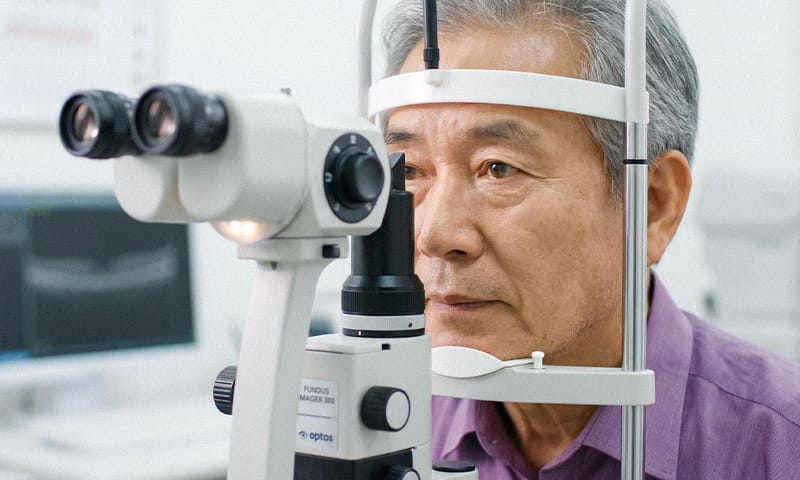
Even if you can see better than before due to a refractive shift, there may be issues affecting the retina or optic nerve itself. In the clinic, doctors assess refraction and directly examine the degree of lens clouding using a slit-lamp microscope. A fundus exam is also used to evaluate the optic nerve and retina in depth. This multi-angle assessment helps establish clear, individualized criteria for your current condition.
✅ Eye changes that are helpful to track at home
- Has your glasses prescription changed frequently over the past 6 months?
- When you cover one eye, does clarity feel different between the two eyes?
- Do you find text more comfortable in dim light than in bright light?
- Have nighttime glare/halos increased, or do colors look more yellow?
3. Timing Surgery: Why “Daily Inconvenience” Matters More Than the Eye Chart Number

As cataract progresses, the lens becomes more cloudy and harder. This can lead to a hypermature cataract, and during cataract surgery, more ultrasound energy may be needed to break up the lens—potentially affecting surrounding eye structures. In addition, as the lens enlarges, it can contribute to complications such as glaucoma, making surgery more difficult and technically demanding. That said, you do not necessarily need to rush into surgery immediately after diagnosis.
You need clear criteria to decide on timing. If you have no major difficulties in daily life—reading, smartphone use, night driving—and there are few risk factors, you may continue using your natural lens while monitoring the condition regularly. Because progression speed varies by individual, it’s best to decide the timing in consultation with a specialist.
On the other hand, even if your measured vision is 1.0 (20/20), if nighttime glare makes driving frightening or daily life feels increasingly uncomfortable, surgery may be considered to address functional decline. Eye drops used in early cataract may only slow the progression of lens clouding; they do not cure the condition or restore the lens to its original state. The timing of surgery is determined by combining objective test results with your subjective level of inconvenience.
4. Choosing an Intraocular Lens: Your Lifestyle Comes Before a “Good Lens”

Once surgery is decided, the cloudy lens is removed and an intraocular lens is implanted. At that point, you choose which lens to use. A higher-priced lens does not automatically produce the top outcome, and each lens has its own characteristics—so selecting what fits you is important.
For a successful outcome, your daily routine should be considered carefully. Review the table below and think about which lens may match your lifestyle.
[Types of intraocular lenses suitable by daily lifestyle pattern]
| Lifestyle Patterns | Intraocular Lens |
|---|---|
| Night driving, sensitive to glare | Monofocal Lens |
| Frequent outdoor activities, prefer not to wear glasses | Multifocal Lens |
| Corneal astigmatism present | Toric Lens |
Managing dry eye before surgery is also important. If the eye surface is dry, measurements used to calculate intraocular lens power may become less accurate. If you have dry eye, treating and stabilizing the ocular surface before surgery should be included to create a safer plan.
✅ Helpful criteria to consider during intraocular lens counseling
- What distance do you look at most often (smartphone, computer, far distance)?
- How sensitive are you to nighttime glare or brightness in general?
- How do you feel about wearing glasses or reading glasses after surgery?
5. Links to Overall Health: How to Set Accurate Expectations

You may come across media claims that cataract surgery prevents dementia or falls. Some studies have observed lower rates of cognitive decline and fall risk in groups that underwent surgery. However, it is difficult to conclude a direct cause-and-effect relationship.
It’s important to be cautious about making systemic health improvement the primary goal of surgery. If blurry vision made you afraid to walk, surgery may help you regain stability, and increased activity could potentially have a positive influence on maintaining cognitive function.
The core goal of cataract surgery is to improve reduced daily function caused by cloudy vision. It may be best understood as replacing an old, cloudy window with a clear one to restore quality of life. Setting realistic expectations and consistently tracking eye health are key to maintaining clear vision for longer.
6. Frequently Asked Questions (FAQ)
Q. My smartphone looks clear without reading glasses lately—do I need an exam?
Yes, it’s safer to get an ophthalmology evaluation. It may not be improved cataract & presbyopia, but a cataract-related myopic shift caused by a hardening lens. Because individual differences are large, a detailed exam is recommended to identify the exact cause.
Q. Can early cataract be treated with eye drops?
Prescribed eye drops may be used to somewhat slow the progression of clouding or for supportive purposes. They do not fully restore a hardened lens back to complete transparency, so regular follow-up should be combined.
Q. What are the downsides of delaying surgery?
If cataract progresses too far, the surgical process can become more complex and the outcome may be less satisfactory. Rather than waiting unconditionally, it’s safer to determine an appropriate timing by combining daily inconvenience with exam findings.
Q. How do you choose an intraocular lens?
Key criteria include lifestyle patterns and occupation—such as your job, how often you drive at night, and how much you read. Because lenses differ in benefits (like reducing dependence on glasses) and trade-offs (like glare/halos), the decision should be made with your medical team based on detailed exam results.

If you experience a sudden improvement in near vision, please remember three points for a rational decision.
First, taking off your reading glasses may not mean your eyes are getting younger—it can be a sign of refractive change in the lens.
Second, treatment timing is determined not only by the number on the vision chart, but by the functional inconvenience you feel in daily life.
Third, intraocular lens selection should be based not on the lens name or cost, but on your lifestyle pattern and overall eye health.
Now that you understand the principles behind what’s happening inside the eye, we hope you’ll work with your clinician to build the most comfortable vision plan and a safe treatment strategy.
Sources
- Korea Disease Control and Prevention Agency (KDCA), National Health Information Portal.“Cataract Health Information.” (2023).
- The Korean Ophthalmological Society. “Eye Health Information: Cataract Guide.” (2022).
- American Academy of Ophthalmology (AAO). “Cataract in the Adult Eye Preferred Practice Pattern”. (2021).
※ The copyright for all content on this blog belongs to medihi. Unauthorized copying, distribution, or derivative use is strictly prohibited, and violations may result in legal action without prior notice.
Recommended reads
 medihi