

In This Article
For long-lasting results when treating a cracked tooth, the amount and structure of natural tooth remaining above the gumline matters. The principle in which a restoration encircles the remaining tooth to help it withstand forces is called the “ferrule effect.” This article summarizes the key criteria to check when trying to save a cracked tooth.
1. What does the ferrule effect mean?
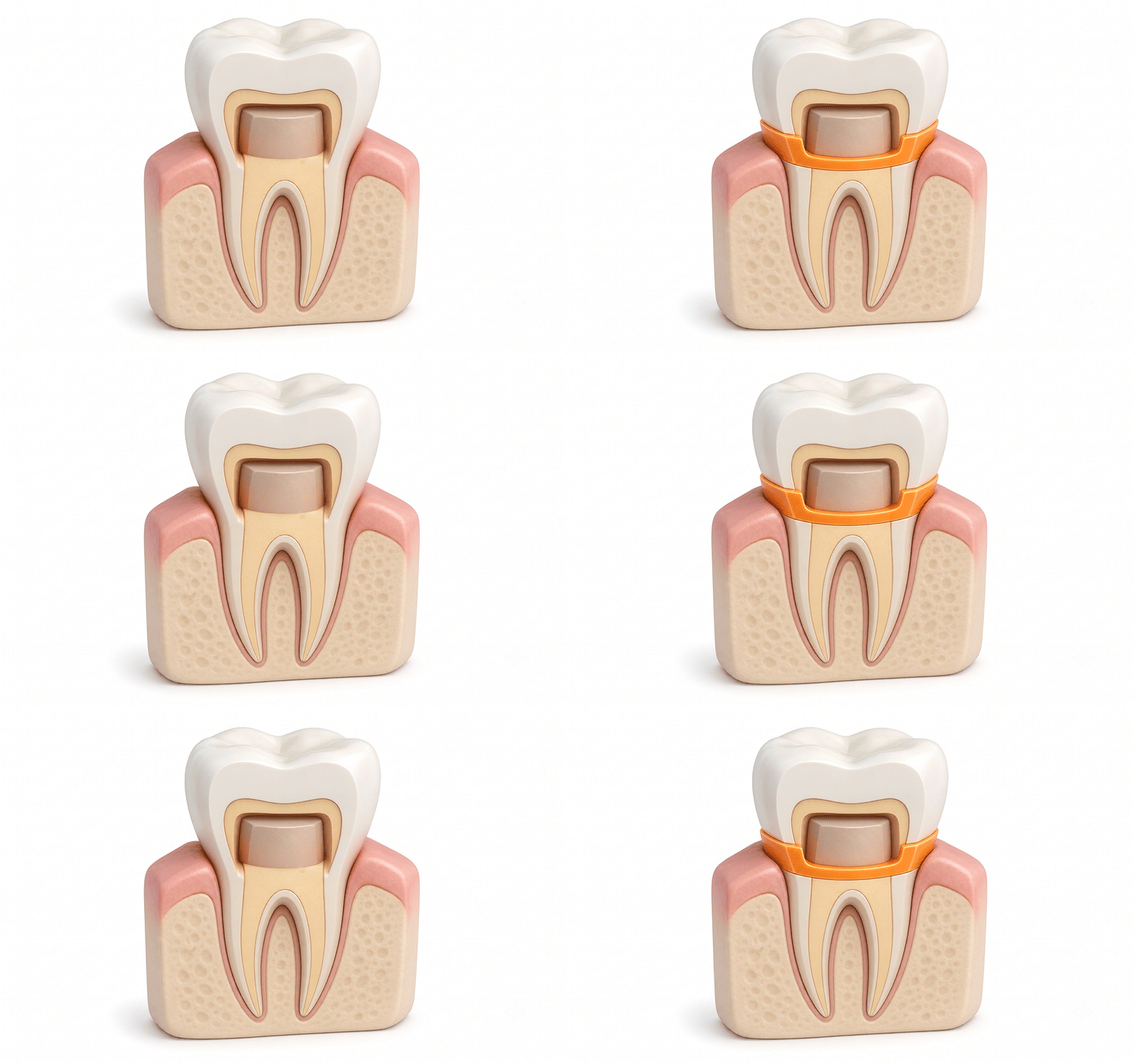
The ferrule effect is not a technique of “gluing a broken tooth back together.” Rather, it is the principle by which a crown encircles the remaining tooth walls to gain structural stability. It is especially important when the coronal portion of the tooth has been significantly damaged due to root canal treatment, cavities, or fracture.
When placing a crown, it’s not only the strength of the restoration itself that matters—how much natural tooth remains to support it is also critical. In a 1990 study, even leaving just 1 mm of sound tooth wall under the crown was associated with improved ability to withstand forces that could otherwise fracture the tooth.
When a crown wraps 360 degrees around healthy dentin like a ring, chewing forces are distributed. However, real-world retention and durability vary depending on the remaining tooth structure and the condition of the root.
2. Ferrule height of 2 mm—why does it matter?
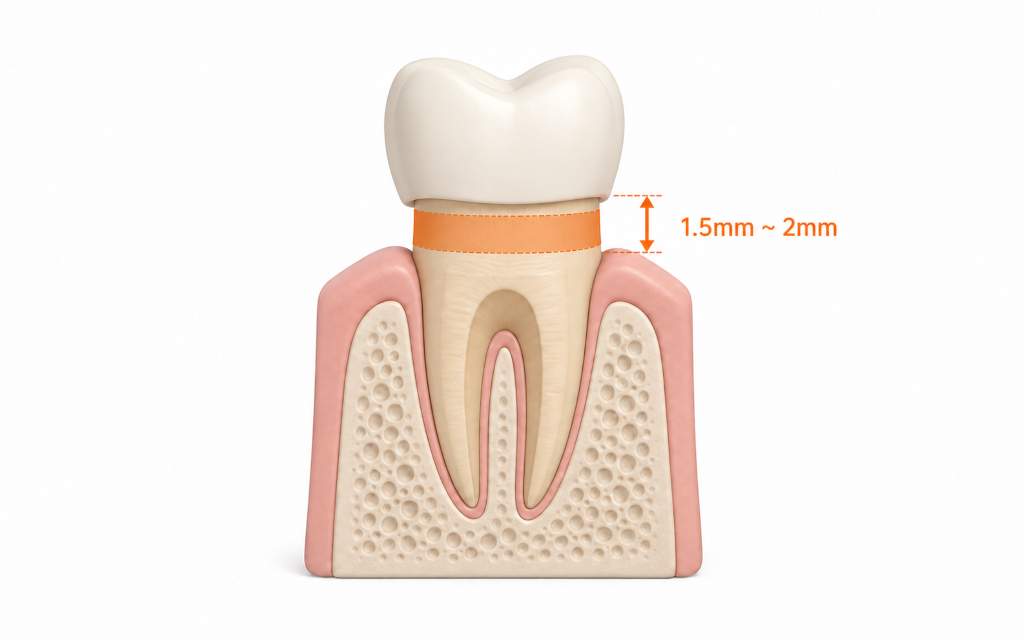
According to multiple studies, when about 1.5–2.0 mm of healthy tooth wall remains above the gumline, fracture resistance and restoration retention tend to improve. However, 2 mm is not an absolute treatment standard that applies to every tooth.
This is because study conditions, tooth shape, and an individual’s chewing forces vary. In addition to height, the thickness of the wall and where the remaining structure is located should be evaluated together.
✅ Conditions for a more stable ferrule effect
- Height and thickness: Securing roughly 1.5–2.0 mm in height and at least 1 mm of dentin thickness is advantageous. Dentin is the hard tissue beneath the outer surface of the tooth.
- Circumferential continuity: A 360-degree encircling structure is favorable, but if two opposing walls are strong, some structural benefit may still be obtained.
3. When is a crown needed instead of a veneer?
When a tooth is cracked, the treatment approach is determined not simply by how large the broken area is, but by the amount of remaining enamel, the depth of the crack, and the patient’s biting forces. Enamel is the hard outer layer of the tooth and plays an important role in bonding for a veneer.
If enough enamel remains and bonding conditions are favorable, a partial-coverage option like a veneer may preserve more natural tooth structure. On the other hand, if dentin is widely exposed or the crack extends close to the gumline, a crown should be considered.
The ferrule effect is a supportive effect achieved when a crown encircles the tooth’s circumference. It is difficult to expect the same effect from a veneer, which is primarily bonded to the front surface. Therefore, the coverage extent should be chosen based on the condition of the remaining tooth.
4. Can a post replace the ferrule?
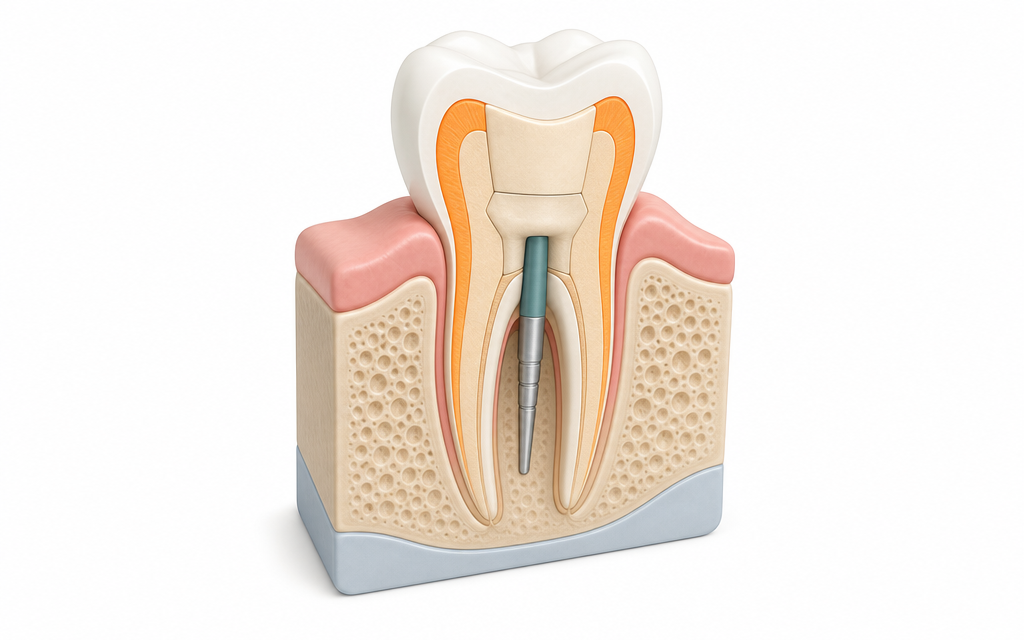
A post placed inside the root cannot replace the ferrule. A post is a pillar (or pin) that helps hold the core (the foundation material for the crown) in place so it does not dislodge.
After root canal treatment, it’s easy to assume that placing a deeper post will make the tooth stronger. However, removing too much internal root structure to place the post can thin the tooth and may increase the risk of fracture.
For this reason, preserving as much natural dentin as possible is important. If enough tooth wall remains, a post may be omitted; but if there is very little wall left and it is difficult to retain the core, a post may be necessary. Before focusing on post thickness, the amount of remaining natural tooth structure should be assessed first.
5. Can a tooth cracked below the gumline still be saved?
Even if the fracture extends below the gumline, preservation may be considered if healthy tooth structure can be exposed. However, controlling blood and moisture becomes more difficult, increasing the risk of bonding failure or inflammation.
✅Ways to expose healthy tooth wall
- Crown lengthening: The gum and bone are reshaped to expose more tooth structure. Removing bone reduces root support. In a 2000 experiment, the surgical group in which a ferrule was created showed a lower fracture load than the group with neither surgery nor a ferrule.
- Orthodontic extrusion: Orthodontic appliances are used to slowly pull the tooth upward. A stabilization period and additional procedures may be needed if the gum tissue follows the tooth upward. In rare cases, root resorption or ankylosis-like issues can occur, and the root length remaining within the bone also decreases.
In one experiment conducted in 2023, the force tolerated was 253 N in the orthodontic extrusion group and 195 N in the crown lengthening group. However, decisions should not be made based on experimental values alone; root length and the condition of the gum and bone should be evaluated together.
6. Frequently Asked Questions (FAQ)
Q. If the ferrule height is under 2 mm, does that mean I can’t get a crown?
Not necessarily. In addition to height, the thickness and shape of the tooth wall and your biting forces are evaluated together to determine whether treatment is appropriate.
Q. My front tooth is badly chipped—can it last long with a veneer?
It may be considered if enough enamel remains and bonding conditions are favorable. However, if the crack is deep or you have severe bruxism, a crown may also be considered.
Q. Do teeth that have had root canal treatment always need a post?
If enough tooth wall remains, it may be omitted. But if there is very little wall left and it is difficult to retain the core, it may be necessary.
Q. If a tooth breaks deep below the gumline, is extraction the only option?
In some cases, it can be preserved through crown lengthening or orthodontic extrusion. However, if it is difficult to secure about 4–5 mm of healthy tooth structure above the bone or if root support is insufficient, extraction followed by an implant may be a more predictable option.
This health content has been reviewed by medical professionals, compiled from authoritative domestic and international sources, and is regularly updated in accordance with the latest clinical guidelines.
Sources
- Journal of Prosthodontics, Ferrule dimensions and restoration outcomes in endodontically treated teeth: A systematic review and meta-analysis, 2026.
- Journal of the Korean Academy of Pediatric Dentistry, Fracture resistance of fragment reattached teeth according to resin materials and tooth preparation methods, 2022.
- The Journal of Korean Academy of Prosthodontics, An anterior prosthetic restoration case using a virtual patient creation method representing dynamic occlusion, 2023.
※ The copyright for all content on this blog belongs to medihi. Unauthorized copying, distribution, or derivative use is strictly prohibited, and violations may result in legal action without prior notice.