

In This Article
When a bridge feels loose, it’s easy to assume the gum bone has weakened. However, the cause may also be a bonding/cementation issue with the prosthesis, or decay and root damage in the abutment teeth. Before deciding on bridge removal and switching to an implant, it’s important to identify the cause of the looseness and evaluate the condition of the remaining teeth, gums, and supporting bone together.
1. What causes a bridge to feel loose?
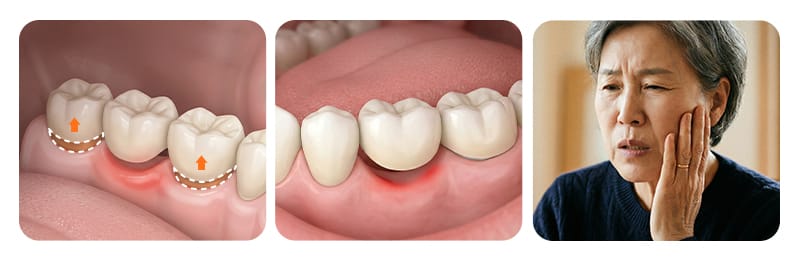
You cannot conclude bone loss based on bridge looseness alone. Because a bridge relies on the natural teeth on both sides as abutments, both the prosthesis and the abutment teeth must be checked.
If a gap forms under or inside the prosthesis, decay can recur in the abutment teeth. Over time, chewing forces may cause cracks in the root, and gum inflammation can weaken the surrounding bone.
Minor internal damage may be difficult to confirm with a standard 2D X-ray alone. Clinicians may distinguish the cause by checking the depth of inflammation between the gums and teeth and reviewing images from multiple angles.
✅Signs to check along with looseness
- If it feels like only the prosthesis is moving, check for bonding/cementation failure or a prosthesis-related issue.
- If the gums are swollen and bleeding, examine the gums and surrounding bone.
- If you feel a sharp, electric-like pain when chewing, check for root cracks/fractures or decay.
If the supporting bone is in good condition and only the bonding has failed, it may be possible to repair the existing bridge and continue using it. Treatment decisions should not be made based on looseness alone.
2. When should you consider switching to an implant?
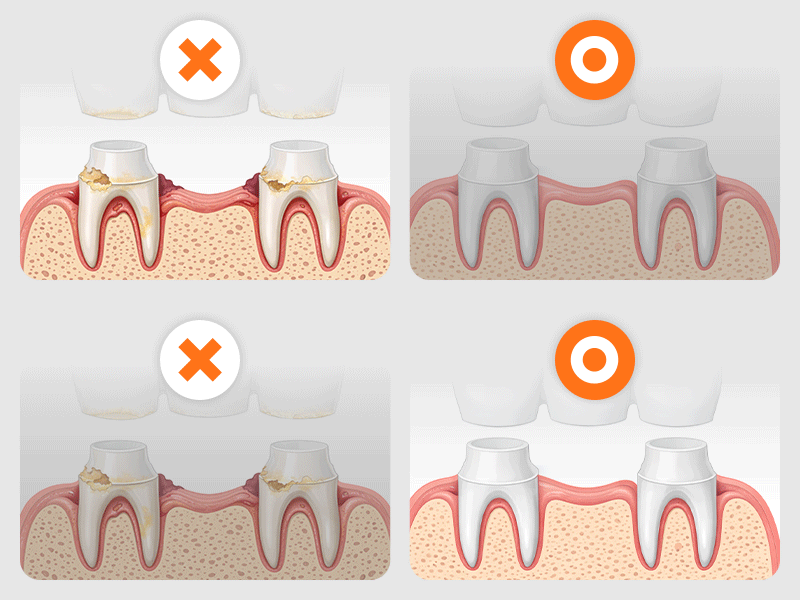
If one of the bridge’s abutment teeth is difficult to save, you may need to consider either remaking the bridge or switching to an implant. A key decision point is how much of the surrounding natural teeth can be preserved.
If adjacent teeth are healthy and structurally stable, remaking the bridge may be an option. However, it’s important to confirm whether additional tooth reduction (shaving) of natural teeth would be required.
If you want to better protect adjacent teeth, or if the missing-tooth span is wide, a single implant may be considered. Because it uses its own separate support, planning can reduce how much adjacent teeth need to be prepared. That said, depending on chewing-force distribution and maintenance, changes can occur in adjacent teeth or the opposing (biting) teeth.
In practice, the decision is made by evaluating (1) whether the abutment tooth/teeth can be preserved, (2) whether additional tooth reduction is needed, and (3) the condition of the bone and gums at the placement site.
3. Is an implant possible on the day of extraction?
When switching from a bridge to an implant after removing the bridge, the timing of extraction and implant placement must be planned. Same-day placement is not possible in every case.
Same-day placement may be considered when:
- there is no acute infection, or infected tissue can be thoroughly removed, and
- there is enough bone to achieve initial stability.
In these situations, the overall treatment period may be shortened.
On the other hand, if inflammation has progressed for a long time and the supporting bone has significantly decreased, or if there is not enough gum tissue to cover the extraction site, waiting for the gums to heal may be recommended. Rather than prioritizing a faster schedule, the priority is stable fixation and adequate inflammation control. Choosing the timing based on the remaining bone and gum condition is important.
4. What are the insurance coverage criteria for those aged 65 and older?
If you are 65 or older and still have some natural teeth remaining, you may be eligible for National Health Insurance coverage for implant treatment in Korea. Coverage applies to up to two implants over a lifetime, and recognized criteria (such as prosthesis materials) should be confirmed before treatment.
Because medical conditions and medications become more relevant with age, they should be reviewed together:
- If you have diabetes or hypertension, wound healing may be affected. Your overall health should be assessed, and if needed, care may be coordinated with the relevant medical department.
- In particular, inform your clinician about osteoporosis medications, including the type and duration of use. Some osteoporosis treatments may be associated with jawbone-related complication risks during invasive procedures such as extraction or implant placement. Depending on the medication type and duration, additional evaluation or co-management may be recommended.
In short, confirm insurance eligibility together with your health status and current medications.
5. How should you manage things after replacement?

Bridges and implants require attention to different issues:
- With bridges, monitor for decay or root damage in the abutment teeth.
- With implants, monitor for inflammation in the surrounding gums.
An implant post itself does not develop cavities, but inflammation can occur in the surrounding gums, so ongoing management of the gums and bone is necessary.
Smoking, poorly controlled diabetes, and inadequate oral hygiene can increase the risk of inflammation around implants. Regular checkups and hygiene care can help detect and manage problems early.
Checkup items and visit intervals vary depending on the condition of your teeth and gums, so it’s important to follow the schedule recommended by your clinician.
6. Frequently Asked Questions (FAQ)
Q. If my bridge feels loose, do I need to remove it right away?
Extraction is not decided based on looseness alone. First, check bonding/cementation, decay or root damage in the abutment teeth, and the condition of the gums and surrounding bone.
Q. If an abutment tooth is decayed or cracked, should I switch to an implant right away?
First, evaluate whether the tooth can be preserved and whether remaking the bridge is feasible. If maintaining the abutment tooth is difficult, a single implant may be considered to reduce additional reduction of adjacent natural teeth.
Q. Can I get an implant placed on the same day as extraction?
It may be considered if there is no acute infection (or infected tissue can be thoroughly removed) and there is enough bone for initial stability. If bone loss is significant or gum tissue is insufficient, waiting for healing may be recommended.
Q. Can I still receive implant treatment if I have diabetes or hypertension?
Before treatment, your current health status and medications are reviewed to plan care. Depending on your condition, the plan may be coordinated with the relevant medical department if needed.
This health content has been reviewed by medical professionals, compiled from authoritative domestic and international sources, and is regularly updated in accordance with the latest clinical guidelines.
Sources
- National Health Insurance Service (NHIS), Implant Benefit Coverage Guide, 2024
- Health Insurance Review & Assessment Service (HIRA), Notice on Recognition Criteria for Dental implant Coverage Under National Health Insurance, 2024
- Jeon et al., Standardized multi-institutional data analysis of fixed and removable prosthesis, J Adv Prosthodont, 2024
※ The copyright for all content on this blog belongs to medihi. Unauthorized copying, distribution, or derivative use is strictly prohibited, and violations may result in legal action without prior notice.