

In This Article
When considering an implant at age 65 or older, it’s more important to first check whether you qualify for National Health Insurance coverage—and exactly which parts are covered—than to look at cost alone. In particular, after the 2025 policy revision, zirconia also became eligible for insurance coverage, expanding the range of prosthetic material options. This article summarizes who qualifies for implant insurance, how out-of-pocket costs are structured, and how materials and payment timing work.
1. Who is eligible for insurance-covered implants?

National Health Insurance coverage for implant treatment applies to National Health Insurance subscribers or dependents aged 65 or older **as long as some natural teeth remain**. Having at least a few remaining teeth is referred to as **partial edentulism**, and insurance-covered implant treatment is recognized for **up to two implants per person over a lifetime**.
On the other hand, if you have **no natural teeth at all** (complete edentulism), you cannot receive insurance benefits for implants. Complete edentulism is typically covered under denture benefits, so it’s important to distinguish it from partial edentulism.
When checking eligibility, you should confirm your age, whether you have remaining teeth, and how many insurance-covered implants you have already used. Because eligibility can change depending on whether any teeth remain, it’s better to confirm your current dental status through an exam rather than trying to judge it on your own.
2. How are out-of-pocket costs calculated?
For insurance-covered implants, the patient copayment rate is generally around 30% of the covered (benefit-eligible) fees. However, this does not mean you pay only 30% of the total treatment cost—if non-covered items are added, the actual amount you pay can differ.
So during consultation, it’s best to review what is covered by insurance and what is not, separately. Even for the same implant treatment, the final cost can vary depending on whether additional procedures are needed, so estimating the total cost based only on coverage criteria can lead to a gap.
When receiving an estimate, it’s also helpful to check whether items that may involve separate charges—such as CT imaging, tooth extraction, gum treatment, or bone grafting—are included. Depending on whether these are necessary, your actual out-of-pocket cost can vary even with an insurance-covered implant.
3. How are covered vs. non-covered items divided?
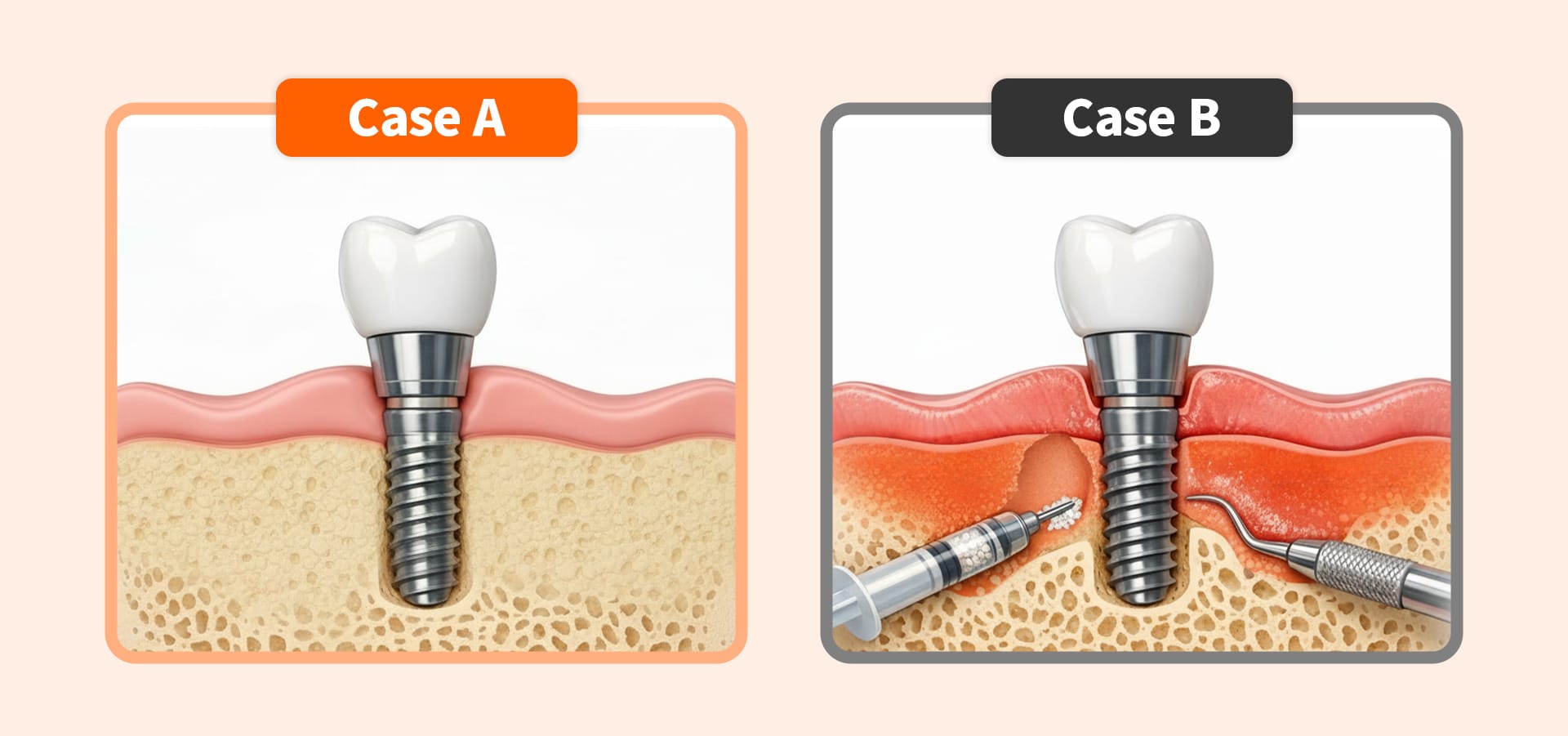
Items that may be covered by insurance include the fixture (the root portion placed into the jawbone), a standard prefabricated abutment that meets the criteria, and a crown within the specified materials and scope. In contrast, procedures such as extraction, gum treatment, bone grafting, and sinus lift surgery (to augment bone in the upper jaw) are often non-covered.
It’s easiest to understand the cost structure by separating covered and non-covered portions. The covered portion is calculated using the applicable copayment rate, while the non-covered portion is billed separately.
Before treatment, it’s a good idea to obtain a written estimate that separately lists covered items and your copayment amount, as well as non-covered items and their expected costs. Confirming the overall treatment timeline and number of visits can also help when discussing budget and scheduling with family.
4. Is zirconia also covered by insurance?
In the past, PFM (Porcelain-Fused-to-Metal) was the prosthetic material most commonly included within insurance coverage for the crown portion of an implant. However, after the 2025 policy revision, zirconia also became eligible for insurance coverage. PFM is a material with porcelain on the outside and metal on the inside, and over time there has been concern about the gumline appearing dark or the material being prone to chipping.
Zirconia is a tooth-colored prosthetic material that does not use metal, and it is widely used clinically due to its advantages in esthetics and strength. Choosing zirconia does not automatically make the treatment non-covered.
That said, the actual amount you pay can vary depending on your eligibility status, the treatment stage, the type of medical institution, and whether additional non-covered procedures are needed. Rather than judging total cost by the material name alone, it’s best to confirm covered and non-covered items together.
5. Do you have to pay the full cost all at once?
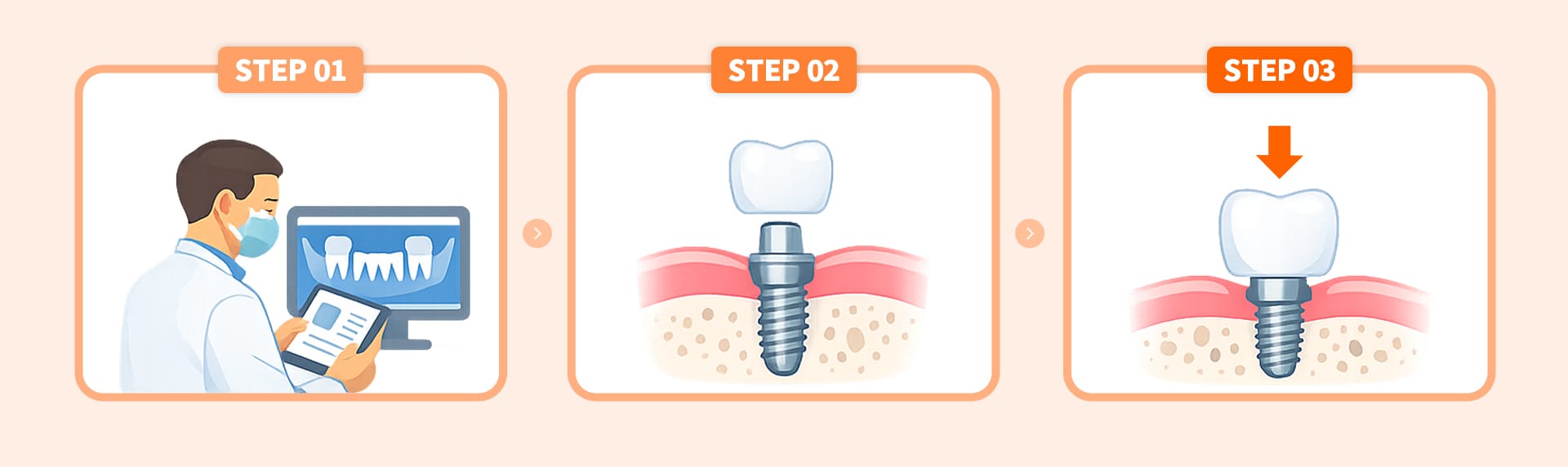
Insurance-covered implant treatment proceeds in three stages—diagnosis & planning, surgery, and prosthetics—and payment is also divided according to these stages. Instead of paying the entire amount upfront, you pay the copayment for the services provided at each stage.
In the diagnosis & planning stage, X-rays are taken and a treatment plan is established. In the surgical stage, the implant is placed into the jawbone. Then, in the prosthetic stage, the final crown is attached.
After treatment begins, switching to another dental clinic due to a simple change of mind can be very difficult. Once the implant placement stage begins, the case is registered to that clinic in the National Health Insurance system, and if you transfer, your insurance benefit count may be considered already deducted or may not be recognized. For this reason, before starting treatment, it’s advisable to confirm not only the treatment process but also how follow-up care will be handled.
6. Frequently Asked Questions (FAQ)
Q. If I use both of my two insurance-covered implants, can I receive additional benefits?
Insurance-covered implants apply up to two implants per person over a lifetime. After that, additional implants are not included in National Health Insurance benefits.
Q. If I transfer to another dental clinic during treatment, will insurance still apply?
After treatment begins, there may be restrictions on transferring to another clinic due to a simple change of mind. Once the placement stage begins, the case is registered to that clinic in the National Health Insurance system, and if you move, your insurance benefit count may be considered already deducted or may not be recognized.
Q. If I choose zirconia, will there be extra costs?
Under the 2025 revision of coverage criteria, zirconia can also receive National Health Insurance benefits. However, the actual out-of-pocket amount can vary depending on your eligibility status, the treatment stage, the type of medical institution, and whether additional non-covered procedures are needed.
Q. In what situations should I consider a dental consultation?
You may consider a dental consultation if your current dentures keep becoming loose and your gums hurt, or if your remaining teeth have started to feel loose and eating is becoming difficult. After a tooth is lost, the jawbone can gradually shrink over time, so it’s best to check your current condition and then establish a treatment plan.
This health content has been reviewed by medical professionals, compiled from authoritative domestic and international sources, and is regularly updated in accordance with the latest clinical guidelines.
Sources
- National Health Insurance Service. (2023). Q&A on dental implant benefit coverage.
- Ministry of Health and Welfare. (2025). Notice on expanding covered prosthetic materials for dental implants and expanding coverage for dental caries testing.
- Abou-Ayash, S., et al. (2025). Implant survival in patient populations with a mean age of 65–75 years compared to older cohorts. Clinical Oral Implants Research.
※ The copyright for all content on this blog belongs to medihi. Unauthorized copying, distribution, or derivative use is strictly prohibited, and violations may result in legal action without prior notice.