

In This Article
Immediate placement—placing an implant on the same day as tooth extraction—can significantly shorten the overall treatment timeline, but it cannot be applied to every oral condition. For safe healing, a thorough, precise evaluation must come first, integrating the condition of the jawbone and gums, the presence of infection, and the ability to achieve primary stability. This post outlines the key decision criteria you should confirm to help prevent complications from overly aggressive surgery and to proceed safely with same-day placement.
1. Six requirements for immediate placement: bony wall, residual bone, inflammation, primary stability, soft tissue, occlusion
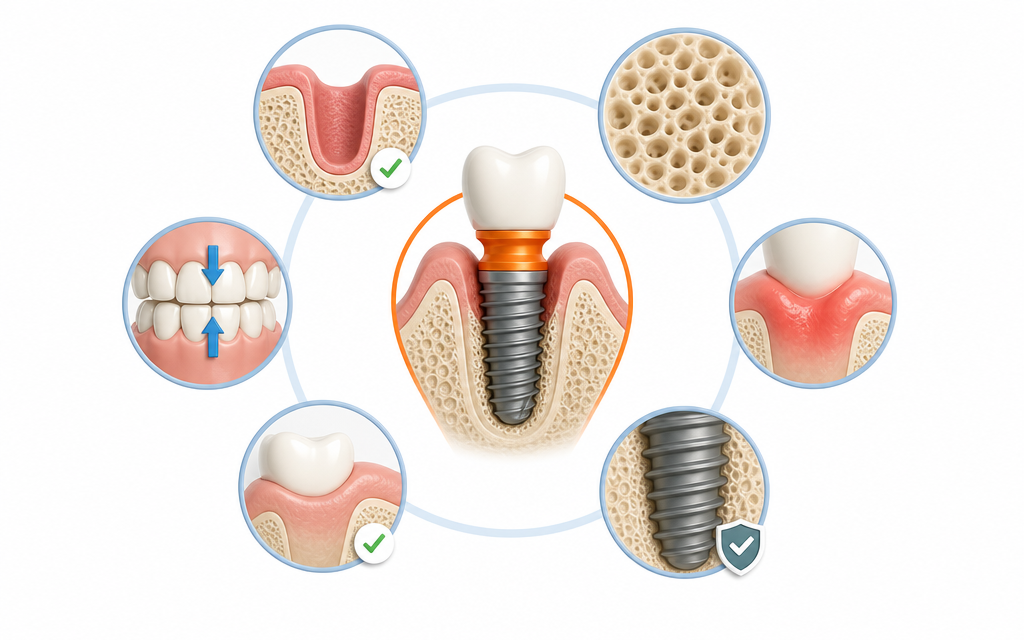
Immediate placement is not simply about shortening the schedule to “the day of extraction.” It should be considered only when the case meets key conditions—such as an appropriate bony wall, healthy soft tissue, and the ability to obtain strong primary stability.
Using CBCT and clinical examinations, clinicians comprehensively assess the morphology of the bony wall and residual bone, infection status, soft-tissue condition, expected primary stability, and occlusal considerations. The jawbone must be deep and dense enough to keep the implant fixture from moving. If detailed testing shows these conditions are insufficient, reinforcing the alveolar bone is often a much safer choice than forcing a same-day procedure.
✅Key evaluation items for safe immediate placement
- Confirm whether the outer bony wall at the extraction site is sufficiently preserved and able to maintain its form.
- Evaluate whether there is dense residual bone capable of firmly stabilizing the implant fixture from the start.
- Check for load-related risk factors that can interfere with early osseointegration, such as bruxism or strong occlusal forces.
2. When immediate placement may still be possible with inflammation vs when you should wait
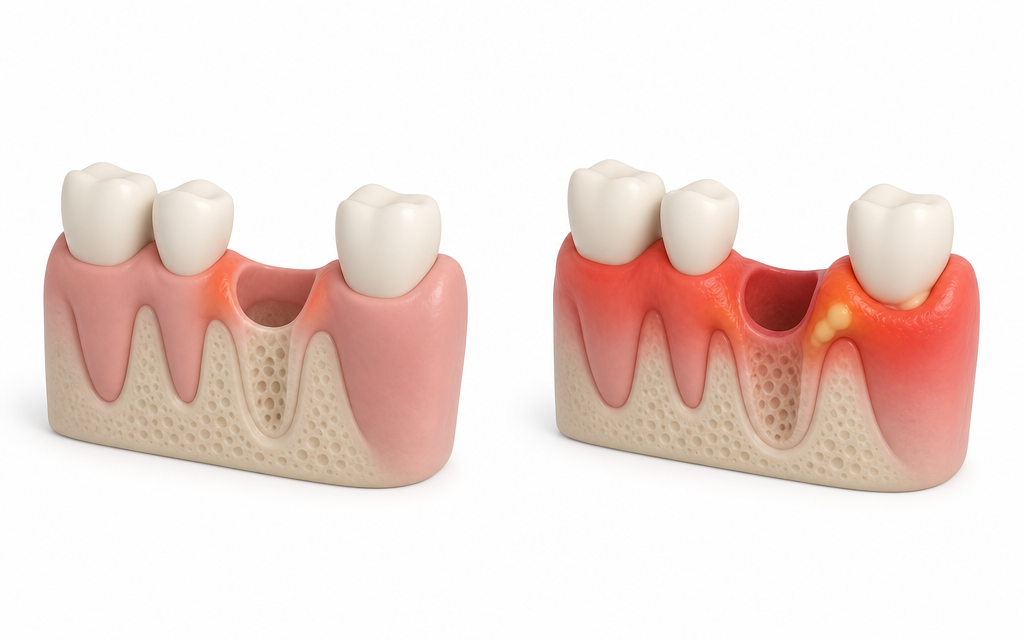
Having gum inflammation does not automatically make same-day placement impossible. Feasibility is determined by carefully evaluating the activity of the inflammation and the extent of bony wall destruction.
If the condition is a localized chronic lesion, thorough curettage and removal of infected tissue are feasible, and sufficient primary stability can be secured, same-day surgery may be considered on a conditional basis. This must be approached cautiously, based on the premise that there is no bony wall destruction around the inflamed area and that adequate initial mechanical stability can be obtained from the remaining bone.
On the other hand, if there is severe pus with an acute infection or extensive alveolar bone destruction, residual bacterial contamination can significantly interfere with osseointegration. In acute phases that are difficult to control, it is preferable to avoid immediate placement, calm the inflammation first, and then transition to early or delayed placement.
3. Anterior (front-tooth) implants: managing thin bony walls and gums that determine esthetics
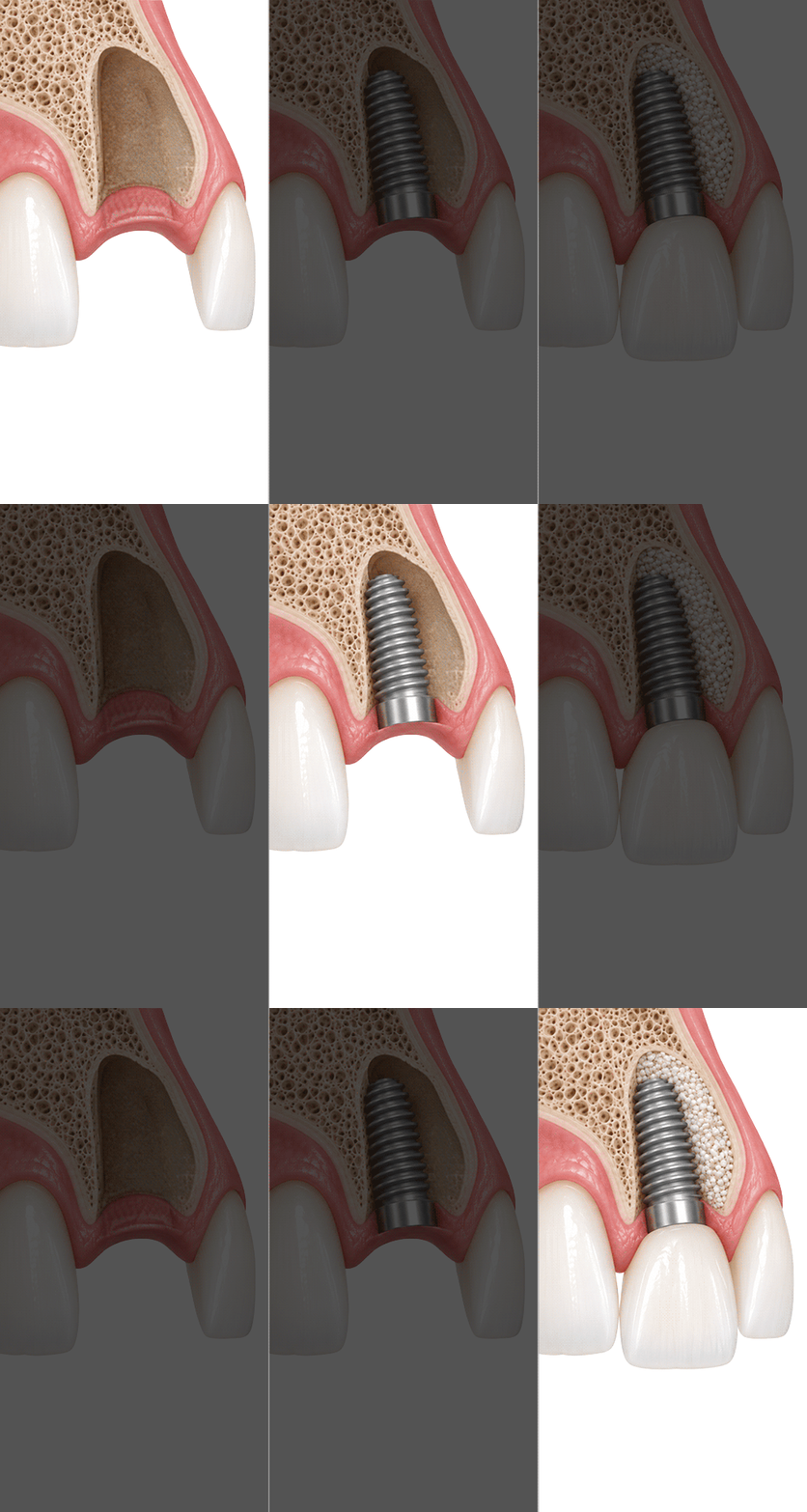
In the front-tooth area, esthetics are just as important as chewing function. Therefore, the thickness of the outer bony wall (buccal plate) and the risk of gingival recession due to thin soft tissue must be prioritized.
The buccal bone in the anterior region is structurally thin, and immediately after extraction it tends to become thinner or lose volume quickly through resorption. If same-day surgery is pushed forward without sufficient augmentation when the bone or gums are thin, gingival recession during healing may cause esthetic issues—such as the metallic portion of the implant or prosthesis showing through.
For this reason, when planning immediate placement in the anterior region, it is essential to predict and address resorption risk in advance through precise diagnosis. Depending on the case, minor bone grafting or soft-tissue augmentation may be combined to secure support so that the gingival margin around the prosthetic tooth remains natural, similar to the original tooth.
4. The purpose and benefits of socket preservation (ARP) and the waiting period
After a tooth is extracted, waiting for a certain period or performing socket preservation (ARP) with bone grafting first is not simply “wasting time.” It is a key treatment step that stabilizes a compromised oral environment and can improve the likelihood of surgical success.
Socket preservation can help reduce the loss of alveolar bone volume that occurs after extraction and may help reduce the extent of additional bone grafting needed later during implant treatment.
| Treatment Timing / Protocol | Target Patients & Key Characteristics |
|---|---|
| Immediate Placement (Same-Day Extraction) | Performed when bone wall preservation is sound, acute inflammation is controlled, and initial stability is achievable |
| Early / Delayed Placement (4 Weeks to Several Months) | Performed after soft tissue healing and acute inflammation treatment; bone augmentation is combined to prevent bone resorption |
5. A schedule for busy professionals: separating the placement day from the final prosthesis completion day
Even if the implant fixture is placed on the day of extraction and a temporary tooth is delivered immediately, several months of osseointegration are still required before the final prosthesis is completed and normal eating becomes possible.
A temporary tooth placed on the day of surgery—especially in the anterior region—is not intended for chewing food. It is a protective device meant to reduce an esthetic gap in social or work settings. Because the process of the implant fixture becoming firmly integrated with the jawbone varies greatly by individual, occlusal contact must be strictly limited early on to prevent even minor micromovement.
Therefore, the busier you are, the more important it is to clearly separate the “surgery date” from the “final treatment completion date” and plan your schedule with a long-term perspective. After surgery, it is important to avoid strong chewing habits or smoking that can interfere with osseointegration, and to follow the planned follow-up visits diligently.
6. Frequently Asked Questions (FAQ)
Q. What tests are needed to perform an immediate implant surgery on the day of extraction?
A 3D CT scan (CBCT) is used to closely analyze the three-dimensional morphology and bone density of the remaining alveolar bone. In addition, clinicians comprehensively assess how well the bony wall around the extraction site is preserved and how active any inflammation is, then determine whether sufficient primary stability can be achieved that day before deciding the final treatment plan.
Q. If a temporary tooth is placed the same day after immediate placement, can I eat hard foods right away?
It is not recommended. A same-day temporary tooth is intended for limited use to maintain appearance, not for chewing hard foods. During the months required for full osseointegration, strict management is needed to prevent loading on the implant site.
Q. I have severe pus due to periodontitis—can same-day placement still be done?
In an acute infection phase with significant pus or extensive bone breakdown, overly aggressive same-day surgery should be avoided. After thoroughly disinfecting and calming the acute inflammation, proceeding with early placement after about 4–8 weeks of soft-tissue stabilization—depending on the condition—is much safer.
Q. Do I always need bone grafting when doing immediate placement?
Not necessarily. However, if the bone structure is thin (such as in the anterior region) and the risk of future gingival recession is high, or if the gap between the extraction socket and the implant (jumping distance) is large, bone grafting may be added to support stable osseointegration and maintain esthetics.
This health content has been reviewed by medical professionals, compiled from authoritative domestic and international sources, and is regularly updated in accordance with the latest clinical guidelines.
Sources
- Journal of Periodontal & Implant Science (2025) - A prospective clinical analysis on early stability and prosthetic loading in immediate placement in the anterior region
- Journal of Evidence-Based Dental Practice (2022) - Systematic review and meta-analysis on socket preservation (ARP) and timing selection for early placement
- Clinical Oral Implants Research (2023) - Clinical guidelines for selecting conditions for immediate placement and immediate loading in the maxillary anterior esthetic zone
※ The copyright for all content on this blog belongs to medihi. Unauthorized copying, distribution, or derivative use is strictly prohibited, and violations may result in legal action without prior notice.