

Asymptomatic diabetes is difficult to judge based on subjective “feelings.” Many people in their 40s to 60s wonder whether additional testing is really necessary when their fasting glucose or HbA1c falls into a borderline range on routine checkups. This post explains why you should respond based on test results even without symptoms, and outlines practical management strategies.
The question, “I don’t have any symptoms—do I really need to see a doctor?” is completely understandable. However, just because your body seems to be coping does not mean your internal metabolic state is safe.

When clinicians evaluate asymptomatic high blood sugar, the first thing they look at is objective glucose markers. They typically start with fasting plasma glucose and HbA1c, and add a 75 g oral glucose tolerance test (OGTT) when needed.
Even if no obvious warning lights are on, using numbers as a “scanner” to detect hidden problems early—and preparing accordingly—is key to maintaining long-term health.
1. Why test results matter most—even when you have no symptoms

Even when diabetes has progressed significantly, classic early symptoms—such as
excessive thirst, frequent urination, and weight loss—may not appear at first. In medicine, this is clearly categorized as “asymptomatic hyperglycemia.” Assuming “I feel fine, so I must be fine” is a common misconception that can get in the way of preventing complications.
By the time a person notices symptoms, microvascular damage has often already advanced to a meaningful degree. If exposure to high glucose continues before symptoms appear, long-term risk can slowly accumulate in organs such as the retina and kidneys. That is why numbers—like fasting glucose and HbA1c—become the decisive standard, rather than whether you feel symptoms.
Medical reports also continue to suggest that starting management early may have a positive impact on lowering long-term risk. Rather than relying on subjective condition, it is far more reasonable to use objective lab values as the starting point for safer management.
2. When fasting glucose is normal—what conditions can still hide a problem?

It can be risky to feel reassured simply because fasting glucose is “normal” on a health screening. This is a common medical pitfall in evaluating asymptomatic hyperglycemia. Using a car analogy, fasting glucose is like checking only the basic dashboard reading before starting the engine.
HbA1c reflects your recent “driving record,” and OGTT—showing how glucose changes after a meal-like load—is closer to a stress test. Even if fasting glucose (the dashboard) looks normal, post-meal glucose can still spike. If you do not review the HbA1c record alongside it, you may miss the problem.
[Situations where additional evaluation should be considered even if fasting glucose is normal]
- HbA1c is borderline or continues to trend upward
- Body mass index (BMI) is high and abdominal obesity is also present
- You have high blood pressure or dyslipidemia, or a first-degree family history
- Strong drowsiness or fatigue repeatedly occurs only after meals
- History of gestational diabetes, or polycystic ovary syndrome (PCOS)
If any of these apply, you may suspect hidden impaired glucose tolerance (postprandial hyperglycemia). Consulting a clinician about an OGTT can help precisely assess post-meal glucose handling and is very useful for building a management plan.
3. Prediabetes (borderline range): tailored response strategies by range

Being told you are in the prediabetes or borderline range can feel overwhelming—what should you do next? This range is not simply a “safe” stage; it is the point where lifestyle intervention and follow-up testing are discussed. According to professional recommendations, the response can vary slightly depending on where your numbers fall.
| 검사 수치 구간 | 의료진 권장 대처 방안 | 다음 검사 주기 |
|---|---|---|
| 공복 100~109 / 당화혈색소 5.7~6.0% | 생활습관 교정 및 기본 추적 관찰 진행 | 연 1회 이상 확인 |
| 공복 110~125 / 당화혈색소 6.1~6.4% | OGTT 등 정밀 평가로 식후 오름세 점검 | 3~6개월 내 확인 |
| 진단 기준 초과 수치 발견 시 | 진단 정확도를 높이기 위한 반복 재검사 | 다른 날 재확인 |
If fasting glucose is 100–109 mg/dL, it is a good time to begin lifestyle improvements such as diet, exercise, and weight management. Setting goals and reviewing progress regularly is recommended.
On the other hand, if fasting glucose is higher at 110–125 mg/dL, or HbA1c falls in the 6.1–6.4% range, a more proactive additional evaluation may be needed.
This is the process of filling in the missing puzzle piece—checking whether there are post-meal glucose changes that fasting values alone might miss.
4.Preventing complications: key markers you must check along with blood sugar

Many people focus on keeping glucose numbers barely within the normal range to prevent complications. But chronic metabolic conditions involve multiple risk factors that interlock like large gears.
Even if glucose is only mildly elevated in a borderline state, the burden on the cardiovascular system and microvasculature becomes much greater when high blood pressure or dyslipidemia is also present.
Think again of a car’s routine inspection. Replacing only the engine oil (glucose) does not complete the checkup.
You also need to check tire pressure (blood pressure), inspect the brakes (lipids), and review everyday driving habits (weight, smoking) to drive safely.
✅Checklist to review before a medical consultation
- Have you identified whether your current fasting glucose falls into a simple monitoring range or a range needing detailed evaluation?
- Are you taking blood pressure or cholesterol medication even without notice able symptoms?
- Considering your age and family history, when is your next routine screening scheduled?
- Have you ever had baseline complication-related evaluations (eyes/fundus, kidneys, nerves)?
If you are diagnosed with asymptomatic hyperglycemia, the safest approach is integrated, simultaneous management of weight, blood pressure, cholesterol, and more. Assessing complication risk from the time of diagnosis can also help reduce long-term risk.
5. Diabetes screening: why it should start at age 35
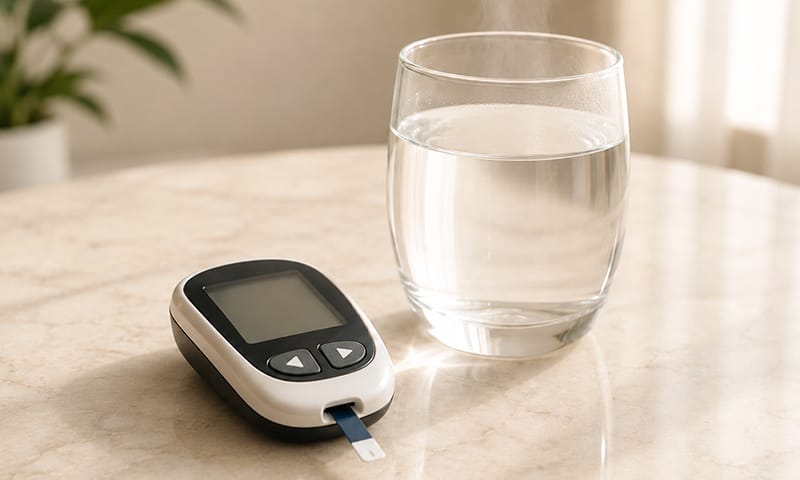
Even without symptoms, you may wonder at what age you should start screening. Public guidance and national health screening criteria often recommend regular testing starting at age 40.
However, recent recommendations from the Korean Diabetes Association clearly show a trend toward lowering the starting age for screening to 35.
This reflects the growing importance of early detection due to westernized dietary patterns and environmental changes. In particular, even adults aged 19 and older should consider earlier screening if they are overweight, have abdominal obesity, or have a family history.
Waiting until you feel thirsty and exhausted is not a good strategy. The most reasonable approach to health management is to proactively set a testing plan based on your age and whether additional risk factors are present.
6.Frequently Asked Questions (FAQ)
Q. My fasting glucose on a health screening is in the 100 mg/dL range—do I need to go to the hospital?
The 100–125 mg/dL range is classified as prediabetes (borderline range), which requires monitoring and intervention. Rather than starting intensive medication right away, it is safer to discuss with a clinician whether additional tests—such as OGTT or HbA1c—are needed based on your range, and what your next testing interval should be.
Q. When are HbA1c or an oral glucose tolerance test (OGTT) needed?
Fasting glucose alone can miss post-meal spikes. If HbA1c is borderline, or if you see a pattern that does not match fasting glucose, an OGTT may be discussed to more precisely evaluate post-meal glucose handling.
Q. Can lifestyle changes alone lower my numbers?
Lifestyle adjustments—such as diet management, regular exercise, and weight loss—can be very helpful. It is important to measure your numbers and weight at 3–6 month intervals to confirm that you are improving in the right direction.
Q. In what situations is it a good idea to get a medical consultation?
If fasting glucose or HbA1c has ever come back at a cautionary or borderline level on a national health screening, a clinic visit is recommended. This is especially true if risk factors such as overweight, high blood pressure, dyslipidemia, or a first-degree family history are also present—consider getting checked proactively.

When asymptomatic diabetes is suspected, subjective “how I feel” cannot serve as a reliable compass for protecting your health. Objectively identifying your current metabolic status—through fasting glucose, HbA1c, and OGTT when needed—is the starting point for management.
Having no symptoms does not mean you can relax right now. On the contrary, it can also mean this is a valuable window of time: with appropriate intervention starting now, you may reduce long-term microvascular and cardiovascular risk. We hope you protect your health with structured testing and integrated management of blood pressure, lipids, and other factors.
Sources
- Korea Disease Control and Prevention Agency (KDCA), National Health Information Portal. Diabetes prevention and management guidelines. 2023.
- Korean Diabetes Association (KDA). 2023 Clinical Practice Guidelines for Diabetes (8th edition). 2023.
- BMJ. Association between prediabetes and risk of cardiovascular disease and all cause mortality: systematic review and meta-analysis. 2020.
※ The copyright for all content on this blog belongs to medihi. Unauthorized copying, distribution, or derivative use is strictly prohibited, and violations may result in legal action without prior notice.
Recommended reads
 medihi