

When high blood sugar is first detected during pregnancy, the first priority is an accurate differential diagnosis. Gestational diabetes is a pregnancy-related metabolic change that can be managed safely with timely prenatal screening and a structured care plan.
“I was told I have gestational diabetes—what if something happens to my baby?”

Online communities are full of meal plans and “success tips” for gestational diabetes (often abbreviated as GDM). After reading them, many people blame themselves, thinking it happened because they ate too many sweets. But gestational diabetes is not caused only by the mother’s diet or “carelessness.” It is closely linked to the natural hormonal changes that occur to sustain pregnancy.
You don’t need to blame yourself. What you need now is not anxiety based on guesswork, but a clear, criteria-based evaluation of which category your condition falls into—so you can prepare for the next steps.
1. Diabetes diagnosed in pregnancy: How is it different from typical diabetes?

Gestational diabetes refers to abnormal glucose metabolism first identified in mid-to-late pregnancy in a woman who did not have diabetes before pregnancy. In contrast, pre-existing diabetes includes cases where blood glucose abnormalities were already present before pregnancy. Distinguishing the two matters because interpretation and management plans differ.
During pregnancy, the hormonal environment changes dramatically. To ensure a stable supply of nutrients to the fetus, the mother’s body becomes like a “shared refrigerator for two.” Hormones secreted by the placenta interfere with insulin action, creating a setting where blood glucose can fluctuate more easily (increased insulin resistance).
In a healthy state, insulin and glucose stay balanced like a seesaw. During pregnancy, placental hormones act like placing a heavy sandbag on one side of that seesaw. The pancreas must produce more insulin to restore balance—but if it cannot keep up, blood glucose rises.
Therefore, if blood glucose is already high in early pregnancy, clinicians should evaluate for pre-existing diabetes. If it first becomes elevated on the 24–28 week screening test, the usual pathway is to suspect gestational diabetes and proceed to confirmatory testing.
2. When early-pregnancy testing is needed
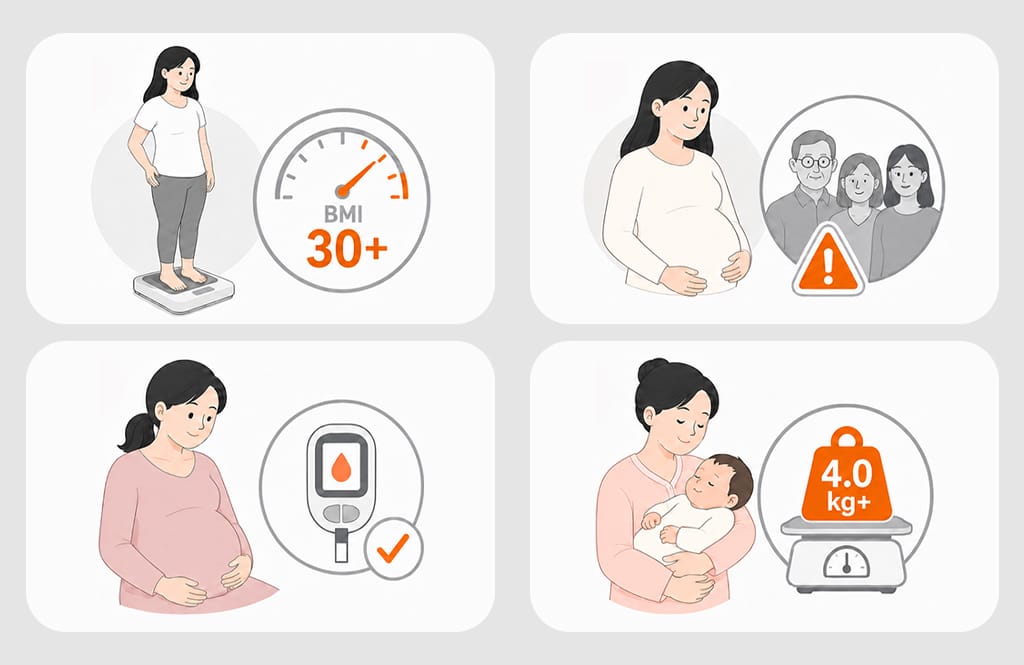
Not all pregnant women are tested at the same time. Most undergo screening at 24–28 weeks, but those at higher risk are advised to test from early pregnancy.
This is similar to bringing a car in for an earlier inspection if it has had warning lights in the past—even if it looks fine on the outside. The goal is to identify factors that make the insulin-resistance “seesaw” more likely to tip out of balance. If you have even one of the risk factors below, discuss early screening with your clinician.
✅ High-risk checklist for early screening
- Obesity with a pre-pregnancy body mass index (BMI) of 30 kg/m² or higher
(*Some references consider BMI 25 kg/m² as high risk when accounting for Asian populations.*) - A first-degree relative with diabetes
- A prior pregnancy with a diagnosis of gestational diabetes
- A history of delivering a baby weighing 4.0 kg or more (macrosomia)
- Age 35 or older
- Polycystic ovary syndrome (PCOS)
- Recurrent miscarriage, stillbirth, preterm birth, congenital anomalies, or other adverse obstetric history
Even if early testing is normal, it’s still important to be rechecked at the recommended gestational weeks. This is one of the best ways to protect fetal development throughout pregnancy.
3. Prenatal screening at 24–28 weeks: What it means if the 50 g screening test is high

The 50 g oral glucose challenge test (GCT), typically performed between 24 and 28 weeks of pregnancy, is the most commonly used screening test. You drink a beverage containing 50 g of glucose, and your blood glucose is measured exactly 1 hour later.
The purpose of this test is not to confirm a diagnosis, but to screen and identify who needs more detailed testing. So, an elevated result at this stage does not automatically confirm gestational diabetes.
| Category | Purpose of Test | Dietary Requirements | Blood Sampling Timing |
|---|---|---|---|
| 50g Screening Test | Screening expectant mothers requiring diagnostic testing | No special fasting required | 1 hour after drink consumption (1 time in total) |
| Diagnostic Test (OGTT) | Final diagnosis of gestational diabetes | Fasting for at least 8 hours required | Multiple draws before and after glucose intake |
If your screening value exceeds the cutoff, schedule a confirmatory oral glucose tolerance test (OGTT) without delay. Some people try to “improve” results by severely restricting food the day before the confirmatory test. However, extreme restriction can disrupt metabolism and interfere with accurate results. The most sensible approach is to keep your usual eating pattern and follow only the fasting instructions provided by the clinic.
4. 75 g vs. 100 g OGTT: Diagnostic criteria and how to interpret results
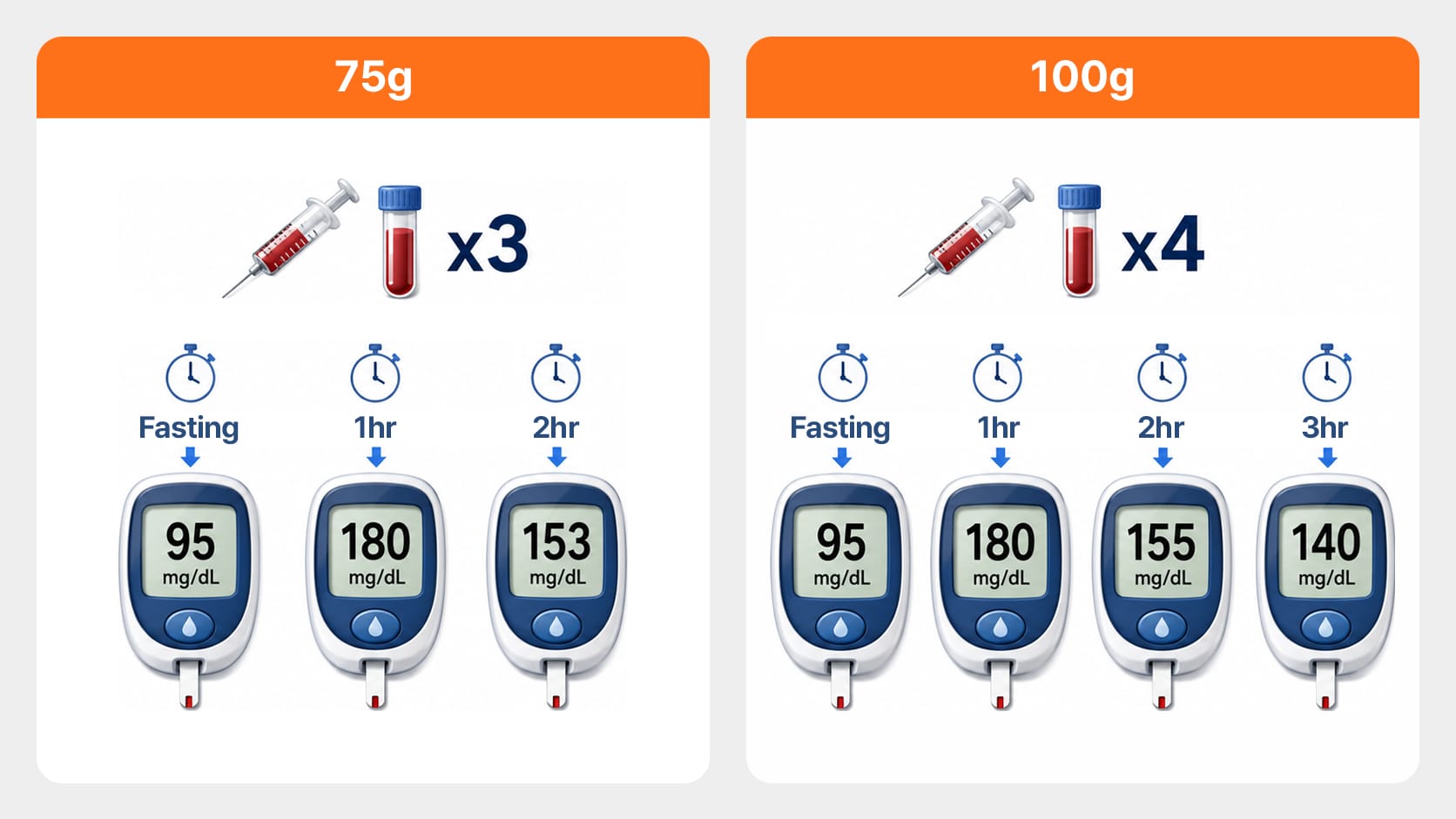
Confirmatory testing varies by hospital protocol in terms of glucose dose and number of blood draws. In Korea, the 100 g OGTT (two-step approach) and the 75 g OGTT (one-step approach) are widely used in clinical practice. Different methods use different diagnostic thresholds.
- 75 g OGTT: Blood is drawn three times—fasting, 1 hour, and 2 hours. Gestational diabetes is diagnosed if one or more values exceed the thresholds (fasting 92, 1-hour 180, 2-hour 153 mg/dL).
- 100 g OGTT: Blood is drawn four times—fasting, 1 hour, 2 hours, and 3 hours. Diagnosis is made when two or more values exceed the thresholds (fasting 95, 1-hour 180, 2-hour 155, 3-hour 140 mg/dL).
If results are borderline, it does not necessarily mean something is immediately wrong. In many cases, clinicians first recommend lifestyle measures—such as distributing carbohydrates across meals and adding walking—based on target glucose goals. If blood glucose remains difficult to control, insulin injections that can be used safely during pregnancy may be discussed. Because insulin has minimal placental transfer, it is widely used as a conservative, standard treatment option from a fetal-safety perspective.
✅ Checklist to confirm during your clinic visit
- Was this confirmatory test the 75 g or the 100 g protocol?
- On the report, how many values specifically exceeded the thresholds?
- When reviewing home glucose logs, above what range do we discuss the next step (such as insulin)?
5. Why it doesn’t end after delivery

It’s easy to think, “Once I give birth, gestational diabetes is over.” In reality, after delivery the placenta is expelled, and the factors that interfered with insulin action often disappear—so blood glucose frequently returns to normal. However, you can’t be completely reassured based on that alone.
According to Korean data, women with a history of gestational diabetes have an increased risk of developing type 2 diabetes compared with the general population. Temporary hyperglycemia during pregnancy may be a signal from the body that ongoing monitoring is needed.
That is why postpartum follow-up is very important. You should return to a medical facility 6 to 12 weeks after delivery for a repeat 75 g OGTT. Even though this is a busy time with newborn care, this postpartum test is essential to confirm whether glucose metabolism has fully recovered and to set a plan for long-term health.
6. Frequently Asked Questions (FAQ)
Q. When is gestational diabetes testing usually done?
If there are no specific risk factors, Korean guidelines recommend screening between 24 and 28 weeks of pregnancy. However, if you have high-risk factors—such as obesity, a family history of diabetes, or a prior macrosomic birth—early testing from early pregnancy may be needed for proper differentiation.
Q. If the 50 g screening test is high, does that mean I definitely have gestational diabetes?
No. The 50 g screening test (1-hour test) is used to identify who needs more detailed evaluation. If you exceed the cutoff at this stage, a confirmatory OGTT is performed to reassess whether you meet the diagnostic criteria.
Q. What is the difference between the 75 g and 100 g tests?
They differ in the amount of glucose consumed, the number of blood draws, and the diagnostic criteria. With the 75 g test, gestational diabetes is diagnosed when one or more of three values exceed thresholds; with the 100 g test, it is diagnosed when two or more of four values exceed thresholds. The protocol used may vary by hospital.
Q. If my blood glucose looks normal after delivery, can I skip testing?
Even if it appears normal immediately after delivery, there is still a risk of progression to type 2 diabetes later on. For this reason, a repeat 75 g OGTT at 6–12 weeks postpartum is recommended to confirm that glucose metabolism has fully recovered.

The fear you feel while awaiting a gestational diabetes diagnosis comes from a mother’s desire to protect her baby’s health. But this is an area that can be managed with clear criteria and appropriate testing.
Follow the recommended schedule for early testing in high-risk cases and routine 24–28 week screening, then plan the next steps calmly based on the diagnostic criteria for the 75 g or 100 g confirmatory test. If you also complete the 6–12 week postpartum follow-up test, you’ll be taking an important step toward protecting a healthy future for both mother and baby.
Sources
- Korean Diabetes Association. Clinical Practice Guidelines for Diabetes (including pregnancy-related content). 2013.
- Diabetes & Metabolism Journal. Diabetes in Pregnancy in Korea: Prevalence, Clinical Characteristics, and Postpartum Comorbidities. 2023.
- American Diabetes Association(ADA). Standards of Care in Diabetes. 2023.
※ The copyright for all content on this blog belongs to medihi. Unauthorized copying, distribution, or derivative use is strictly prohibited, and violations may result in legal action without prior notice.
Recommended reads
 medihi