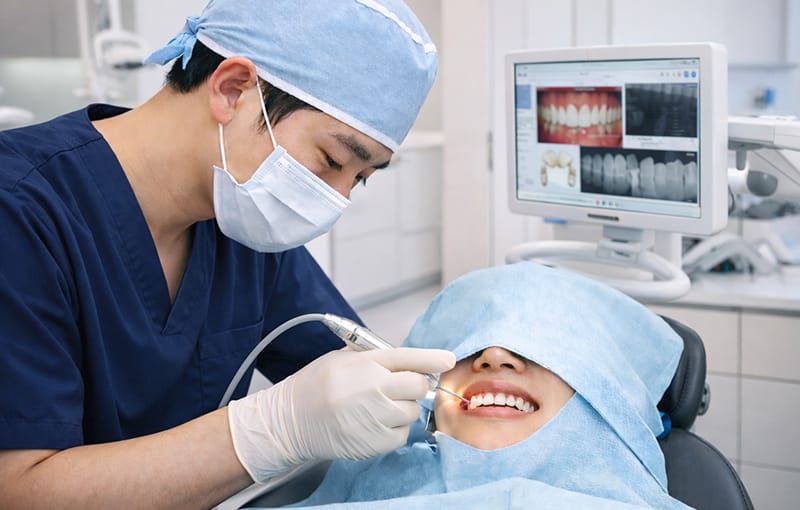

If your veneer looks duller or darker than before, the first step is not to immediately consider a “full replacement,” but to identify where the discoloration is happening.
“Did they turn yellow because I didn’t take good care of them?”
In the clinic, many people blame themselves like this. However, the mouth is an environment exposed every day to chewing, moisture, and temperature changes, so it’s natural for surface shine to decrease over time.
Rather than simply blaming coffee or wine, it’s important to determine whether your veneer color change is something that can be “cleaned and polished,” or whether it has reached a stage that requires a “structural fix.” Below is a practical set of color-management criteria designed to reduce unnecessary treatment and help extend the lifespan of your veneer.
1.Veneer color change: you must first distinguish surface staining from internal
discoloration
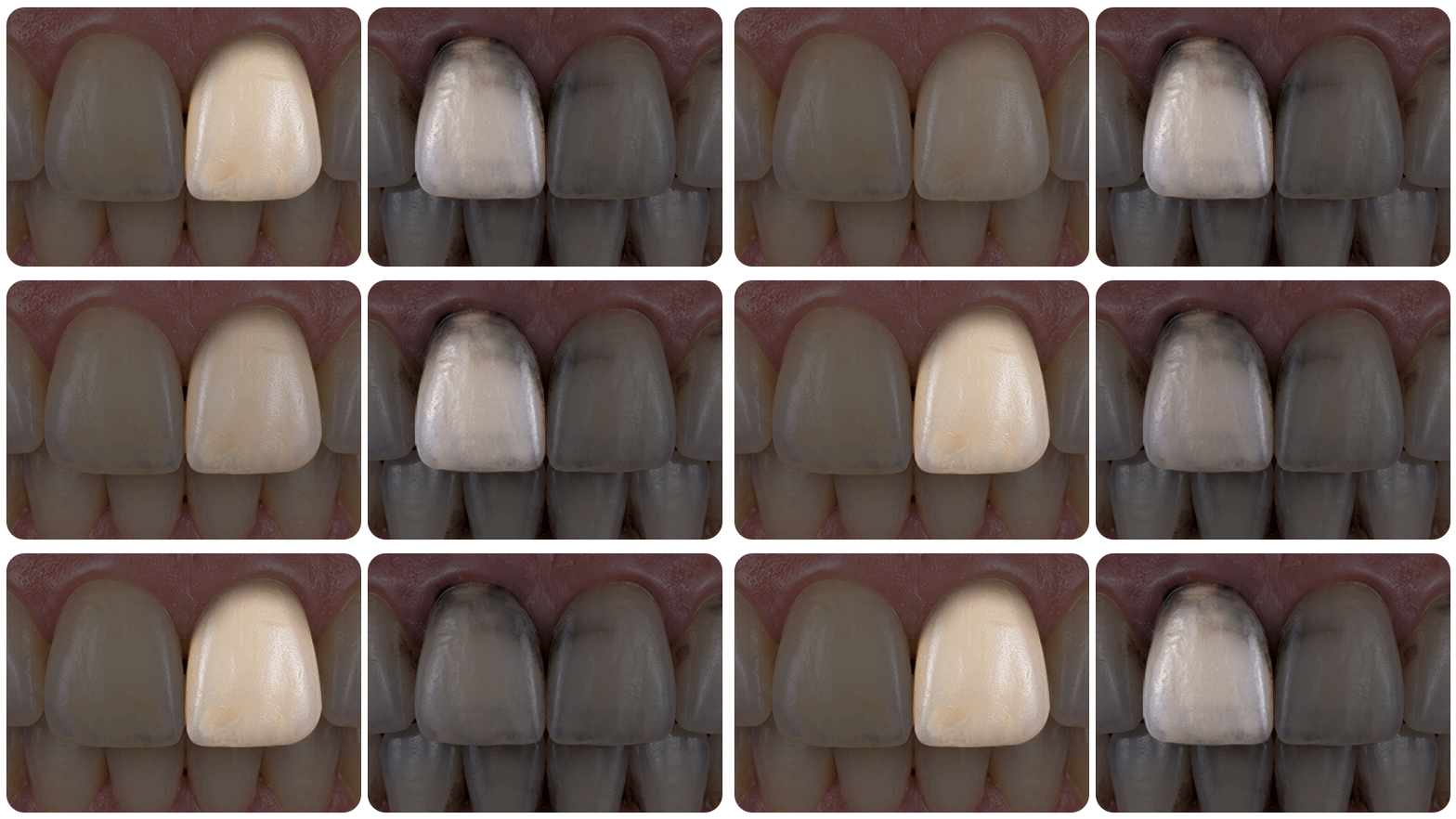
When a veneer looks yellow, many people assume the material itself has deteriorated. However, ceramic is chemically stable, so it’s uncommon for the material itself to discolor rapidly.
To make this easier to understand, think of it like a “window.”
A high-quality window does not turn yellow over time. But if dust or water stains build up on the outside (surface staining), the view looks hazy and darker.
Veneers are similar. In many cases, it’s not that the ceramic has changed, but that pigments from coffee, tea, smoking, and so on have adhered to the surface—or debris has become trapped in tiny everyday scratches.
However, not all cases are surface-level. If the adhesive inside the “window” has changed, or if the scenery beyond the glass (the natural tooth) has darkened, wiping the outside alone won’t solve it.
In other words, separating surface staining from internal discoloration is the first step to preventing unnecessary replacement.
2.If you whiten your teeth, can your veneer become brighter too?
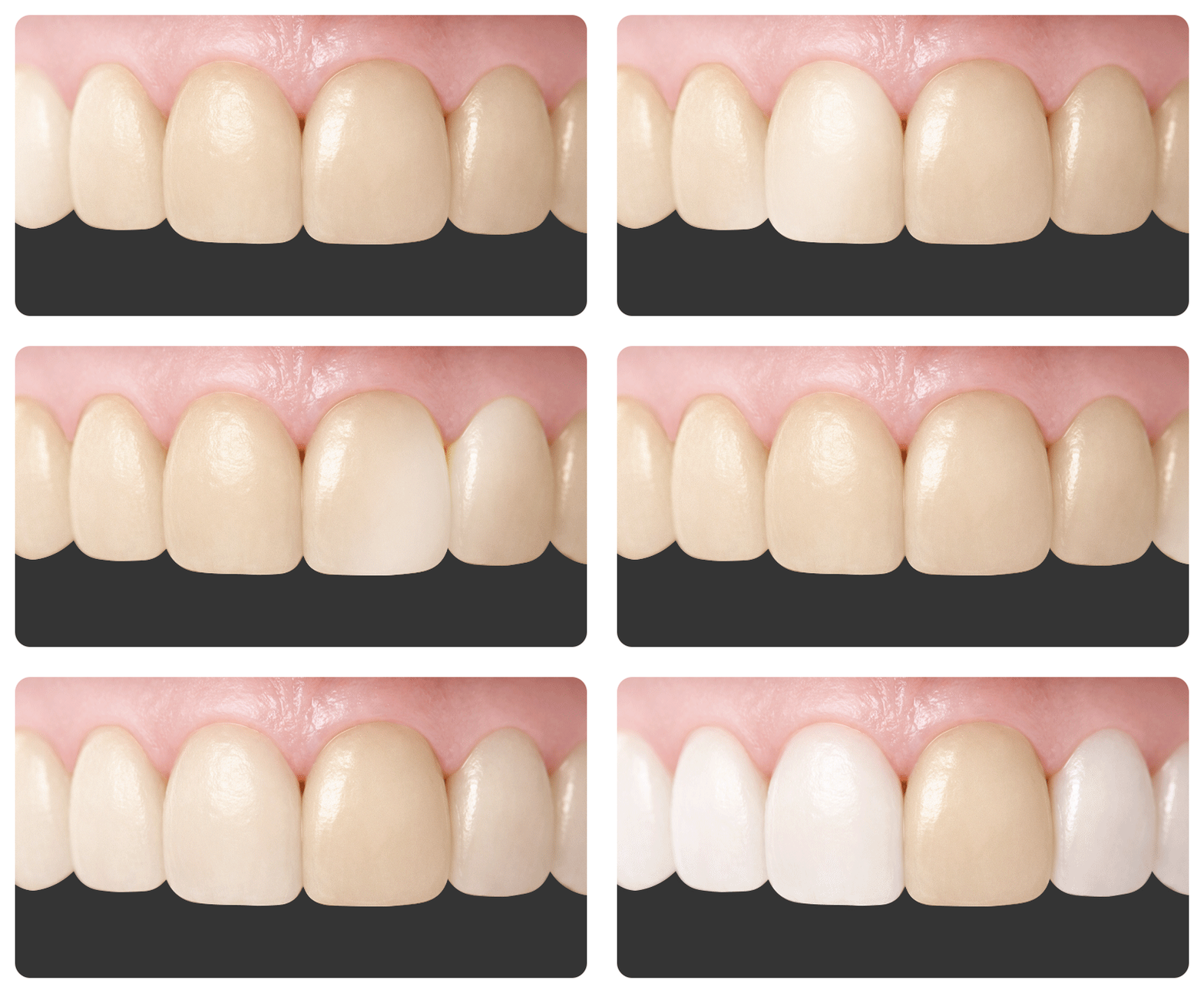
Some people think, “If it got darker, wouldn’t teeth whitening make it whiter too?” In conclusion, standard whitening procedures do not work on veneer.
Whitening agents penetrate the microscopic tubules of natural teeth (dentinal tubules) and break down pigments. But veneer has a smooth, dense ceramic surface, so whitening agents cannot penetrate.
If whitening is done anyway, only the surrounding natural teeth become brighter, and a “color contrast” can occur where the veneer looks relatively more yellow or darker. This is especially noticeable when only some front teeth have veneer, so caution is needed.
Therefore, if you want to brighten the tone of a veneer, the approach should not be chemical bleaching, but rather physical cleaning and gloss restoration.
3.Conditions for restoring the “original shine” with scaling and polishing
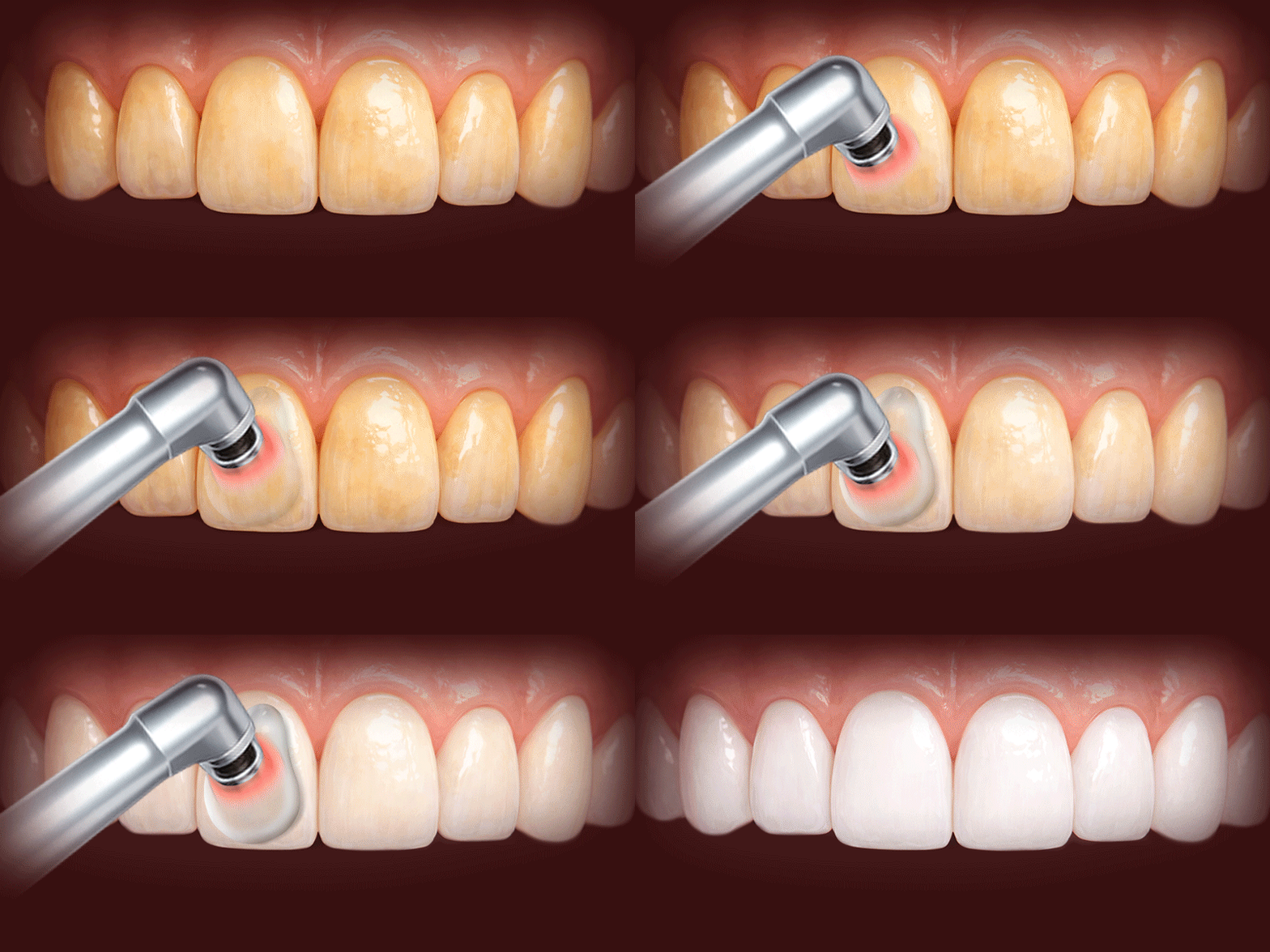
The treatment that corresponds to “wiping the window” is professional cleaning and polishing (Polishing).
This process removes fine pigments attached to the veneer surface and smooths a
roughened surface to increase light reflectivity. When the surface becomes smoother, light passes through more cleanly, creating a clearer and brighter appearance.
However, polishing is not effective in every case. Please check which category your current condition falls into.
| Category | Surface Discoloration (Resolvable) |
Internal Damage (Limitations Exist) |
|---|---|---|
| Symptoms | Overall dullness and lack of luster | Dark gumline or only specific areas are dark |
| Causes | Coffee, smoking, micro-scratches | Adhesive discoloration, prosthesis fracture, internal tooth decay |
| Solution | Professional polishing & scaling | Replacement or repair required |
If surface staining is the main cause, professional polishing can help restore a brighter, cleaner impression.
That said, if scratches are too deep or the veneer has become thin, excessive polishing may shorten the lifespan of the restoration. In such cases, it’s important to discuss supportive options—such as surface-protective coatings—with your clinician and decide carefully.
4.When polishing doesn’t work and you should consider “replacement”
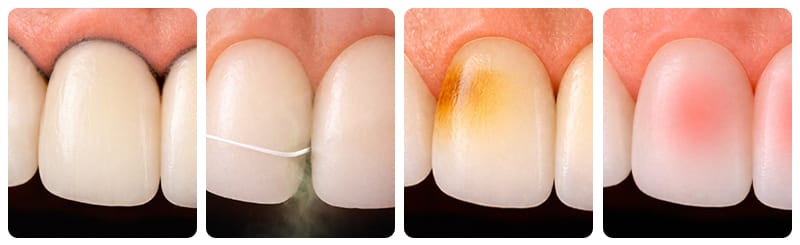
If a window doesn’t get clean no matter how much you wipe the outside, the silicone between the glass and the frame may be contaminated—or there may be a problem inside the glass. Similarly, when internal factors are the cause, surface care alone has limitations.
A common example is yellowing of the adhesive (resin cement). In cases treated in the past, the adhesive can yellow over time, and the color may show through a thin veneer. Also, if the margin between the veneer and the gumline lifts and staining progresses through the gap, leaving it untreated may lead to cavities underneath, so careful monitoring is needed.
✅Signs you should consult about re-treatment (replacement)
- A black line or gap is visible at the boundary between the gums and the tooth.
- Floss catches around the restoration or there is an odor.
- Even after scaling, the dark color of a specific tooth does not disappear.
- You feel pain or sensitivity from inside the veneer.
If these internal factors or structural leakage are confirmed, removing the existing restoration and remaking it may be a more fundamental solution for dental health than polishing. However, depending on the condition, partial repair may be possible—so a detailed examination should come first.
5.If you want it to last longer, why “low-abrasion” is better than “whitening toothpaste”
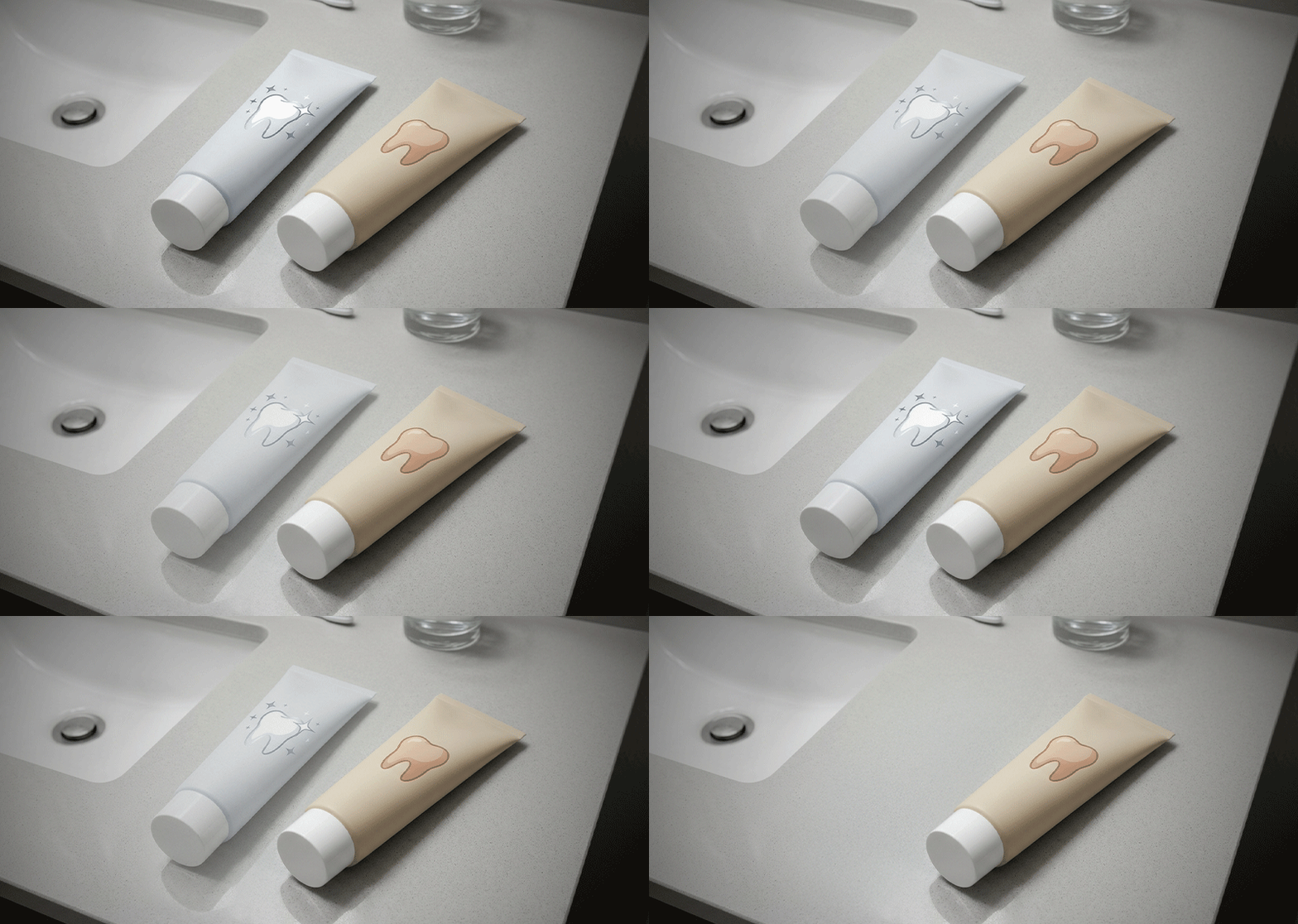
Some people use strongly “whitening” toothpastes or charcoal toothpastes because they want to keep their teeth as bright as possible after treatment. However, this can work against veneer surface maintenance. Some whitening toothpastes contain a higher amount of coarse abrasive ingredients designed to scrub the tooth surface. Strong abrasives can create invisible micro-scratches on the veneer surface, allowing pigments to penetrate more easily. In other words, trying to clean more aggressively can actually create a surface that stains more readily.
Therefore, after veneer treatment, it’s advisable to use a low-abrasion toothpaste and choose a soft-bristled toothbrush. It’s the same principle as maintaining a window: you preserve clarity longer by wiping with a soft cloth rather than a rough scouring pad.
6.Frequently Asked Questions (FAQ)
Q. When can polishing (surface gloss restoration) solve the problem?
Surface stains from coffee or tea, reduced gloss, and fine superficial scratches often improve well with polishing. However, deep scratches, chipping/fracture of the restoration, and internal discoloration are not targets for polishing.
Q. My veneers are old and look yellow—will scaling alone make them bright again?
If the issue is simple tartar buildup or food-related staining, scaling and polishing can make them look much brighter. But if the cause is adhesive discoloration or an internal issue, scaling is unlikely to produce meaningful color change.
Q. If I whiten my teeth, will my veneers brighten too?
No. Veneer (ceramic) does not respond to whitening agents. Whitening can brighten only the surrounding natural teeth, making the veneer look relatively darker—so proceed only after consulting your clinician.
Q. I see a black line along the gumline—do I need replacement?
A black line may be a sign of gum recession exposing the root, or staining developing in a gap at the bonded margin. A very small gap may be repairable, but if there is a risk of secondary cavities, replacement may be necessary.

To resolve concerns about veneer color, you need to start by accurately understanding the current condition of your teeth.
Your response should be completely different depending on whether the discoloration is surface staining or an internal issue involving the adhesive or the tooth underneath. If it’s a surface issue, polishing and proper brushing habits may help you regain a brighter impression. On the other hand, if it’s an internal issue, it may be time to consider replacement or repair to prevent more serious damage.
Just as cars benefit from periodic polishing, veneer can also maintain a clean appearance longer with professional checkups and maintenance.
Sources
- Korea Disease Control and Prevention Agency (KDCA), National Health Information Portal: information on dental prosthetic treatment and maintenance, 2024.
- Korean Academy of Esthetic Dentistry, Guidelines for maintenance and complication management of esthetic prostheses, 2022.
- Haralur et al., Effectiveness of porcelain polishing methods on surface roughness and color stability, Materials, 2023.
※ The copyright for all content on this blog belongs to medihi. Unauthorized copying, distribution, or derivative use is strictly prohibited, and violations may result in legal action without prior notice.
Recommended reads
 medihi