

To restore aesthetics naturally during veneer re-treatment without damaging the underlying natural tooth, this post outlines the key clinical criteria from a medical perspective.
“Will replacing my veneer damage my original tooth?”
“I’m worried it might look very unnatural.”
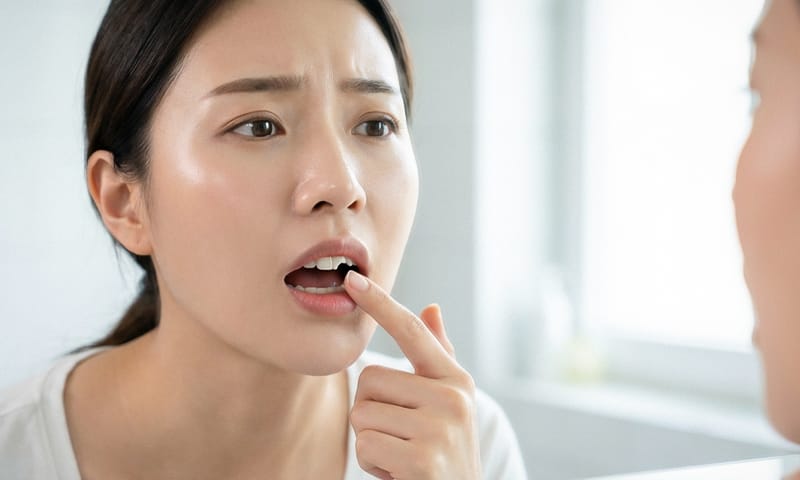
Many people preparing for veneer replacement worry about damage to the natural tooth and an unnatural look. If you previously experienced an unsatisfactory outcome, these concerns are understandable.
However, re-treatment is not a simple “restoration” back to the pre-treatment state. It is a process of “redesigning” the safest and most aesthetic structure based on the current condition of the remaining tooth. With the right removal approach and material selection, it may be possible to reduce additional tooth reduction while still aiming for a natural-looking result.
When clinicians plan re-treatment, the top priority is not the “outer appearance,” but rather assessing the condition of the natural tooth under the restoration and identifying the cause of failure—so the remaining natural tooth can be preserved as much as possible. If the underlying problem is not addressed, the same issue is likely to recur even after placing a new restoration, which is why identifying the true cause matters.
1. A simple fracture? Finding the “real cause” that determines whether re-treatment is needed
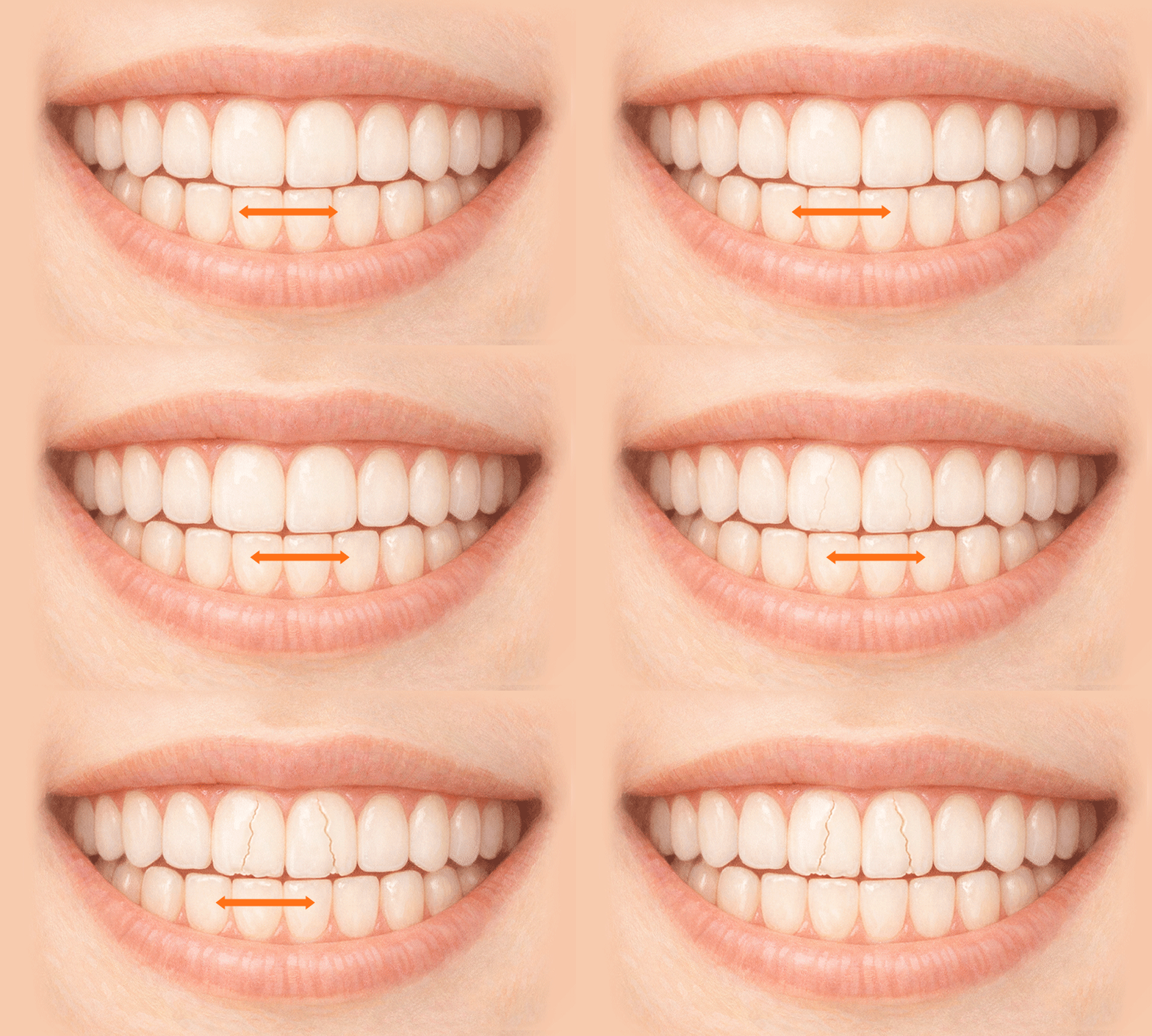
A restoration breaking or coming off may be a one-time accident, but it can also indicate a structural issue in the oral environment. Let’s understand veneer treatment using the analogy of “wallpapering.”
When wallpaper tears, you need to check whether the paper itself is old—or whether moisture (inflammation) has built up inside the wall, or the building is shifting (occlusal interference), causing it to tear. If you apply new wallpaper without knowing the cause, it can tear again easily.
If the same tooth keeps breaking repeatedly, teeth grinding (bruxism) or strong bite force may be the cause. Research suggests that strong occlusal forces are a major factor that increases the risk of restoration debonding. In such cases, beyond simply switching to a stronger material, a protective device worn during sleep (a splint) or occlusal adjustment may also be considered. In other words, re-treatment should not be just a replacement—it should be a process that improves the overall oral environment.
2. If the gumline looks dark: why periodontal management should come first
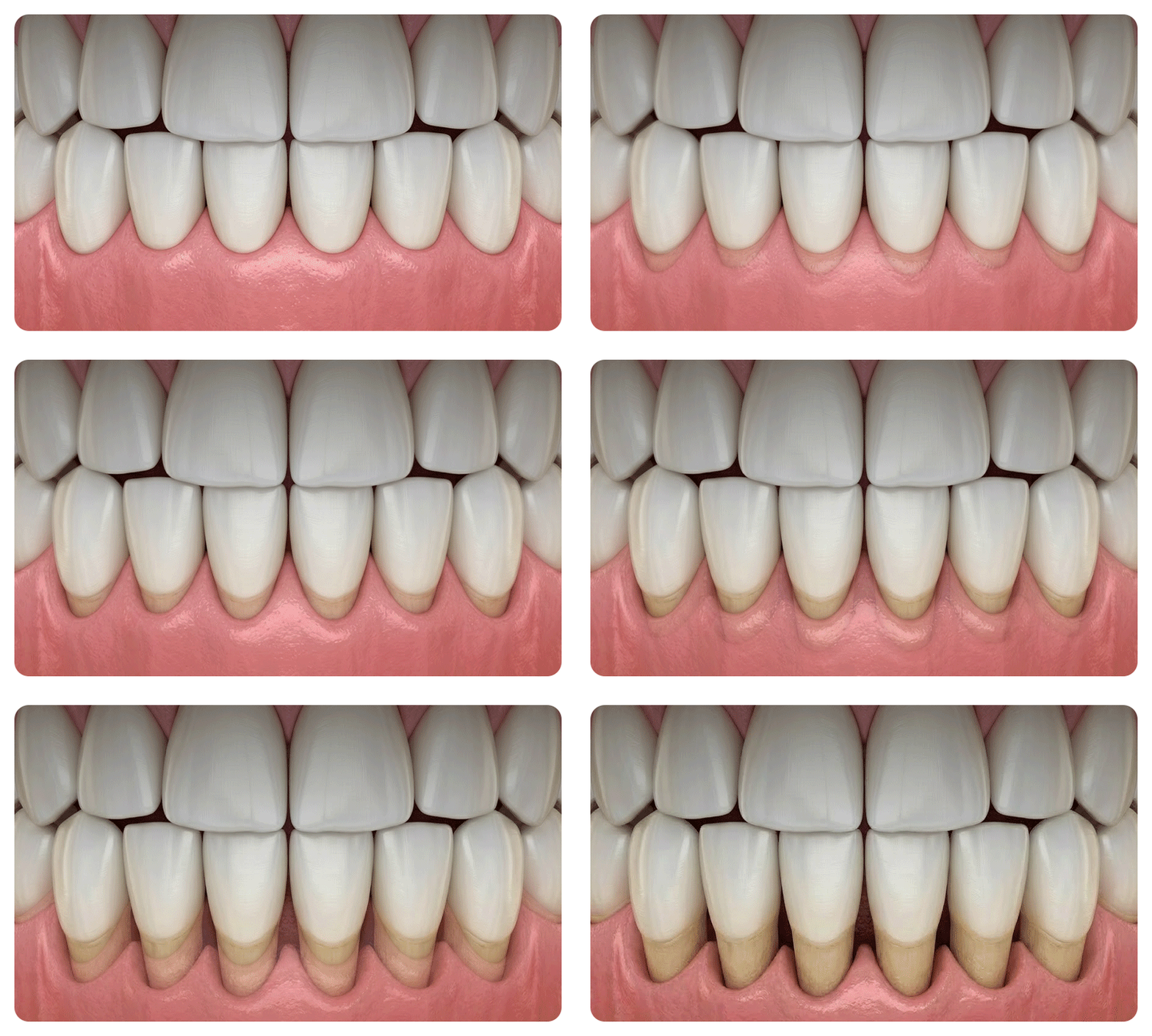
Before re-treatment, some patients notice that the border between the veneer and the gums has turned dark, or the gumline looks red and swollen. This is often not simple discoloration—it may indicate gum recession exposing the root surface, or chronic inflammation caused by the restoration margin irritating the gums.
Even if a building is strong, if the foundation collapses the house will tilt. Likewise, replacing only the restoration when the gums are unhealthy is unlikely to solve the problem. In these cases, gum treatment should be performed before re-treatment.
After inflammation is controlled and the gumline stabilizes, impressions should be taken so the restoration can fit closely without lifting at the margin. If recession is extensive, additional treatment such as gum grafting may be considered depending on the clinician’s diagnosis.
3. Key techniques to prevent “tooth damage” when removing an existing restoration
The biggest reason many people hesitate about re-treatment is fear of the “removal process.” If additional tooth structure is removed during removal, it can place extra burden on the tooth over time.
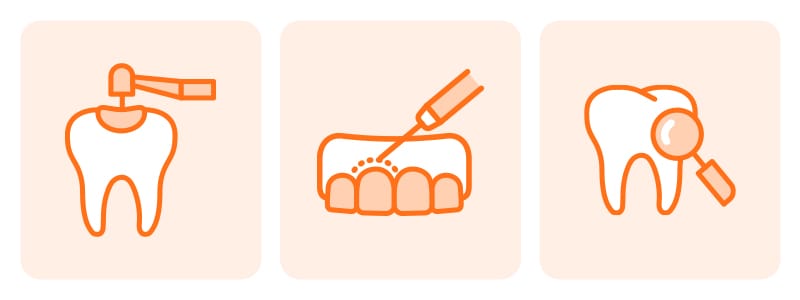
As in the earlier analogy, the key skill is removing old wallpaper without pulling off the cement wall (the tooth) underneath. Depending on the patient’s condition, clinicians may selectively use tools such as the following.
| Category | Features & Applications | Remarks |
|---|---|---|
| Dedicated Bur | Uses rotational force to precisely grind down prostheses | Most standard removal method |
| Laser | Weakens the adhesive layer to induce detachment | Not applicable to all materials (auxiliary method) |
| Magnifying Loupe | Enlarges the boundary between tooth and prosthesis to secure field of view | Important for precise removal |
What matters most is not “removing it quickly,” but “reducing tooth reduction even if it takes more time.” Lasers and magnification are tools that can help, but the clinician’s experienced judgment is the most important factor.
✅Pre-removal checklist
- What equipment do you use to minimize reduction of my natural tooth?
- Do you use magnifying loupes or a dental microscope when removing an existing restoration?
- How do you manage potential sensitivity that may occur during the removal process?
4. A detached piece: conditions for rebonding vs conditions requiring a new restoration
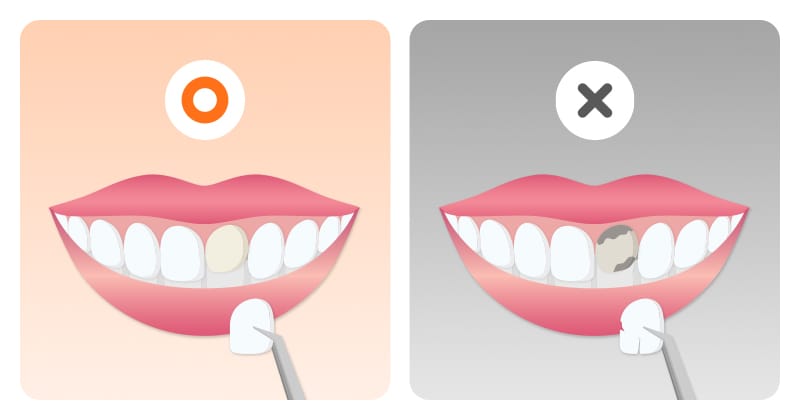
During re-treatment, it’s natural to worry about the financial burden of making a new restoration. However, it is not always necessary to remake it at a high cost. Depending on the situation, “rebonding” may be possible—re-attaching the existing restoration.
The deciding factors are whether the restoration is fractured and whether the tooth is contaminated. Use the table and example conditions below to review your oral status and check whether rebonding may be possible.
| Category | Status (Condition) | Recommended Action |
|---|---|---|
| Reattachment Possible | • Prosthesis detached intact without breaking • No decay inside the tooth |
Visit dental clinic for re-cementation (Store existing prosthesis in moist gauze) |
| Replacement (Remaking) | • Prosthesis chipped or cracked • Decay visible on the detached tooth surface |
Discard existing prosthesis, treat decay, and fabricate a new prosthesis |
- If the restoration is intact and there is no cavity
Rebonding may be advantageous. If the restoration has not deformed and the fit to the tooth remains accurate, it may be reused after cleaning and surface treatment.
- If it is fractured or there is decay underneath
Remaking is safer. Forcing a fractured surface to bond can allow bacteria to penetrate through gaps and lead to bigger problems.
5. How to eliminate a “thick and opaque look” and restore translucency
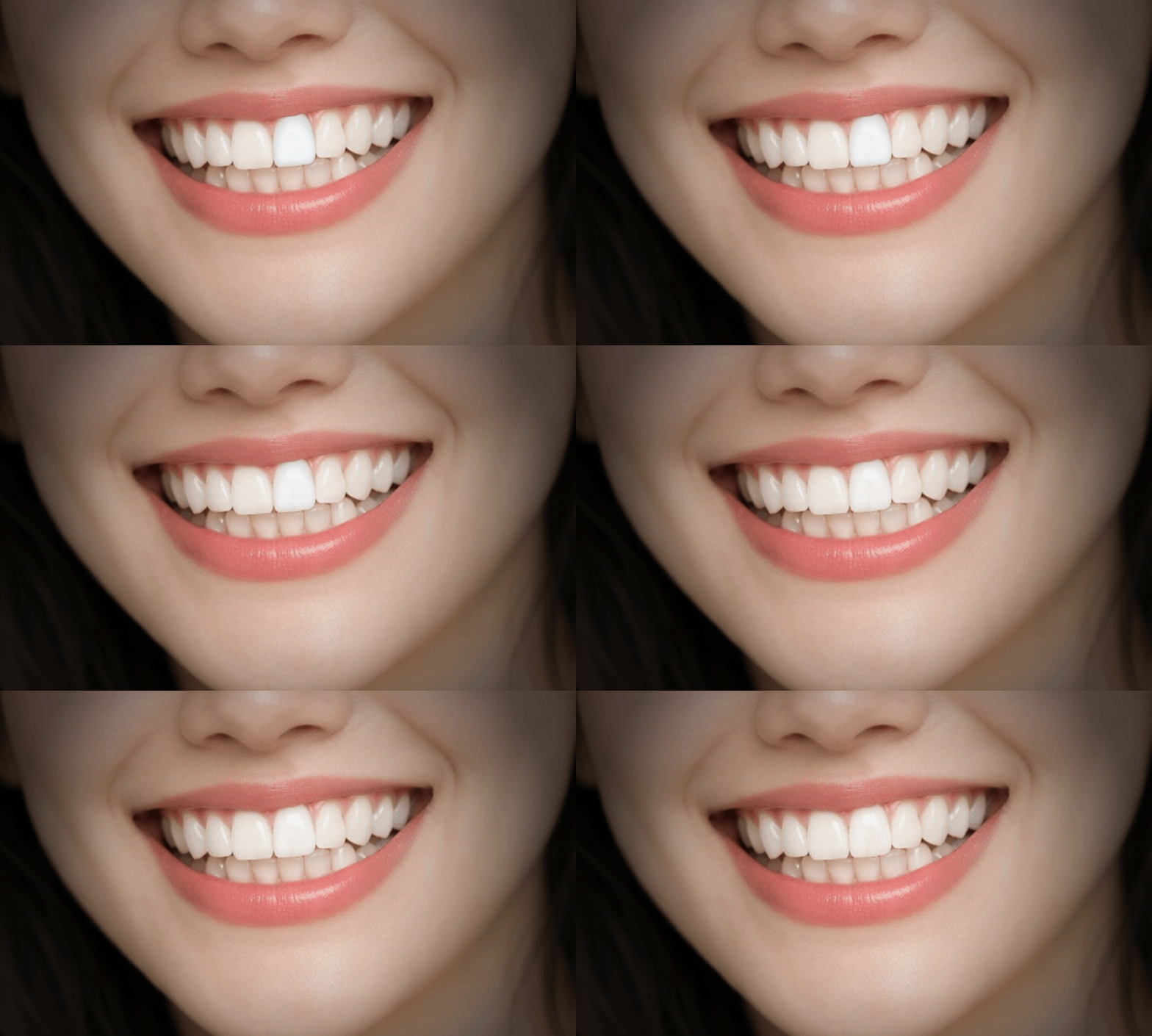
“My old veneer looks too thick and dull.” This is a common aesthetic complaint among people who decide on re-treatment.
This often happens when a “no-prep” approach was applied too aggressively in the past to avoid tooth reduction, or when a low-translucency material was used. It’s like placing thick tiles on top of a thin surface—everything can look bulky and heavy.
To restore natural thickness and translucency, two approaches are needed.
First, measure how much your natural tooth protrudes and secure the minimum space required. Not reducing the tooth at all is not always the right solution. Adequate space is necessary for the restoration to seat thinly.
Second, choose newer ceramic materials with improved translucency. This can help restore aesthetics so that when light passes through, the boundary between the restoration and the natural tooth is less noticeable.
✅Aesthetic recovery checklist
- Have you confirmed whether the “thick look” is due to tooth protrusion?
- Have you seen a sample to check whether the material’s translucency is similar to natural teeth?
- Have you reviewed the design to ensure the gumline and tooth proportions look harmonious when you smile?
6.Frequently Asked Questions (FAQ)
Q. My veneer fell off—can I glue it back on?
You should avoid using household instant glue. It can be toxic and may contaminate the tooth surface, making proper rebonding at the dental clinic more difficult later. It’s best to store the detached restoration in wet gauze or a small container to prevent breakage and bring it to the dentist.
Q. Will my teeth be very sensitive after re-treatment?
During the procedure, anesthesia is used to control pain, which can reduce major discomfort. However, you may still feel vibration or pressure during removal. After treatment, temporary sensitivity can occur as the tooth becomes more reactive, but it often improves over time. If symptoms persist, you should consult your clinician.
Q. Are there cases where I should switch to a crown instead of a veneer?
Yes. If repeated re-treatment has left insufficient tooth structure, or if the fracture is extensive and a veneer alone may not be stable, a crown that covers the entire tooth may be a safer option. This choice is intended to protect the tooth and reduce the risk of further fracture.
Q. When should I visit a clinic for a re-treatment consultation?
It’s a good idea to get evaluated if you notice cracks, partial detachment, swollen or bleeding gums at the margin, or a dark shadow near the restoration. Even without pain, cavities can progress through gaps around the restoration, so if you notice visible changes, an earlier check-up is recommended.

The core of veneer re-treatment is not simply getting “new teeth,” but resolving problems from the previous treatment and helping extend the life of your natural teeth.
First, it is important to be diagnosed for the exact reason the restoration came off or fractured (occlusion, gums, bonding, etc.). Replacing it without addressing the cause can lead to another cycle of re-treatment.
Second, during consultation, consider asking your clinician specific questions about how they plan to preserve your natural tooth structure.
Third, remember that gum health and hygiene management can significantly affect re-treatment outcomes—just as much as aesthetic improvements.
Your current discomfort can become an opportunity to care for your teeth more healthfully. With careful diagnosis and planning, we hope you can regain a smile that is healthy on the inside as well as natural-looking on the outside.
Sources
- Korea Disease Control and Prevention Agency (KDCA), National Health Information Portal, Dental Prosthetic Treatment Guide, 2024.
- Korean Academy of Prosthodontics, Patient Guide to Dental Prosthetic Treatment, 2023.
- American Dental Association (ADA), Veneers (Consumer Information), 2023.
※ The copyright for all content on this blog belongs to medihi. Unauthorized copying, distribution, or derivative use is strictly prohibited, and violations may result in legal action without prior notice.
Recommended reads
 medihi