

With a lumbar disc herniation, the tests you may need and the step-by-step treatment plan can differ depending on how pain and tingling travel down the leg. Before undergoing indiscriminate imaging or procedures, take a moment to confirm a reasonable treatment direction that fits your current condition.
“Every time I sneeze, it feels like electricity shoots all the way down my leg. Could this be a disc problem?”

This is a symptom commonly reported by people who spend long hours sitting for work. If simple low back pain is followed by a sharp, electric sensation that shoots down the leg whenever you sneeze, daily discomfort—and anxiety—can understandably increase.
In the clinic, the first thing we check when evaluating patients like this is not “How much does your back hurt?” A key clue is whether pain, tingling, reduced sensation, or weakness travels downward along the nerve distribution—from the buttock to the thigh, calf, and foot. Through this article, you can review the possible causes of that “electric” pain down the leg and learn safer criteria for deciding what to do next.
1. When your back hurts less but your leg feels numb: clues that suggest radiating pain
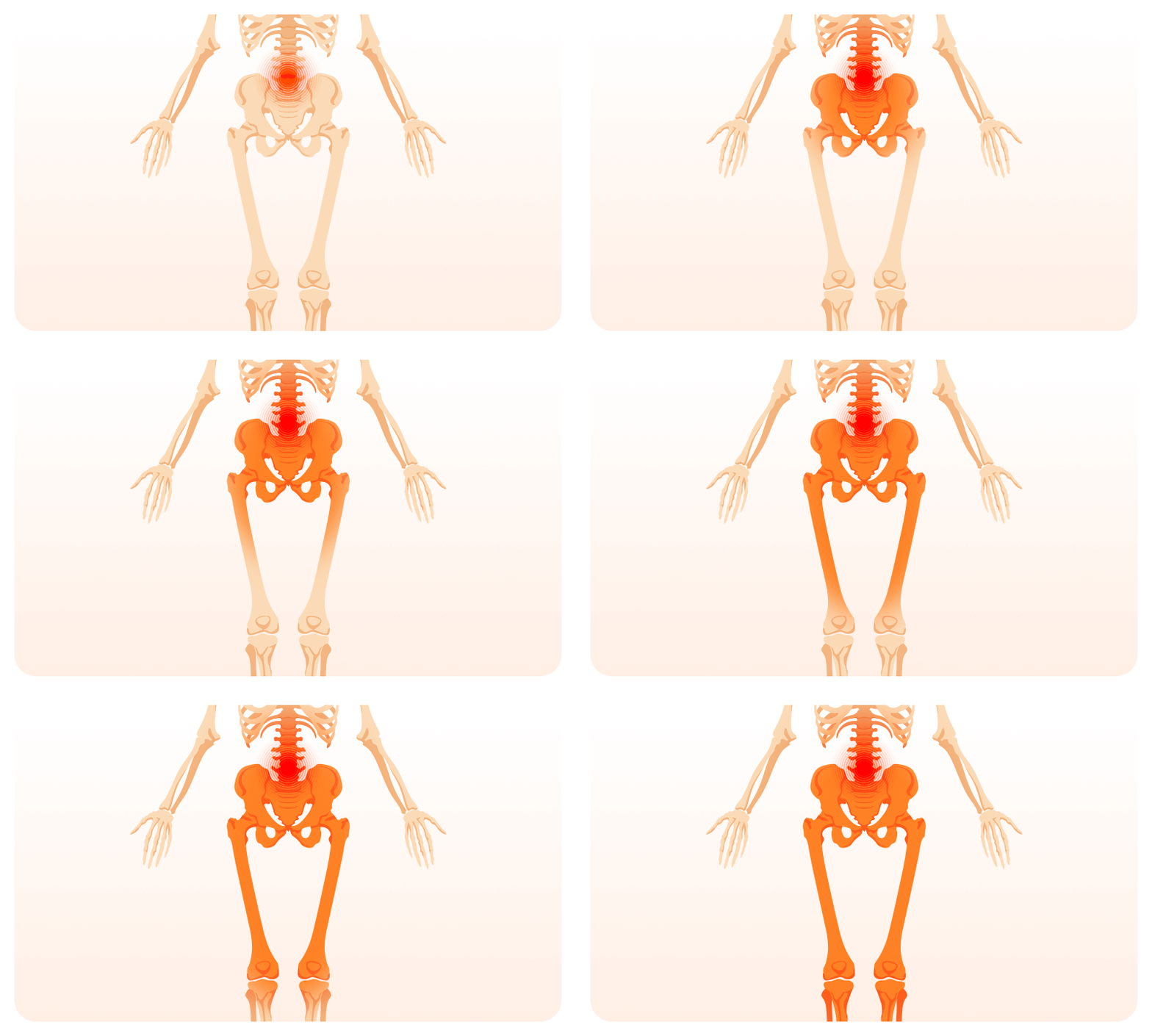
Radiating pain from a disc (pain spreading outward from the low back) is often
misunderstood as a condition where severe low back pain is the main feature. In real clinical practice, however, even when low back pain is relatively mild—or almost absent—radiating pain down the leg can be much more prominent. This is especially common among people who sit for long periods, such as office workers, who often come in saying, “My back is fine, but my calf or the top of my foot feels intensely numb or tingly.”
The spinal nerve system is like a large electrical wiring network. If the low back is the main breaker panel, the sciatic nerve branching from it is like a long wire running down the leg to the toes. When a lumbar disc shifts out of place and bulges or herniates, it can physically compress that “wire” or trigger a chemical inflammatory response. In that case, symptoms may show up less in the low back and more as tingling or numbness where the nerve is “in contact”—the buttock, back of the thigh, calf, and toes.
If only the muscles around the low back feel stiff, heavy, or sore, a non-nerve cause such as muscle strain or ligament issues is more likely. But if sharp tingling, numbness, reduced sensation, or weakness accompanies symptoms down the leg, the situation is different. At that point, it becomes very important to perform a careful nerve root assessment. Rather than lumping everything together as “my leg hurts,” it helps greatly to write down specifically where the symptoms start and how far down they travel.
2. Why sneezing can send a jolt down your leg (everyday triggers)

Pain that suddenly spikes with sneezing or coughing does not automatically confirm a specific spinal disorder. However, if you are experiencing disc-related radiating pain, symptoms down the leg often become more noticeable in moments when you strongly brace your abdomen—such as during coughing or sneezing. This can happen because increased intra-abdominal pressure raises pressure within the spinal canal, and an already sensitive nerve root may react to that added pressure and “declare itself.”
If you sit in front of a monitor all day, pay close attention to how your body feels when you stand up after prolonged sitting. Noticing that your leg becomes more numb or achy than usual after maintaining a slouched seated posture for a long time is an important clue.
To keep the spine—your “main breaker panel”—aligned and to help prevent symptom flare-ups, it’s helpful to stand up at least once every 50 minutes, walk briefly, or do gentle stretching that extends the spine.
✅ Everyday trigger checklist
- When you cough or sneeze, a sharp tingling sensation shoots down into the leg
- When you stand up after sitting for a long time, your calf or foot feels more numb than usual
- The longer you sit, the more one leg feels tight, pulling, or achy
- Discomfort in the leg feels more significant than pain in the low back itself
3. Nerve root clues based on where your toes feel numb
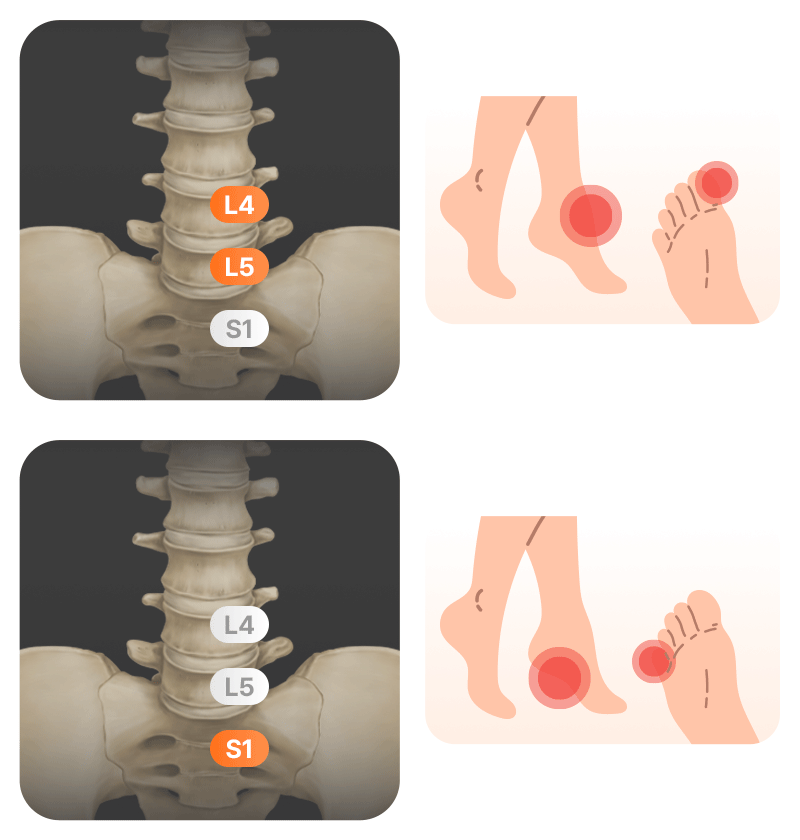
When discussing radiating leg pain or toe numbness, identifying “exactly where it feels numb” is very important in the diagnostic process. If a specific nerve is irritated due to a lumbar disc herniation, the symptom location can be closely related to the corresponding nerve root.
For example, if the main tingling is felt on the top of the foot or around the big toe, it may suggest an issue involving the L4 or L5 lumbar nerve roots in the lower spine. On the other hand, if sensation feels dull or blunted on the sole of the foot or around the little-toe side, compression of the S1 nerve root (near the sacral area) may be considered. A band-like radiating pathway—starting deep in the buttock, running along the back of the thigh, and traveling down the outer calf—is also clinically meaningful information.
In the exam room, clinicians do not ask only about pain intensity. They also check which areas feel different from usual and the specific route along which numbness spreads. Rather than saying “my whole leg hurts,” a concrete note like “it feels numb along the side of my calf down to my big toe” provides a much clearer basis for pinpointing a nerve-related problem.
4. When is an MRI needed for lumbar disc symptoms? Screening criteria
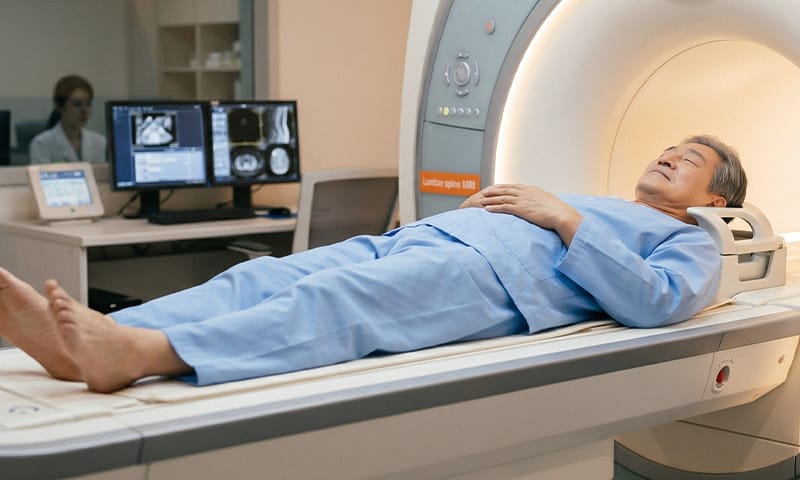
If leg numbness appears intermittently and you can still walk and manage daily life without major difficulty, it is generally reasonable to start with conservative treatment and monitor progress. Imaging is not meant to be used indiscriminately “just to check.” It is more like a high-performance camera used to find evidence when a clinician needs to change the treatment strategy.
In contrast, if you develop changes in bladder or bowel function, or warning signs such as the leg giving way and difficulty lifting the ankle or toes, and if sensory loss becomes more distinct or new weakness appears, you should be evaluated promptly. In such cases, structural confirmation—including imaging when needed—should be carried out without delay.
✅ Signs that may require MRI and urgent evaluation (red flags)
- New changes in urination or bowel movements, or numbness around the perineal/saddle area
- Noticeable loss of strength when walking, such as difficulty moving the ankle or toes on your own
- The area of reduced sensation keeps expanding, or pain makes daily life and sleep impossible
5. From conservative care to surgery: when should the strategy change?

When severe pain hits the low back and leg, it’s easy to assume you must lie flat in bed to recover. However, staying in bed excessively can actually reduce essential core strength needed to support the spine, making long-term functional recovery slower. Except for a few days in the acute phase when pain is truly intolerable, a shared global principle of conservative care is to maintain everyday activity within what you can tolerate. Continuing conservative activities such as walking or gentle stretching for about 6–12 weeks can be very helpful for functional recovery.
If acute radiating pain is so severe that you cannot even begin light rehabilitation or walking, acupuncture and pharmacopuncture may be considered. These are conditional options aimed at short-term pain relief by reducing the chemical “inflammatory spark” around the nerve, with the main goal of calming symptoms enough to create a foothold for returning to daily activity and exercise.
On the other hand, if you have diligently completed a sufficient period of non-surgical treatment but functional decline remains significant—and imaging findings match your real symptoms—then it may be safer to cautiously pursue a surgical evaluation. This is a surgical approach that directly relieves a strongly compressed “wire,” and it should be preceded by in-depth coordination with your medical team.
6. Frequently asked questions (FAQ)
Q. If I have leg numbness, should I get an MRI right away?
A uniform recommendation for immediate advanced imaging from the very beginning is not typically made. If you can manage daily life, conservative treatment is usually tried first while monitoring progress. However, if warning signs such as bladder/bowel control problems or severe muscle weakness are present, you should promptly receive medical evaluation and imaging confirmation.
Q. If my back feels fine but only my calf and foot are numb, could it still be a disc problem?
Yes, it can. If a bulging or herniated disc compresses or inflames the nerve root going to the leg, tingling around the buttock, calf, and toes connected to that nerve can be more prominent than low back pain itself.
Q. How long is conservative treatment usually tried?
In general, it is continued consistently for about 6–12 weeks while observing functional changes. During this time, it is important to maintain daily activity within a tolerable range without overdoing it. Regular walking or gentle movement can support recovery more than excessive bed rest.
Q. What symptoms mean I should not delay seeing a clinician?
If your leg feels weak enough to make walking difficult, or if sensation becomes noticeably dull, a professional evaluation is needed. In particular, if you develop changes in urination or bowel movements along with numbness around the perineal area, it may be an emergency warning sign (possible cauda equina syndrome), so it is advisable to seek medical care as quickly as possible.

Putting everything together, if you are dealing with disc-related radiating pain, try to remember these three criteria.
First, lumbar disc symptoms are judged more importantly by nerve-related symptoms spreading down the leg (tingling, reduced sensation, etc.) than by simple low back stiffness.
Second, rather than rushing into imaging unconditionally, use warning signs such as muscle weakness as screening criteria to decide the timing.
Third, conservative treatment for 6–12 weeks is the main foundation, but depending on progress, the strategy may shift to injections or a surgical evaluation.
Sudden leg numbness and electric-like pain can be alarming. But if you understand the nerve signals your body is sending and take a step-by-step approach, you can make more reasonable choices and work toward regaining everyday comfort.
Sources
- National Health Information Portal (Korea), disease information on lumbar disc herniation
- Kim et al. Trends in lumbar disc herniation surgery using HIRA claims data. BMC
Musculoskeletal Disorders. 2024. - NICE. Low back pain and sciatica in over 16s (NG59). 2020.
※ The copyright for all content on this blog belongs to medihi. Unauthorized copying, distribution, or derivative use is strictly prohibited, and violations may result in legal action without prior notice.
Recommended reads
 medihi