

This post explains—in simple terms—why neurogenic claudication caused by lumbar spinal stenosis tends to worsen with walking and improve when bending forward. It also organizes essential patient guidance, from practical MRI interpretation principles that help set a treatment direction, to when surgery may be considered, and the high-risk warning signs that require urgent evaluation.
“Even after just 5 minutes of walking, my legs hurt so much that I end up sitting down right on the street.”

Many older adults experience a drop in quality of life and begin avoiding going out because of this pain, yet they often dismiss it as a natural part of aging. However, leaving it unaddressed can allow anxiety and discomfort to grow over time, so it is advisable to receive a thorough evaluation from a medical professional.
In the clinic, what a spine specialist checks first is not only X-rays or MRI images. They carefully observe the patient’s gait—from the moment the patient opens the door to the moment they sit down. Then, taking a history by asking, “How far can you walk before the pain starts and makes you stop?” becomes the first key step in planning treatment.
1. Why bending forward feels better: it’s not just a posture issue
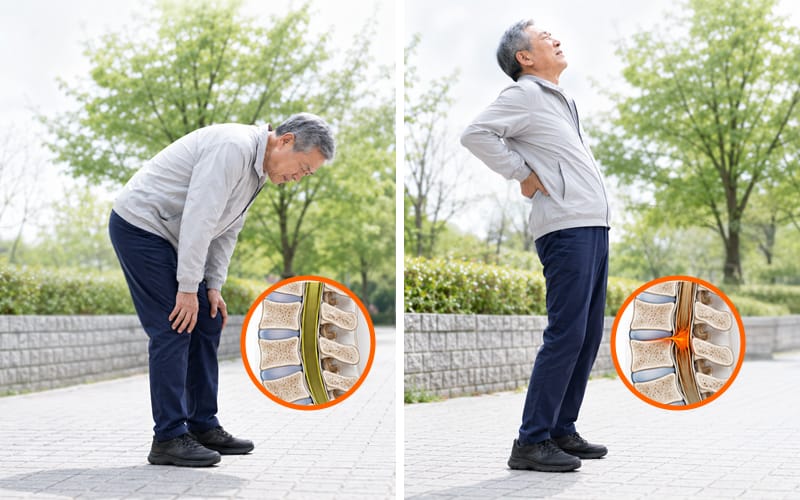
Inside the spine, there is a passageway through which many nerves travel from the brain down to the legs. As we age, bones around the spine may overgrow or ligaments may thicken, reducing the space available for nerves to pass. This state—where neural structures are compressed due to a narrowed passage—is called lumbar spinal stenosis.
To understand the mechanism, it helps to imagine the spinal canal as a “hallway people walk through,” and the nerves as “people moving through that hallway.” When the hallway becomes narrow, people are more likely to bump into things as they pass. When we stand or walk, the lower back naturally straightens, and with that postural change, the “hallway” (the nerve passage) tends to have even less spare room. As a result, signals that should travel to the lower body are disrupted, leading to leg numbness and sharp, radiating pain.
So what happens when the pain becomes severe while walking and you bend forward deeply or squat down? The narrowed hallway temporarily opens up, giving the nerves a bit more room—almost like they can “breathe” again. That is why, when you sit on a bench and lean forward for a moment, your legs may start to feel lighter. This posture-related change—where symptoms improve because the space inside the spinal canal increases—can be an important clue pointing toward stenosis.
2. Leg numbness that makes you stop walking: how is it different from typical age-related
back pain?

When your legs feel numb and your back hurts, it is easy to assume it is simple muscle pain or a herniated disc. However, the signal sent by lumbar spinal stenosis often shows a clear contrast between rest and movement. A common feature of lumbar spinal stenosis is that pain is minimal when you are lying down watching TV or resting comfortably.
The problem becomes pronounced when you stand up and start walking. After walking a little, the calves and thighs can feel heavy, and you may end up repeating a cycle of walking and resting. This is medically referred to as “neurogenic intermittent claudication.” In contrast, typical age-related low back pain often does not settle quickly just because you change posture.
With neurogenic claudication, as described earlier, symptoms tend to ease within a relatively short time when you sit down and bend forward. For that reason, observing how your walking difficulty pattern is changing can provide useful diagnostic clues.
- Neurogenic claudication (suggestive of stenosis): When pain occurs while walking, symptoms improve quickly if you bend forward or sit down.
- Vascular claudication (consider vascular causes such as peripheral arterial disease): When pain occurs while walking, symptoms lessen even if you simply stand still and rest—without needing to bend forward.
✅ Three self-check observations you can do at home
- During one outing, how long can you walk comfortably without pain?
- When your legs start hurting while walking, do you feel better quickly if you squat down or bend forward?
- Is walking much easier when you lean on a cane or a walking aid (such as a stroller-style walker)?
3. If the MRI looks narrow, should you decide on surgery right away?
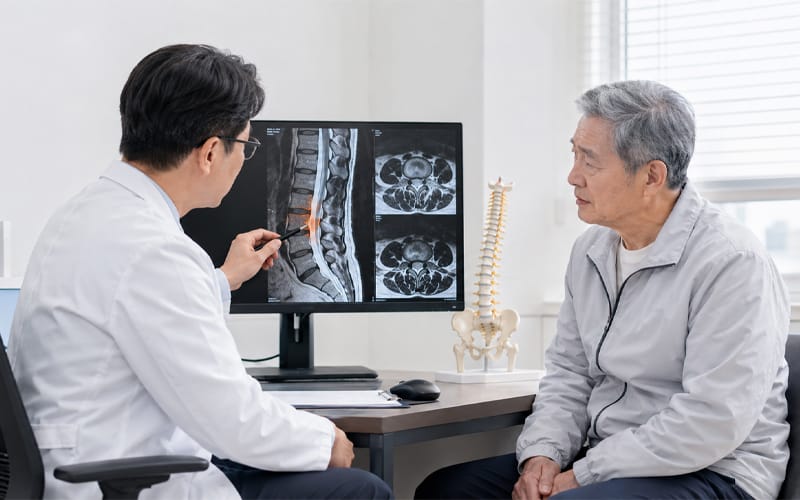
Hearing that the nerve passage is “almost completely blocked” on imaging can be
frightening, and it may make you feel as though you must immediately undergo major surgical treatment. However, even if stenosis appears severe on imaging, that does not automatically mean you are headed straight to the operating room.
A helpful analogy for checking your situation is this: “It looks narrow on imaging” is like a map. Meanwhile, “My legs go numb when I walk, and it improves when I rest or bend forward” is what is happening on the ground in real life. Clinicians place far more weight on how difficult walking is in daily life than on how intimidating the map looks.
Some people have a fairly narrowed nerve passage but still maintain daily activities and enjoy neighborhood walks. Others may have images that look less narrowed yet cannot walk even a short distance due to severe leg numbness. Ultimately, a clear treatment path emerges when the image (the map) aligns with the functional limitation the patient experiences (real life). Imaging is a reference compass; the degree of functional limitation that lowers your quality of life is the true standard that guides treatment decisions.
4. Conservative care vs. decompression surgery: what is the right timing for my situation?

Spine care is generally approached step-by-step, monitoring how the body responds, rather than aiming to achieve every result all at once. In general, if daily function is reasonably maintained and symptoms are manageable, “conservative treatment” is prioritized.
Conservative treatment is not only about reducing pain. It bundles walking exercise, physical therapy, rehabilitation, and lifestyle adjustments, focusing on restoring everyday function. If needed, injection-based treatments such as nerve blocks or medications may be used as supportive tools, helping you re-engage in rehabilitation exercises during periods when pain is reduced.
However, even with consistent conservative care, some people continue to have functional limitations that make even routine walking difficult. If neurological deficits—such as worsening leg numbness or decreasing strength—continue to progress, the decision-making changes. In such cases, the next step, including surgical options such as decompression that physically widens the “hallway,” is actively discussed with the medical team. Surgery is not simply something to avoid; it can be a reasonable option chosen at the appropriate time to help restore a patient’s disrupted daily life.
✅ Items that are helpful to tell your clinician during a visit
- Has the distance or time you can walk continuously without resting decreased compared with before?
- When pain worsens while walking, do symptoms settle if you sit on a bench or bend forward?
- Have you recently experienced episodes of your ankle or toes feeling weak, causing you to misstep?
5. Bowel/bladder changes and sudden leg weakness: when you should go to the hospital
without delay
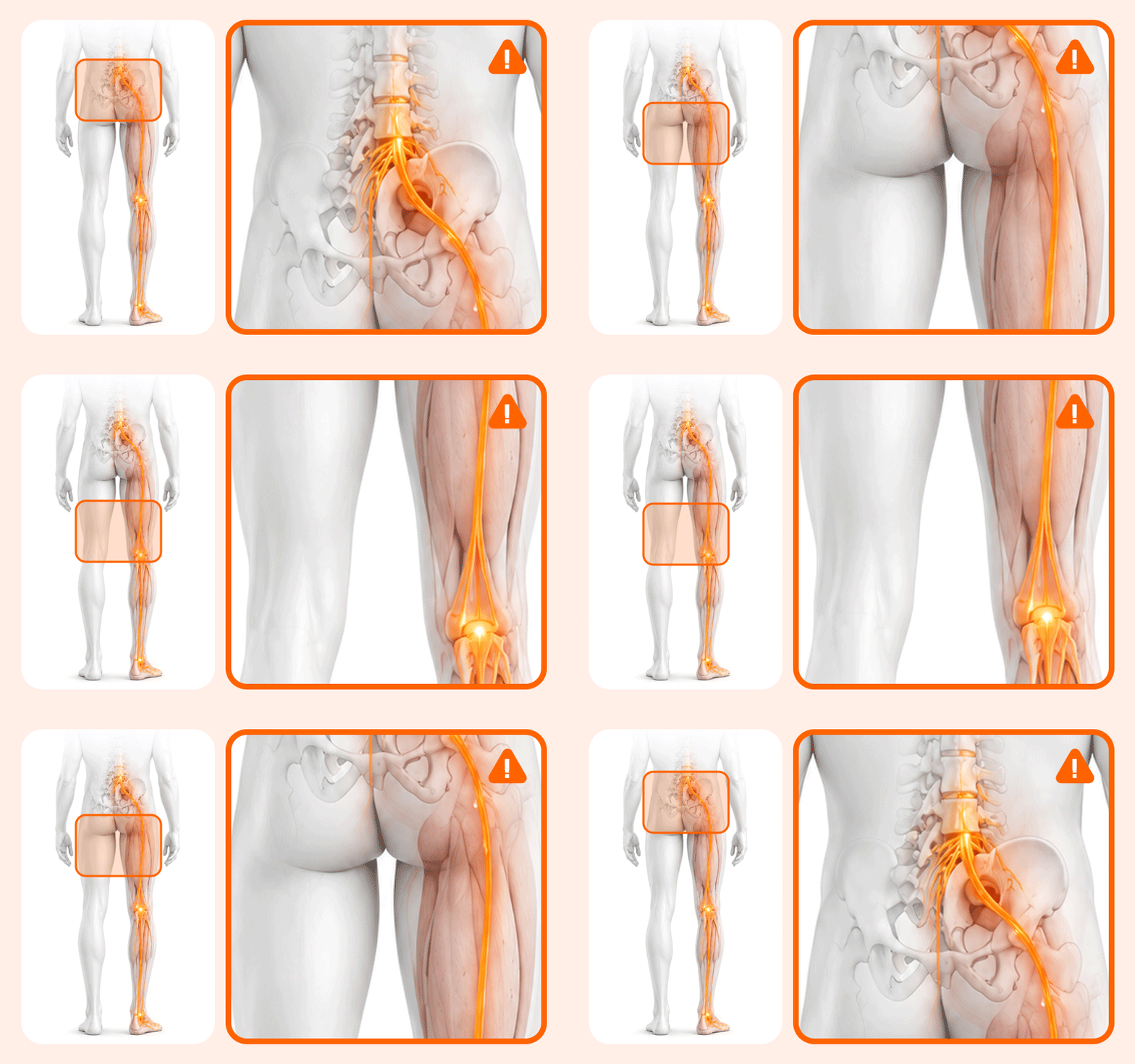
Most spine conditions are not immediately life-threatening emergencies. In many cases, it is reasonable to discuss options with a clinician and decide on a treatment direction over time. However, certain symptoms can be exceptional high-risk signals from the body and require special attention.
Sometimes, symptoms go beyond “difficulty walking,” and you may feel your ankle or entire leg repeatedly “give out,” making walking itself feel difficult. If, in addition, sensation around the buttocks or perineal area becomes dull (saddle anesthesia), and there are changes in the ability to control urination or bowel movements, this can raise concern for what is medically referred to as cauda equina syndrome.
If nerves are being severely compressed and sensation and strength are continuing to decline, prompt evaluation is needed regardless of how intense the pain feels. When these warning signs appear, you should seek assessment at a large hospital or specialized medical facility without delay to confirm the situation accurately. Rapid decision-making and evaluation can be important for prognosis. Simply being aware of these safety signals can help you prepare for unexpected situations.
6. Frequently Asked Questions (FAQ)
Q. If I have to rest because my legs hurt while walking, does that mean it is always stenosis?
Severe calf pain while walking can also occur with peripheral arterial disease (vascular claudication), where blood vessels supplying the legs become narrowed. With vascular causes, symptoms tend to improve just by standing still and resting, and bending forward does not typically make symptoms resolve faster. If pain relief is clearly linked to posture—such as improving when you bend forward or sit—then a nerve-related cause should also be evaluated.
Q. If I receive injection treatment, can I keep symptoms under control long-term?
Injection treatments such as nerve blocks can be a useful supportive option to calm inflammation around sensitized nerves and reduce pain in the short term. However, if stenosis is severe, the effect may be limited, and repeated steroid use requires consideration of potential side effects. Therefore, it is important to discuss with your clinician and use the pain-reduced period to focus on rehabilitation exercises that build walking capacity.
Q. Will minimally invasive surgery using an endoscope lead to better results?
Minimally invasive decompression using an endoscope or tubular approach may reduce damage to surrounding muscles and tissues, and reports suggest it may be associated with less bleeding or a shorter hospital stay in the short term. (However, this varies depending on the patient’s condition and indications.) That said, meaningful differences compared with conventional surgery in long-term functional improvement or reoperation rates have not been clearly proven, so the approach should be decided through discussion with the medical team based on the individual spine condition and indications.
Q. When should I hurry to seek medical evaluation and consultation for leg numbness?
If pain has noticeably shortened the distance you can walk at one time and it is interfering with daily life or going out, it is advisable to receive an overall evaluation. In particular, if functional deficits such as bowel/bladder changes, abnormal perineal sensation, or progressive lower-extremity weakness are present, you should not delay—seek care promptly to assess nerve status.

So far, we have reviewed the characteristic symptom pattern of lumbar spinal stenosis and the criteria used to decide on treatment tailored to the patient. For reasonable, safe care, please remember these three points.
First, if your leg pain improves when you squat down or bend forward after it starts while walking, this may be a clue of neurogenic claudication.
Second, even if MRI results (the map) look narrow, the more important standard for determining the treatment direction is your actual walking tolerance and functional limitation in daily life (the real-world situation).
Third, if daily life remains difficult even after sufficient conservative treatment, or if neurological deficits continue to progress, it is safer to discuss the next-step treatments—including surgery—with your medical team.
Rather than attributing everything to age and gradually losing the enjoyment of going out, carefully observe “how long you can walk before you must stop” and “which postures make you feel better.” Simply writing these down can greatly help clinicians create a clearer and safer treatment plan during your visit.
Sources
- Korea Disease Control and Prevention Agency (KDCA), National Health Information Portal: public health information on spinal stenosis, 2024
- Health Insurance Review & Assessment Service (HIRA), coverage criteria for procedures such as spinal fusion, 2024
- Bussières et al., Non-Surgical Interventions for Lumbar Spinal Stenosis Leading To Neurogenic Claudication: A Clinical Practice Guideline, The Journal of Pain, 2021
※ The copyright for all content on this blog belongs to medihi. Unauthorized copying, distribution, or derivative use is strictly prohibited, and violations may result in legal action without prior notice.
Recommended reads
 medihi