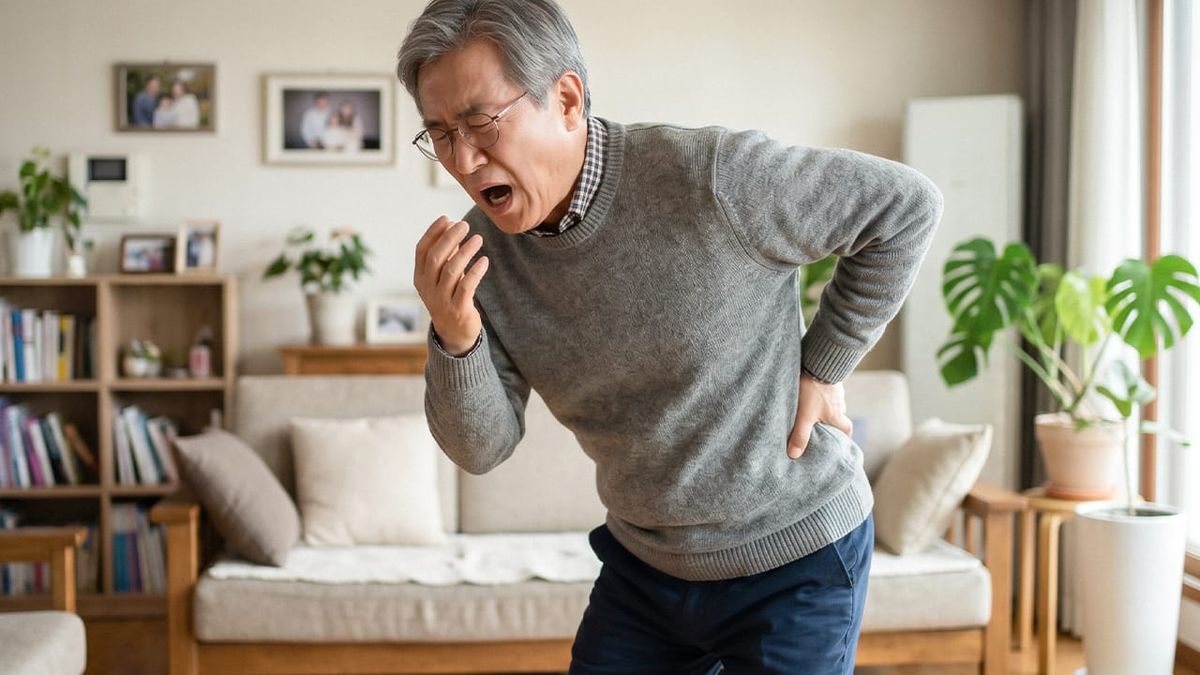

Low back pain in an older adult with osteoporosis after a minor fall may signal a vertebral compression fracture rather than a simple muscle strain. This post outlines practical treatment principles that support safe recovery—rather than prolonged bed rest—and decision points to help prevent a second fracture.
“My mother had a small fall recently, and now she can’t straighten her back at all.”
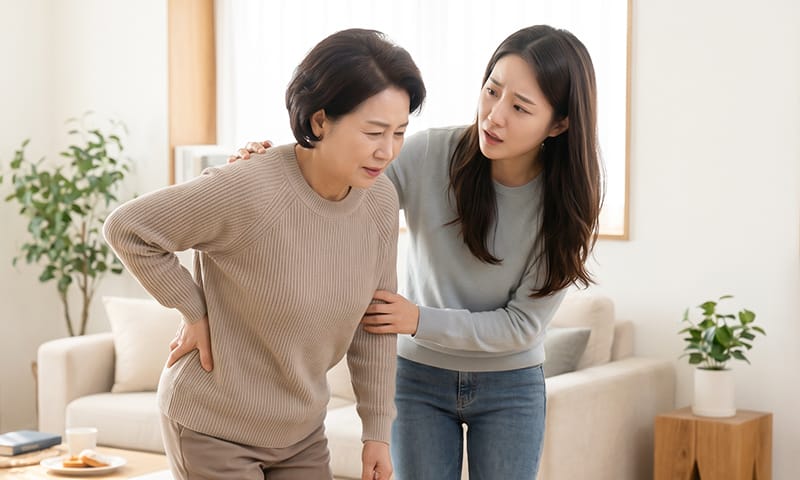
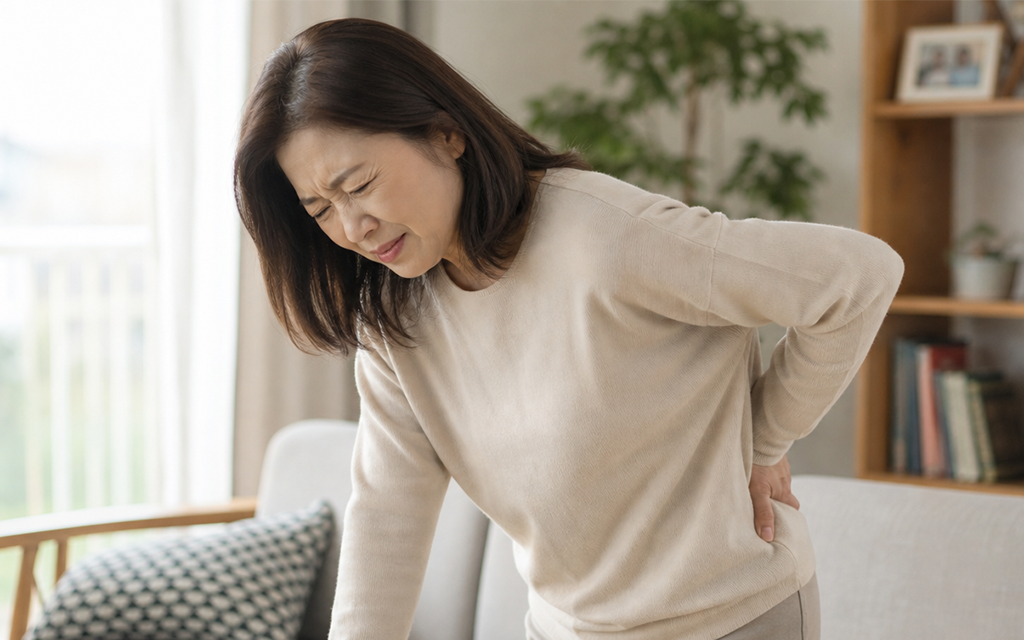
This is something caregivers often say with concern in the clinic. From the outside, it can look like a simple “back sprain,” making it easy to just apply a pain patch and move on. However, when bones are weakened by osteoporosis, even a small impact can cause a fragility fracture in an older adult.
There is something clinicians pay close attention to when evaluating older patients. After a fall or a sudden “sit-down” incident, low back pain should not be managed by focusing only on immediate pain relief. In the clinic, we first assess whether the patient can walk again. Just as importantly, we consider whether we can reduce the risk of a second fracture.
This article provides clear criteria to help you choose the safest next steps for your parent’s recovery after a fall.
1. After a fall, how is “can’t straighten the back” different from simple muscle pain?
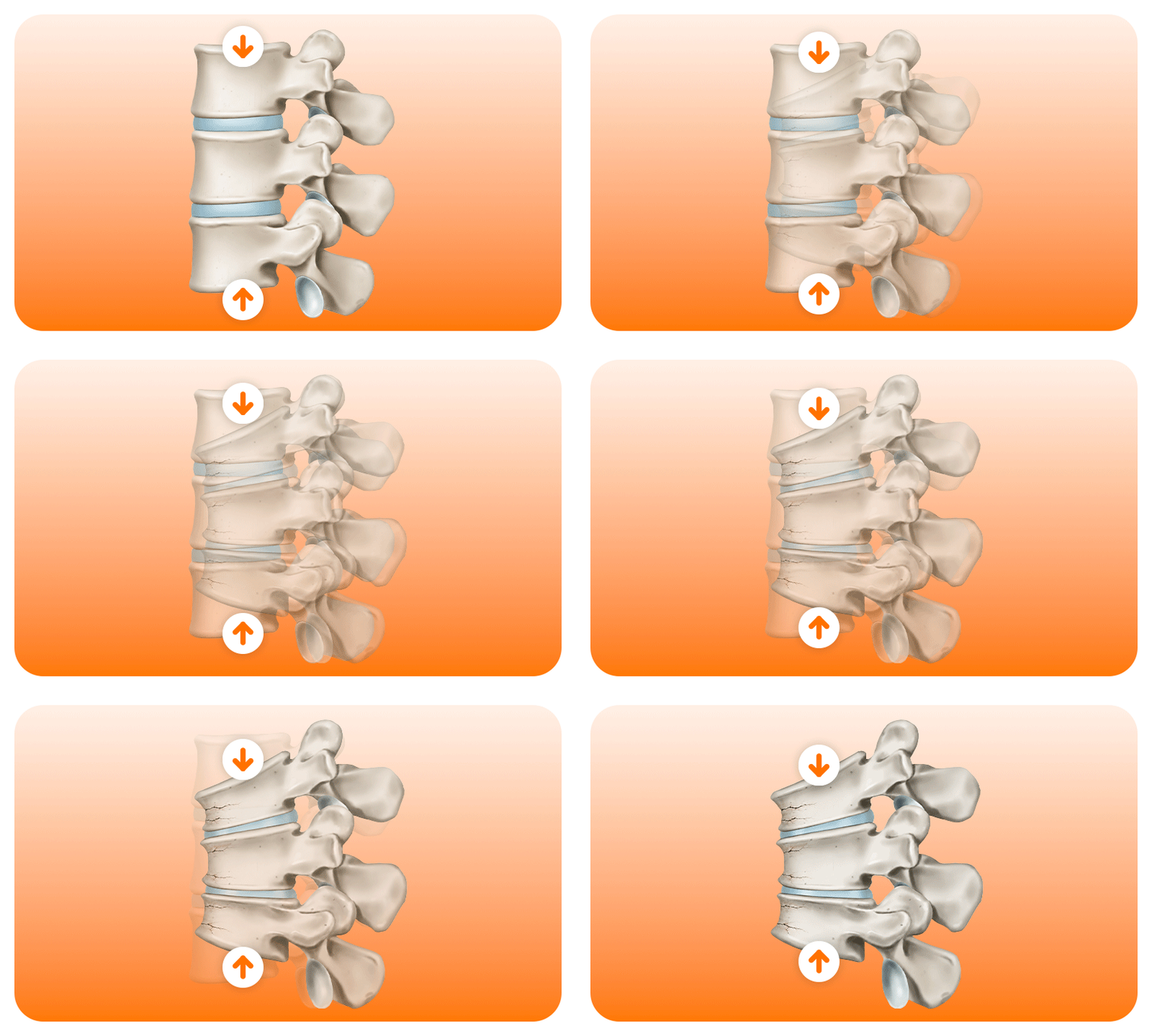
When people think of a fracture, they often imagine a branch snapping cleanly in two. Vertebral compression fractures in older adults are very different. They are more like an old building pillar crumbling and collapsing flat.
In younger, stronger bones, a minor impact often ends as muscle soreness. With muscle pain, movement tends to become easier over time. In contrast, a compression fracture—where the vertebral body itself is crushed—can cause severe, localized low back pain. Getting up from lying down can feel breath-stoppingly painful, and one specific spot may hurt much more than others. Because straightening the back increases load on the “pillar,” patients instinctively avoid pain by bending forward and may become unable to walk normally.
If this kind of focal pain is accompanied by a noticeable posture change, it should not be dismissed as routine back pain. Imaging is needed to confirm vertebral collapse. Typically, a plain X-ray is used first to check overall shape changes. However, when it is necessary to distinguish an unstable acute fracture from a prior fracture that has already healed and hardened, more detailed imaging such as MRI (and, when needed, CT) may be added.
2. Why “just lying down” is not always the right answer for vertebral compression fracture
treatment
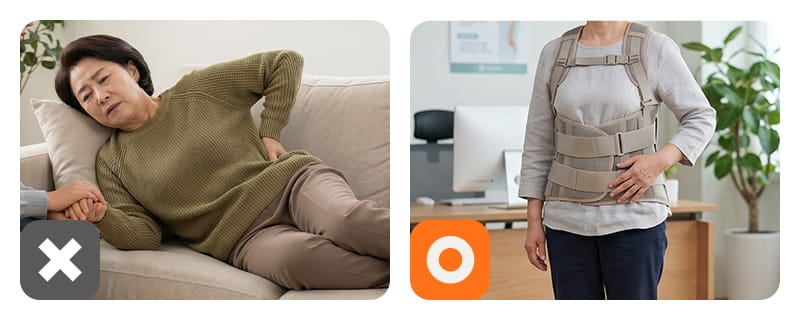
It is easy to assume that if the back is injured, the patient must stay in bed until the bone heals. But under current medical standards, prolonged bed rest in older adults can be very risky.
Even a few days of immobility can lead to rapid muscle loss in older patients. The risk of pressure sores increases, and it can also raise the risk of serious pneumonia. It is like an empty building becoming damp and deteriorating quickly. For this reason, the core of conservative treatment is to reduce pain to a tolerable level with medication or injections, support the spine with a brace (TLSO/LSO, etc.), and encourage early walking.
If pain is so severe that even breathing is difficult, short-term rest may be necessary. But once that phase passes, starting “early mobilization”—moving the body as early as safely possible within allowed limits—is important to preserve overall function. When mobility is interrupted, older adults often need much longer to recover.
✅ Caregiver observation checklist for safe early mobilization
- Can the patient gently roll over in bed, and is the pain tolerable when doing so?
- When sitting briefly on the edge of the bed, is breathing comfortable?
- Within the limits permitted by the medical team, can the patient wear the brace and manage short, routine walks?
3. Four warning signs during conservative treatment that mean “re-evaluation is needed”

The goal of conservative treatment is not to endure pain blindly. It is a process of monitoring progress and setting criteria for deciding the next treatment step. Rather than simply “waiting 2–3 weeks,” caregivers should closely watch for the following warning signs during conservative care:
- The patient cannot walk—even to the bathroom—despite wearing a brace
- Severe pain does not improve at all even while lying down, and instead worsens
- New numbness radiating into the buttock or leg, or new weakness, appears
- After taking medication, excessive drowsiness occurs or the overall condition worsens rapidly
In particular, neurological symptoms radiating into the leg or changes in bowel/bladder control may suggest possible nerve compression. If these signs appear, do not lose time with conservative care alone—inform the medical team and seek prompt re-evaluation.
4. “Cement augmentation” procedures: three situation-based criteria for choosing the next
step
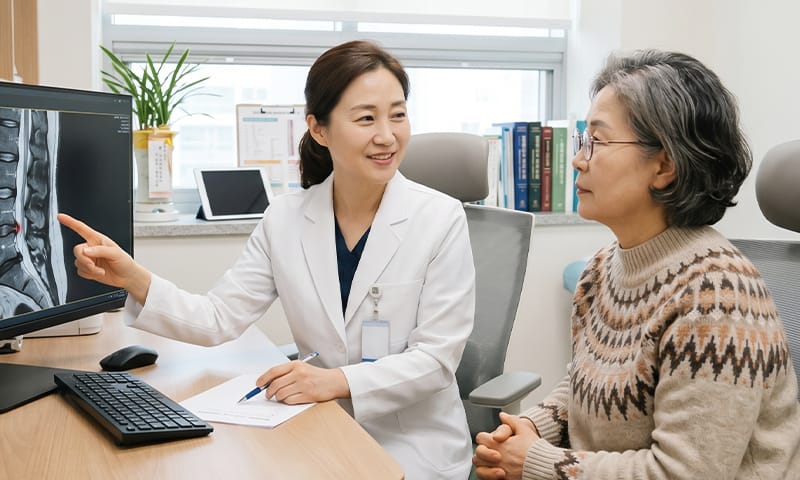
Not everyone who receives the diagnosis needs a procedure right away. Vertebral
augmentation (vertebroplasty/balloon kyphoplasty) works by filling the collapsed “pillar” with medical bone cement to stabilize it. For some patients, it may help with relatively rapid pain relief and functional improvement, but there are also potential complications such as cement leakage or additional fractures in adjacent vertebrae.
Therefore, in real-world clinical practice in Korea, treatment direction is discussed by integrating the course of conservative treatment and imaging findings, using the following three situation-based criteria:
First, when neurological abnormalities are suspected or spinal instability is severe. In this case, imaging-based re-evaluation is performed without delay, and depending on the patient’s condition, a procedure or surgical treatment (decompression/fixation, etc.) may be discussed.
Second, when there are no neurological abnormalities and the fracture is relatively stable. Conservative treatment focused on medication adjustment, brace use, and early walking becomes the first-line choice.
Third, when severe pain persists despite adequate conservative treatment. If pain severe enough to make walking difficult continues, and the cause of that pain clearly matches the fracture seen on imaging, vertebral augmentation may be selectively considered based on clinical judgment.
✅ What caregivers should confirm before the clinic consultation
- Does the patient’s current pain match the acute fracture site identified on imaging (MRI, etc.)?
- Has the medical team been given an accurate list of current medications (e.g.,
anticoagulants, diabetes medications, hypertension medications)? - Are pain and walking-function decline persisting to the extent that a procedure is being considered?
5. Even if pain improves, it’s not the end: long-term planning to prevent a second fracture

If back pain improves and your parent returns to daily life, that is reassuring—but it does not mean treatment is finished. A vertebral compression fracture is a strong warning that bone durability has reached its limit. Repairing one collapsed pillar does not make the entire building strong again.
If osteoporosis medication is stopped on one’s own simply because pain is gone, the risk of a second new fracture in other vertebrae or the hip can increase. Post-discharge care is the start of a long-term plan to strengthen the remaining bones.\
Because adherence to daily medication can easily decline, it helps greatly when family members also track dosing schedules and injection intervals. Along with this, active fall prevention and rehabilitation to preserve muscle strength should be implemented—such as removing thresholds in the home and installing non-slip mats and night lighting in the bathroom.
6. Frequently asked questions (FAQ)
Q. Isn’t an X-ray alone enough to check the bone condition?
A plain X-ray is the basic test for confirming the overall shape of a collapsed vertebra. However, it is difficult to distinguish whether the fracture occurred years ago and has already healed, or whether it is an acute fracture from a fall a few days ago. To accurately assess acuity and the possibility of nerve compression, additional detailed imaging such as MRI or CT may be needed.
Q. The back brace feels uncomfortable—does it have to be worn all day?
A brace helps reduce pain by distributing load when body weight is placed on the spine. It is safer to wear it when sitting, standing, or being active. On the other hand, when lying down to rest, loosening it can help prevent skin problems and excessive muscle tension. The wearing period should be adjusted in consultation with the medical team based on pain changes.
Q. During conservative treatment, how severe does pain need to be before a procedure is considered?
It is considered first when severe pain persists to the point that routine walking—such as going to the bathroom—is not possible, despite appropriate medication, brace use, and rest. In addition, the decision is discussed in depth when that pain matches the fracture findings confirmed on detailed imaging, and vertebral augmentation is being considered.
Q. What are the emergency criteria for seeking hospital care quickly?
When severe leg tingling or a sense of paralysis occurs along with back pain, or when there are unusual changes in bowel or bladder control. These may suggest that fractured bone is compressing spinal nerves, so prompt evaluation is needed rather than delaying with conservative care.
So far, we have reviewed the key criteria clinicians consider in the clinic when an older patient (age 70 and above) has a vertebral compression fracture.
First, focal pain and posture changes that prevent the patient from straightening the back after a fall are not simple muscle pain, and imaging is needed to accurately confirm bone status.
Second, rather than prolonged bed rest, starting “early mobilization” within the range where pain is controlled is the direction that helps prevent decline in overall body function.
Third, vertebral augmentation is selectively considered for patients whose pain and imaging findings match, and even after pain settles, continuing osteoporosis treatment and fall prevention is important to help reduce the risk of re-fracture.
A sudden accident can feel frightening, but if you proceed step by step—using today’s symptoms and walking function as your guide—you can make the safest and most reasonable choices for the patient.
Sources
- Archives of Osteoporosis (2025). Trends of incidence and 1-year mortality of vertebral fractures in Korea using nationwide claims data.
- Journal of Korean Medical Science (JKMS) (2025). Factors Associated With Compliance and Persistence With Pharmacotherapy in Patients With Osteoporosis.
- Korean Journal of Neurotrauma (2024). Pain Intervention for Osteoporotic Compression Fracture, From Physical Therapy to Surgery: A Literature Review.
※ The copyright for all content on this blog belongs to medihi. Unauthorized copying, distribution, or derivative use is strictly prohibited, and violations may result in legal action without prior notice.
Recommended reads
 medihi