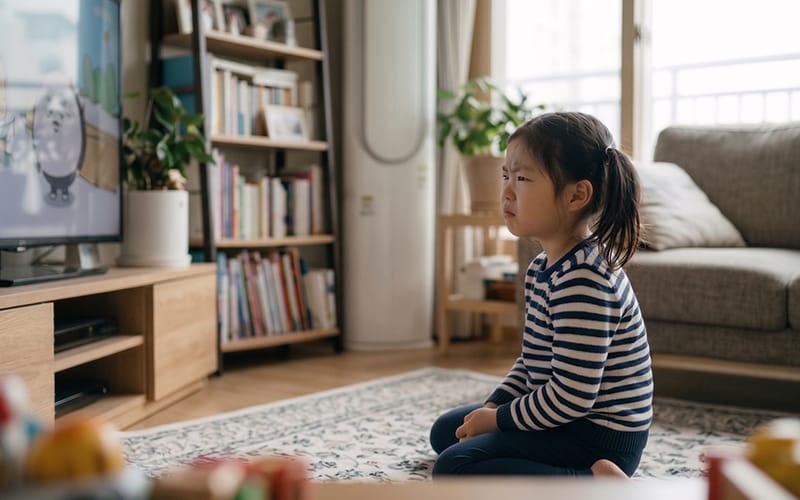

A child’s habit of tilting their head to one side can be a sign of pediatric strabismus. This post explains practical criteria for deciding when a detailed evaluation is needed and the general treatment direction to help protect visual function during ages 4–7.
“My child keeps tilting their head when looking at things.”
“One eye looks slightly misaligned... could it be strabismus?”
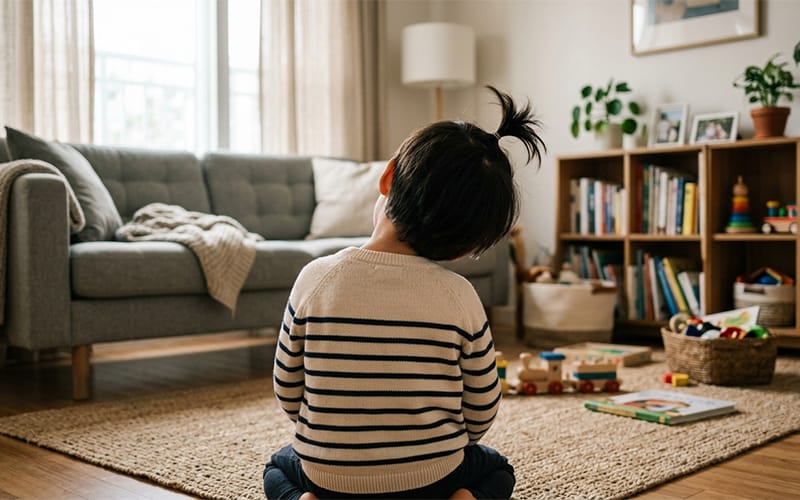
Many parents visit the clinic with these concerns. Some blame themselves for not correcting posture earlier, but in many cases, it’s unlikely to be the parent’s fault. The behavior can appear intermittently, making it easy to miss in daily life, and it may be a natural adaptation as the child tries to find a more comfortable field of view.
In pediatric ophthalmology, when clinicians notice a child’s head tilt, the first thing they check is not the neck—it’s eye alignment. From the outside, it can look like a posture issue or a habit from smartphone viewing, but it may also be an unconscious compensatory behavior by the brain to reduce visual discomfort caused by misalignment.
In this article, from the perspective of visual development between ages 4–7, we’ll organize which situations warrant a detailed exam.
1. Is it a neck issue or an eye issue? The hidden mechanism behind “head tilt”
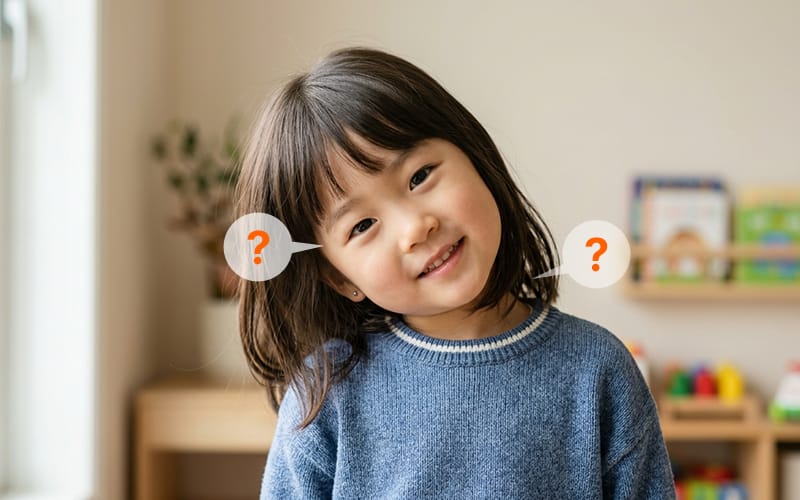
If a child repeatedly tilts their head in a particular direction or repeatedly lifts/drops their chin, there are two major causes to consider: muscular torticollis, a structural issue where neck muscles are shortened or tight, and ocular torticollis, a visual compensatory behavior used to achieve a clearer, more stable view.
The mechanism of ocular torticollis is easy to understand if you imagine a pair of binoculars that’s out of alignment. When the angles of the two lenses are slightly off, you can see double (diplopia). An adult might adjust the focus, but children often try to escape the disorienting sensation by tilting their head to make the image “merge” into one. It’s the body adapting so the brain can process visual information more comfortably.
This compensatory behavior is often clearly seen in vertical strabismus (where the eyes are misaligned up/down) or paralytic strabismus (when a specific eye muscle is weak). Use the simple checklist below at home to help estimate what may be driving the head tilt, and then consider a detailed exam for an accurate diagnosis.
✅ Home observation points for ocular torticollis
- In strong sunlight outdoors, does your child especially tend to squeeze one eye shut or squint?
- Right after waking up in the morning, or when tired, does one eye drift outward?
- In photos, do the eye height or the position of the pupil light reflex often look different?
2. If your child squints one eye especially in bright places: consider intermittent exotropia

Some children usually appear to have straight eyes, but when they are tired or “zoned out,” one eye drifts outward. This is one characteristic feature of intermittent exotropia, which is relatively commonly observed among children in Korea.
When a child goes outside into bright sunlight, glare can make visual stability easier to lose. At that moment, the child may unconsciously close or squint one eye—like covering one misfocused lens with a hand—to block confusing visual input that occurs when both eyes are open. Indoors, there may be fewer noticeable issues, but if your child frequently squints one eye specifically outdoors, it may not be a simple reaction to brightness.
Because these symptoms can appear only briefly, you may worry, “What if it doesn’t show up on the day of the exam?” If you prepare photos or videos taken at home, it can help fill in those gaps and be very useful during the visit. In pediatric ophthalmology, clinicians evaluate the frequency of episodes and whether visual function is being maintained. It can also help to track how often the drifting happens throughout the day before the appointment.
3. Vision 1.0 at an infant/toddler screening—does that mean strabismus and amblyopia
are not a concern?
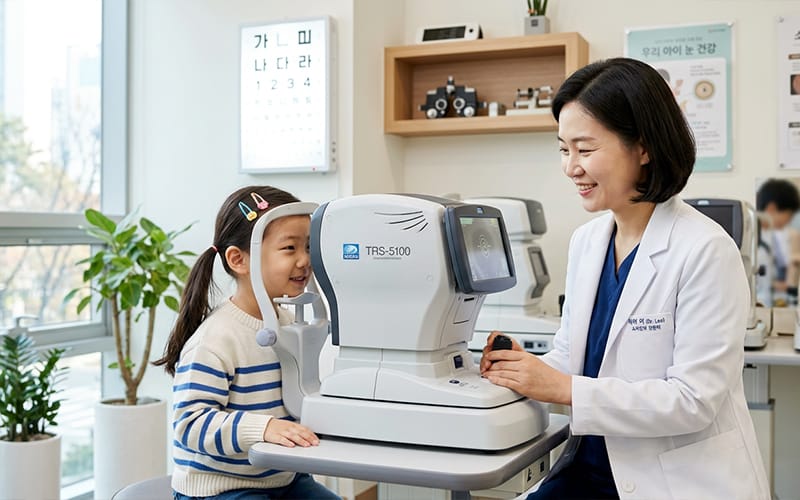
Even if a child scores 1.0 on a vision test during an infant/toddler health screening, it’s difficult to conclude that all visual functions are stable. Strabismus and amblyopia are different conditions, but they are closely connected in terms of visual development. If strabismus is an alignment problem where the two eyes point in different directions, amblyopia is a functional problem where visual development stalls because visual input from one eye is suppressed.
Problems can arise if misalignment persists and the child relies mainly on one eye. To prevent confusion, the brain tends to ignore visual information coming from the misaligned eye. As the brain uses that eye less, visual development may not progress adequately, potentially leading to amblyopia.
In particular, ages 4–7 are when the brain combines input from both eyes and
stereopsis (3D depth perception) becomes established. Even if the misalignment looks brief from the outside, if fusion becomes unstable, it can affect distance judgment and depth perception. This is why, even when a child can read the chart well, eye alignment and stereopsis should be evaluated together.
4. From observation to surgery: a treatment roadmap tailored to your child
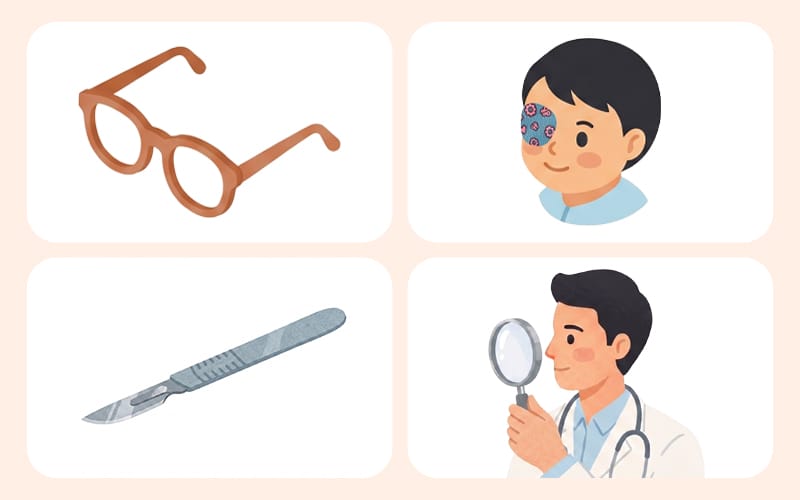
Treatment direction can vary significantly depending on the child’s eye status and
developmental stage. Based on factors such as symptom frequency, whether stereopsis is reduced, and whether refractive error is present, common stepwise options to discuss with the clinician include:
- Glasses: If accommodative esotropia is suspected in the setting of hyperopia,
correcting the refractive error is often considered first. - Patching therapy: When there is a risk of amblyopia, the better-seeing eye is covered to encourage use of the other eye.
- Surgical treatment: In intermittent exotropia with a large deviation angle and clearly reduced stereopsis, extraocular muscle surgery may be discussed.
- Follow-up observation: If fusion is maintained to some extent and symptoms appear only occasionally, the course may be monitored through regular checkups at set intervals.
Above all, it’s important to accurately analyze your child’s visual situation and how well function is being maintained, then proceed step by step. Detailed records from home observations become key data in deciding the treatment direction..
✅Pre-visit observation checklist
- Is the direction of the head tilt fairly consistent?
- Do symptoms tend to appear at a specific time of day or under certain fatigue
conditions? - If you gently cover one eye, does your child tend to straighten the previously tilted head?
5. Understanding recurrence of misalignment after strabismus surgery and long-term
management
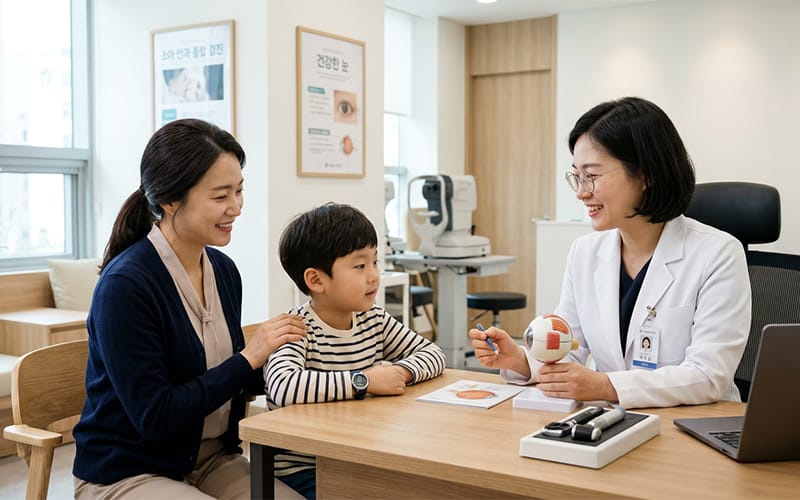
When considering extraocular muscle surgery, many parents worry about the possibility of recurrence. Surgery that adjusts the position and tension of the eye muscles to restore alignment is performed with great precision. However, children’s eyes continue to grow, and their facial bones also change as they develop.
Depending on this developmental process and the status of the brain’s fusion function, clinical studies have reported that some degree of misalignment can reappear after surgery. Early on, the alignment may look temporarily overcorrected, but in some cases it gradually adapts over time and is adjusted through follow-up observation. The specific surgical plan and expectations depend on the treating specialist’s judgment after considering the child’s overall condition.
Surgery is not the end of treatment as a one-time event. It should be approached as one part of a longer journey to keep binocular vision stable, and consistent follow-up after surgery is important.
6.Frequently Asked Questions (FAQ)
Q. One eye looks different in photos—are there ways to observe this at home?
One method is to take a front-facing photo of your child using the camera flash and check whether the light reflection on both pupils appears in the same position. However, this is only a reference and does not confirm a diagnosis. If the reflection positions look different, it’s advisable to visit an eye clinic for confirmation with proper examination equipment.
Q. How can I tell whether the head tilt is from a muscle issue or an eye issue?
If gently covering one eye leads your child to straighten the previously tilted head, ocular compensation (ocular torticollis) may be suspected. On the other hand, if the head tilt persists even when an eye is covered and the neck area feels stiff, muscular torticollis is more likely. Accurate differentiation should be made through a clinical evaluation.
Q. If we do patching therapy, won’t the originally “good” eye get worse?
During patching therapy, the child may feel temporary discomfort because the better-seeing eye is covered. However, if you follow the prescribed duration and method tailored by the clinician and keep up with regular checkups, treatment can be carried out while managing the risk of reduced vision in the other eye.
Q. If the head tilt continues, should we see an eye doctor right away?
If a child aged 4–7 increasingly squints one eye in bright places, or shows signs of poor focusing when tired, it may be time for a visual function evaluation. If head tilt is consistently observed in everyday photos and shows a clear pattern, it is safer to seek a pediatric ophthalmology evaluation early.
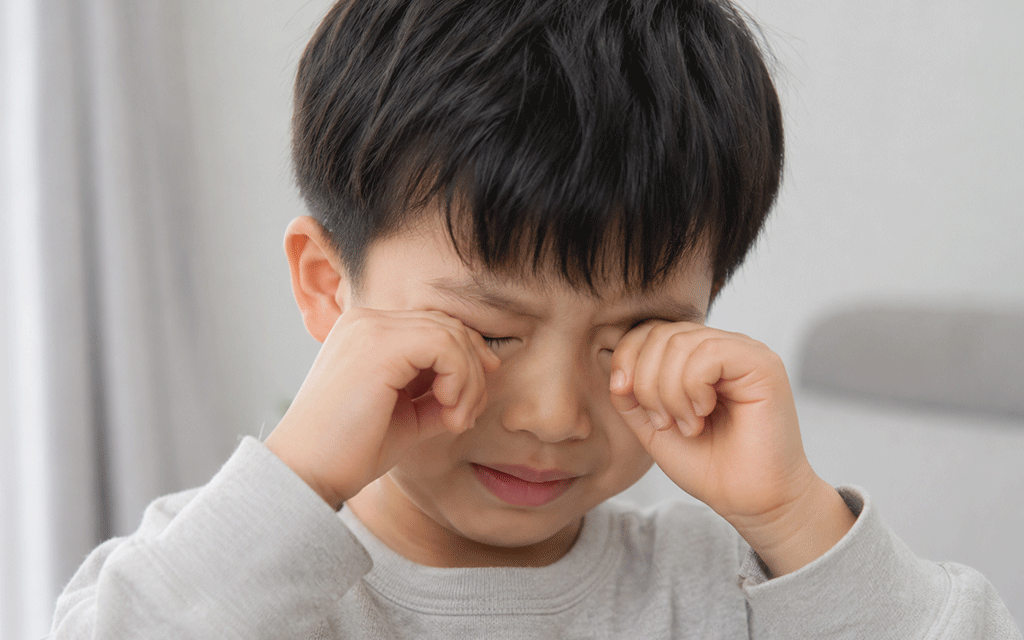
Children’s optic nerves and brains, unlike adults’, are still in a flexible stage of development. Medically, helping them receive accurate visual input during this period supports stable development of stereopsis and fusion function—abilities they will rely on throughout life.
A tilted head and one-eye squinting may not be a simple habit; they can be adaptive signals that the child is trying to align their vision on their own. Careful observation and records from parents provide strong groundwork for setting diagnostic and treatment directions. To help your child view the world with a comfortable, stable field of vision, try not to overlook small daily signs—and plan an appropriate checkup in a calm, timely way.
Sources
- Kim et al. Ophthalmology. 2020. (Korean multicenter epidemiologic study on intermittent exotropia, KIEMS)
- Journal of the Korean Medical Association. 2013. Commentary on visual screening guidelines in infant/toddler health checkups
- International Ophthalmology. 2021. Correlation between head tilt and vertical deviation in superior oblique palsy
※ The copyright for all content on this blog belongs to medihi. Unauthorized copying, distribution, or derivative use is strictly prohibited, and violations may result in legal action without prior notice.
Recommended reads
 medihi