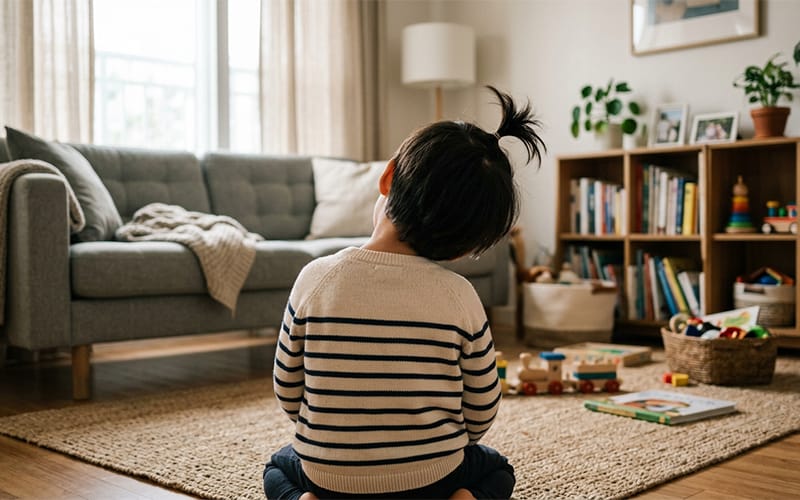

Children’s learning fatigue may stem not from a lack of focus, but from reduced visual function. This post summarizes practical, realistic ways to manage eye strain at home and clear criteria for deciding when medical evaluation or intervention is needed.
“My child says their eyes hurt as soon as they open a book.”
“Their eyesight is good, so I think they’re just making excuses to avoid studying.”
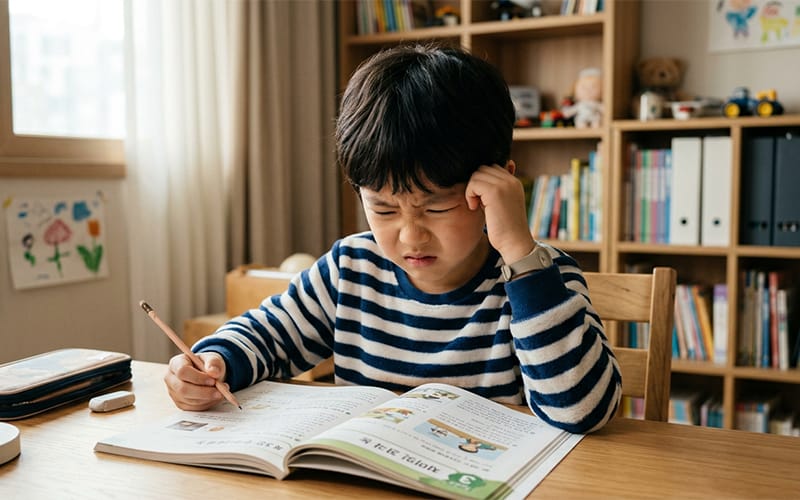
When a child complains that their eyes start hurting quickly whenever they open a book and cannot stay seated at a desk for long, many parents assume the child is making excuses to avoid studying. However, this situation is not always due to a lack of willpower. In some cases, detailed testing reveals contributing factors such as refractive errors, dry eye, or other visual function issues.
Before concluding it is purely a behavioral problem, considering an eye exam and starting with an objective assessment of visual function can help reduce the child’s discomfort.
1. Why can’t a child read for long even with 20/20 vision?
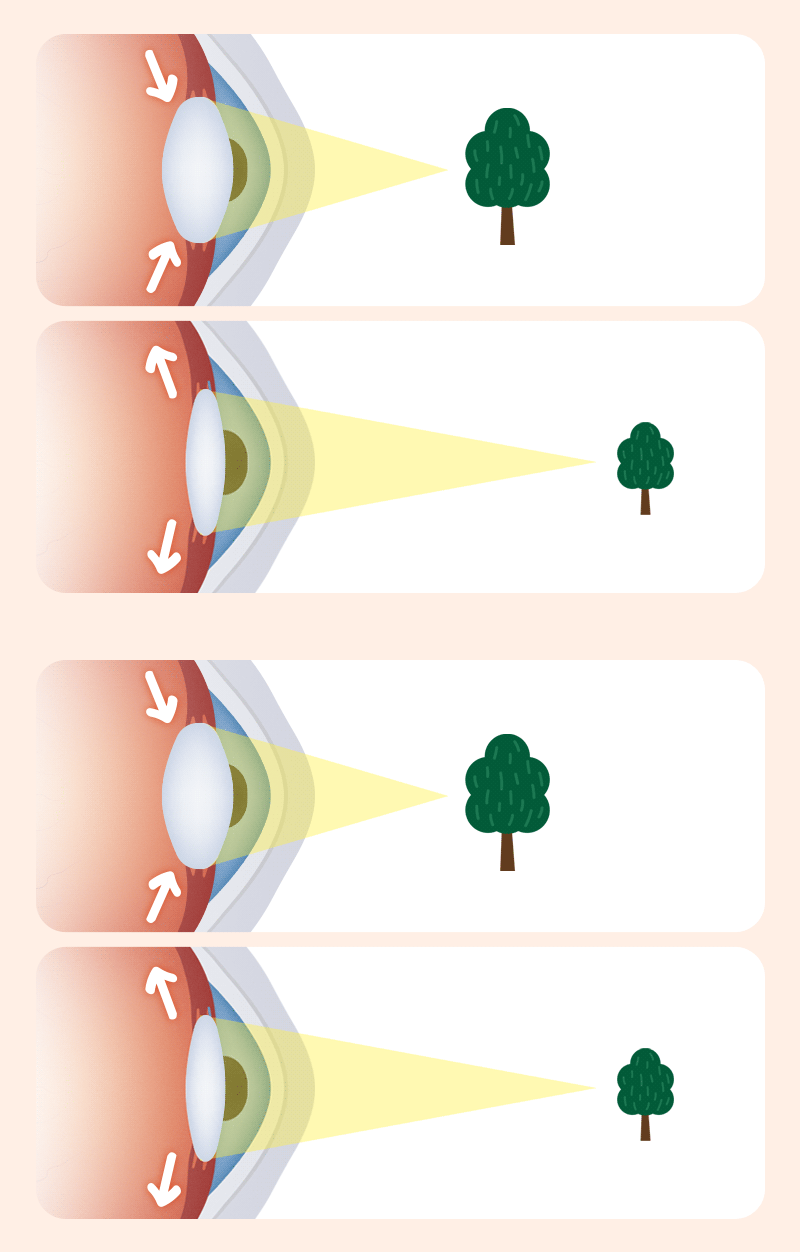
Even if a child reads the eye chart at an ophthalmology clinic or school screening and gets a “20/20” result, it is difficult to conclude that their eyes are under no strain. Eye chart testing is closer to measuring static distance visual acuity—how clearly one can recognize stationary letters far away. In contrast, learning activities such as reading and writing require a high level of visual effort, because the child must accurately focus both eyes on near text and sustain that focus for long periods.
Our focusing ability (accommodation) works very similarly to a smartphone camera’s autofocus (AF) motor. When looking at distant mountains, this “focus motor” (the lens system) is in a relatively relaxed state. But when looking down at a workbook up close, the motor must stay continuously tightened to maintain a clear image. Children with weak accommodation or weak ability to bring both eyes inward (convergence) can experience significant fatigue during this process.
If this continues, the focus motor becomes overloaded. The child may experience double vision, lines that appear to shake, tightness around the eyes, and headaches—making it difficult to concentrate on a book. To a caregiver, it may look like the child is simply distracted, but it is important to consider that the child may be experiencing fatigue due to visual limitations.
2. Why do headaches worsen when switching between the board and a book—and what can help?
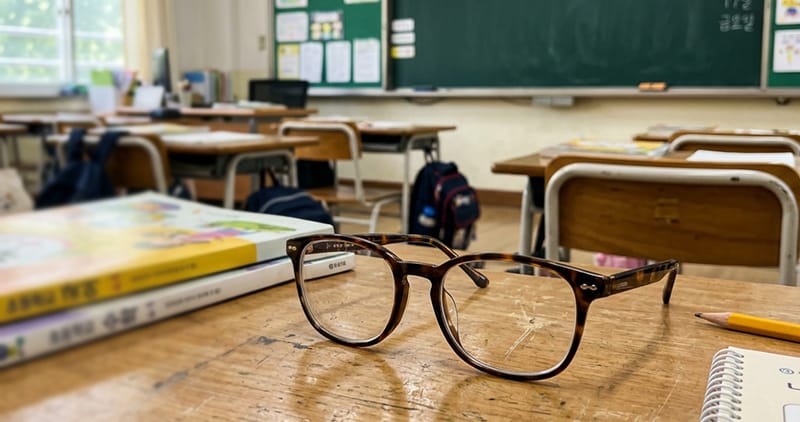
The classroom environment constantly challenges a child’s visual function. The child repeatedly looks up to check what is written on the board far away, then lowers their head to write notes on a notebook at close range. If there is an uncorrected or under-corrected refractive error—such as mild myopia, hyperopia, or astigmatism—eye fatigue increases because the visual stress the eyes must handle becomes amplified compared with usual.
Each time the child alternates between two points at different distances, the camera-like focus motor must move quickly and smoothly. But if there is a refractive error or reduced binocular vision function (using both eyes together), the motor’s movement can become stiff and slow. When focusing takes longer, the board may look blurry for a moment before becoming clear, which is uncomfortable and quickly leads to fatigue.
If the board is consistently blurry, prescribing glasses with the correct power can help. On the other hand, if the board is clear but the child complains of overlapping letters or headaches when looking down at a book for a long time, it is reasonable to evaluate accommodation and binocular vision function. If the cause is focusing overload or insufficient convergence, depending on the situation, customized glasses or vision therapy may be considered to reduce strain.
3. Smartphones and blue light—what actually causes eye strain?
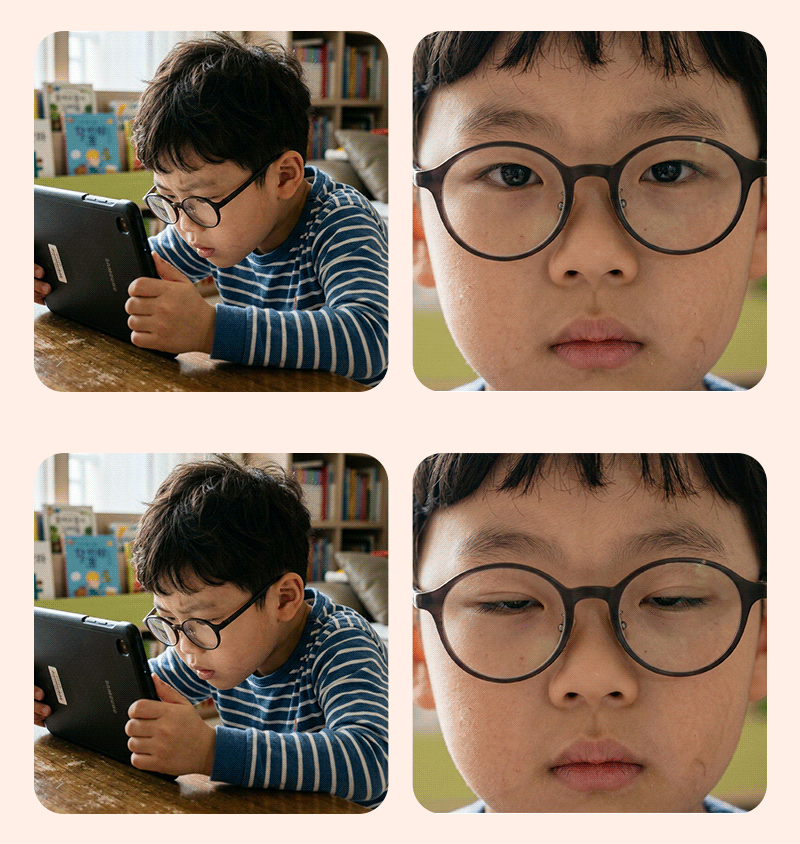
When children use digital devices such as tablets, many caregivers feel reassured by having them wear blue-light-blocking glasses. It may seem intuitive that filtering certain wavelengths protects the eyes, but the main causes of digital-device-related eye strain—often referred to as VDT-related symptoms—are an excessively close viewing distance and a sharp decrease in blinking frequency.
Here, it helps to recall the camera focus motor again. If the focus motor stays extremely tightened at a close distance for a long time, muscle fatigue accumulates. And when concentrating on the rapid transitions of moving content, children often blink far less than usual without realizing it. When blinking decreases, the tear film that covers the eye surface can dry out more quickly.
When the tear film breaks up, the ocular surface becomes dry and feels gritty or tight. Dryness can blur vision, leading the child to strain even more to refocus—creating a vicious cycle. If the child frequently rubs their eyes or squints/frowns while looking at a screen, the viewing distance should be increased. It is also important to adjust the environment so the child intentionally looks away from the screen at regular intervals.
✅VDT visual environment checklist you can assess at home
- Is the distance between the screen and the eyes at least 30 cm?
- After 20–30 minutes of viewing, does the child look away and rest?
- While viewing, does the child frequently rub their eyes or squint/frown?
4. What daily environment helps reduce eye strain and slow myopia progression?

Managing eye strain and slowing myopia progression overlap in many ways. The basics are reducing uninterrupted near work and increasing time spent looking into the distance in bright outdoor settings.
After 20–30 minutes of near work, it helps to briefly look out a window or at something at least 6 meters away to relax the eyes. If only the desk is overly bright while the rest of the room is dark, glare and fatigue may increase, so it is better to balance general room lighting with task lighting.
Outdoor activity is known as a lifestyle factor associated with a lower risk of myopia progression. Helping a child spend a certain amount of time each day moving under natural light and looking into the distance is an important foundation for protecting vision.
5. Recurrent eye strain—when are exams and treatment needed?

If a child still struggles to read for long periods or repeatedly experiences headaches, overlapping letters, or blurriness even after adjusting the environment, it is difficult to view it as a habit issue alone. In that case, it is recommended to check not only refraction, but also accommodation, convergence, and binocular vision function.
In addition, if myopia started at an early age, the prescription increases rapidly over a short period, or a parent has high myopia, myopia progression itself should also be evaluated. This is because myopia progression is not only about stronger glasses; it is related to elongation of the axial length of the eye, which can increase long-term risk of ophthalmic diseases.
Treatment approaches vary depending on test results. If refractive error is the issue, an accurate glasses prescription comes first. If accommodation or convergence problems are clear, customized lens prescriptions or vision therapy may be considered. For children with fast myopia progression, along with lifestyle management, medical treatments such as orthokeratology lenses, low-dose atropine, or myopia-control glasses/lenses may be reviewed.
6. Frequently Asked Questions (FAQ)
Q. My child complains of headaches while studying—Is a standard vision test enough?
Even if the eye chart shows 20/20, the child may have insufficient accommodation (focusing up close) or weak convergence (bringing both eyes together). If fatigue and headaches recur during learning, it is safer to receive a comprehensive evaluation that includes detailed refraction testing and binocular vision function assessment, not only a basic visual acuity measurement.
Q. If it’s hard to reduce screen use immediately, what should we do first?
If controlling total screen time right away is difficult, focus on breaking up “continuous use” rather than only the total duration. Keeping at least 30 cm between the device and the eyes and taking a break after 20–30 minutes by looking at distant objects can help.
Q. With low-dose atropine eye drops, what should caregivers monitor?
With atropine drops, the pupils may dilate slightly, and the child may feel glare outdoors in strong sunlight. There is also a possibility that near text may look temporarily blurry. Early on, caregivers should closely monitor whether these discomforts interfere with the child’s learning.
Q. When should we consider an ophthalmology visit for eye strain symptoms?
If the child goes beyond temporary fatigue after long reading and complains of persistent headaches, eye tightness/soreness, or double vision (diplopia), it is reasonable to consider a visit. If blurriness does not recover even after rest and sleep, or if the child frequently says they cannot see the board, it is important to check for underlying issues.
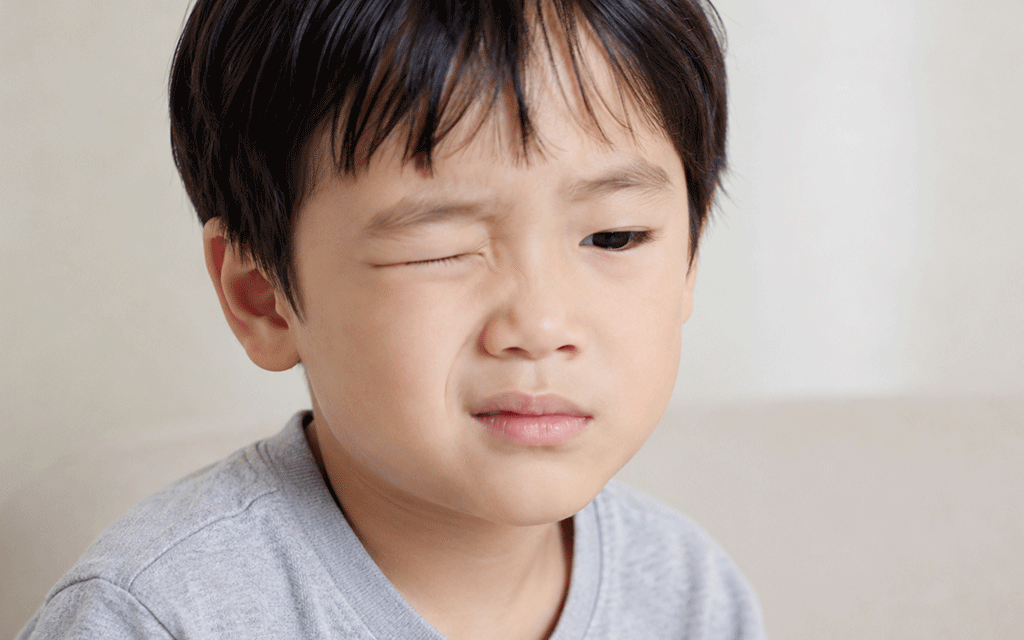
If a child repeatedly avoids books or experiences discomfort such as headaches, eye rubbing, losing their place while reading, or overlapping letters, it is worth first checking the everyday visual environment. Adjusting small daily factors—such as viewing distance for books or smartphones, scheduled breaks, lighting, posture, and outdoor activity—can help reduce strain on the eyes.
If discomfort persists, rather than feeling reassured by a simple vision test alone, it is advisable to also check refractive status, accommodation, and binocular vision function together.
May parents’ careful observation and regular professional guidance help protect a child’s clear vision and support a stable foundation for learning.
Sources
- Korea Disease Control and Prevention Agency. (2022). Vision screening guidelines for infant and toddler health checkups.
- Korean Ophthalmological Society. (2021). Clinical recommendations for pediatric myopia management and prevention.
- Ha, J., et al. (2025). Digital screen time and myopia progression: A systematic review. Ophthalmology, 132(4), 405-412.
※ The copyright for all content on this blog belongs to medihi. Unauthorized copying, distribution, or derivative use is strictly prohibited, and violations may result in legal action without prior notice.
Recommended reads
 medihi