

This post organizes the causes of shoulder pain that occurs only within a specific range when lifting your arm, along with safe, reasonable treatment standards. You can explore practical alternatives aimed at restoring shoulder function—rather than assuming it’s simply a “bone problem.”
“I get a sharp jolt when I reach up to grab something from a shelf.”
“Every time I change clothes, I’m afraid it’ll hurt.”

Many office workers in their 30s to 40s visit the clinic with these symptoms. They often worry that their shoulder has already been seriously damaged at a young age. However, this is a common pattern associated with ongoing upper-body use and posture. There’s no need to blame yourself for not having “managed your shoulders” well enough.
If you feel a sharp pain only in a certain range while lifting your arm, it should be approached differently from typical muscle tightness. The first step is distinguishing whether it’s a structural issue or a functional movement-control issue.
1. Is a bone “growing and scraping”? The real standard for correcting the cause of pain
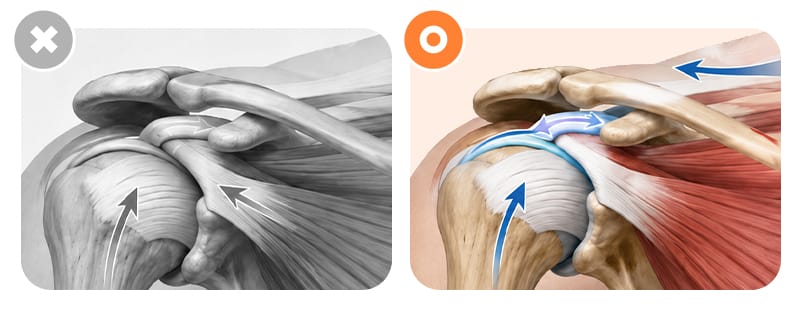
Many people interpret complex pain around the shoulder tendons simply as “impingement syndrome.” Because of the name, it’s easy to assume a bone has become sharp and is scraping the tendon. However, based on more recent medical evidence, this is not merely a straightforward mechanical “bone shape” problem. It often occurs when the muscles and tendons that move the shoulder—and the motion of the shoulder blade—fail to work in harmony.
To understand this intuitively, think of a sliding door rail. If the rail is slightly misaligned, what happens? Only in a certain section, the door becomes stiff and may make a metallic noise. The shoulder works on a similar principle. When the balance between the shoulder blade and upper arm bone is off, pain can stand out in a specific range.
Pain may appear roughly around 60–120 degrees, which is called the “painful arc.” It’s safest to understand this as a pattern created by overlapping factors such as tendinopathy, bursa irritation, and altered scapular movement.
The exact angle is only a reference point and varies widely by individual. If a door is noisy, it’s often better to level the rail than to focus on shaving down the door. Likewise, rather than fixating on “making more space” by shaving bone, it can be more reasonable to focus on restoring smooth joint mechanics.
2. Frozen shoulder vs rotator cuff–related pain: how to tell what condition you may have
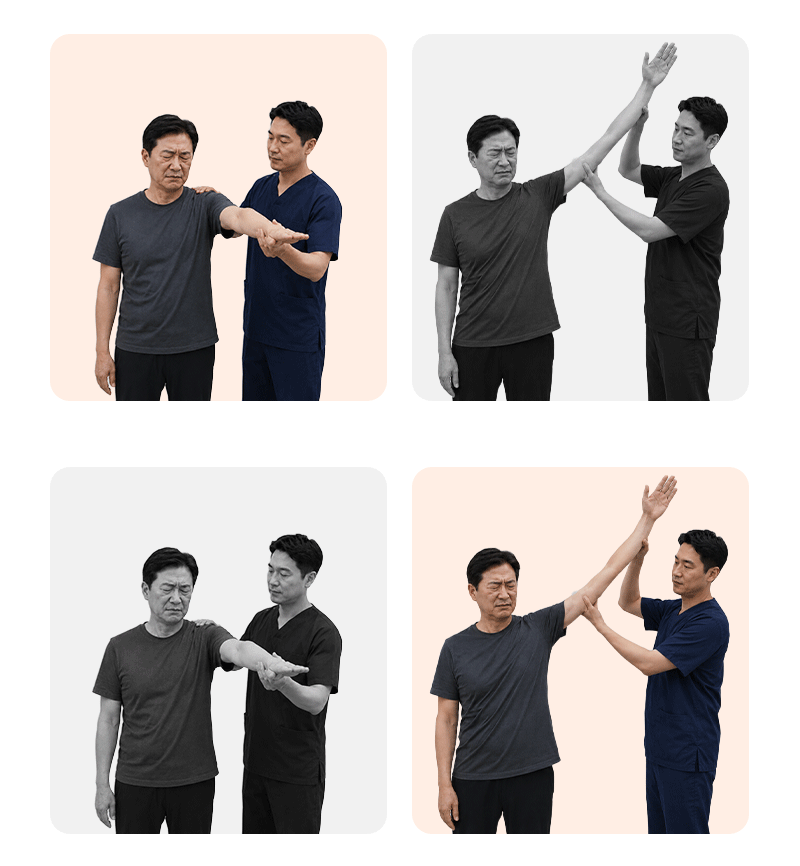
When the shoulder hurts, many people first think of frozen shoulder. But these two
conditions differ significantly in causes and diagnostic criteria.
If your shoulder feels “stuck,” and even when someone else tries to lift your arm it barely moves—meaning overall motion is reduced—frozen shoulder is more likely. This is like a sliding door rail that has rusted throughout and won’t move at all.
On the other hand, you may feel a sharp pain only at a specific angle. After passing that range and fully raising your arm overhead, the pain may actually decrease. In that case, rotator cuff–related pain is more likely.
Another typical feature is that if someone else supports and lifts your arm, it may go all the way up without pain. It’s not that everything is “rusted”—it’s that friction occurs only in a certain misaligned segment.
✅ Self-check: Frozen shoulder vs rotator cuff–related pain
- If someone else lifts your arm, can it go all the way up without pain?
- When your arm is fully raised overhead, does the pain decrease?
- Is your shoulder stiff and restricted in all directions rather than only in one specific direction?
3. Advanced imaging (MRI): should you get it right away?

When pain starts, many people feel reassured only after getting advanced imaging. They believe finding a visible, exact cause will speed up treatment. However, you don’t necessarily need to rely on imaging from the very beginning.
From a cost-effectiveness standpoint, a physical exam and X-ray alone may be enough to narrow down the condition. Also, ultrasound does not necessarily fall behind MRI in diagnostic specificity for many shoulder conditions, so we generally recommend ultrasound first because it is more economical and allows real-time observation.
There is another important reason. Even in healthy people in their 40s with no pain at all, subtle degenerative changes in the shoulder are commonly seen. These are like wrinkles that naturally appear with age. So there is no need to become overly fixated on incidental findings when you have no symptoms.
If imaging is done too early, attention can shift toward “natural wrinkles” rather than correcting the misaligned movement path. This can lead to treatment focusing on findings unrelated to symptoms, raising concerns about overtreatment or unnecessary procedures. For this reason, major clinical guidelines also recommend prioritizing clinical evaluation and using imaging selectively depending on the course.
Of course, if you suddenly cannot lift your arm after trauma, evaluation should come first. But pain that develops in repetitive environments such as computer work is different. In that case, it is a safer approach to have a clinician assess your movement and try conservative treatment first.
4. When fixing your “work environment” is more advantageous than surgery or injections
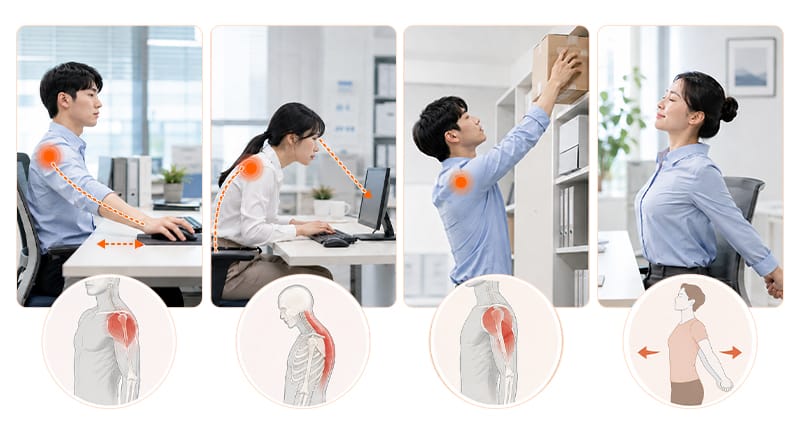
When people think of treatment, they often think first of painkillers, injections, or surgery. But the key in treating rotator cuff–related pain is not simply “rest”—it’s designing a safe return to work and daily activity. Before considering injections or surgery, it is essential to review and adjust your daily environment.
Steroid injections can provide strong pain relief. They are like lubricant that washes out sticky dust caught in a rail. When pain is so severe that rehabilitation is not possible, they can be an excellent short-term option. However, repeated injections are unlikely to be a fundamental solution and may increase the risk of tissue weakening, so they should be used cautiously.
In addition, some long-term studies have reported that subacromial decompression (bone-shaving surgery) alone offers limited additional benefit compared with progressive exercise therapy. This is one reason many treatment plans prioritize movement retraining and graded strengthening first, when appropriate.
For office workers, the realistic goal is often not “eliminating pain completely.” What matters is how to modify movements that repeatedly trigger pain at work so symptoms remain within a manageable range.
Try to avoid reaching up to take items from high shelves when possible, and lift objects while keeping them as close to your body as you can. When raising your arm, rotating your torso together to distribute the load on the shoulder can also help.
✅ Office-worker checklist for a shoulder-protective work environment
- When using a mouse, is your elbow excessively flared away from your torso?
- Is your monitor positioned too low, causing your shoulders to round forward?
- Do you have a way to replace overhead movements?
- After 50 minutes of work, do you take a break by lowering your arms and gently extending your shoulders backward?
5. Persistent pain: when is it reasonable to see a doctor?

Recovery time for shoulder pain can vary greatly depending on early response. Enduring it no matter what—and becoming overly anxious—are both unwise. Try to make an objective decision based on the signals your shoulder is sending.
Mild pain may improve within days to weeks with activity modification alone. However, if pain at a specific angle repeats, or functional limitation persists even after appropriate rest, evaluation through an exam may be more effective.
In particular, if you have the following warning signs, you should seek care without delay.
If pain began with a “pop” sensation while lifting something heavy, or if you suddenly cannot lift your arm after a fall. If you feel a sudden drop in strength when trying to raise your arm, caution is needed. Severe night pain that disrupts sleep can also be a signal suggesting structural injury or significant inflammation. Rather than forcing painful self-exercises, work with a clinician to set a safe range of motion appropriate for your shoulder.
6. Frequently Asked Questions (FAQ)
Q. It only hurts when I lift my arm out to the side—what condition should I suspect?
If pain is most noticeable around the 60–120° range and improves when you lift higher, you may first suspect rotator cuff–related shoulder pain (supraspinatus tendinopathy/bursitis, calcific tendinitis, partial supraspinatus tear). Unlike frozen shoulder, passive range of motion—when someone else lifts your arm—tends to be relatively preserved.
Q. If I have night pain, does that mean it’s more serious?
Worse pain at night may occur because structures such as the bursa around the shoulder are irritated in a lying position. Night pain itself does not automatically mean a tear or a severe condition, but it can reduce sleep quality and interfere with rehabilitation—so supportive pain control (medication/injection) can be helpful.
Q. Repeated steroid injections—how many times are possible?
Steroid injections are a short-term supportive tool to reduce inflammation and pain. There is no absolute fixed number, but repeated injections are approached cautiously because they may increase the risk of tissue weakening. After pain decreases, it is important to connect treatment to rehabilitation that corrects the joint’s movement path.
Q. In what situations should I consult a hospital for shoulder pain?
Consultation is recommended when pain at a specific angle persists or gradually worsens. In particular, if you have difficulty lifting your arm right after trauma or have clear strength loss, it is safer to get an early evaluation for possible structural injury.

We’ve reviewed the causes and treatment direction for shoulder pain that occurs at specific angles. The core of shoulder treatment is not simply shaving down a protruding bone. It is about restoring a stable, well-aligned movement path of the joint so you can return to daily life.
Rather than relying only on short-term solutions such as surgery or injections, checking your daily environment and combining it with gradual rehabilitation is often the most reasonable long-term choice. Even if daily life feels difficult right now, if you build a step-by-step treatment plan with medical professionals, you can regain healthy shoulder function.
Sources
- Health Insurance Review & Assessment Service (HIRA), Healthcare Big Data Open System—Disease Statistics, 2023
- Korea Disease Control and Prevention Agency (KDCA), National Health Information Portal—Rotator Cuff Syndrome, 2022
- Paavola M et al., Long-term follow-up of subacromial decompression (FIMPACT 10 years), BMJ
※ The copyright for all content on this blog belongs to medihi. Unauthorized copying, distribution, or derivative use is strictly prohibited, and violations may result in legal action without prior notice.
Recommended reads
 medihi