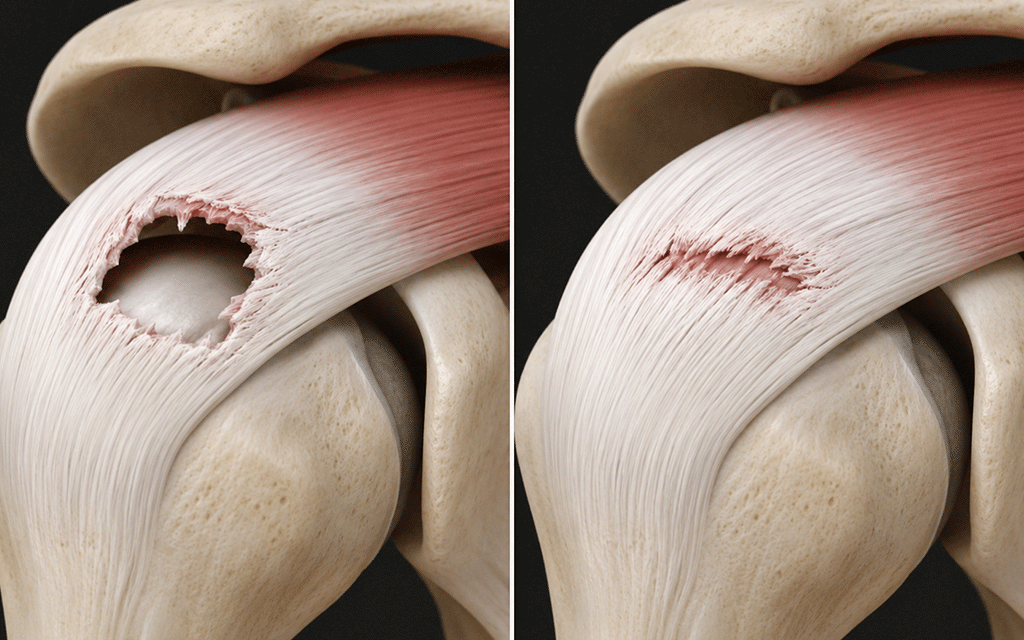

This post outlines red-flag signs to check when shoulder pain does not improve and continues day and night. You’ll learn practical criteria to respond safely by distinguishing simple inflammation from shoulder infection or a tumor that requires medical evaluation.
“My shoulder hurts all the time—whether I move it or not, day and night.”
“It hurts so much that it’s hard to fall asleep.”

Many people come to the clinic because of severe shoulder pain. When shoulder pain persists day and night, it disrupts daily life and affects sleep.
Ads and people around you often emphasize stretching or massage, saying you need to “loosen up” a stiff shoulder quickly. In the exam room, however, the first priority is to look for red flags that require prompt differentiation. We need to classify whether the pain can be attributed to simple degenerative change—or whether it may reflect a condition that needs medical evaluation, such as infection or a tumor. This step matters because it becomes the starting point for appropriate treatment.
If you’ve been struggling with persistent shoulder pain, use today’s post to learn how to distinguish possible causes and how to respond safely.
1. A swollen, hot shoulder—why is it different from simple inflammation?

Pain in our body is like a fire alarm installed in a building. A throbbing shoulder is the alarm going off. Simple inflammation from overuse is closer to a small alarm without smoke. But if there is clear swelling and noticeable warmth/heat in the shoulder, it’s different. It may mean something is happening inside the joint that requires medical differentiation.
Medically, an acute inflammatory condition caused by bacterial infection within the joint space is called septic (suppurative) arthritis. In this state, some people develop pseudoparalysis, where they cannot lift the arm at all. Patients often misunderstand this as “a shoulder nerve being cut,” but in reality, the inflammation may be so severe that the muscles effectively apply a protective brake.
With simple sprains or degenerative conditions, symptoms often improve with rest and avoiding overuse. In contrast, a bacterial infection can raise the risk of joint damage and systemic complications the longer it is left untreated. If there is redness, acute swelling, and a major reduction in range of motion, it’s advisable to seek medical evaluation without delay.
2. When should you suspect a shoulder infection even without a fever?

When a serious infection occurs, the body’s defense mechanisms usually produce a high fever. However, the absence of fever does not rule out infection. It’s like a fire smoldering quietly so that smoke doesn’t leak outside. It’s too early to feel reassured based on normal temperature alone.
This is especially important if you are over 50 and have diabetes, chronic disease, or rheumatic disease. The same applies to people taking long-term medications that reduce immune function (immunosuppressants). In these situations, baseline immune responses may be blunted, and infections can present atypically. It is not uncommon for persistent aching pain and swelling to continue without a clear fever.
If you recently had an injection or procedure inside the shoulder joint, you should be even more cautious. It’s easy to mistake worsening pain after a procedure as a simple medication reaction. Some temporary soreness can occur, but even without a high fever, subtle swelling and persistent aching should not be dismissed—keep infection as a possibility.
✅ Checkpoints for suspecting a shoulder infection even without a fever
- Do you have diabetes, chronic kidney disease, take immunosuppressive medications, or have a rheumatic disease?
- After a recent joint injection or invasive procedure, did swelling, warmth, or pain worsen?
- Did your range of motion decrease significantly—enough that you suddenly can’t lift your arm well?
- Even without a clear fever, do you feel systemic changes such as chills or unusual fatigue?
3. A shoulder that hurts day and night—when is it not a “simple problem”?

When the shoulder aches, many middle-aged and older adults first think of frozen shoulder (adhesive capsulitis). Frozen shoulder is a condition in which the joint capsule surrounding the shoulder stiffens, causing pain and restricted movement. A typical feature is difficulty lifting the arm or rotating it behind the back. As frozen shoulder progresses, pain may worsen at night, or discomfort may appear even at rest.
What matters is the change that accompanies the pain. If the pain gradually worsens over time, or if it shows little improvement despite rest and standard treatment, it can be difficult to dismiss it as a simple shoulder condition. In particular, if the shoulder becomes noticeably swollen, feels hot, the skin turns red, and systemic symptoms such as chills or fever occur, an infectious condition should be differentiated.
You should also be cautious if you can feel a new lump around the shoulder that was not there before, or if it continues to grow. Even if the pain is not severe, a newly appearing lump together with unexplained weight loss warrants evaluation for a possible tumor-like lesion as well.
Many people assume it is “just frozen shoulder,” endure the pain, and push through aggressive stretching. If the pain is related to infection or a tumor, forcing exercise can be harmful. In such cases, rather than continuing intense stretching or self-rehab, it is more important to assess the pain pattern and accompanying symptoms and receive an accurate evaluation of the cause.
✅Night pain / rest pain checkpoints
- Does it hurt enough to wake you up, or does it get worse when you lie down?
- Does the pain continue even when you are not using the shoulder?
- Has the pain changed from “about the same” to “gradually getting worse”?
- Along with the pain, have you developed new swelling or a newly palpable lump?
4. When do you need advanced testing even if the X-ray is normal?
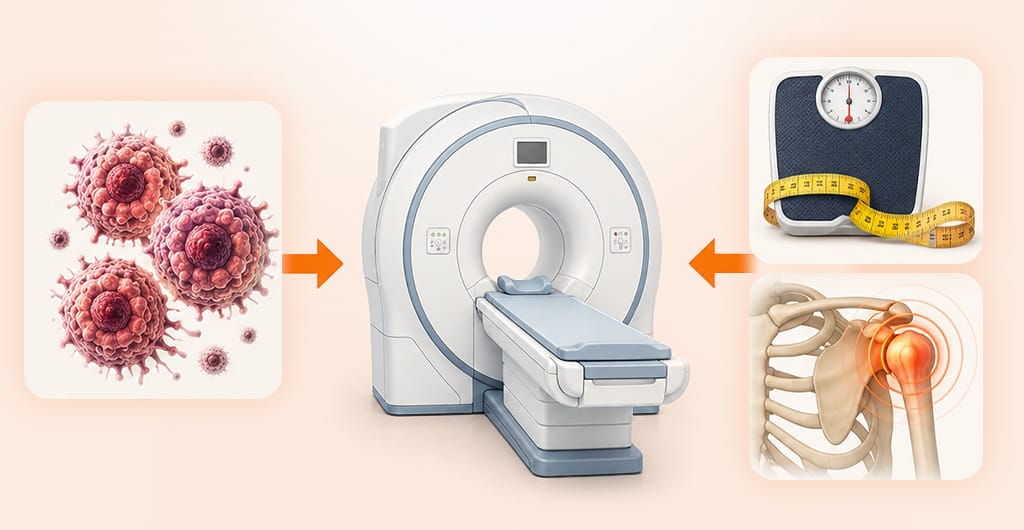
When you visit a hospital for shoulder pain, an X-ray is typically performed to assess the bones. Many people feel reassured when they are told there is no bone abnormality. However, an X-ray is essentially a black-and-white picture that shows only the building’s frame and outer walls. Problems involving soft tissues—such as tendons, the joint capsule, bursae, and muscles—as well as early infection or tumor-like lesions can be difficult to identify on X-ray alone.
If you have a history of cancer treatment, or if unexplained weight loss accompanies shoulder pain, additional advanced testing is needed. In these situations, MRI (Magnetic Resonance Imaging) plays a major role. MRI helps evaluate the inside of the joint and soft tissues in greater detail—like a precise inspection to find where a leak is occurring inside the plumbing.
When septic (suppurative) arthritis is strongly suspected, blood tests and joint aspiration (drawing fluid from inside the joint) may be performed. This helps identify the causative organism. If pain has persisted day and night for a long time or a lump is palpable, the typical approach is not to rely solely on X-ray results, but to proceed with advanced evaluation such as MRI.
✅ Items that are helpful to confirm during a consultation
- When the pain started and how it has worsened (including night pain/rest pain)
- Records of whether recent swelling, warmth, or a progressively enlarging lump has been observed
- Recent injection/procedure history and current medications (including immunosuppressants)
- Past history of tumor treatment and whether there is unexplained weight loss
5. How should you approach evaluation so you don’t miss the treatment window?

Once diagnostic results are obtained based on red-flag signs, the treatment plan is adjusted according to overall health status and the extent of the lesion. For septic (suppurative) arthritis, antibiotic therapy is fundamental. Considering test results, imaging findings, and underlying conditions, intravenous antibiotics often become the mainstay.
A cautious approach is needed when deciding the treatment direction. If infection is strongly suspected from joint fluid, if imaging suggests an abscess, or if pain and motion limitation are rapidly worsening, surgical irrigation (washout) or drainag of the infected area may also be discussed.
If you have chronic conditions such as diabetes, it is important to manage overall health—not just the shoulder joint. If warning signs appear that interfere with daily life, don’t endure them vaguely. Finding an objective cause through a clear diagnostic system that integrates tests and imaging is a rational choice to protect joint function.
6. Frequently Asked Questions (FAQ)
Q. My shoulder is swollen and feels warm—could it still be a simple sprain?
Temporary swelling can occur after strenuous activity or work. However, it is different if strong warmth is present and you cannot lift your arm at all. Because differentiating infectious conditions such as septic (suppurative) arthritis should come first, it is safer to receive prompt evaluation with X-ray, blood tests, and related assessments.
Q. If I don’t have a fever, do I still need joint aspiration?
If you have diabetes, chronic disease, or an immunocompromised state, your temperature may remain normal. Regardless of fever, if acute swelling, warmth, severe pain, and limited range of motion are present, it can be difficult to rule out infection. When suspicion is clear, joint aspiration can play a key role in identifying the organism and determining the treatment direction.
Q. How can I tell frozen shoulder from a tumor/infection based on symptoms?
Frozen shoulder can also cause night pain and limited motion, so it can be difficult to distinguish based on symptoms alone. However, if pain progressively worsens, persists even at rest, is accompanied by obvious swelling, or comes with a progressively enlarging lump, infection or a tumor should be differentiated.
Q. Are there situations where co-management with internal medicine (not only orthopedics) is needed?
Yes. If a shoulder infection is suspected or systemic symptoms such as chills appear, an evaluation of overall health may be needed as well. Diabetes control status and the use of immunosuppressive medications can affect both the infection pattern and treatment. Therefore, it is advisable to share your medications, recent procedures, and underlying conditions in detail so the care team can coordinate with internal medicine when necessary and proceed safely.

Many people think, “It’s just aging,” when shoulder pain lasts a long time, and try to push through with self-rehab. However, swelling, warmth, a sudden and marked loss of range of motion, night pain/rest pain that persists even when you are not using the shoulder, and a progressively enlarging lump are red-flag signs that call for prompt evaluation rather than a “simple malfunction.”
If you have chronic conditions such as diabetes, symptoms may be atypical, so extra caution is needed. Please avoid enduring pain alone or aggressively stimulating the area with unverified methods. I hope you can confirm the objective cause with medical professionals, set a clear treatment direction, and ease the anxiety that comes with uncertainty.
Sources
- Publicly available health information from major domestic hospitals (intent: red-flag signs when shoulder joint infection is suspected and a diagnostic flow centered on joint fluid testing)
- National-level health information (intent: persistent or non-resolving enlargement and swelling require differentiation for infection and malignant disease)
- J Clin Med, Administering Antibiotics for Less than Four Weeks Increases the Risk of Relapse in Culture-Positive Septic Arthritis, 2023
※ The copyright for all content on this blog belongs to medihi. Unauthorized copying, distribution, or derivative use is strictly prohibited, and violations may result in legal action without prior notice.
Recommended reads
 medihi