

In This Article
If you’ve been waking up with a heavy, stiff body for a long time, it may be worth considering a systemic immune-mediated condition rather than simple aging or fatigue. How long your body stays stiff after waking, and which joints become painful and swollen, are key clues for distinguishing inflammatory arthropathy. In this post, based on rheumatology society guidelines, we objectively summarize the features of multi-joint inflammation that can cause whole-body stiffness and outline an appropriate evaluation approach.
1. Morning stiffness lasting over 1 hour—could it be a sign of an inflammatory condition?
If morning stiffness—such as your fingers or whole body feeling “locked up” after waking—lasts longer than 1 hour, it’s reasonable to first consider the possibility of a systemic inflammatory process rather than simple degenerative change.
With degenerative problems, stiffness tends to ease relatively quickly once you start moving. In contrast, inflammatory diseases caused by immune dysregulation can lead to inflammatory effusion accumulating in the joint capsule during sleep, so stiffness may persist for quite a while even after you get up.
If it lasts longer than 2 hours, it can be viewed as a clear signal that goes well beyond the commonly referenced 1-hour clinical threshold. Even recording when stiffness starts and when it gradually improves for just a few days can provide useful information for identifying the cause during a medical visit.
2. What if small joints in the hands and feet swell symmetrically?

If multiple small joints—such as the fingers or wrists—are swollen symmetrically on both sides and accompanied by overall fatigue, prioritizing the differential for inflammatory polyarthritis, namely rheumatoid arthritis, is appropriate.
Because inflammatory mediators circulate through the bloodstream, inflammatory conditions often affect small joints on both sides at the same time, unlike degenerative diseases that may cause pain in a specific area. When inflammation develops in the thin membrane surrounding the joint (the synovium), swelling and tenderness can occur, and discomfort with movement becomes more noticeable.
It’s important not only to note which joint hurts the most, but also to observe whether the number of swollen joints is increasing. A brief comparison of degenerative joint disease vs. inflammatory arthropathy is as follows:
- Degenerative joint changes: temporary worsening with movement, mainly affects large joints such as the knee
- Inflammatory arthropathy (rheumatoid): worsens after rest, morning stiffness lasting over 2 hours, involvement of 3 or more joints
3. If blood tests are normal, are you in the clear for rheumatoid arthritis?
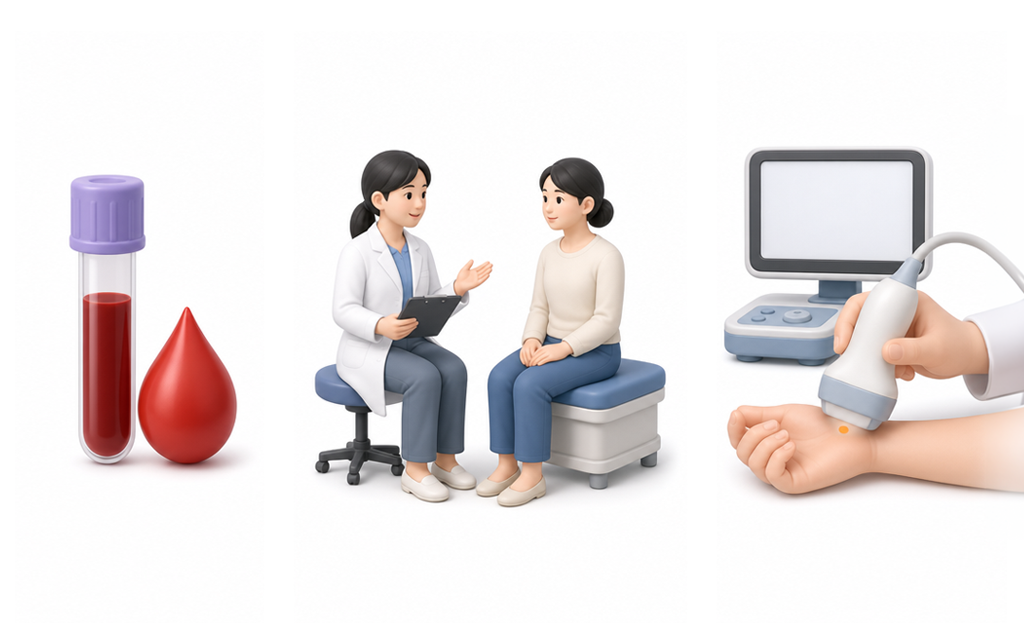
Even if rheumatoid factor (RF) or anti-CCP antibodies are negative on blood tests, it can still be difficult to completely rule out inflammatory arthropathy.
That’s because seronegative rheumatoid arthritis—where autoimmune-related antibodies are not detected in blood—is encountered fairly often in clinical practice. Even when lab values fall within the normal range, if multi-joint pain and swelling recur, it is safer to keep inflammation on the differential.
Rather than relying on a single blood test for reassurance, it is more appropriate to proceed with a comprehensive assessment—medical history, physical exam findings, and confirmation of synovitis via joint ultrasound.
4. Shoulder stiffness—should you only suspect frozen shoulder?

If a woman over 50 experiences severe, persistent stiffness around the shoulders and pelvic girdle, polymyalgia rheumatica (PMR) should also be considered in the differential.
Shoulder pain is often easily attributed to frozen shoulder or rotator cuff problems. However, if both shoulders become very stiff and overall fatigue is present, it’s important to evaluate the broader range of inflammatory conditions. In such cases, stiffness tends to concentrate around the body’s central axis—neck, shoulders, and hips—rather than primarily in the fingers.
If the condition is mistaken for something else and the differential is delayed, systemic inflammation may worsen. If your shoulders and hips feel so heavy and stiff in the morning that it’s difficult even to get out of bed, it’s advisable to promptly visit a rheumatology clinic to review inflammatory markers and the overall clinical picture.
5. How does treatment typically progress step by step?
Once multi-joint inflammation is confirmed, standard principles include early use of disease-modifying antirheumatic drugs (DMARDs) centered on methotrexate (MTX)—an antimetabolite that inhibits cellular proliferation—along with a treat-to-target strategy.
The main goal of treatment is to reduce disease activity and maintain remission or a low-disease-activity state. To achieve this, clinicians reassess the condition at regular intervals and flexibly adjust medication types and doses.
- Initial standard treatment: First-line medications such as methotrexate are prescribed to reduce abnormal immune cell activity and control joint inflammation. Steroids may be used for short-term symptom control, but they are used conservatively due to potential adverse effects.
- Stepwise medication escalation: If initial treatment is insufficient, injectable therapies may be considered stepwise.
- Safety-based selection: Oral targeted therapies are convenient, but in people aged 50 or older or those with cardiovascular risk factors, potential adverse-event risk should be carefully reviewed and prescriptions adjusted accordingly.
6. Frequently Asked Questions (FAQ)
Q. How many minutes of morning stiffness should prompt me to consider seeing a doctor?
If the joint stiffness you feel after waking lasts longer than 2 hours, caution is warranted. This can be a clue that the likelihood of inflammatory arthropathy is increasing beyond simple fatigue or degenerative change. If it is accompanied by swelling in multiple joints (suggestive of synovitis) and overall fatigue, we recommend not delaying a differential evaluation.
Q. If rheumatoid factor (RF) or inflammatory markers are normal on blood tests, can I feel reassured?
Not necessarily. There is a group of “seronegative” patients in whom rheumatoid arthritis progresses even when autoantibodies are negative or lab values are within normal ranges. Even with normal test results, if joint swelling, pain, and morning stiffness persist, you should receive a comprehensive rheumatology evaluation, including additional assessment such as ultrasound.
Q. Is there anything helpful I can track before my rheumatology appointment?
It helps greatly to time and write down how many minutes or hours your morning stiffness lasts. On days when swelling is especially severe, take photos of the affected joints, and keep a brief log of: “which joints feel uncomfortable,” “whether it’s symmetric left-to-right,” and “what your overall fatigue feels like.” This makes it much easier for clinicians to identify clinical patterns. Additionally, it’s helpful to note how many joints feel uncomfortable.
Q. What are the safety principles for using medications in treatment?
When using biologics or targeted therapies, careful prescribing that considers underlying conditions (such as cardiovascular risk factors) is important, not just effectiveness. In particular, because there is a risk of reactivation of infections such as tuberculosis or hepatitis B, screening tests are required before treatment. Medications are adjusted safely on an individualized basis through consultation with your physician, so you should not change the dose on your own.
This health content has been reviewed by medical professionals, compiled from authoritative domestic and international sources, and is regularly updated in accordance with the latest clinical guidelines.
Sources
- Annals of the Rheumatic Diseases, 2010, 2010 Rheumatoid arthritis classification criteria (ACR/EULAR).
- Annals of the Rheumatic Diseases, 2022, EULAR recommendations for the management of rheumatoid arthritis: 2022 update.
- New England Journal of Medicine, 2022, Cardiovascular and Cancer Risk with Tofacitinib in Rheumatoid Arthritis.
※ The copyright for all content on this blog belongs to medihi. Unauthorized copying, distribution, or derivative use is strictly prohibited, and violations may result in legal action without prior notice.