

In This Article
If you’ve received non-surgical treatment for shoulder pain for 6–12 weeks but still struggle with everyday tasks like washing your hair or getting dressed, it may be time to revisit the diagnosis and treatment plan. This article summarizes what to review during a shoulder pain reassessment: daily functions to check, the usual order of tests, key differences between frozen shoulder and rotator cuff disorders, and warning signs that mean you should return for care sooner.
1. What should you check after 6–12 weeks of treatment?
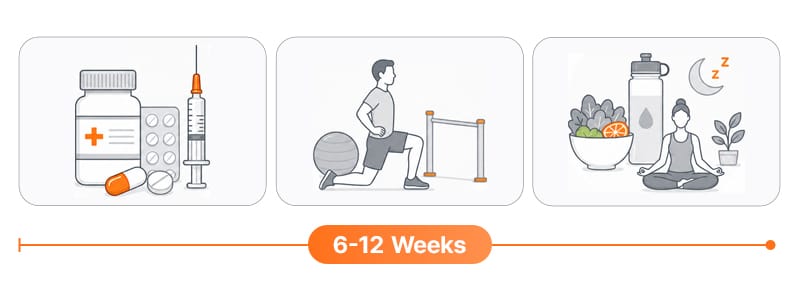
If daily function hasn’t improved after about 6–12 weeks of non-surgical treatment, consider a reassessment of your shoulder pain. Non-surgical treatment may include medication, exercise and rehabilitation, and lifestyle modifications, with injection therapy added when needed. It’s also important to review whether you received only physical therapy, or whether these treatments were combined as part of a comprehensive plan.
It’s important to assess not only pain intensity but also whether your usual movements are returning. Even if pain decreases slightly, if you still have difficulty lifting your arm to wash or brush your hair, or reaching behind your back to get dressed, functional limitation remains. Another key point to check is whether shoulder pain has been disrupting your sleep for nearly three months.
If functional recovery has stalled, it may be more helpful to re-check whether the current diagnosis fully explains your condition rather than simply extending the treatment period.
2. Which tests should be checked before an MRI?

In most shoulder pain reassessments, symptom review, a physical examination, and X-rays are considered first. Shoulder pain can have many causes, including rotator cuff disorders, frozen shoulder, arthritis, or pain referred from the neck.
Clinicians first confirm when the pain started and how it presents. Next, the doctor evaluates range of motion and strength and uses X-rays to assess the structural condition of the bones. If there’s a need to evaluate soft tissues such as tendons in more detail, an ultrasound or a non-contrast MRI may be considered.
However, the testing sequence may change if you suddenly lose strength in your arm, or if you have leg numbness and weakness. In such cases, a rapid evaluation—including a cervical spine MRI—may be prioritized to assess possible spinal cord problems in the neck and whether surgery may be needed.
3. What’s the difference between frozen shoulder and rotator cuff disorders?

Frozen shoulder and rotator cuff disorders are differentiated by assessing both range of motion and strength. With frozen shoulder, it’s often difficult to lift the arm on your own, and even when someone else tries to lift it for you, the joint may feel “stuck” and not move beyond a certain angle. In contrast, with rotator cuff disorders, you may feel pain or weakness when lifting your arm yourself, but if someone supports the arm, it may still raise relatively close to full range.
This difference alone cannot definitively confirm one condition over the other. In some cases, a rotator cuff tendon injury leads to reduced movement due to pain, which can then progress to frozen shoulder.
In addition, research suggests that in people in their 40s to 60s, diabetes and prediabetes may increase the risk of frozen shoulder. Because inflammation and stiffness of the joint capsule may be related to overall metabolic status, it can be helpful to review and manage any coexisting conditions as well.
4. What criteria determine whether to change or continue treatment?
Treatment direction should not be decided solely based on the fact that 12 weeks have passed. It should be determined by considering changes in daily function together with any warning signs.
✅Criteria for choosing a treatment direction
- Reassessment and treatment pathway adjustment: If everyday movements such as washing your hair or getting dressed remain difficult even after 6–12 weeks of treatment, re-check the diagnosis and consider whether tests such as ultrasound or a non-contrast MRI are needed.
- Extending non-surgical treatment: Even if pain remains, if daily function is gradually improving and there is no loss of strength, treatment may be continued while adjusting the intensity and progression of rehabilitation exercises.
If, after an injury, you suddenly cannot raise your arm or your strength drops rapidly, seek follow-up care promptly. Rapid evaluation is also needed if the shoulder becomes severely swollen and warm, or if you experience numbness that runs from the back of the neck down to the fingertips.
5. Is treatment decided based only on MRI results?
Even if an MRI shows a tendon tear, the treatment approach is not determined by that result alone. This is because even tears of the same size can differ in how much they limit daily activities, how much strength is reduced, whether there was trauma, and how the person responded to prior non-surgical treatment.
Even when a full-thickness rotator cuff tendon tear is confirmed, the patient’s level of social activity and treatment preferences are also considered.
However, insurance coverage is not determined simply because pain has lasted a long time. Coverage depends on physical exam findings and the Ministry of Health and Welfare’s official criteria, so it’s important to confirm expected costs and coverage standards before imaging.
6. Frequently Asked Questions (FAQ)
Q. I keep getting physical therapy—why am I not getting better?
Physical therapy alone may have limitations, or the current treatment plan may need to be reconsidered. If daily function does not improve even after 6–12 weeks of treatment that includes medication, exercise and rehabilitation, and injections when needed, consider a reassessment.
Q. If my shoulder hurts, should I get an MRI first?
In general, symptom review, a physical examination, and X-rays are done first. However, if there is sudden arm weakness or leg numbness and weakness, a rapid MRI evaluation may be considered first to assess possible spinal cord problems in the neck.
Q. If I have frozen shoulder, should I force my arm to move even if it hurts?
Forceful joint movement can even cause an upper arm (humerus) fracture. Move gently and progressively within a range where pain can be controlled, and follow exercises under medical guidance.
Q. When should I seek follow-up care urgently?
If, after an injury, you suddenly cannot raise your arm or your strength drops sharply. You should also seek care quickly if there is severe swelling and warmth in the shoulder, or numbness that extends from the back of the neck to the fingertips.
This health content has been reviewed by medical professionals, compiled from authoritative domestic and international sources, and is regularly updated in accordance with the latest clinical guidelines.
Sources
- Korea Disease Control and Prevention Agency (KDCA) National Health Information Portal, information on frozen shoulder (adhesive capsulitis)
- Kim et al., Prediabetes and type 2 diabetes and risk of adhesive capsulitis, Diabetes & Metabolism Journal, 2023
- Cederqvist et al., Surgery vs non-surgical treatment after 3 months of rehabilitation for rotator cuff tears, Annals of the Rheumatic Diseases, 2021
※ The copyright for all content on this blog belongs to medihi. Unauthorized copying, distribution, or derivative use is strictly prohibited, and violations may result in legal action without prior notice.