

In This Article
A traumatic shoulder dislocation may involve not only a joint that has slipped out of place, but also possible nerve or blood vessel problems and associated fractures—so an urgent evaluation is generally recommended. At the scene, it’s more important to check for associated injuries than to focus only on pain control. Rather than forcing the shoulder back in, the priority is to immobilize the arm, apply a cold pack, and then go to a medical facility.
1. What should you do if you think your shoulder is dislocated?
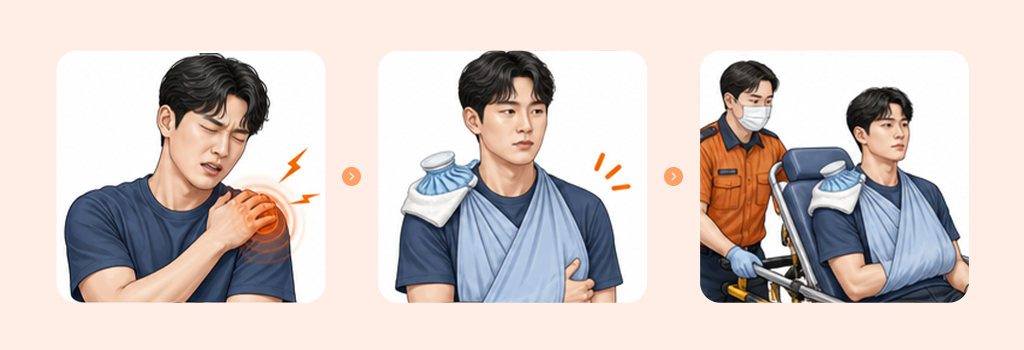
If you fall, your shoulder shape looks different, and you can’t move your arm well, you may suspect a shoulder dislocation. In this situation, “quick action” does not mean putting the bone back yourself—it means keeping the arm in a comfortable position to reduce further movement.
Use clothing or a triangular bandage to keep the arm from hanging down, securing it close to the chest. Wrap an ice pack in a towel so it doesn’t touch the skin directly, and apply it for about 10–15 minutes to help reduce pain and swelling. Keeping that position, it’s recommended to go to the nearest emergency room for evaluation.
✅Signs you should hurry to the emergency room
- Tingling in the fingertips or changes in sensation
- Pale or bluish discoloration around the fingernails
- A weaker-than-usual wrist pulse or difficulty moving the arm
If you notice tingling in the fingertips or signs of poor circulation, it’s advisable to have the emergency room check for brachial plexus injury beneath the clavicle as well as possible clavicle dislocation or fracture.
2. Why is self-reduction dangerous?
It’s best to avoid self-reduction, such as pulling or twisting your shoulder to “pop it back in.” Applying force without confirming the exact condition can cause additional injury to nearby nerves and blood vessels, soft tissues, and tendons around the shoulder.
In particular, if the axillary nerve—which passes beneath the shoulder joint—is compressed, it can lead to loss of sensation or weakness/paralysis in the deltoid area. If you have fingertip tingling, skin color changes, a weak pulse, or decreased sensation in the arm, it’s recommended to stop any manipulation and go to the emergency room. On-site, immobilization to prevent movement should take priority over attempts to reduce the shoulder.
3. In what order is reduction performed in the emergency room?

At a medical facility, clinicians first check fingertip sensation, skin color, temperature, and the wrist pulse to assess whether nerve and blood vessel function is intact. Next, an X-ray is used to confirm the direction the humeral head has dislocated and whether there are any associated fractures.
If it’s considered safe, the medical team performs a manual reduction (closed reduction). Pain medication or sedation may be used to reduce pain and muscle tension. After reduction, X-ray and physical examination are repeated to confirm the joint is back in place and that no new nerve or blood vessel problems have appeared.
4. What is an irreducible dislocation?
Most acute shoulder dislocations can be put back in place with manual reduction, but in some cases reduction is not possible even with pain medication or sedation. This is called an irreducible dislocation, and it may occur when a tendon or a bone fragment becomes trapped in the joint space and blocks the reduction path.
The long head of the biceps tendon or the subscapularis tendon may be interposed, or small bone fragments may create a mechanical barrier. Repeated forceful attempts in this situation can worsen soft-tissue injury or fractures. If reduction fails repeatedly or a mechanical block is suspected, clinicians stop further manipulation and decide whether advanced imaging such as CT or MRI is needed; depending on the results, they may consider surgical reduction (open reduction).
After an accident, if you have severe pain, a “stiff/locked” feeling in the arm, sensory changes, or a persistent sense of shifting/misalignment even after first aid, it’s helpful to describe these details clearly to the medical team.
5. Does the treatment plan differ by age?
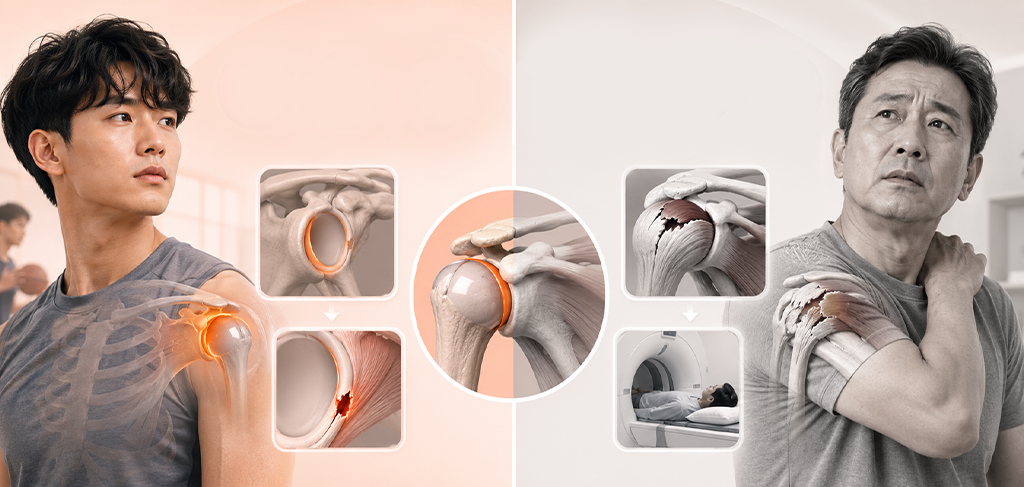
Post-reduction treatment planning may vary depending on age and activity level. In highly active age groups such as people in their 20s to 40s, there is a higher risk of recurrent instability after a first dislocation, and associated labral injury is common.
If returning to work or sports is urgent, if the sense of instability is significant, or if bone loss is identified, surgical treatment may be considered in discussion with the medical team. In contrast, from the late 40s through the 60s and older, the risk of rotator cuff injury increases. If pain persists after reduction, if you cannot lift the arm on your own, or if you have night pain, an ultrasound or MRI to evaluate for a rotator cuff tear may be recommended.
6. Frequently Asked Questions (FAQ)
Q. How should I immobilize my arm if I suspect a shoulder dislocation?
Use clothing or a triangular bandage to keep the arm from drooping, securing it close to the chest. The goal is to reduce shoulder and arm movement to avoid additional injury.
Q. Can I eat or drink before going to the emergency room?
Reduction, sedation, or emergency surgery may be needed in the emergency room. Considering the possibility of surgery, at least 8 hours of fasting is required, and clear liquids are only allowed up to 2 hours before a procedure. If you have eaten or drunk anything, you should tell the medical team exactly what you had and when.
Q. Do I need an MRI or ultrasound even after reduction?
X-ray alone may not clearly show soft-tissue injuries such as labral tears or rotator cuff damage. If pain continues after reduction or it’s difficult to lift the arm, advanced imaging may be recommended to assess for additional injury.
Q. Are there warning signs that mean I should return to the hospital after reduction?
If tingling or numbness worsens, or if the area around the fingernails becomes pale and feels cold, nerve or blood vessel problems should be evaluated. If the shoulder feels like it is slipping out again with small movements or if pain worsens, it’s best to seek medical care without delay.
This health content has been reviewed by medical professionals, compiled from authoritative domestic and international sources, and is regularly updated in accordance with the latest clinical guidelines.
Sources
- Korea Disease Control and Prevention Agency (KDCA), National Health Information Portal. (2023). Symptoms of shoulder dislocation (glenohumeral dislocation) and emergency response.
- Korean Orthopaedic Association. (2022). Health information for the public: Standard guidance on response and treatment for glenohumeral dislocation.
- Kearney et al. “First-time traumatic anterior shoulder dislocation management (ARTISAN Trial)”, *BMJ*, 2024.
※ The copyright for all content on this blog belongs to medihi. Unauthorized copying, distribution, or derivative use is strictly prohibited, and violations may result in legal action without prior notice.