
Online consultation is not a stage for finalizing a treatment plan, but rather a process of organizing necessary materials, classifying risks, and documenting potential scenarios before your visit. Submitting standardized data before departure helps in identifying "factors that may change the number of visits" and "signals for additional tests" earlier.
"I'm worried my schedule will fall apart if I start testing only after arriving in Korea."
"What if the consultation is delayed because I don't have enough data?"
If you are preparing for treatment from abroad, these concerns are perfectly natural. Patients in their 40s to 70s, in particular, often prefer a 'documented plan' over 'verbal explanations,' and this approach is actually safer.
The key to reducing anxiety is simple: instead of rushing to a conclusion during the online stage, separate the conditional possibilities from signals indicating a need for additional tests or procedures. This is because an implant is not a treatment determined by a few photos alone; the plan is materialized through in-person oral examinations, occlusion and soft tissue evaluation, identification of the extent of inflammation, and actual measurements after your arrival.
1. What are the 6 types of data needed for an online implant consultation in Korea?

The most frustrating part for international patients during an online implant consultation in Korea is often, "Why can't I get a definitive answer?" However, because implants involve bone shape, the extent of inflammation, systemic health, and schedule constraints all at once, judgment can easily shift if even one piece of information is missing.
By organizing your materials into 6 categories before departure, the online consultation can function as a "definition of conditions" rather than an "unconfirmed promise."
The 6 core materials recommended for online consultation are listed below. Each piece of data plays a role in reducing uncertainty. Think of it as the process of aligning blueprints, ground surveys, material lists, and construction schedules before building a house.
- 3D CT/CBCT Original DICOM (Entire Folder) (CT DICOM for implant consultation)
- What is it for? It allows for a 3D confirmation of the bone structure where the implant will be placed.
- Submission Tip: Providing the entire DICOM original folder is ideal. JPEGs or screenshots offer limited views of cross-sections. Request "Original DICOM files" from the dental clinic or hospital where you were scanned.
- Panorama (2D)
- What is it for? A screening map providing a wide view of the entire dentition, remaining teeth, and large lesions.
- Submission Tip: Including the date of the scan with the image helps speed up data organization.
- Medication List
- Why is it important? This relates to risk classification for bleeding, infection, wound healing, and jawbone complications (such as MRONJ), which can lead to schedule adjustments.
- Submission Tip: Organizing this into a table including the medication name, administration route, duration, and time of last dose reduces omissions.
- Systemic Medical History Summary
- Why is it important? Cardiovascular diseases, diabetes control status, and immune-related conditions can alter the treatment method and the follow-up plan.
- Submission Tip: Instead of just listing diagnoses, write one line for each: "Current status (controlled or not) + Recent changes (hospitalization/worsening)."
- Oral Photos
- Why is it important? These help outline the 'current oral environment,' such as gum status, swelling, prosthetic condition, and hygiene.
- Submission Tip: Take photos of the front, left/right sides, and upper/lower arches (to the extent possible) in a bright area.
- Stay Schedule (Available Dates/Duration)
- Why is it important? The schedule often acts as the ceiling for treatment options and is a key variable in dividing visit scenarios.
- Submission Tip: Documenting both your "minimum possible stay" and "extension availability" makes the plan more realistic.
Once these 6 types of data are gathered, the online stage can attempt documentation by conditionally classifying cases into: 1) Possibility of a relatively simple case, 2) Possibility of additional procedures like extraction/infection treatment/bone grafting, and 3) High-risk signals (medical consultation needed, potential for treatment delay).
2. What can be confirmed in advance with DICOM (3D) and Panorama?
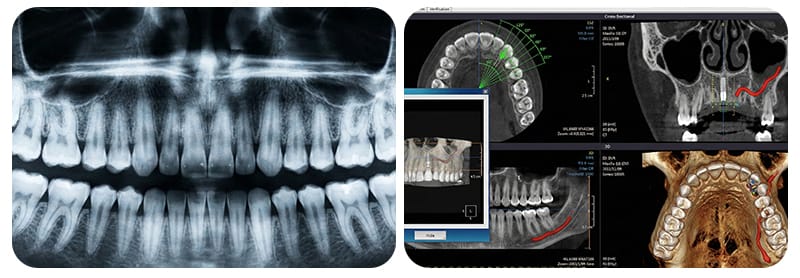
It is easy to think, "I'll just send whatever images I have," but different types of imaging serve different roles. Distinguishing between what can be confirmed in advance and what can only be finalized after a physical visit prevents the misconception that online consultation results are 'final.'
- Panorama (2D) is a single-sheet map of the whole area. It is useful for identifying remaining teeth, large lesions, and overall alignment. However, because depth information is limited, there are constraints when 3D judgment is required, such as the distance to nerve canals, relationship with the maxillary sinus, and bone width. It is similar to trying to judge the firmness of the ground for a building using only a flat map.
- CBCT/CT (3D) DICOM is a topographic map that views the inside of the bone in three dimensions. This is a core component in identifying anatomical constraints in an implant plan. Specifically, DICOM data allows the medical team to rotate your jawbone 360 degrees, analyze cross-sections, and perform simulations using professional software. This enables a detailed advance estimation of whether bone grafting is necessary and if there is sufficient space to place the implant.
However, there are items that remain difficult to finalize through imaging alone. It is safer to note the following limitations in your documentation:
- Occlusion (Biting Force and Habits): How force is applied can change the plan and management, requiring an in-person evaluation.
- Soft Tissue (Gum) Condition: Gum thickness and the actual nature of inflammation may need to be confirmed in the clinic.
- Final Plan Based on Actual Measurements: The online stage sets the outline, which is materialized through tests and evaluations after your visit.
3. Designing an Implant Schedule for Expats: How to Document the Number of Visits and Aftercare?
The question international patients ask most is, "How many visits will it take?" However, it is difficult to define the number of visits with a standard figure; it is safer to organize it into scenarios based on conditions.
Understanding that the schedule is a part of the treatment helps. Just as work drags on without a construction schedule, implant visits can increase if conditions are not organized.
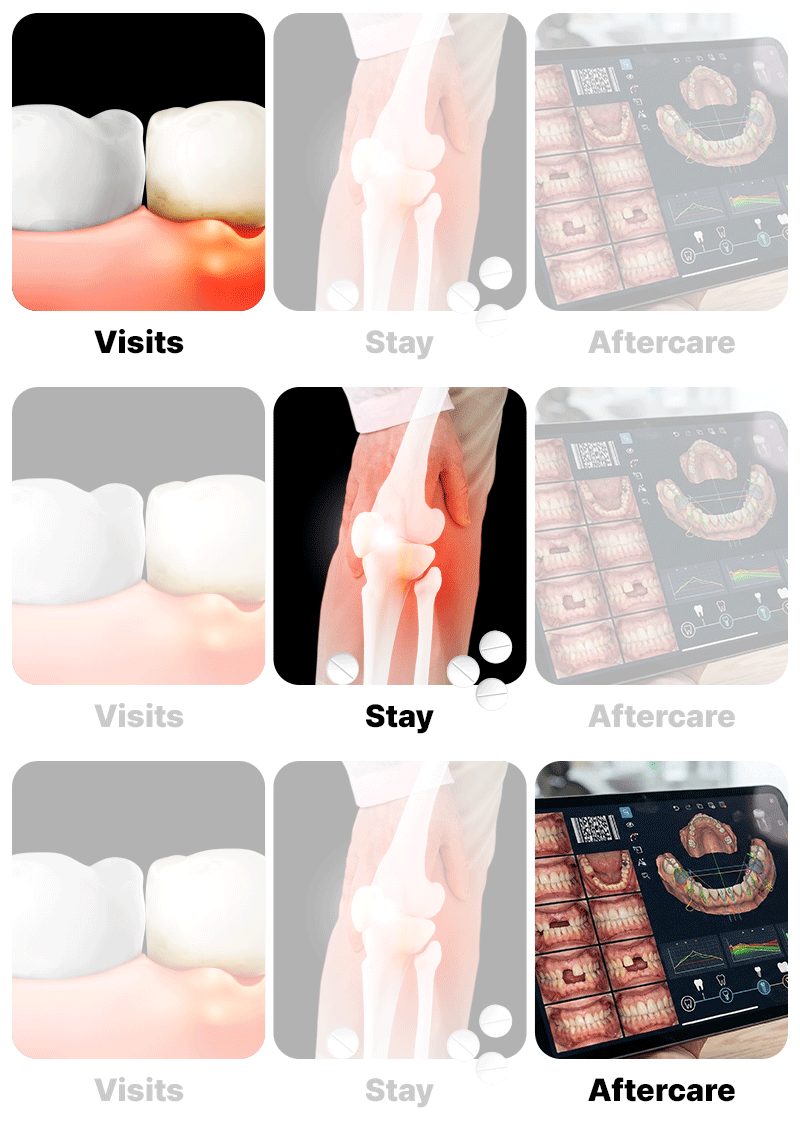
The central pillars for an international patient's documentation are Visits, Stay, and Aftercare.
1) Visits: Scenario Classification Based on Bone Condition
The number of visits is largely divided into two scenarios depending on the bone condition and the presence of inflammation.
- Case A (Relatively Simple Condition): If the bone condition is good and inflammation is limited, a scenario involving immediate placement during extraction or proceeding with the surgery stage within the first visit can be reviewed.
- Case B (Additional Treatment Required): If a large amount of bone grafting or procedures related to the maxillary sinus are needed, the treatment stages will be divided because sufficient time is required for the bone to harden, leading to an increased number of visits.
2) Medication and Systemic Disease Variables
Information on medications can significantly change the progress and schedule.
- Osteoporosis Medication: Risk evaluation related to jawbone healing (MRONJ) varies depending on the administration route (oral vs. injection) and duration. Particularly if there is a history of injections, the possibility of surgery or the need for a drug holiday must be judged conservatively before the visit.
- Anticoagulants/Antiplatelets: Rather than stopping them unconditionally, a process of coordinating the risk of thrombosis versus the risk of surgical bleeding in consultation with the prescribing physician must come first.
3) Aftercare: Documenting Maintenance After Returning Home
For those living abroad, maintenance after returning home is part of the treatment plan. Including the following items in the pre-departure consultation document makes the transition to realistic treatment easier:
- Sharing Implant Specifications: Request a medical summary containing the types of products placed (diameter, length, connection method). This is essential information when coordinating with a local dentist.
- Regular Checks and Emergency Plans: It is safe to receive a document outlining the interval for check-ups after returning home and how to handle symptoms such as screw loosening.

The purpose of an online consultation before departure is not to receive a final diagnosis, but to classify conditional scenarios and risk signals and to standardize preparation.
Therefore, rather than concluding "possible/impossible" in a single sentence, documenting the possible scenarios and necessary conditions helps manage schedules and expectations more safely.
Preparation centers on the 6 types of data. Having the Original DICOM, Panorama, Medication List, Systemic Medical History Summary, Oral Photos, and Stay Schedule reduces consultation delays and makes it easier to connect Visits, Stay, and Aftercare into a single plan. Especially for expats, documenting the sharing of records and emergency plans for after your return serves as a realistic safety net.
Even with well-prepared online materials, the final plan can be adjusted through in-person tests and evaluations. The way to reduce that uncertainty is not by rushing for a definitive answer, but by clearly recording the conditions and plans. With these records, it will be much easier to understand the reasons for any schedule changes and move forward with the next decision.
Sources
- Korean Academy of Periodontology, Consensus on the Treatment of Peri-implant Diseases, 2022
- JPIS, Peri-implantitis definition and management, 2022
- American Dental Association (ADA), Managing patients on anticoagulants, 2024
※ The copyright for all content on this blog belongs to medihi. Unauthorized copying, distribution, or derivative use is strictly prohibited, and violations may result in legal action without prior notice.
Recommended reads
 medihi